
You are currently browsing petebrook’s articles.

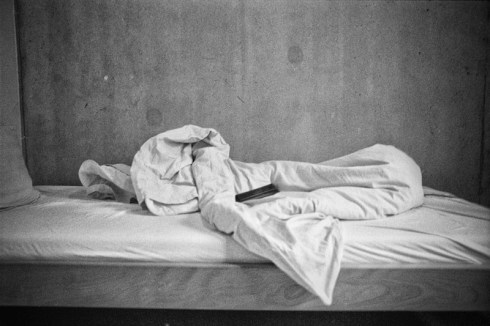
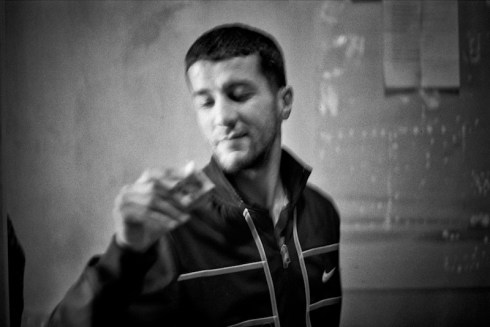
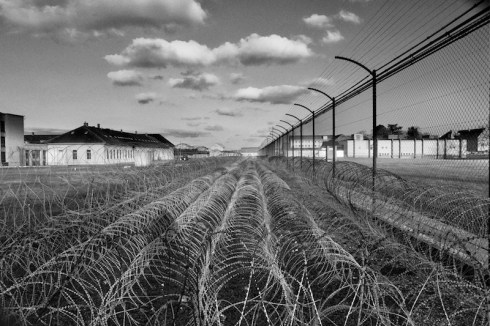
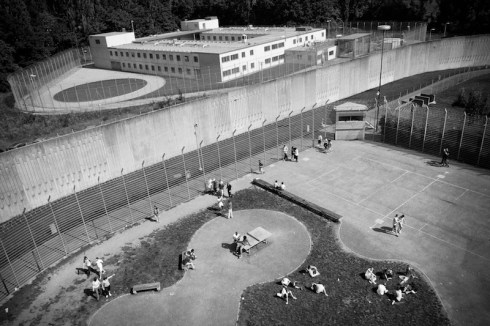
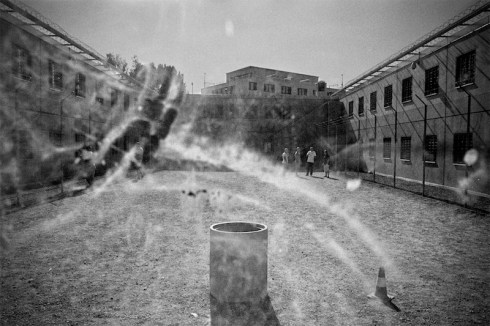
In 2012, Swiss photographer Patrick Gilliéron Lopreno documented – alongside journalist Jean-François Schwab – three prisons: Prison Champ-Dollon and Prison La Brenaz in Geneva and Bochuz Prison in Vaud, Switzerland. The result was the series Puzzle Carcéral.
Two of the prisons were at that time subject to national scandals. Skander Vogt, a prisoner at Bochuz died of asphyxiation after setting fire to his mattress. Prison Champ-Dollon was notorious for its overcrowding. Prison La Brenaz was built purposefully to reduce the population at Champ-Dollon from its bloated 200% capacity, although with mixed results.
I wanted to ask Patrick a few questions about working inside Swiss prisons that were at that precise moment under scrutiny.
How did you gain access to the prison?
Bochuz was closed to journalists because of the recent death of Skander Vogt, a prisoner. I managed to gain access because my work was outside of traditional news media. I was working toward an exhibition in a gallery. I worked in the prison for nearly a year.
How are the prisons in which you photographed characterised?
Champ-Dollon still suffers from overcrowding. Bochuz is for prisoners serving long sentences.
What are attitudes in Switzerland toward criminal justice and prisons?
Swiss prisons are not like Rwandan prisons, but there is a lot of dysfunction. The current trend is to move towards more secure and less social (rehabilitative) prisons.
Can you explain the title Puzzle Carcéral?
Puzzle Carcéral refers to Baudelaire‘s theme of the fragmented body. As a story, this body of work builds like a “photo puzzle”.

What did the staff think of your presence and your photography?
The relationship with management was not always good; there was a lot of mistrust on both sides. Some guards did not help me at all because they did not like my approach, other guards would help.
What did the prisoners think of your presence and your photography?
At first, the prisoners were suspicious of my camera which is normal. After explaining my approach, some were willing to be photographed, others not. Those who agreed to be photographed signed a consent form which explained that the photographs would be seen – on the outside – in a newspaper and in an exhibition.
Puzzle Carcéral was included in Swiss Press Photo 2011 and exhibited at Halle Nord Gallery in Geneva. What was the reception to the work?
The Halle Nord Gallery is a contemporary art gallery. Puzzle Carceral was the first time that this gallery exhibited documentary photography. Television, press and radio still work in this way so for me the story is that documentary is not yet quite dead!
Why choose the documentary approach?
I always use Black & White 400 ASA Tri-X Kodak film. This is not an artistic bias; it’s a practical decision. I love the texture and thickness of the film.


A CONTEXT, OF SORTS
We have all become very familiar with the horror stories of violence resulting from virtual open warfare between the Mexican government and the drug cartels in Northern Mexico. On the topic, I can’t recommend enough Dominic Bracco II‘s work from Ciudad Juarez. That said, Juarez and the US/Mexico border is, in many cases, a long way from other towns and cities across the expansive Northern Mexico deserts. It is through this landscape that the drug trade operates, corrupts, benefits, endows and murders – both individuals and communities.
CE.RE.SO, GUACHOCHI
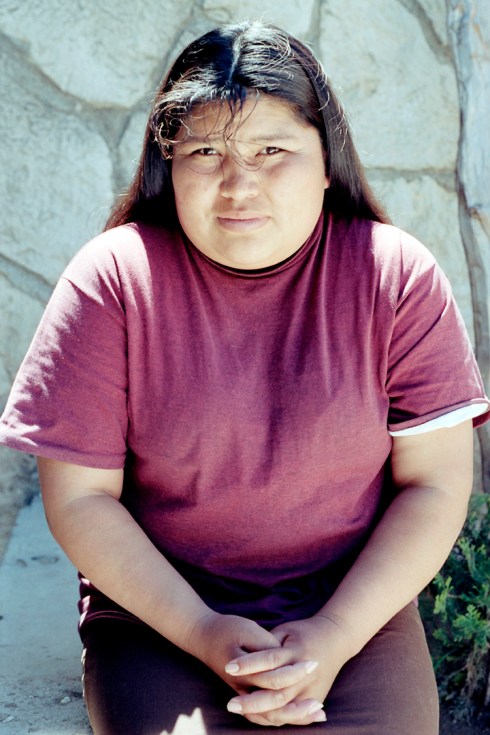
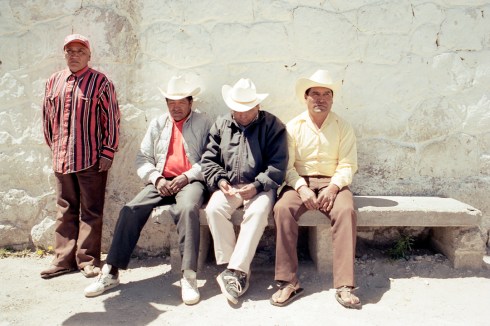
In one such town, Guachochi in the State of Chihuahua, photographer Oskar Landi stumbled across the Centro de Reabilitacion Social (CE.RE.SO). Landi had the opportunity to photograph prisoners in this scorched, sleepy jail during their open-air break.
On the evidence of Landi’s photographs, CE.RE.SO is not a maximum security prison of hardened criminals; oversight seems minimal; male and female, young and old mix; uncertainty hums in the air. If they have anything in common with one another, these prisoners look lost.
Oskar sent me his images, but knowing very little about the town and region, it is only responsible to let his words speak.
“Members of usually non-violent indigenous communities, the Tarahumaras and Tepehuanes, make up the majority of the prison population,” says Landi. “These sober portraits belie the intricate, complex and dramatic history of Mexico’s indigenous community.”
Discrimination is routine.
“The indigenous are often considered inferior because of their dark skin, traditional clothes and customs. As with the rest of the Americas, Mexico’s indigenous population endured invasion, violence and Christianization by the Europeans. This history still haunts their local daily life,” he says.
Guachochi is the largest city in a vast, remote rural region inhabited by both indigenous communities and a relatively much larger number of mixed race people, referred to collectively as mestizos.
“In an area where isolation has helped maintain indigenous culture, extreme poverty and vacant land has also contributed to the spread of illegal drug production as did the birth and collapse of the economic bubble between the late-1980s and mid-1990s,” he says.
“As profits diminished, large quantities of alcohol and weapons were introduced into these isolated communities, soon leading to an increase in violence between the mestizos and the indigenous groups. Honour also plays a central role in the violent conflicts that take place, as intricate circumstances provoke an endless cycle of violence and revenge,” Landi concludes.


OSKAR LANDI
Oskar Landi (b. Italy) has lived and worked in New York since 1998. He attended the International Center of Photography and has a certificate in cinematography from New York University. A successful editorial portraitist, Landi has photographed some of the world’s most renowned artists and innovators. He has worked commercially for Armani, Levi’s, The Village Voice, Bon Appetit, FN Magazine, Style, DDN Magazine, Runner’s Magazine, Wienerin. His personal projects have been recognized by the International Photo Awards and Prix de la Photographie Paris. Landi’s work is distributed by Anzenberger Agency.

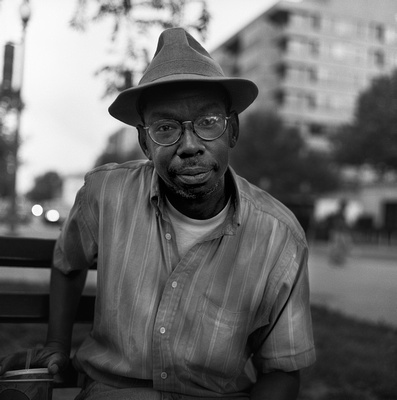
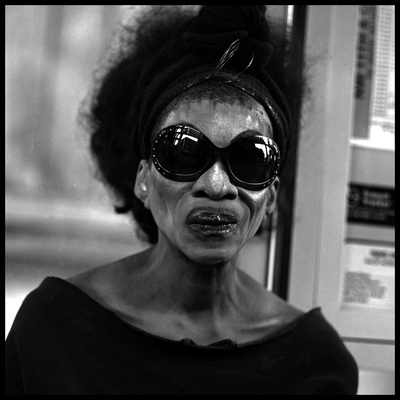
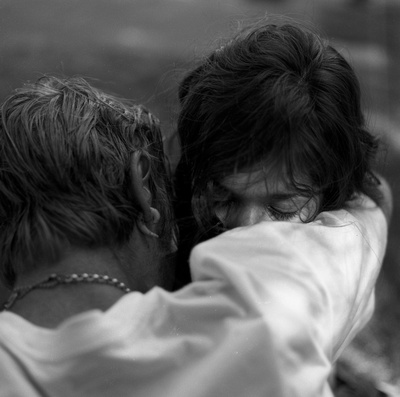
Ward Shortridge makes portraits in Portland and other cities, but mainly in Portland, Oregon where he lives. Ward used to work as a psychiatric social worker. Good portraits often come from the same place as good counselling.
“The best photographs, like the best therapy, occur when I don’t talk too much, when I engage my subjects with unconditional acceptance and love, when I let go of my desire for a particular result and take my direction from the life that is presented to me,” says Ward.
This post is the second in a new series called Eye on PDX. Once a week, I’ll post some images and words by a different photographer working in Portland, the town I now call home. Think global, shoot local.
Ward Shortridge’s website and blog.


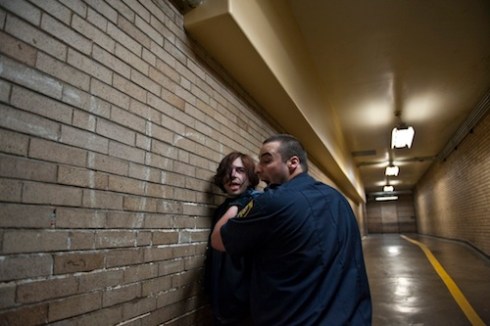
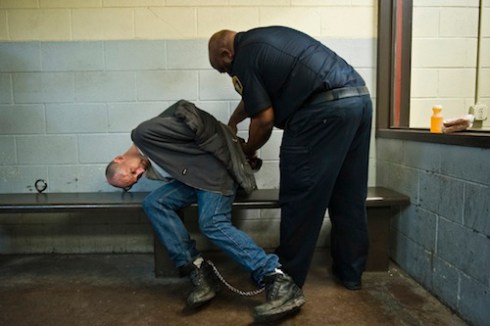
A Corrections Officer forcibly restrains an unruly prisoner who was screaming and claiming abuse by the officer, Cook County Jail, Chicago, Illinois. April, 2011.
CONTEXT
In April 2011, Peter van Agtmael was assigned by Newsweek to photograph Tom Dart, the Sheriff of Cook County, Chicago, Illinois. The coverage involved one day’s access to Cook County Jail and day of access to the ride-alongs with the PD. With a daily average of 11,000 inmates, Cook County Jail is the largest facility of detention in the U.S.
During his time in the jail, van Agtmael witnessed an altercation and heard allegations of abuse.
“The possibility of one more day of access to the jail was floated, but then didn’t come through.”
It is uncertain as to whether van Agtmael’s photographs of the contact between prisoner and deputy affected the decision to cancel the next day’s proposed visit. Van Agtmael isn’t even sure if it was Newsweek or the Sheriff’s department’s decision to cancel.
Newsweek consequently killed the story.
“I don’t know why the story was killed,” says van Agtmael. “No reason was given. Tony Dokoupil, the reporter, briefly referenced the trip in a May 29, 2011 article, Mad As Hell.”
Van Agtmael explains the background to the story, “Dart had became notorious in 2008 for halting evictions tied to foreclosure. He became something of a populist hero, and a deal made with the courts gave homeowners and tenants more leeway to contest their evictions.”
TESTIMONY
Van Agtmael recounts, “Sheriff Dart was giving Tony Dokoupil and I a tour of the jail system, and I heard screams and dull thuds coming from down a corridor. I ran towards the sounds and began photographing a cop pushing the young man against a wall. I began photographing the scene. The young man was screaming that the officer had been beating him, and the officer was yelling at me to stop photographing as he pushed the man further down the hallway. I followed and continued to photograph.”
[Continues below …]
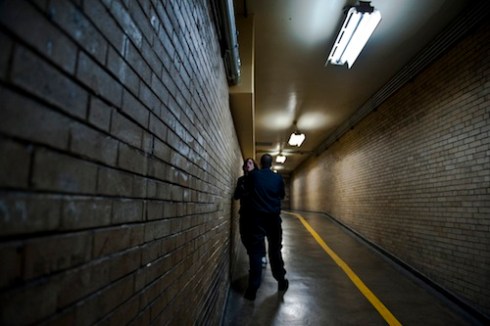
A Corrections Officer forcibly restrains an unruly prisoner who was screaming and claiming abuse by the officer.
“The officer kept yelling at me to stop, and seemed to be trying to simultaneously restrain me as well as the man, but I kept out of arm’s length and explained that I was a guest of Sheriff Dart and had been promised open access to the jail. A moment later, Dart appeared and upon his arrival the situation calmed considerably. He asked the man to explain what had happened to him, wrote a few things down, and then the police officer pushed the young man into an elevator.
[Continues below …]

“A few minutes later we came across the bald man who asked me to take his picture and whispered to me that the cops had punched him repeatedly in the face, resulting in the bruising in the portrait. I had no way of independently verifying the statement,” says van Agtmael.
[Continues below …]

A Corrections Officer leads a prisoner – who had tried to escape – to a holding cell. The man was cut and bruised and claimed he had been beaten by officers after he tried to escape.
“Honestly, it’s very hard for me to make an informed commentary based on a day spent in the jail system. I saw a lot of desperation, and heard stories of alleged abuse, but the context and time limitations would compromise any superficial interpretation. I’ll let the pictures represent my experiences,” van Agtmael concludes.
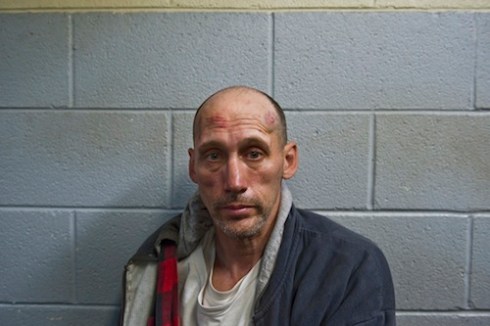
Inmate of Cook County Jail who is cut and bruised. He claimed he had been beaten by officers after he tried to escape.
THOUGHTS
This ambiguous series of photographs goes right to the heart of the efforts I make on Prison Photography to decipher prisons and jails, which for the most part are invisible worlds. Immediately, their meaning and interpretations are up for discussion; they are contested.
Maybe, Newsweek wanted a fuller picture of the Cook County Jail system? Maybe, the relevance of the planned story passed? For me, the fact the story was killed is a sad turn of events.
Getting involved in meta-analysis of journalism can be dangerous but in van Agtmael’s photographs are the kernels of a larger story. It’s not that the stories of these two inmates and these two correctional officers were not told, it is that no story at all was told.
But, let’s not be churlish; this blog post is not an exposé. Van Agtmael’s images are not an illumination of a definable event because the details cannot be verified. They are, however, a depressing suggestion of the fraught and intense-contact situations that play out in prisons and jails across the U.S. every day.
I am not amplifying the inmates’ allegations; to do so would be baseless. I also don’t want to appear to be generally criticising correctional officers. I will however criticise politicians and a voting public that allows mammoth-sized prisons and jails to operate. The experience of prisoners and staff would be less frantic in smaller institutions, and in institutions designed to treat (as well as categorise) and not necessarily detain as their main task.
By publishing these photos my aim is to – again – call readers to think not only about the images they see but those they don’t see. Ultimately, I take van Agtmael’s tack, which is, to let the photographs speak for themselves.
– – – –
Here’s some other selects from van Agtmael’s visit to Cook County Jail:
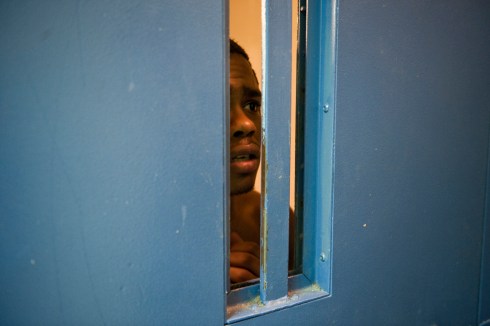
Anthony Smith, a prisoner in the Cook County Jail, Chicago, IL, complains to Sheriff Tom Dart about his treatment and sentence.

Sandwiches for prisoners in the Cook County jail system.

An employee of the Cook County jail system.

A deputy at the Cook County Jail.
PETER VAN AGTMAEL
Peter van Agtmael (b. 1981) graduated from Yale University in 2003 with a degree in History. Following graduation, he spent a year in China on the Charles P. Howland fellowship photographing the effects of the Three Gorges Dam. Since the beginning of 2006, he has documented the consequences of America’s Wars, at home and abroad. A monograph of the work, ‘2nd Tour Hope I Don’t Die’ was published in 2009. In 2008, he helped organize the exhibition and book Battlespace, a retrospective of unseen work from 22 photographers covering Iraq and Afghanistan. Peter is represented by Magnum Photos.
Peter van Agtmael has been awarded the ICP Infinity Award for Young Photographer (2011); PDN Photo Annual (2011); PDN 30 (2010); PDN Photo Annual (2010); American Photography Annual (2010); FOAM Talent (2009); Santa Fe Project Competition – Honorable Mention; Pulitzer Center Grant (2008); World Press Photo Joop Masterclass (2008).
– – – –
All images: Peter van Agtmael/Magnum Photos.
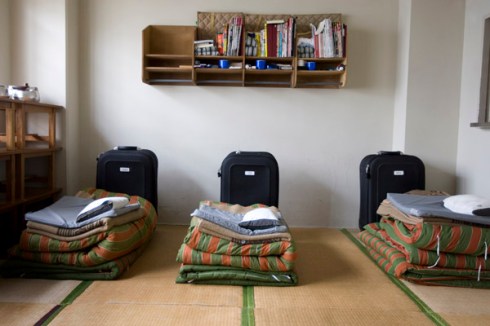
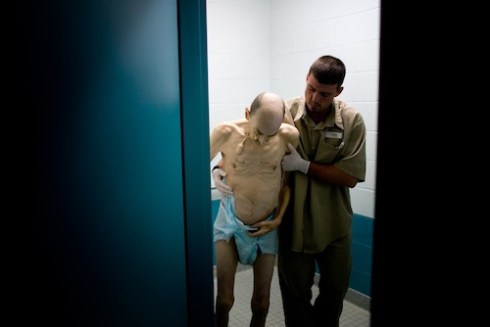
In a room shared by seven prisoners, the folded futon and bedding for three of them sits neatly beside black cases in which they can store their personal belongings during the day in Onomichi prison, Japan. Monday, May 19th, 2008.
– – – – – –
The over 60s are the fastest-growing group of criminals in Japan, which incarcerates its pensioners at a rate far higher than any other country in the industrialised world.
In my last post, I featured Tim Gruber’s photographs of aging prisoners in the U.S. As chance would have it, Jeremy Sutton-Hibbert contacted me about his 4 hour assignment in a Onomichi prison in Japan, designed specifically for the detention of the elderly. Sutton-Hibbert’s photographs are a good point of comparison with Gruber’s photographs of elderly U.S. prisoners.
Sutton-Hibbert’s photographs from Onomichi prison accompanied a thorough investigation of aging Japanese prisoners by Justin McCurry:
The number of Japanese aged 70 and over charged with crimes trebled between 2000 and 2006, from 9,478 to 28,892, according to the national police agency. In Japan, while the number of charges against juveniles increased by 2% from 2000-04, there was a 125% increase among over-70s.
The number of Japanese aged 60 and over grew by 17% between 2000 and 2006, the number of prisoners in the same age bracket soared by 87%.
Most are inside for crimes, that seemingly result from poverty. Again, McCurry:
Of the 46,637 people over 60 convicted in 2006, just over half were found guilty of shoplifting, followed by 23% who had committed petty theft.
Criminologists blame record levels of poverty among pensioners, the breakdown of the extended family, and a lack of professional help for those with depression and other mental illnesses. […] The best chance many [elderly former-prisoners] have of security, decent healthcare and three meals a day is another stint behind bars. […] According to a recent justice ministry study, almost two-thirds of Onomichi’s older inmates will walk back through its doors within five years of their release.
That’s a recidivism rate as bad as that in the U.S. the world’s most renowned broken prison system. We must bear in mind that the U.S. prison system, by population, is roughly 28 times the size of the Japanese (and UK) prison systems. McCurry:
At 80,000, the prison population of Japan is approximate to that of the UK. However, 12% of Japanese prisoners are at least 60, whereas 2.8% of prisoners in the UK are 60 and over.
Regardless of geography, aging prison populations bring about the same challenges, health problems and associated expense. In Japan, about 1,000 prisoners have difficulty walking, feeding themselves or doing prison work. That is surely a figure dwarfed in the states, which has 124,900 prisoners aged 55 or older.
THOUGHTS
Prisons are designed for punishment. The punishment is the deprivation of liberty. Prisons are also designed for a minority of prisoners to ensure public safety and remove violent people off the streets. When it comes to aged people, the first legal constant must remain, but in the case of the second – and when a prisoner is clearly old and infirm – is a prison always the right place for society to mete out it’s judgement? In the case of the UK, Edmund Clark’s photographs and Erwin James’ commentary might help us come to some conclusions.
– – – –

Ramps for elderly inmates to walk up, leading to the bathroom, instead of using stairs, in Onomichi prison , Japan. May 19th 2008.

Elderly prisoners (in white) preparing lunches for their fellow inmates, presided over by a prison guard, in Onomichi prison, Japan. Monday, May 19th, 2008.

Many of the elderly prisoners suffer from high blood pressure and diabetes, with 70-80% of them receiving medication.

Following a roll call of names, elderly prisoners (and one pushing a stroller chair for stability) make their way to a room for their lunch, in Onomichi prison, Japan.

Elderly prisoners playing Japanese board game ‘shogi’, during recreational time in an indoor recreational room, whilst two fellow inmates use the exercise bikes, in Onomichi prison, Japan. Monday, May 19th 2008.

Elderly prisoner exercising on a rowing machine in an indoor recreational room, watched over by guards, in Onomichi prison, Japan. Monday, May 19th 2008.
– – – –
All images: Jeremy Sutton Hibbert
– – – –
JEREMY SUTTON-HIBBERT
Jeremy Sutton-Hibbert‘s work has appeared in magazines such as Time, National Geographic, Italian Geo, Le Figaro, The Guardian, The Sunday Times, and many others. For the past decade, Sutton-Hibbert has been one of the principle photographers for Greenpeace International. His work has taken him to over 40 countries, as far flung as Antarctica and Outer Mongolia. Sutton-Hibbert’s photography has been widely published and exhibited in Europe and USA. For 9 years, Sutton-Hibbert was based in Tokyo, Japan and recently returned to his native Scotland to live and work.
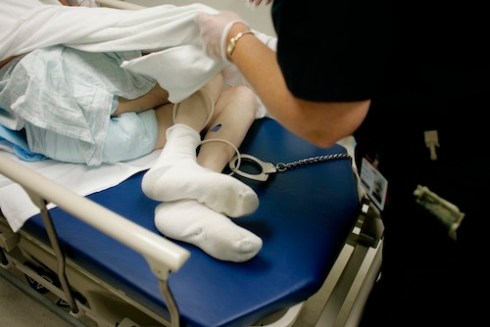
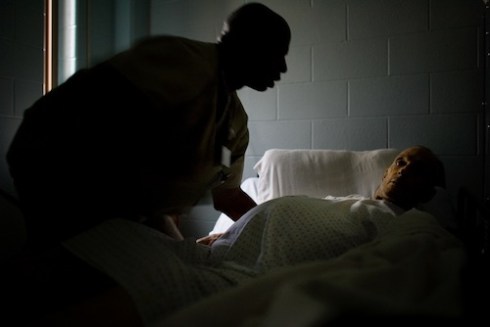
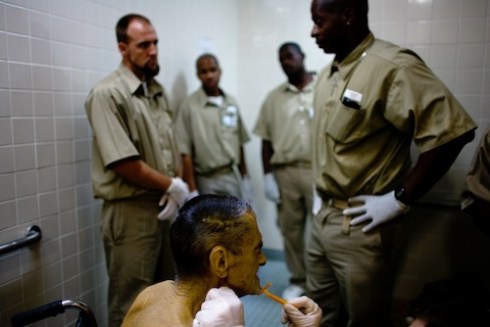
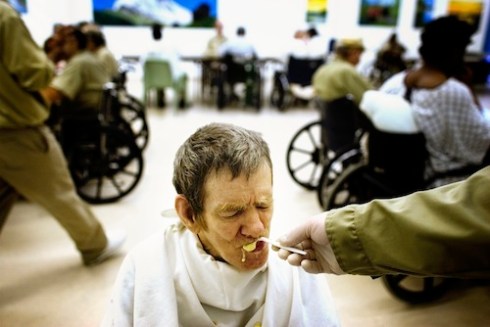
In 2008, Tim Gruber embedded at the Kentucky State Reformatory to photograph in the geriatric wing designated for elderly and terminally ill patients. The result is Served Out, a photography and multimedia project. Here, I featured six images included in the PPOTR/Cruel and Unusual exhibition, but you should check out Tim and Jenn’s website for more stellar images.
Both Tim and his wife Jenn Ackerman worked in KSR the same summer. Tim is unequivocal: their access was down to then-Warden Larry Chandler’s good grace and good sense. Chandler wanted people to see how their tax dollars were spent and understood photography as part of the transparency he insisted on for the institution. KSR even gave weekly tours of its facilities.
Tim and Jenn, after brief training, were given staff-badges and were free to go about their work in the prison. They moved down to La Grange, KY for the summer to make the project and it wasn’t easy; Tim blogged some of the challenges (one, two, three, four, five.)
When we spoke last October, Gruber was in discussion with the ACLU. Last month, his images were used to illustrate the ACLU’s latest report ‘At America’s Expense: The Mass Incarceration of the Elderly‘ (Tim’s announcement.)
Of course, the common knowledge of the problems of incarcerating the elderly shaped our discussion. From the ACLU report:
Over the last 25 years, state corrections spending grew by 674%, substantially outpacing the growth of other government spending, and becoming the fourth-largest category of state spending. […] It costs $34,135 per year to house an average prisoner, but it costs $68,270 per year to house a prisoner age 50 and older. to put that number into context, the average American household makes about $40,000 a year in income.
In 1981, there were 8,853 state and federal prisoners age 55 and older. today, that number stands at 124,900, and experts project that by 2030 this number will be over 400,000, amounting to over one-third of prisoners in the United states. in other words, the elderly prison population is expected to increase by 4,400% over this fifty-year time span. this astronomical projection does not even include prisoners ages 50-54, for which data over time is harder to access.
The U.S. keeps elderly men and women locked up despite an abundance of evidence demonstrating that recidivism drops dramatically with age. For example, in new York, only 7% of prisoners released from prison at ages 50-64 returned to prison for new convictions within three years. that number drops to 4% for prisoners age 65 and older.
But, also, Tim and I talked about the emotions and first-hand experiences statistics don’t capture – the need for alternative imagery of prisoners and their humanity; what it was like to work on the wings, sit with the men and witness death (“Tears would overwhelm me”); compassionate release, prisoner-volunteer medical assistants and how Tim’s imagery may effect change.
LISTEN TO OUR CONVERSATION AT THE PRISON PHOTOGRAPHY PODBEAN PAGE


The Prison Library Project will be having a mail art exhibition in October 2012 and invites inmates, families and those who look to improve the lives of those incarcerated to participate:
The Prison Library Project receives hundreds of letters every week from inmates across the country. These letters requesting books and dictionaries, are often beautifully illustrated. In the spirit of these talented prison artists the Postmarked show was created, using the envelope as a canvas to create and share mail art.
The art of letter writing and the use of “snail mail” is on the decline, a casualty of the electronic age. But who among us does not smile when we received a letter in our mailbox? Who doesn’t thrill to find art instead of junk mail and bills? The Postmarked show is a chance for all of us to reconnect with the magic of “snail mail” while helping a population whose voice, if heard at all, is limited to the humble envelope, letter and pen.
Interested participants may decorate, illustrate or create art on an envelope and mail it in for the Postmarked mail art exhibition and fundraiser. Send submissions to:
Postmarked 2012
Prison Library Project
112 Harvard #303
Claremont CA 91711
Entries must be postmarked by September 30, 2012.

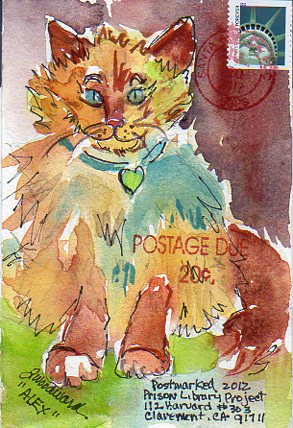
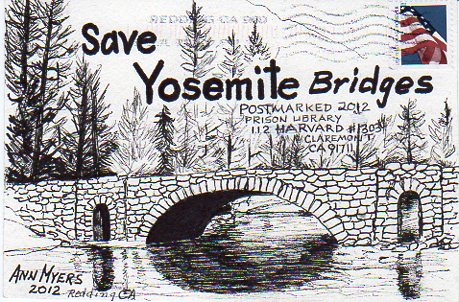

Only the side with the official USPS Postmark/barcode will be displayed. Mail art may be painted, stamped, collaged, printed, decorated or constructed. It may be any shape and size that will go through the mail and receive an official postmark.
“Mail may get worn or torn through the mail, but the handling process is an important part of the theme,” says organiser, Rachel McDonnell
Mail will be opened only by the person who purchases the art envelope.
Exhibition: October 5 – November 2 at the Claremont Forum Bookshop & Gallery. Opening Reception: Friday, October 5 Final Bid Party: Friday, November 2, 6:30 – 8:00pm
For more information, see PLP’s Postmarked blog or contact Rachel McDonnell at rachel@claremontforum.org

The Prison Library Project is a prison book and literacy program which sends thousands of books, study aids, educational and spiritual resources to inmates nationwide.

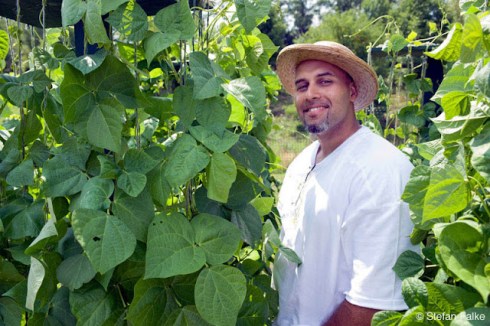
Woodbourne Correctional Facility inmate and Bard College student Abdullah Kamau Sankofa (left) studies in the computer room. He was been sentenced to 18 years in prison at the age of 17. Bill Doane (55) is one of his mentors.
Brooklyn-based German photographer, Stefan Falke made a series of photographs of the Bard Prison Initiative for a 2010 Die Zeit story.
I’m a huge fan of prison education programs and certainly college levels instruction. The interactions and the learning can shatter stereotypes. Falke’s photos do the same.

 Prison Photography