
You are currently browsing petebrook’s articles.
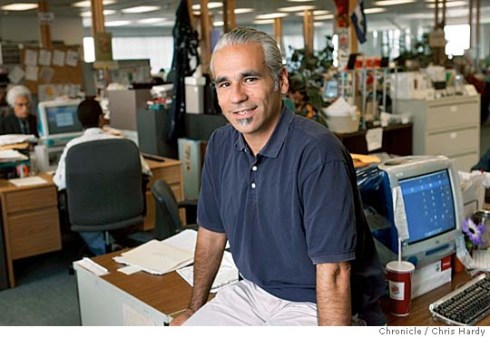
In 1996, David Inocencio began writing-workshops to youth detained in S.F.’s Youth Guidance Center. A zine developed and The Beat Within was born. It is the nation’s biggest weekly publication of incarcerated youth writing.
The first publication followed the murder of rapper Tupac Shakur as young people sought ways to publicize their feelings of loss. Originally, The Beat Within was a 6-page magazine. Today the full-fledged weekly magazine is at 70 pages.
For some contributors, The Beat Within is the first positive recognition they have ever received that they have a voice worthy of an audience.

The Beat Within staff and volunteers hold weekly workshops in many California county juvenile halls: San Francisco, Marin, Alameda, Santa Clara, Santa Cruz, Solano, Monterey, and Fresno. The Beat workshop model is replicated in Maricopa Arizona, in San Bernalillo New Mexico, Miami Florida, and Washington DC.
Each week, The Beat Within serves up to 700 detained youth and the San Francisco office provides internships and social services to more than a dozen formerly detained youth.
David Inocencio and I spoke about what it means to give juvenile prisoners a voice.
LISTEN TO OUR DISCUSSION AT THE PRISON PHOTOGRAPHY PODBEAN PAGE.
Below is To The Streets, a piece of writing by Lady Streetz, from Alameda, CA. It featured in Volume 16. 18/19 (p. 6) of The Beat Within.
It is a difficult read but it gives us an unmistakable view of some of the serious problems incarcerated youth, and particularly incarcerated women face.
Dear Streets
I want to write this letter to tell you how ashamed of you I am. How could you ever raised your hand to a female, what I want to know is what did I do so wrong that you had to lay your hand on me for the last months and months?
Why would you beat me, kick me out of my own car, and make me walk home bare foot? Where the hell do they do that at? I can’t believe you had the nerve to beat me in front of your friends and then make me sit out in the cold in my little dress.
Who gave you the nerve to take my keys and my phone? Did you buy my car, no! Did you buy my phone, hell no! Someday I hope to forgive you for all the shhh you did to me. Someday I will forgive but I will never forget.
I will never be the same since you happened to me. I stride to try to trust the black men staff here, but I’m scared they’re going to hurt me. I’m always scared someone is about to abuse me. Why? Because of you, because of all the times you beat me and left me bleeding. I hate you, You’ll never change women beaters.
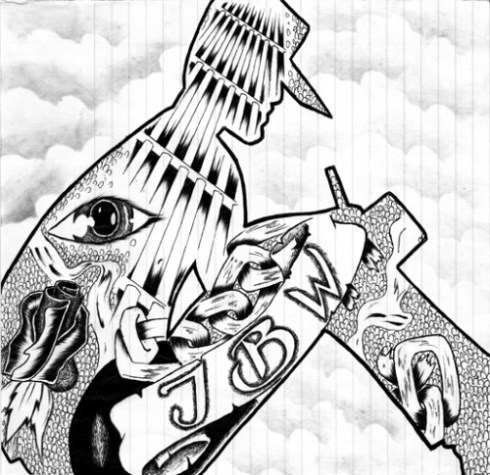
Artist unknown © The Beat Within

David, DJ at the prison radio station holds a Polaroid of him and his wife. He said the picture was taken more than 15 years before, when he was 18 and she was 16 years old. During his hour as DJ he played mostly Gospel and Christian music at the Louisiana State Penitentiary at Angola, June 27, 2000.
Photographer, writer and psychotherapist Adam Shemper and I talk about his portraits and photographs from Louisiana State Penitentiary.
LISTEN TO OUR DISCUSSION AT THE PRISON PHOTOGRAPHY PODBEAN PAGE.
At the age of 24, Adam was challenged (almost dared) by a family friend to “experience something real.” The friend offered him an introduction to warden Burl Cain and the test to photograph within Angola Prison.
We all have difficulty putting our work out in the world, and Adam found that after his nine-month stint at Angola he had more questions than answers.
For many years the work remained unpublished and Adam’s own justifications for the work unsteady. We discuss the life-cycle of the photographs, the reactions of the prisoners to Shemper and his work, and generally, the responsibilities of photographers toward their subjects.
In photography, as in life, it is all about relationships and positive connections that benefit all parties.

Victor Jackson, cell block A, upper right, cell #4. He had ‘I Love U Mom,’ tattooed on the inside of his right forearm. Louisiana State Penitentiary in Angola, April 17, 2000.
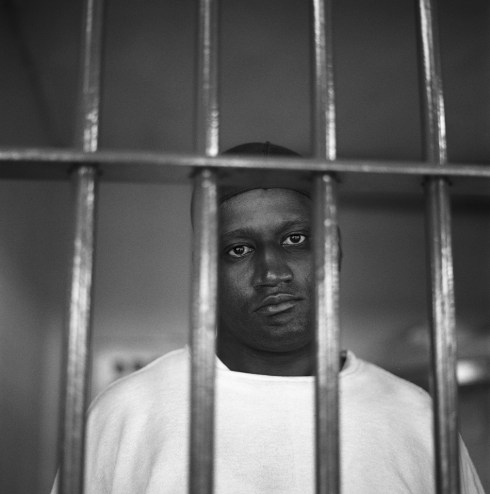
LaTroy Clark, cell block A, upper left, cell #6, Louisiana State Penitentiary in Angola, April 17, 2000

Don Jordan reads the Bible in his cell, Louisiana State Penitentiary in Angola, April 17, 2000
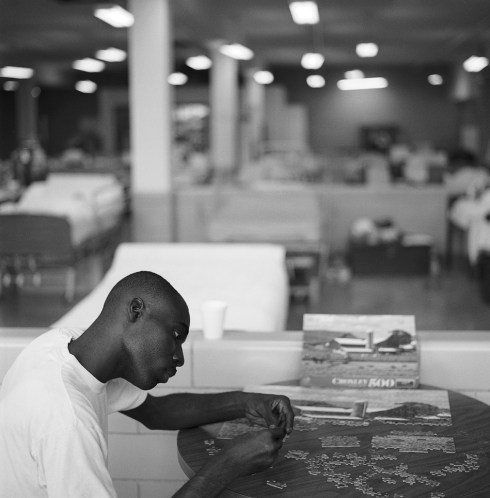
Jonathan Ennis puts a puzzle together of a farm scene in Ward 2 of the Louisiana State Penitentiary hospice at Angola, March 21, 2000.
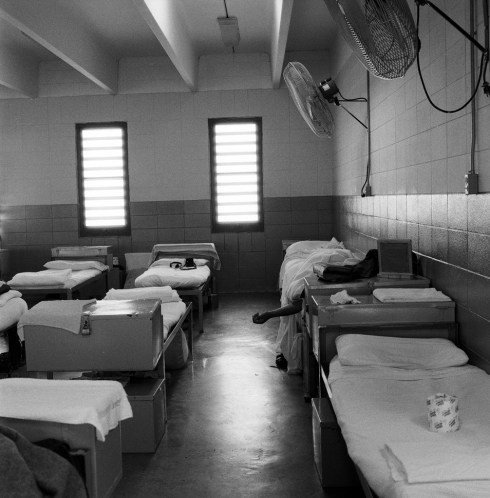
A man sleeping during the day in the main prison complex, camp F dormitory, Louisiana State Penitentiary in Angola, February 1, 2000.
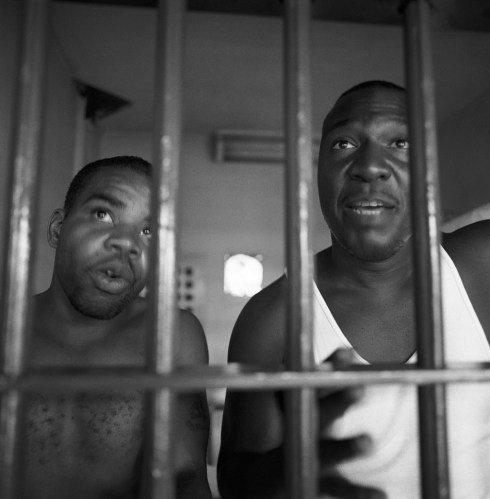
Henry Kimball and Terry Mays in cell block A, upper right section, cell #15, Louisiana State Penitentiary in Angola, September 6, 2000.

Brian Citrey, main prison, cell block A, upper right, Louisiana State Penitentiary in Angola, April 17, 2000

Nolan, a prison trustee, standing in front of the lake, where he often spends his days fishing. He caught catfish and shad on this day for the warden and his guests. Louisiana State Penitentiary in Angola, June 27, 2000.
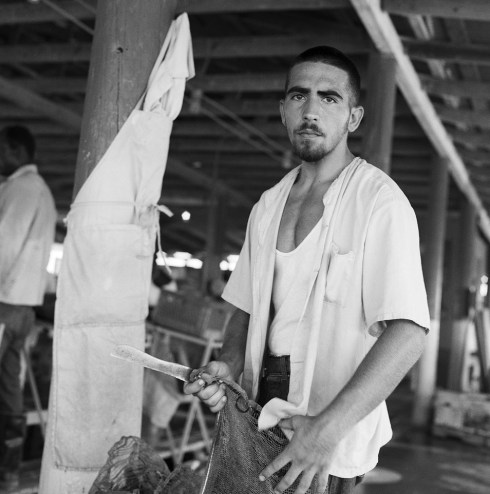
Man cuts open sacks of vegetables to sort through, Louisiana State Penitentiary in Angola, June 27, 2000

After chopping weeds in the fields, men wash up as they transition back to their cell blocks at the Louisiana State Penitentiary in Angola, April 17, 2000.
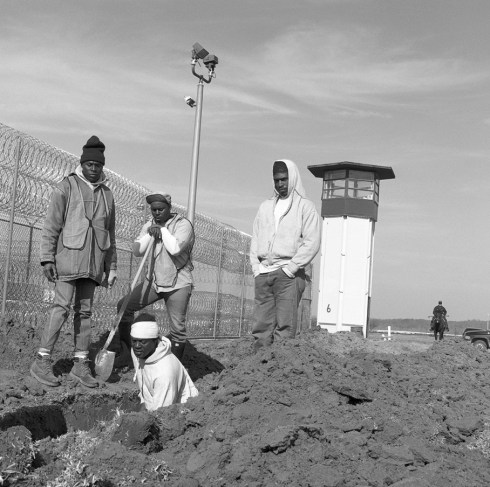
Men housed at prison camp C dig a ditch at the Louisiana State Penitentiary in Angola, January 31, 2000.
All images © Adam Shemper.
Images may not be reproduced elsewhere on the web or in print without sole permission of the photographer, Adam Shemper.
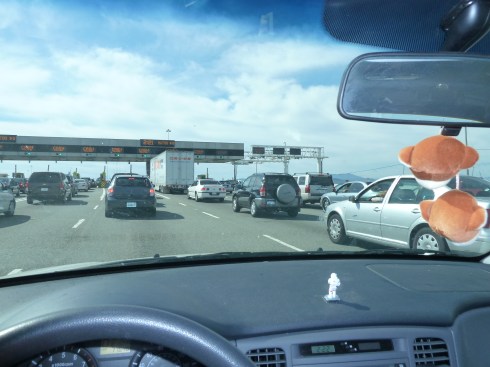
Name that toll booth?
Two weeks in, eleven interviews down, three published and eight in the can.
I can only anticipate getting more and more busy. My discombobulation may be interrupted by episodic bouts of fear, exhilaration and self-doubt.
Fortunately, technology will offer consistency.
All audio interviews will be hosted on Podbean at http://prisonphotography.podbean.com.
If you so desire, sign up for the ‘Prison Photography’ on the Road Podbean RSS feed.
‘Prison Photography’ on the Road is licensed under a Creative Commons Attribution-NoDerivs 3.0 Unported License, making all the audio published at http://www.prisonphotography.podbean.com available to the prison reform and photography communities free of charge. Please download and share responsibly.
All audio interviews will be linked to here on Prison Photography, sometimes with little juicy behind the scenes extras, and often with phenomenal galleries of work by the photographers I meet.
As ever, I’m throwing out tweets at @brookpete. Furthermore, I’m using the hashtag handle #PPOTR to let you know about the all the incidentals.
Come ride with me.

3 Years out of a Death Row Sentence (river)
It may have been her family member sucked into the U.S. prison system or it might be Amy Elkins‘ curiosity about the darker undercurrents of humanity that led her to pick up a pen and write to Americans on death row and serving life without parole.
Four years ago, Amy opened up communication channels with seven prisoners. “My original fascination was with the idea of being pulled away from society and how that affects people; how it affects memories,” said Amy during a sun-drenched interview in the garden of a Portland coffee shop.
“The whole project has been about searching,” says Amy. “I searched out these men on the internet, then I had to search my motives as to why I write these.” Later, Amy searched news clips and court transcripts to piece together the stories of the persons to whom she’d reached out.

26/44 (Not the Man I Once Was). Portrait of a man having thus far served 26 years in prison (18 of which were out of a deathrow sentence), where the ratio of years spent in prison to years alive determined the level of image loss.

13 Years out of a Death Row Sentence (river)
Unlike the fates of her condemned correspondents, Amy’s project Black is the Day, Black is the Night has no prescribed end-point.
As she has got know her pen-pals, collaborations have developed; common cell-house objects constructed, photographed and bought; portraits made from the last words of the executed; obscured quotes from the poems of her pen-pal friends; pixelated portraits of dead men walking, whose stories are dominated by the narratives of courts and institutions. Black is the Day, Black is the Night contributes new chapters … in some cases they might ultimately double as eulogies.
Of most interest to Prison Photography are Elkins’ composite landscapes. The catalyst for each is the description of a memory by one of Amy’s pen-pals – childhoods spent under cloudless skies, a born-again fascination with baptism rivers of the South, and wide open desert. Inmates had no access to images and Amy had only access to these scenes through their words. If reality exists for them or us, it’s a feeble reconstruction several steps removed. Searching again, this time through Google images.
To create the distorted landscapes and pixelated portraits, Amy uses a couple of mathematical formulas driven through photoshop. The numbers involved in each formula relate to the age of the pen-pal and the numbers of years they’ve been incarcerated. Amy wants to keep the algorithm under her hat, but it appears the longer they’ve been locked-up the more vague the visages become.

13/32 (Not the Man I Once Was)
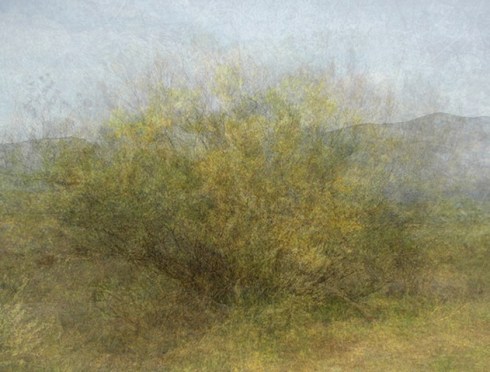
12 Years out of a Death Row Sentence (Dying Wish Retama Tree)

14 Years out of a Death Row Sentence (Dying Wish Retama Tree)
Currently, there are approximately 1,500 American citizens on death row.
“To be honest I’d never considered that this country has such a huge population of people on death row,” says Amy.
She began her research by signing up to one of the many online prison pen-pal services. The prisoners are categorized; one option ‘DEATH ROW INMATES’. “I clicked it and it was 50 pages; a sea of faces looking back at me. […] to click on one button and get hundreds of people looking for contact with the outside world. […] it’s difficult to describe. Nerve-racking and unnerving?”
Simultaneously engrossed and “freaked out”, Amy was conscientious in how she progressed. “It was never a photo project! I was just writing. I wrote with them for a year before I did anything with it. […] Part of that had to do with creating my own comfort levels,” explains Amy. “I deliberately contacted people who’d been in for 13 years or more. I didn’t want to write with someone who was angry. I wanted to be in touch with people who were at some sort of peace with the situation, who could look back and have some perspective.”
Of her seven original corespondents, three remain.
One was executed. The letters stopped coming and the news was confirmed through internet news stories. “No one went to his execution – no one from his family, no one from the victim’s family. He was poverty stricken. There was doubt in his case. He very well could not have done any of the things he was accused of. Every letter he wrote said ‘I am innocent’.”
Another pen-pal was released after serving 15 years, “He never contacted me [post-release]. He’s getting on with life. I hope he’s doing well,” says Amy.
A third pen-pal in Nevada wrote to explain that he was working on a novel and had developed a romantic writing relationship with another woman. He broke it off. “I was fascinated by that. It’s weird to be out here free and have them in there with relatively nothing and see them decide not to write. I respect that. They have so little, but they are careful about their time,” says Amy.
Amy’s pen-pal at San Quentin is erratic in his letters, writing after long periods of silence and often emerging from one [mental health] crisis or another. Amy has never felt that they’ve been able to develop a sustained relationship.
Her pen-pal in Mississippi writes on the 10th of every month but his letters are shorter now as he presses his last remaining options for appeal against execution. “From his letters he’s describing that it’ll be up before the year is out,” sighs Amy.
The sixth is in Georgia.

17/35 (Not the Man I Once Was) Portrait of a man having thus far served 17 years out of a deathrow sentence, where the ratio of years spent in prison to years alive determined the level of image loss.
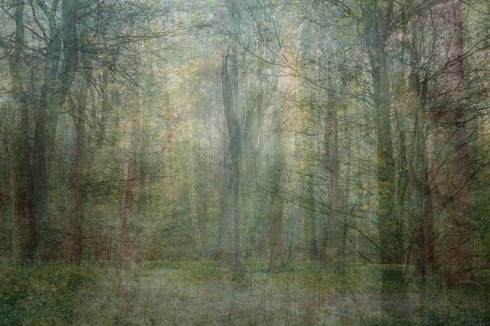
7 Years out of a Death Row Sentence (forest)

9 Years out of a Death Row Sentence (forest)
The most sharing, personal and colorful letters are from a lifer in the renowned Secure Housing Unit (SHU) at California’s Pelican Bay State Prison. Pelican Bay was America’s first SuperMax and currently the focus of the California Prisoners Hunger Strike. Of all her pen-pals, Amy can predict most this man’s future “The guy in Pelican Bay is going nowhere.”
On any given day in the U.S., there are 20,000 people held in solitary confinement.
“In California, solitary is a 6’x9′ cell with no windows and a steel door. I don’t think anyone would do well in that situation. People are extracted [from general population] and placed into these cells already upset and then they left to themselves. I don’t think prisoners are going to read the bible 30 times and then be okay,” speculates Amy, “I go stir crazy if I’m in my house for a day without going outside.”
Amy describes the Pelican Bay prisoner’s letters of unusual “formal British” tone. Unusual because he is originally from Tijuana, Mexico. “He must have been reading a lot of books?” wonders Amy.
“His first letter was 15 pages long and he said, very poetically, that he sits in his cell 23 hours a day. Once a day, he is shackled, walked down a corridor, on his own, and let into a concrete pen with 25 foot walls and a metal grate over it. He doesn’t describe it like ‘this is all I have, I can’t stand it here.’ He says he has 60 minutes of freedom, where he just gazes up at the sky; the only aspect of the outside world he can have. And even still, he watches the sky through a metal grate so it is not a pure version of open sky.”
Amy put out an open call for people to send her pictures of the sky. “I started making composites and sent them to him,” says Amy. “He didn’t understand the computer or photoshop. He hung them all up in his cell and wrote me back about how excited he felt being surrounded by skies. That was the first person I made something for and got feedback on. It felt like a collaboration. I started pulling images from other people’s letters. Other guys shared things about past experience, in some case decades prior. I’d repeat the process, make composites and send them.”
The prisoner at Pelican Bay has been in prison for 21 years, in solitary for 16 years. He has experienced another of Amy’s intrigues – juvenile offenders sentenced as adults.
“He went to Juvie, and he’s had no break in his incarceration,” says Amy.
“His mugshot was of him as a 13 year old boy. His profile read ’34 year old man, Pelican Bay State Prison’. But that was the last photo taken of him in the system. I’ve never been politically driven or hugely into criminal law. I’m just a portrait photographer interested in psychology and cultural anthropology. There is something about someone in that level of isolation, I just wanted to reach out. If that makes any sense.”

15/30 (Not the Man I Once Was)

4 Years Out of a Deathrow Sentence (ocean). A penpal 26 years into his sentence in a landlocked prison, described an early childhood memory that haunted him, of walking further and further into the ocean during low tide until the sudden depth and darkness before him overcame him with fear.
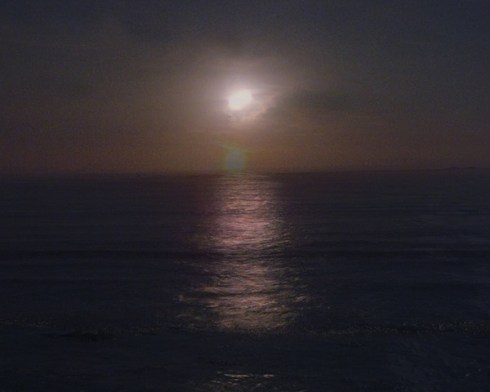
26 Years out of a Death Row Sentence (ocean)
Questions of whether or not Amy’s project in some way exploits these men have been floated before. She worked on the Black is the Day, Black is the Night “obsessively” during her Lightwork residency earlier this year.
“During my exit interview, the director expressed concern. How could I be this person in the world, who is fortunate enough to live a nice life, have a gallery, have nice things and focus on these individuals? He wanted to make sure I was ready for those types of questions. But, those question could be asked of all documentary work. It’s not about that; it is about getting the stories out in the world and having people think. I don’t know what people have in their minds [about me]. I’m not some “privileged girl” writing to “savage men”. No. I didn’t come in the project with any type of judgement. I like that I can talk about their stories in a way that’s not conventional. I think it’s correct that we can write; be trusting and share. […] I always write them back and I’m pretty open about my life as well.”
And the pen-pals reactions? “I don’t know if it’s that they’re bored or genuinely fascinated, but they’ve always expressed that they find it intriguing,” says Amy. “They’ve been sought out and they’re being interacted with. I’m not a housewife or someone for a church reaching out in those ways. I am their age and I’m reaching out with mail that’s perhaps a little more interesting than the average.”

Correspondence
To date, Amy has never profited from the project, but if – in the future – someone wanted to pay $10,000 for a landscape? “I’d sell. I’d send them the money. I have sent money to my pen-pals in the past. I have become friends with these men.”
The title, Black is the Day, Black is the Night, derives from a quote in a poem Amy received. “It spoke about that environment so well. The idea of being pulled away from anything. Experiencing no variance. Everything is the same; everything is dark. The poem is mind-blowing. Better for him to describe the situation than me.”
As the afternoon sun waned, and Amy and I squinted at the sky, that much was obvious.
All images © Amy Elkins
I’m still in Los Angeles making PPOTR magic happen.
Artist, photographer and prison fangirl Alyse Emdur has been working with hundreds of U.S. prisoners on a collaborative study of visiting room portraits and backdrops (more on that to come.)
During her MFA show When I Get Out of Here, she projected Gary Boyd’s Body Talk video on the gallery wall.
The footage was shot on a prison owned video camera which was in the prison for an event. The footage was then smuggled out. Gary Boyd has since been released and has changed his name to Sol Amen Ra.
While we’re on the topic of body sculpting inside prisons, check out Arnold Schwarzenegger helping inmates weight train in the era before California banned weightlifting equipment in prisons – a ban, if I recall correctly, Arnold criticised as Governor.

Danny Lyon, Guns Are Passed to the Picket Tower, Ferguson Unit, Midway, Texas, 1968
During a brief speech made upon receiving the Missouri Honor Medal in Journalism, documentary photographer Danny Lyon made an astonishing call for insurgency in America:
“There, I said it, ” he added.
Lyon evokes the blood spilt as matter of course to forward the campaigns of the American revolution, the civil rights movement, and the anti-Vietnam protests.
I cannot argue with his politics but I am not ready to make a call for “blood on the streets.” Maybe, I am not brave enough; maybe I am still hopeful that meaningful change can occur in America through non-violent means. I just know if a right-winger made similar calls, I’d be repelled.
I bring this up because Lyon and I are scheduled for an interview in December and his comments must be revisited and tested.
For the benefit of the media, Lyon penned an 11-point “laundry list” of issues he wishes to see addressed – jail terms for the bankers responsible for the economic crash; rights for immigrant workers; jobs to enrich the environment. Items 9 and 10 caught my eye:
9) Abolition of the American prison system as it stands.
10) Immediate reviews and interviews inside state or federal prisons by public committees and parole boards with any inmates that have been inside prison for twenty calender years.
Prisons have grown as a result of social division, greed and flawed abstract notions of justice – seemingly, the same damaging forces in *free* society to which Lyon responds.
(Silent movie)
… Joseph Bristow from Harrogate, UK!
The four books will wing their way to you as soon as you provide a mailing address.
The 25 entries came in from 9 different countries. And for those 13 U.S. entrants, I might just be tapping you up for a couch in the next 10 weeks.
That was fun. Enjoyed that.
Videography by Sye Williams


 Prison Photography