
You are currently browsing petebrook’s articles.
It’s fair to say that building, finding and maintaining momentum for a Kickstarter project keeps you busy (the case for any crowdfunding effort I’d guess).
In promoting Prison Photography on the Road, I’ve been lucky this week to tap a couple of networks previously beyond me.
KICKSTARTER BLOG
Cassie Marketos and I did an email interview for the Kickstarter blog: Creator Q&A: Pete Brook and Prison Photography.
This seems to be the most popular quote: “We live in a visual world. Every image is political. Sometimes we should not be thinking about the images we see, but instead thinking about the images we do NOT see.”
THOUGHTS ON PHOTOGRAPHY
Paul Giguere and I did a phone interview for the Thoughts on Photography podcast (available on iTunes).
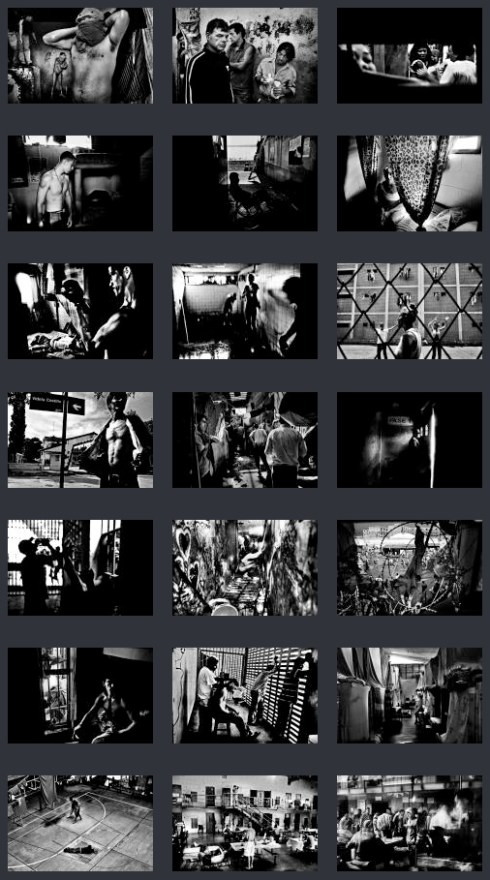
Valerio Buspuri‘s work from South American prisons is on view at Perpignan now. Buspuri says:
“A ten-year trip visiting 74 prisons for men and women in every South American country turned out to be a portrait of the continent, describing troubles, violence and massive overcrowding, as well as lifestyle, habits and the mood of the inmates. The story offers an in-depth view of the mind and soul of prisoners.”
Prisons as a portrait of a continent? That’s pretty bleak and too reductive for me.
The image of the prisoner using a “bathroom” probably sums up the vast differences in prisons between North and South American prisons; securing basic sanitary conditions is more of a concern than the other pressing issues of rehabilitation, and fair legal process.
The Attica Prison Uprising occurred at the Attica Correctional Facility in Attica, New York, United States in 1971. The riot was based in part upon prisoners’ demands for better living conditions, and was led in large part by a small band of political revolutionaries.
On September 9, 1971, responding to the death of prisoner George Jackson, a black radical activist prisoner shot dead on August 21 by correctional officers in California’s San Quentin Prison, about 1,000 of Attica prison’s approximately 2,200 prisoners rioted and seized control of the prison. They took 33 staff hostage and began negotiations with the state. Governor Rockefeller refused to visit the site and sanctioned the taking of Attica Prison by force.
At 9:46am on Monday, September 13, tear gas was dropped into the yard and New York State Police troopers opened fire non-stop for two minutes into the smoke.
In total there were 39 deaths during the Attica Rebellion; 29 of which were prisoners and ten were guards held hostage.

Poster created by the Students for a Democratic Society (SDS) advocating support of prison rebellions, and the abolishment of alleged racist prison terror. Source: Wisconsin Historical Society
The most famous prison rebellion in American history began in the early hours of September 9th, 1971.
I’ve written about the Attica Prison Uprising before, mainly in relation to Cornell Capa’s involvement in the general politics of prisons and his testimony during the inquiry that followed the riot.
I wanted to share an image of this poster and ask you if you can imagine this type of visual being used today. It wouldn’t happen. Universities are less and less incubators for radical action; prison issues are rarely incorporated into overarching critiques of capitalism; and, sad to say, solidarity and Socialist motifs are derided in today’s media culture of garish graphics, breasts, comments of misdirection and ridiculous 24-hr coverage.
Not wanting to end on a down note, these groups are working against our society of excessive, blaring infotainment. Check them out.
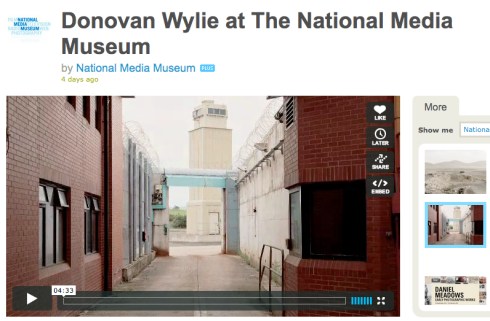
Donovan Wylie, whose work I’ve discussed before, talks about his approach photographing the retired Maze Prison (also known as Long Kesh).
Wylie, who describes his work generally as “conceptual-documentary” attempted at the Maze to pin-point the design decisions behind the politics behind the structures.

For any of you in Seattle this Thursday, September 8th, I’ll be speaking at the “Photo Slam” event in the PIONEER PASSAGES alley between 1st Avenue S & Occidental Ave S and Yesler Way & S Washington St.
I’ll be talking about a handful of prison photographers, my motives for focusing on U.S. prisons and asking the audience to think about the images they don’t see.
Others presenters are John Keatley, Mike Kane, Alan Berner, Danny Gawlowski, Jordan Stead, Genevieve Alvarez, Joshua Trujillo and Chantal Anderson.
The event runs from 6pm to 8pm.

The goodies just keep rolling in. Shame they aren’t shifting as quick as the smaller level funding incentives. So while this print is amazing and I want it myself, I must encourage any of you with big “photography collector friends” to pay the Prison Photography on the Road Kicksarter page. They might just get a bargain!
If you want to know more about Stephen’s work and motivations see The Feedback of Exile, an interview we did a couple of years ago.
– – – – – – – – – –
Photographer: Stephen Tourlentes
Title: Comstock, NY State Prison
Year: 2009
Print: 11″x14″ B&W, Archival Pigment Print
Aritist’s Proof, Signed
Print PLUS, self-published book, postcard and mixtape = $500 – BUY NOW

A Meeting of the Harvard Corporation, which invests Harvard’s endowment, guarded by police. © Gregory Halpern
As a resident alien, much of the American revelry is lost on me. But Labour Day? That’s a national holiday dedicated to the social and economic achievements of American workers. That’s something I can celebrate.
Today then, I point you in the direction of Gregory Halpern‘s neatly edged project Harvard Works Because We Do (it has a beginning, a middle and an end) about the service workers employed by Harvard University. From portraits to playful presentation (above) to messy colour film shots of a student sit-in to a successful outcome securing over $10 million in pay and benefits for the more than 1,000 service workers on campus.
Harvard Works Because We Do is a project full of character and a clear voice. Halpern was one of the sitting students. From his portfolio:
“Between 1994 and 2001, the endowment of Harvard University tripled, making the school the wealthiest non-profit in the world, second only to the Vatican. In the same years, Harvard heavily outsourced many service jobs to lower-paying companies, thus resulting in average wage cuts of 30% for the schools’ custodians, food-workers and security guards. In response, I got involved with a student group called the Harvard Living Wage Campaign and I began this project. My goal was to publicize the situation, to share the stories of a number of service-workers I had come to know, and to raise questions about the prevailing class-structure at Harvard and on college campuses in general.”

 Prison Photography