
You are currently browsing petebrook’s articles.
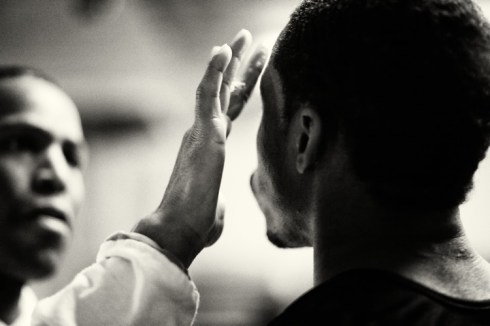
Another day, another Kickstarter incentive to peddle.
Frank McMains‘ B&W digital print on archival paper (8″x12″) is available at the $100 funding level. And I’ll throw in a postcard from the road and the PPOTR mixtape (CD). BUY NOW.
You can read more about Frank and the AABA in Exclusive: Photos of the Angola Amateur Boxing Association, Louisiana State Penitentiary, previously on Prison Photography.
Visit Frank’s website Lemons and Beans to read more about his time photographing the AABA.
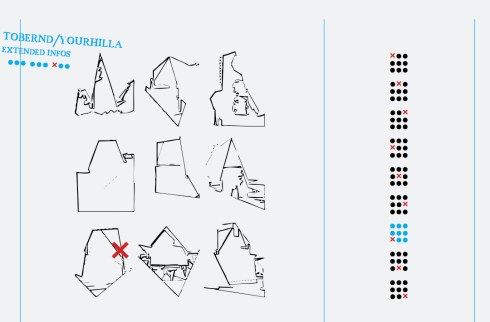
You might be asking what’s the funny doodle in the new banner?
I should precursor my answer with a history of pain as regards the banner image. Back in 2008, I used a detail of a crumbling wall – a poor metaphor of the hundreds of thousands of carceral sites if there ever was one. Soon after, I abandoned that for the commonly-used image of a line-up of book spines. But, still, the books were a mere representation of knowledge … and of whose knowledge, it wasn’t exactly clear.
So, when I learnt about the project TOBERND,YOURHILLA, with it’s distribution of etch-a-sketch-like graphics relating to the Becher’s oeuvre I was tempted. The tickling generosity of TOBERND,YOURHILLA toward the photoblog community is also a nice touch. I decided I was happy to give over the banner to some sort of distant artistic force.
Dider Falzone quotes the introduction to the 2008 exhibition “Bernd and Hilla Becher: Landscape/Typology” at The Edward Steichen Photography Galleries, to put TOBERND,YOURHILLA in context:
“The Bechers are best known for their “typologies”: grids of b/w photographs of variant examples of a single type of industrial structure. […] At each site the Bechers also created overall landscape views of the entire plant, which set the structures in their context and show how they relate to each other. The typologies emulate the clarity of an engineer’s drawing, while the landscapes evoke the experience of a particular place.”
Falzone draughted nine of these landscape plans (see above) with the intention that each would become a calling card on photography blogs. He adds, “each slot of the 3×3 logo grid evokes one of the storage silos arranged into grid for comparation of form and design. Once the nine logos are assigned, the digital manipulation will mirror itself in a systematic auto-generated community.”
That might be grand language for what I appreciate as a cheeky game and badge of membership to a club of like-minded, whimsical bloggers. I got to the party late, but was lucky enough to snag Slot ●●● ●●● ×●●. The only other remaining slot has since been claimed. As such, Prison Photography finds itself in good company; below are seven photoblogs also part of this doodle-based nonagon group.
Slot ●×● ●●● ●●●

Slot ●●× ●●● ●●●
Lenscratch

Slot ●●● ×●● ●●●
Sister I’m A

Slot ●●● ●×● ●●●
Melanie Photo Blog

Slot ●●● ●●× ●●●
Mrs. Deane

Slot ●●● ●●● ●×●
On Landscape

Slot ●●● ●●● ●●×
MOSSfull
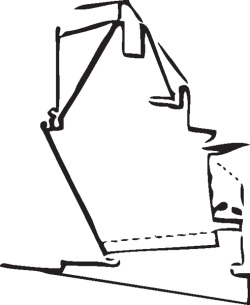
INTRODUCING THE NEW LOGO

The Prison Photography logo (above) is a pretty solid walled-in shape. It reminds me off some modern prison cells that have gone beyond the four-wall cuboid (below). I also like the fact it resembles an arrow pointing down to everything else that will pass through the pages of Prison Photography; whatever goes on between the lines and limits of this blog, you can always be reminded ‘You Are Here’.
Q. How long will the logo last?
A. As long as life continues without a better alternative and – given the fun and oblique references of the TOBERND,YOURHILLA project – I expect that to be quite some time.

© Steve Davis

Untitled #1, by Steve Davis. From his ‘Captured Youth’ series. 8×10 on a 10×12 heavyweight archival paper, for $300. Signed. Special Edition of 4.
Steve Davis is an old buddy. I shouldn’t have been surprised he quadrupled-down on the generosity. He’s kindly offered a selection of prints to sell in order to raise money for my Prison Photography on the Road Kickstarter project.
Our conversation went something like this:
Pete: I didn’t want to ask, because I don’t want to interview you. You’ve answered everything I can think to ask. I mean we could talk about photography non-stop, but about prisons … (tails off)
Steve: What do you need?
Pete: Well, ideally some mid-level incentives, something around $300.
Steve: No problem, I’ll find some images, probably a couple that have not been seen before. We’ll print them small in a special edition of four, four of each, that way you can offer “a choice of one from four”.
Pete: Thanks Steve.
Steve: No problem.
Pete: No, really, thanks Steve.
Steve: No, really, no problem Pete.
– – – – – – – – – – – – – –
A Steve Davis print PLUS a postcard, a mixtape and a self-published book – going for $300. BUY NOW.
– – – – – – – – – – – – – –
CLICK ON IMAGES FOR LARGER VIEW
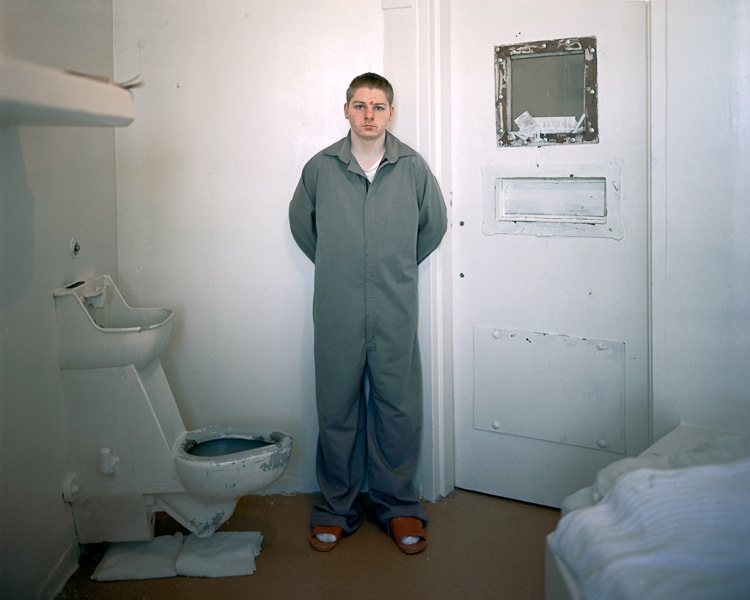
Untitled #2, by Steve Davis. From his ‘Captured Youth’ series. 8×10 on a 10×12 heavyweight archival paper. Signed. Special Edition of 4.

Untitled #3, by Steve Davis. From his ‘Captured Youth’ series. 8×10 on a 10×12 heavyweight archival paper. Signed. Special Edition of 4.
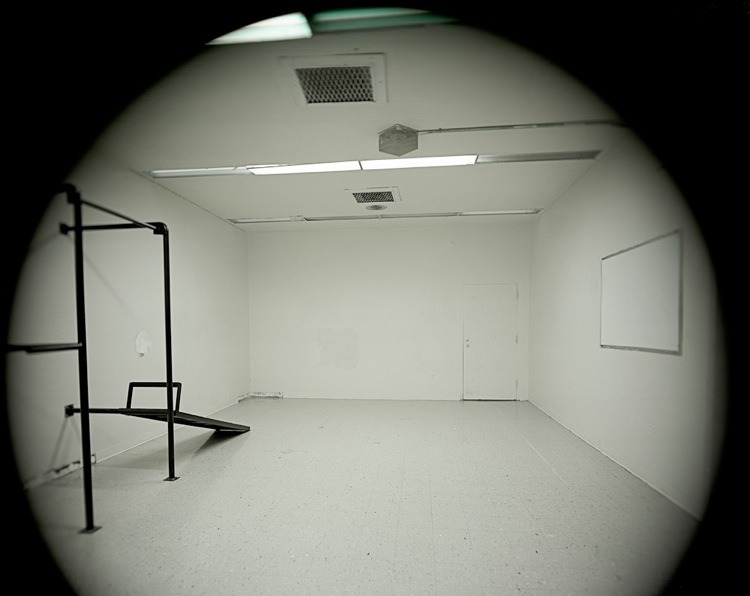
Untitled #4, by Steve Davis. From his ‘Captured Youth’ series. 8×10 on a 10×12 heavyweight archival paper. Signed. Special Edition of 4.
A Steve Davis print PLUS a postcard, a mixtape and a self-published book – going for $300. BUY NOW.
– – – – – – – – – – – –
See all available prints as part of my Kickstarter fundraising campaign.

IT has been going for 5 days now and I am floored to type (almost make real) the fact $2,000 has been pledged to my blogging-road-interview-trip-extravaganza.
Erica McDonald has inserted my talking head front, top and centre (at least for a few more days) of the rapidly growing DEVELOPphoto YouTube Channel.
Julie Grahame, a.k.a. aCurator says, “This is an important project that deserves your backing if you are in any way concerned about or interested in the business of incarceration in the United States.”
Meanwhile, with typical meandering, meaningful context, Hester Keijser over at Mrs. Deane ties my project, and all those like it, to the need to realign the priorities (and associated funding and opportunities available) in capitalist society, “Photographers or artists who refuse to side with who is on either side of whatever divide have a hard time finding private sponsors, precisely because there are very few individuals of wealth and power who are capable of the gusto needed for funding such undertakings, and who can afford to be disinterested. This might be one of the reasons why micro-funding models like the US-based Kickstarter are so important.”
It means so much to get support, words of encouragement and validation during this nerve racking five weeks of fundraising. If you want to get in on the public show of love, please visit the ‘Prison Photography’ on the Road: Stories Behind the Photos Kickstarter page.
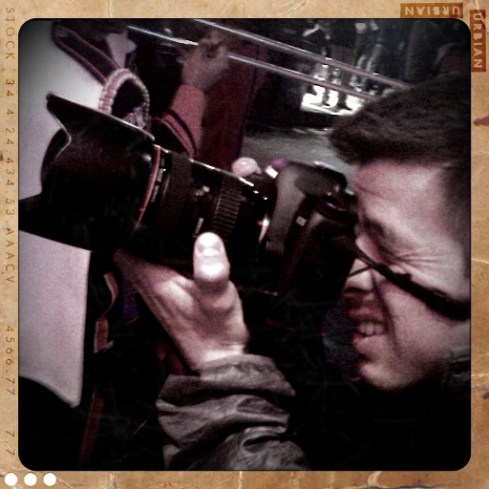
As many of you will know, I recently pitched Prison Photography on the Road on Kickstarter.
The video-pitch for any Kickstarter proposal is key, so I was very lucky to have Tim Matsui offer his time, advice and skills in multimedia for the filming of the video pitch. In offering his help, Tim became the first official supporter of the project so please allow me to say a few words about Mr. Matsui.
Tim was the very first photo-bloke I met when I arrived in Seattle three years ago. At that point, I already new of his committed and extended investigations into human trafficking.
By coincidence, an old university friend of mine worked at a Phnom Penh NGO that Tim had liaised with. As both Tim and I were in the same city, my friend urged us to connect.
Tim knew nothing of me.
Late in 2008, I had just launched Prison Photography and Tim, like many in those early days, was totally baffled about what it was. But he still agreed to meet for coffee. We spoke about Bergen-Belsen concentration camp, Tuol Sleng prison, Blue Earth Alliance, and the mores of the digital age. We didn’t see much of each other for well over a year, but we developed a mutual respect for each others work.
Last month, when I put out the call for help with filming (via the NW Photojournalism group) Tim didn’t hesitate. Two weeks later, he was over at my house with a two camera set up, separate audio track and a set of tricky questions.
Tim wears his heart on his sleeve. He works hard, and he’s also got a bunch of great ideas for his next story telling projects; the only thing holding him back is the hours in the day.
If you want to get to know Tim’s take on the world, photography and storytelling then his blog is a great place to begin. There you’ll find writing about his successes (his recently published Kivalina work, his Emmy nominated Mediastorm multimedia project for the Council for Foreign Relations); about breaking journalism relating to previous stories; about important pioneer projects in journalism such as BaseTrack; and about pressing global issues relating to our digital age, such as reports on conflict minerals in tech-manufacturing industry. You should also check out his very fun docu-short Sasquatch or Bust.
Tim, thanks for the integral help with Prison Photography on the Road. You are a gentleman.

The subjects of The Living Road, Noel Jabbour‘s portrait of prostitution on the Italian roadside, are not anonymous like those women in Mishka Henner, Paolo Patrizi and Txema Salvans‘ photography.
Other notable projects in Jabbour’s portfolio are Palestina, Palestinian Interiors and One Million $ Homes.
Thanks to Hester for the tip off.
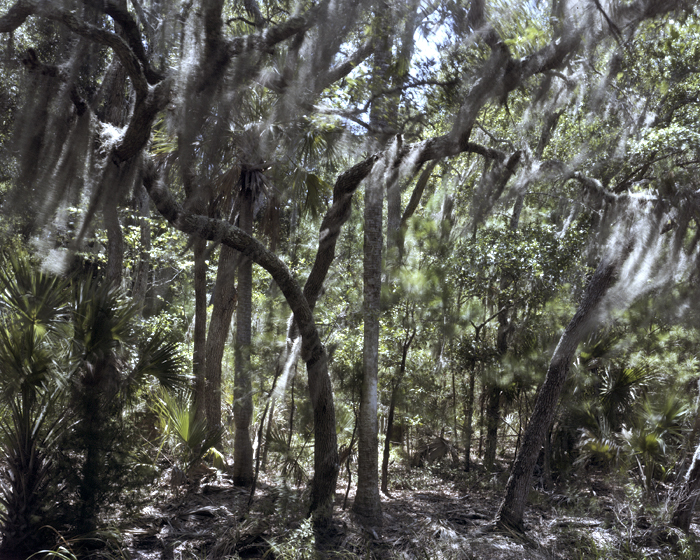
Forest, St. Helena Island, South Carolina, 2010
Dana Mueller ‘s series The Devil’s Den are studies of former prisoner-of-war camps in which German POWs were put to work by the US military. At the end of WWII, there were over 400,000 prisoners who worked on local farms and in small industries.
From Mueller’s project statement:
“There is an irony where these German soldiers, both high-ranking Nazi officers and foot soldiers, were tilling the fields, cutting the lumber, picking apples, taking care of the American soil. This caring, benign work with the land stands in complete contrast to the horrific actions by Nazis and German soldiers in Eastern Europe of that time, such as Hitler’s scorched earth policy. […] Romanticism has played a role in understanding the relationship of Germans to the landscape. In some photographs the land is overgrown appearing in a kind of primal state, suggesting the return to the original forest. It also suggests a Fascist aesthetic of purity promoted by pre-war German culture. Innocence and purity can be seen as a natural desire to regress after one has become corrupted.”
I was fascinated by this little known chapter of U.S. history. Dana answered a few of my questions.
How did you arrive at this subject?
History, politics, memory and our understanding of individual experiences verses collective memory of past events, especially war, always interested me. As East German, my ‘German’ identity was shaped by the two wars. I talked at length with Art Space Talk about my personal responses.
As much as this is a personal investigation I want there also, ideally, to be a collective engagement with places of our past. With passage of time comes nostalgia and romanticism, which is a very complex way of relating, looking at the past.
Jeff N. Wall – for Southern Photography – recently wrote about one photograph of mine; it was wonderful to know that someone would spend actual time discussing a photograph and as an American to relate it to his own American history.

Camp Edenton field, Northeastern Regional Airport, Edenton, North Carolina, 2009, Photograph by Dana Mueller and Bonnell Robinson.

Near Camp Camden, Kershaw County, South Carolina (branch camp under Fort Jackson, SC) 2010.
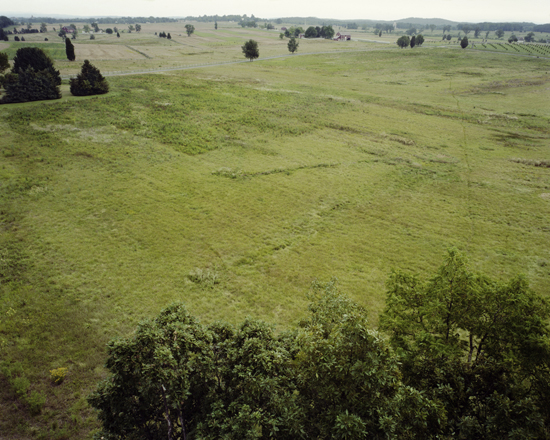
Site of Pickett’s Charge, Gettysburg, Adams County, Pennsylvania, 2009. In 1944 tents for a German prisoner-of-war camp were erected on the field of Pickett’s Charge.
How do you think of landscape?
There is power at just looking at a landscape knowing that an event took place at one time, it is not what we see that sparks our fascination with the past, it is what remains invisible.
Photography is often about witnessing and revealing, but not here. In The Devil’s Den I suggest and contemplate; in relation to the experiences the soldiers had, the American guards had and the civil population who had them work on their farms, married their girls, etc.; in relation to the landscape and German identity – both the mythical and very real ties to the land, the homeland which define one’s nationality, and the irony that German soldiers found themselves here.
I am interested in crossing historical planes, i.e. the site of Pickett’s Charge is not only relevant to my ideas but also to American [Civil War] history, and those two come together; both relate to war, participation, consequences and follies.
What are your influences?
Romanticism in literature: all W.G Sebald’s works, especially Rings of Saturn, Emigrants and On the Natural History of Destruction, Simon Schama’s Landscape and Memory, and many others that not necessarily discuss memory and landscape but have Eastern European backgrounds, i.e. Brodsky, Eva Hoffman, Milan Kundera, Czeslav Milosz. Also, the visual works of Anselm Kiefer and Casper David Friedrich.
How were the prisoners originally captured?
The North African Campaign by the allies began in 1940, between the Brits and the Italians. The Germans moved in in 1941. The U.S. got involved in late 1941 and militarily in 1942. Shortly after, the US Army created a prisoner-of-war camps all over the U.S. for captured German soldiers, many of whom were from Rommel’s African Tank Corps.
Others were captured at sea as German U-Boats neared the east coast, but there were not that many, and it happened sporadically. Many Germans were shipped from interim camps for German POWs in Normandy, France.
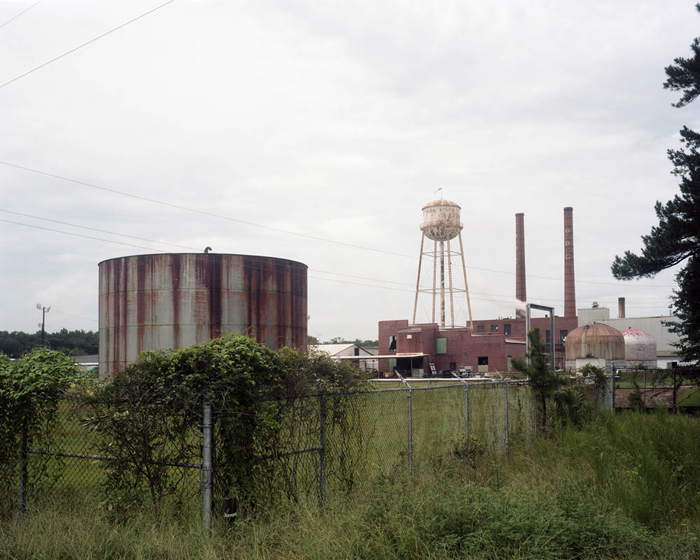
PPC factory near Camp Camden, Kershaw County, South Carolina, 2010. German prisoners-of-war worked at PPC factory between 1942 and 1946.
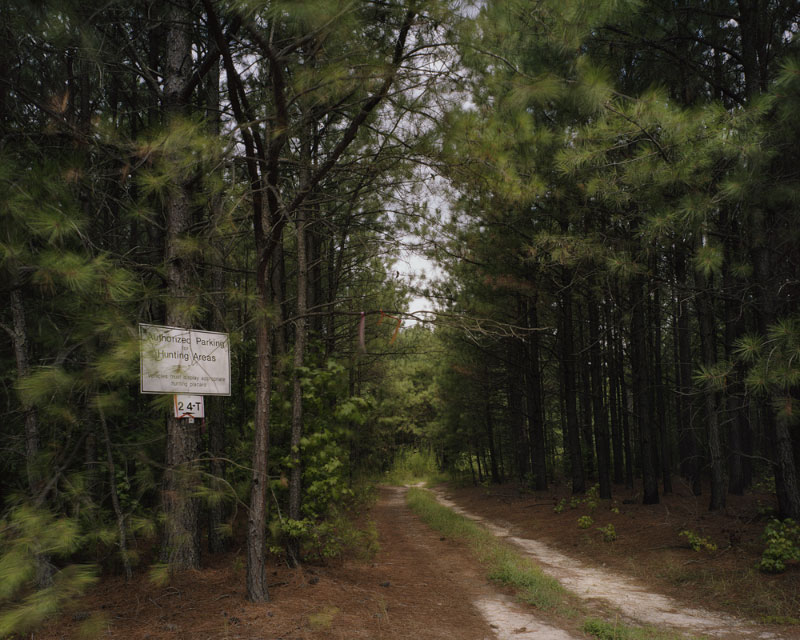
Camp Lee at Fort Lee Military Base near Petersburg, Virginia, 2009.

Camp Edenton, Northeastern Regional Airport, Edenton, North Carolina, 2009. North Carolina received its first group of POWs when German sailors were rescued from U-boat 352 that sank off the coast on May 9, 1942. The War Department eventually set up seventeen base and branch camps of Fort Bragg including Camp Edenton.
What happened to the prisoners?
Most prisoners were sent back to Germany after the war ended or a year later. The camps were in general also seen as rehabilitation facilities, where the American government wanted to re-educate the Germans in terms of democratic societies. As I talked to some historians, they mentioned that the foot soldiers and those less tied to Hitler’s ideology were stationed in camps on the east coast, higher ranking Nazi officers were send down south or west (Texas for instance).
Within a camp if there were a mix of soldiers, those who had allegiance to Hitler and never wavered and those who were happy to get out of the war, tensions existed and fights broke out. Therefore, they separated them depending on how ‘re-habitable’ they were. Nazis would rally at times in the camps but it never got out of hand as guards prevented revolts.
Most prisoners made friends with the Americans, they had their own newsletters, celebrated their holidays and some married American women. There were isolated escapes, most were caught soon after they fled. Most escapes were a result of the soldiers not wanting to return to Germany because Germany was completely devastated and life was better here, or Nazis knew they were not welcomed at home. Most prisoners had to return home unless, as I said, they married but those were very isolated instances.
Camps maintained strict guidelines and soldiers were treated well – times have changed when we look at Guantanamo Bay today.
Prisoners were used for labor, and some made even a little money so they could buy cigarettes and such. Off-and-on, some former German POWs come back to visit the camps and celebrate anniversaries even today. It’s strange to imagine that anyone would want to come back to where they were imprisoned. Not all was rosy – there were tensions between American guards and the prisoners, but overall the soldiers contributed to lumbering, harvesting, laboring in factories, etc and were tolerated by most of the American public. Of course, there were many Americans who thought ‘Why spend money to keep these people here?’ but as long as the prisoners contributed in terms of labor the practice became more accepted.
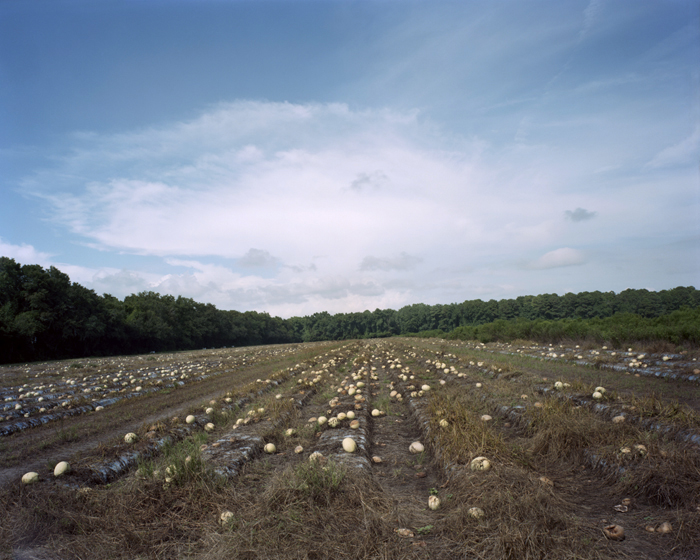
Melon field, St. Helena Island, South Carolina, 2010

Tomato field, St. Helena Island, South Carolina 2010. German prisoners-of-war stationed in Beaufort, SC, lumbered forests, worked in the fields and on farms at St. Helena Island.
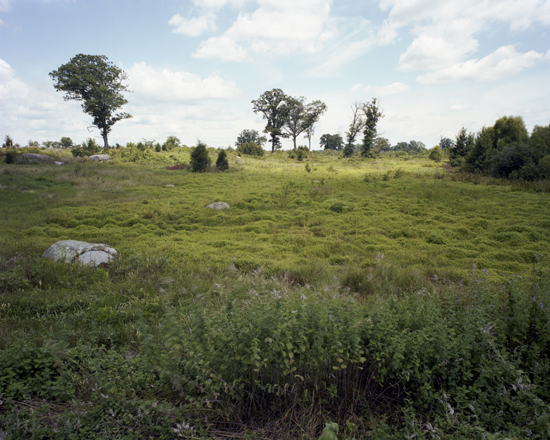
Gettysburg, Adams County, Pennsylvania, 2009.
Are these sites marked?
Not all of them are forgotten. Only some are marked and some are just known to be sites by locals or at the Historical Societies in towns. For example, the site of Pickett’s Charge which is imbued with American Civil War history was also, amazingly, the field where they decided to put up a German POW camp. I found a sketch of the camp in Gettysburg. In 1944, it was mostly just tents. Once winter arrived, they moved POWs to more solid structures, some existed on military bases already and others were built for them, such as Camp Pine Grove, Cumberland County, Pennsylvania. The foundations of the camp’s facilities are still visible underneath the overgrowth.
Other areas where prisoners actually worked I found through coincidence as I traveled along and inquired, for instance Sheldon’s farm and cotton field was owned by an American family whose son I met by chance near Elizabeth City, NC and who told me that he remembered the prisoners working in the field. His parents treated them well and the soldiers seemed content.
Camp West Ashley (below) is only place I photographed that had a marker. The ruin, which consists of a chimney, was saved by the residential neighbors who petitioned to save the historical spot instead of having it torn down, moved and the small piece of land used for development.
Other places are still working military bases, such as Camp Peary in Virginia (below) which I had no access to because today it’s the location of a covert CIA training facility known as “The Farm.” and I needed to improvise and find other ways of photographing it.
The camp at Beaufort, SC (below) was very interesting as the camp was located where is now a recreational park and structures of the building were only recently demolished, which made local news. So in terms of finding things, I base my direction of where I go on facts from literature, see below, or I just go to areas that are known to have had prisoners and I talk to people who might know the local history and then they tell me stories, or I find references at the local library or Historical Society.
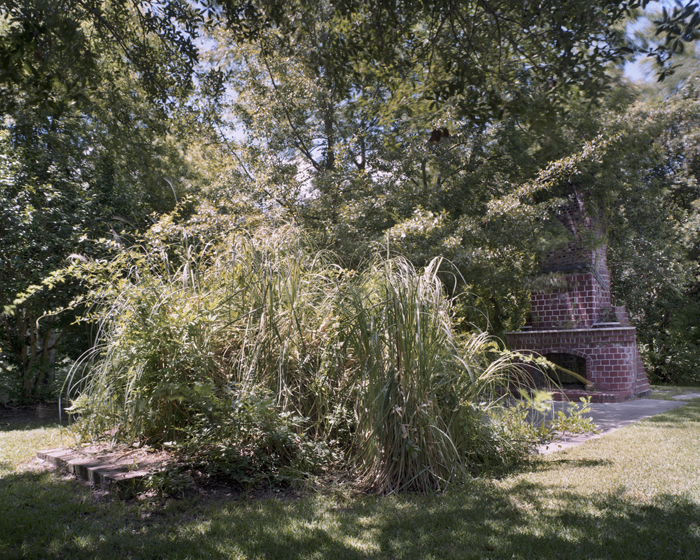
Camp West Ashley, Charleston County, South Carolina 2010. The remaining chimney marks one of five prisoner of war camps established in the Charleston area toward the end of World War II. The West Ashley camp existed for only two years and consisted mostly of tents.
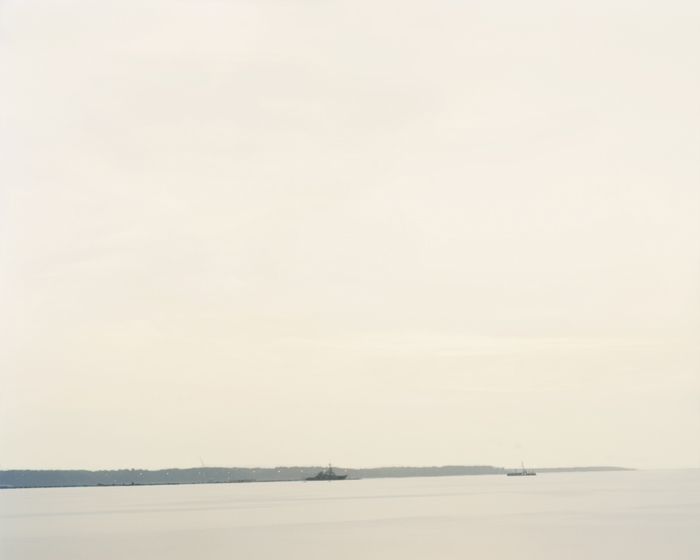
Camp Peary across the York River, York County, Virginia, 2009.

Site of former German prisoner-of-war camp, Beaufort, South Carolina 2010. The camp was located at Pigeon Point Park where barracks of the camp were recently demolished.
And finally, what resources exist for readers who want to know more about his shrouded episode of American history?
In regards to contemporary American politics, Hendrik Hertzberg at the New Yorker wrote Prisoners, a very interesting article some months ago. As for books, I recommend:
Stark Decency: German Prisoners of War in a New England Village, Allen Koop
Nazi Prisoners of War in America, Arnold Krammer
Hitler’s Soldiers in the Sunshine State: German POWs in Florida (Florida History and Culture), Robert D. Billinger Jr.
Stalag Wisconsin: Inside WWII Prisoner of War Camps, Betty Cowley
We Were Each Other’s Prisoners: An Oral History Of World War II American And German Prisoners Of War, Lewis H. Carlson
Behind Barbed Wire: German Prisoner of War Camps in Minnesota, Anita Buck
Guests Behind the Barbed Wire, Ruth Beaumont Cook
The Barbed-Wire College, Ron Theodore Robin
Nazi POWs in the Tar Heel State, Robert D. Billinger Jr.
Local libraries and Historical Societies have references to communities that housed German POWs. Both will have actual news materials and old photographs available. I found these original photographs of German POWs and campsites in Pennsylvania, at the Adams County Historical Society, PA.
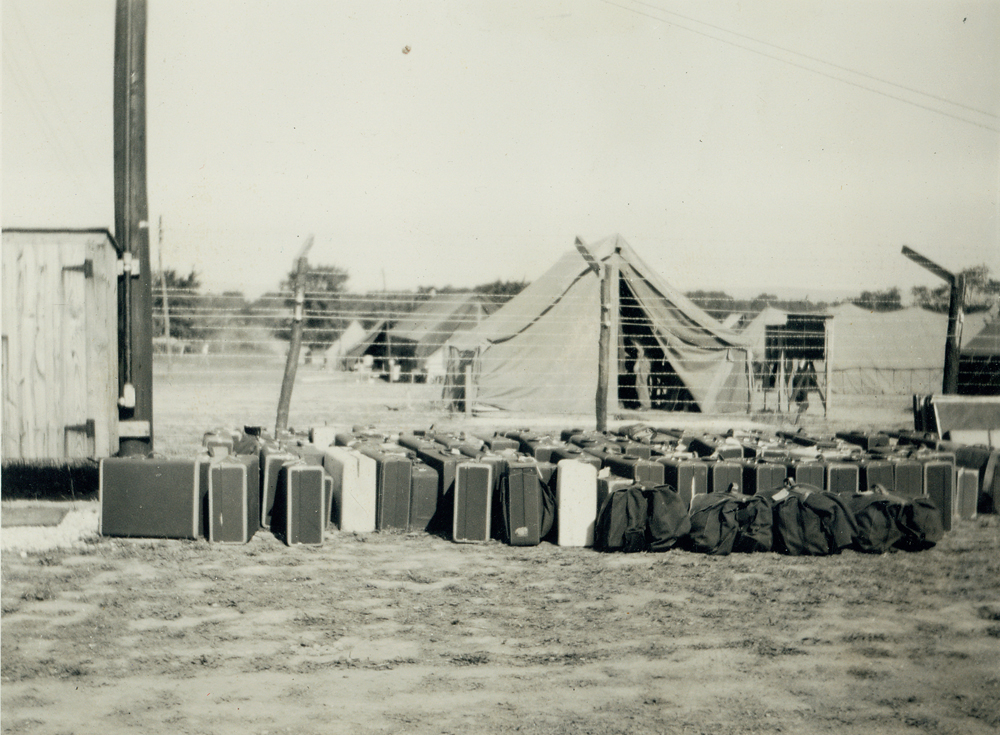
Copyright: Adams County Historical Society, Gettysburg, PA.

Copyright: Adams County Historical Society, Gettysburg, PA.

The Great Dismal Swamp, Virginia/ North Carolina border, 2009. © Dana Mueller
___________________________________________________________
*There’s some irony in the fact that one of the U.S. camps Mueller photographs is called Edenton. Eden? Paradise it was not. Likewise, in the UK, the most famous former POW camp is Eden Camp in Yorkshire, which is now a heritage museum.
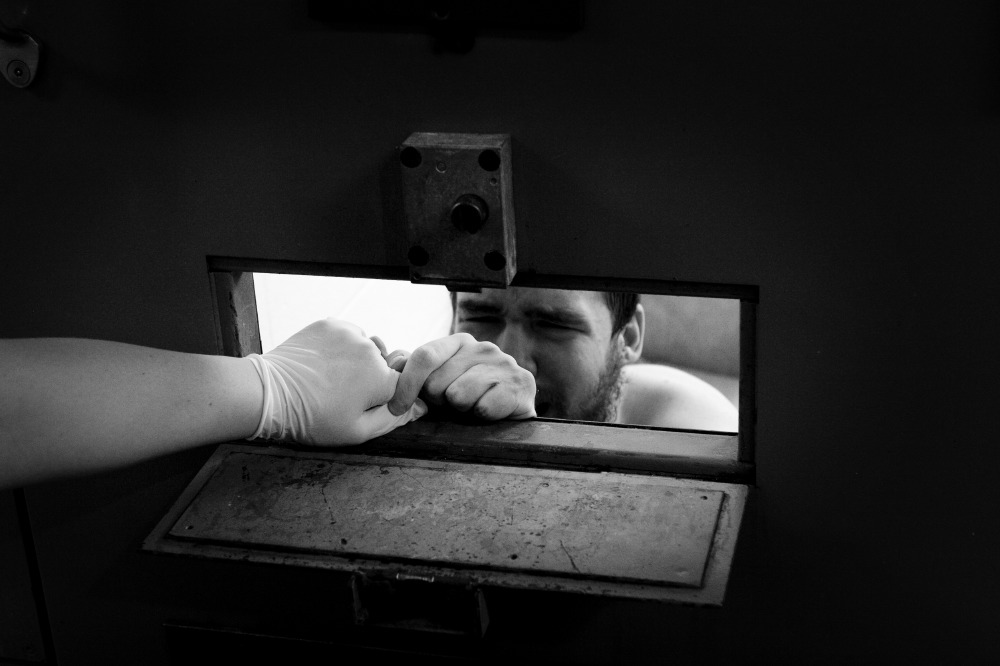
Julia Lish, a correctional officer, comforts an inmate during one his psychotic episodes. “Its going to be OK,” she repeats as he cries and yells to the voices in his head. © Jenn Ackermann
Jenn Ackerman: ‘A Hand to Hold’ (2008) from the series, Trapped.
11×14. B&W, archival matte.
Edition #2 of an edition of 25.
Signed.
Print PLUS, self-published book, postcard and mixtape = $600.
– – – – – – – – – – – – –
It’s still the very early stages of Prison Photography on the Road, my Kickstarter project, and I’m super pleased and humbled by the generosity of folks.
I won’t lie, it’s been a lot of work to co-ordinate all the information among potential interviewees, and the photographers who’ve donated prints, and those practitioners whose will be included in the self published book.
Info on half a dozen prints (available to funders of the project) is still outstanding. No fear, I’ll turn a negative to a positive and feature the photographs and the print info here on the blog as and when it arrives. At the same time, I can make repeated calls for support.
The Minneapolis based wunder-couple Jenn and Tim – a.k.a. Ackerman Gruber Images – were the first photographers to respond to my early inquiries about collaboration. Then there was silence. They’re a little late to the party because they’re down in Brazil on assignment. No worries guys.
I’ve written about Jenn’s series Trapped here on Prison Photography before. Tim and I have played email tag for two years trying to conjure a nice format to discuss his series Served Out.
Below are the prints Jenn and Tim kindly donated. Available on my Kickstarter page.
– – – – – – – – – – – – –
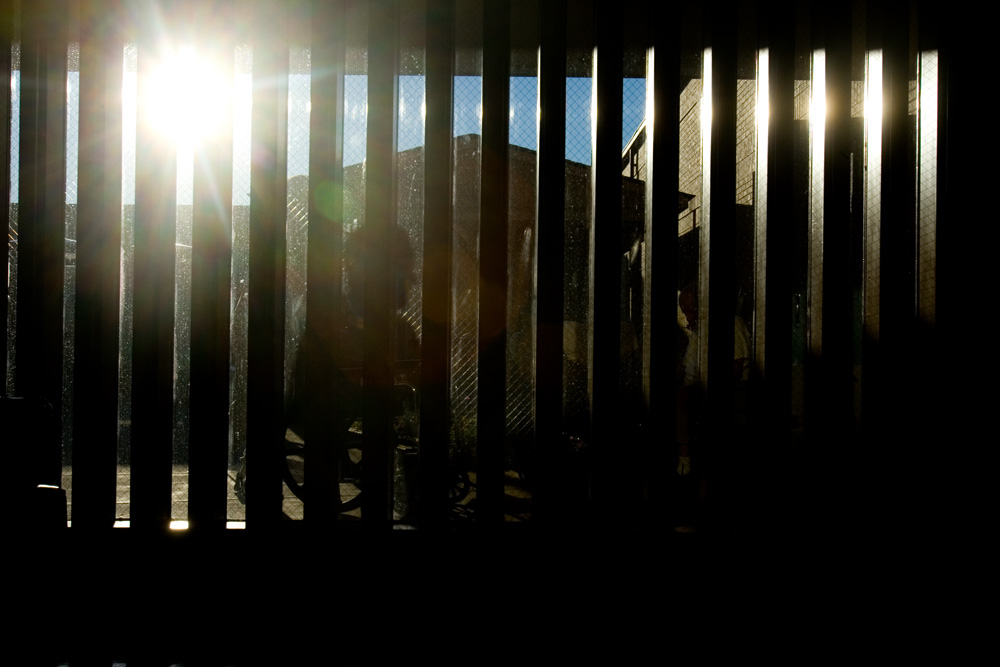
The sun breaks through the bars of the Nursing and Hospice Care Unit at the Kentucky State Reformatory, as part of the series ‘Served Out.’ © Tim Gruber
Tim Gruber: ‘Sunset Behind Bars’ (2008).
14×11″ B&W, archival pigment print on matte paper.
Edition #1 of an edition of 25.
Signed.
Print PLUS, self-published book, postcard and mixtape = $500.

 Prison Photography