
You are currently browsing the category archive for the ‘Activist Art’ category.

I particularly liked this newsletter by Roger White, Campaign Director, of activist group Critical Resistance. I’ve reproduced parts below.
I especially appreciate White’s reinsertion of slave’s acts of resistance into the historical narrative.
Two and a half years after the Emancipation Proclamation was issued ordering states in the confederacy to release their slaves, Black people in Texas achieved their liberation from chattel bondage. On June 19,1865, General Order Number 3 was read from the Ashton Villa balcony in Galveston, Texas, that demanded that slaveholders free their slaves. That day has become an annual occasion for celebration, reflection, and education about the meaning of freedom and the on-going, universal struggle for liberation from domination.
These questions about the real meaning of freedom are more relevant to the work of abolitionists and those working against the prison industrial complex (PIC) than ever.
Today we struggle with how to stem and reverse the growth of imprisonment, surveillance, and policing. […] In our current work fighting against the construction and expansion of jails and prisons in California and New Orleans, we consistently find that the most durable victories against the PIC take place when the people are active participants in their own liberation. The same resolve that fueled the abolitionists in the state 150 years ago still lives today.
While the history of slave revolt in Texas is less well known, it is why we celebrate Juneteenth today. According to historian James M. Smallwood, “gangs of runaway slaves participated with Indians and Mexicans in a guerrilla-like warfare” against the planter class throughout the 1830’s. Resistance to slavery in Texas included everything from thousands of slave escapees fleeing into Mexico to freedom, to work slowdowns and refusals to submit to the enslavers. This record of resistance counters the popular narrative of a passive Black slave population in Texas that was freed by 2,000 heroic and benevolent Union soldiers on June 19, 1865.
To invoke the language of slavery abolition in calls to end the prison industrial complex may be confusing to some, even perverse to others. ‘What has the struggle to end slavery got to do with 21st century criminals?’ some may ask. For Critical Resistance, however, the inequality between the powerful and the powerless, between the wealthy and the poor are as marked now as ever. Racial bias is in sentencing, in the death penalty, in the drug war; it permeates our criminal justice system.
Critical Resistance is a member-led and member-run grassroots movement to end the Prison Industrial Complex (PIC) by challenging the belief that caging and controlling people makes us safe. Critical Resistance refers to their form of activism as abolitionism very deliberately:
“We call our vision abolition, drawing, in part from the legacy of the abolition of slavery in the 1800′s. As PIC abolitionists we understand that the prison industrial complex is not a broken system to be fixed. The system, rather, works precisely as it is designed to — to contain, control, and kill those people representing the greatest threats to state power.”
Read more on the logic behind CR’s language here. This brief history of CR’s trajectory will also help in positioning them on the political spectrum, which, is to say the far left.
I’ve been thinking about the absolute necessity of peoples’ power recently — about how it emerged briefly during Occupy and wondering where and how it bubbles since. I’m inspired by protests outside of prisons in solidarity with prisoners and when I hear about groups such as DecarceratePA marching from Philadelphia to the capitol in Harrisburg, I’m inspired and wish I could be with them. Walking (or standing) are distinctly undervalued forms of civil disobedience.
Measuring the successes of Occupy is a tricky proposition. Most people will admit that it shifted the politics of a national debate on economic justice back toward the centre, toward the interests of everyday people. Grassroots activism is achieving that constantly at a local level. I just wanted to celebrate that on this, the anniversary of one of the more progressive steps toward equity in American history. Love our neighbours and fight for them.

If you’re strolling around the centre of Charlottesville these next few days and peep a red newspaper box, reach inside and grab yourself a copy of the free paper within.
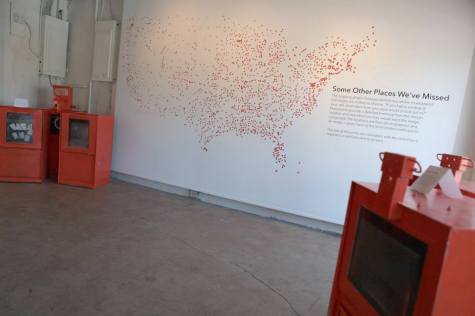
Accompanying his exhibition of Some Other Places We’ve Missed at The Bridge: Progressive Arts Initiative in Charlottesville, artist Mark Strandquist has created eight pages of photos, activist resources and a call to engage.
I have a vested interest in promoting this newspaper. For it, I wrote an editorial about the history of — and imperative of — photographers and artists working in American prisons. It is reproduced in full below.
Even if I wasn’t personally involved, I’d still be singing the praises of Mark’s work – I’ve posted about Some Other Places We’ve Missed before and I am including the work in a prison photography show next year. When Mark and I chatted about the exhibition of Some Other Places We’ve Missed, we got all giddy about the fact that his show is outside of the official LOOK3 program, and yet he is able to grab some mindshare among the throng of photobodies in Charlottesville this week.

© Mark Strandquist. A photograph made of a scene described by an incarcerated male.
ART AND SOCIAL ENGAGEMENT
For the longest time, photojournalism and documentary work has pursued common good, reliable information, hidden stories and social change. At least, that’s the ideal. With guests such as Susan Meiselas and Martha Rosler, and with Koudelka’s exhibit, the LOOK3 schedule looks serious and seriously good.
Mark and I are huge fans of this year’s LOOK3 line up, but LOOK3 remains a big festival where the cucumber martinis flow like wine and big name photographers will hold court in Charlottesville town center. Festivals are about learning, meeting and sometimes brown-nosing … and, for that, we love them. Everyone leaves photography festivals feeling connected and re-energised and that’s how it should be. But, there’s more.
Some Other Places We’ve Missed asks us to think about image-making in slightly different ways. Not everyone can produce a 20 foot tall Nat Geo vinyl banner, but everyone can have the type of intimate conversations on which Some Other Places We’ve Missed is based. Of course, I am biased because Mark is having conversations with American prisoners and I think there’s rehabilitative value in that.
I’ll stop prattling on now and just say if your interest is piqued then you should attend the panel talk More than A Witness – Photography as Social Engagement on June 15, 2pm – 3:30pm. Speakers are David Levi Strauss, Chair of Critical Studies at the School of Visual Arts, Edgar Endress of Floating Lab Collective, Yukiko Yamagata of the Open Society Foundation, and Matthew Slaats, Executive Director of the Bridge. They’ll discuss how art facilitates dialogue and can be used to reach out to new subjects and engage broader audiences. Find out more on Facebook here.
Mark has programmed a busy schedule of events at The Bridge including a poetry reading and discussion between gallery-goers and prisoners via a direct feed from a local jail. Full details on The Bridge website.
[Scroll down for my newspaper editorial.]

Installation shot of Some Other Places We’ve Missed, opening night at The Bridge, Charlottesville, VA.
EDITORIAL: DRAWING ON MEMORY, WORKSHOP GETS PRISONERS AND PUBLICS THINKING ABOUT PHOTOGRAPHY, STORY AND HIDDEN SPACE
In the 1970s, a purple barge floated up and down the Hudson River in New York state. Once moored, photographers emerged to teach workshops to communities traditionally outside of art circles; hospital patients, rural high-schoolers and — perhaps most remarkably — prisoners. The buoyant vessel with living and gallery spaces was operated by the Floating Foundation of Photography (FFP).
Not all New York State prisons are on the Hudson and so after initial offerings at Sing Sing, FFP ventured inland, eventually delivering photographic arts education in eight prisons. The majority of workshops were facilitated by founder Maggie Sherwood, her son Steve Schoen and a handful of close associates. But, the FFP enjoyed close ties with the New York arts scene and as such invited leading photographers in recent memory to deliver day-long workshops in the prisons – W. Eugene Smith, Arthur Tress, Mary Ellen Mark, Les Krims, Judy Dater, Lisette Model and Lee Witkin to name a few. The FFP mounted exhibitions of “outsider photography” on the anchored barge in Manhattan and in Central Park.
As one browses the images and stories within Some Other Places We’ve Missed, perhaps it is worth bearing in mind the history of arts education — and specifically the role of photography — in the rehabilitation of those locked up within our prisons and jails. The Floating Foundation represents a particular high point in this history; the access into prisons that it negotiated, the pedagogy it employed, and the optimism it eschewed stand out as extraordinary. These days, opportunities for arts education (with strong photographic components) in the prison industrial complex are rare. As such, projects such as Mark Strandquist’s deserve attention.
In the 1980s, mass incarceration began. In the past 35 years, the number of Americans locked up has more than quadrupled. The war on drugs, indeterminate and longer sentencing, broader definitions of criminal behaviour, the decimation of many safety-nets for society’s most vulnerable, and the politics of rhetoric and fear all contributed to the tumorous growth of America’s prisons. Even in states that entered a prison building boom, facilities were soon overcrowded. As costs soared, pressures mounted and efficiencies took priority, both the ability to provide — and belief in — the efficacy of education and arts to help in the rehabilitation of prisoners waned.
States previously provided high school and college education to prisoners as item lines on their budgets. These were scratched from budgets early, and when the Clinton administration revoked prisoners’ right to federally funded Pell Grants in 1994, the message was clear: prisons exist to incapacitate, not to rehabilitate. The majority of college level education provided in state prisons these days is administered by either earnest non-profits, University departments with social justice mandates, and sometimes the two in partnership. Prisons remain legally obliged to enroll prisoners without high-school diplomas into GED programs, but the success of students already alienated by public schooling often hampers success. To speak generally, it is the limited scope of — and limited opportunities for — education in prison that scupper advancement. To wright this ship, a huge shift in political will, informational (media) exchange and tax-payer attitude is required.
Prisoners are lining up to be part of this collective shift of consciousness. “Lucky” prisoners may live in state facilities close to a big city which can draw on volunteers to run programs previously provided by the state. Others find opportunities designed for successful reentry toward the end of their terms. But still, the majority of American prisoners have little to no voice and are for all intents and purposes invisible. Existing creative outlets include law libraries (although not in private prisons), pen-pal programs, and vocational work (prison factories remain because of the immediate profits they create), but these are programs that should exist for all and form merely first rung of the ladders to self-improvement and broadening of the mind.
Some Other Places We’ve Missed brings to us the voices, regrets, dreams and imagination of just a small number of men incarcerated in Richmond County Jail. Mark Strandquist provides us a bridge into their worlds. One needn’t share the political position of an artist to recognize the imperatives of a work or an action; intellectual curiosity and community engagement can saturate the entire political spectrum. Strandquist’s work is sadly exceptional, but it needn’t be. Perhaps, his tenacity is exceptional, but I believe it is within reach of us all. Whenever possible we should be thinking of ways that we can engage with our nation’s prison population. It is a population that has been strategically manipulated to the point of invisibility.
Cameras are a security tool for prison administrations, but in the hands of others are a security hazard. The ability to see, frame and witness life behind bars inherently involves power. In mugshots, in surveillance and in tightly-controlled visiting room digital portraits, prison authorities have a near monopoly on such power. Only rare and serendipitous moments (usually a sympathetic superintendent) give rise to an artist being permitted to use a camera in prison space — Robert Gumpert, Kristen Wilkins, Jenn Ackerman and Jeff Barnet-Winsby are a few examples.
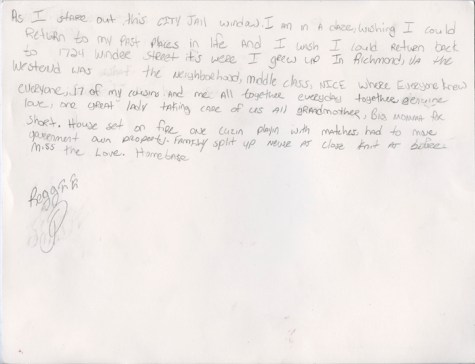
Strandquist navigated this potential barrier by conducting a photography workshop without any introduction of cameras into the classroom. His simple question, “If you had a window in your cell, what place from your past would it look out to?” acted as proxy to any release of the shutter. He asked students to think photographically. While the images are made by Strandquist beyond the prison walls, the essential discussions about memory, self-reflection, the power of photography and the comfort of the image all inform the project.
Through Strandquist’s photographs, we the public, are given an opportunity to connect with the incarcerated; their imagined windows become, momentarily, our window into their lives. But the 1/125th of a second needed to make a photograph is a perverse fraction of the months and years many spend imprisoned. Are the photographs enough? On their own, probably not. But the collaborative and educational core to the project is considerable. As audience, we should employ the same amount of imagination as Strandquist’s students and consider similar ways we can engage with incarcerated persons. There is every reason to think Strandquist’s methodology can be replicated in prisons and jails across the nation. With 2.3 million men, women and children behind bars Some Other Places We’ve Missed should also be a prompt for us to meditate on the millions of sights and experiences in American prisons that we never witness.

“The neighborhood was middle class, nice, where everyone knew everyone. One great lady taking care of us all – grandmother; Big Momma for short. The house set on fire when one cousin playing with matches. Had to move into government owned property. Family split up. Never as close as before. Miss the love. Home base.”
BIOGRAPHY
Mark Strandquist is a multi-media artist and curator based in Richmond, VA, who creates work that incorporates viewers as direct participants, features histories that are typically distorted or ignored, and blurs the boundary between artistic practice and social engagement. His work has been featured in various film festivals and independent galleries as well as a current exhibit at the Art Museum of Americas in Washington, DC. He is currently working on a BFA at Virginia Commonwealth University. He has a Tumblr.

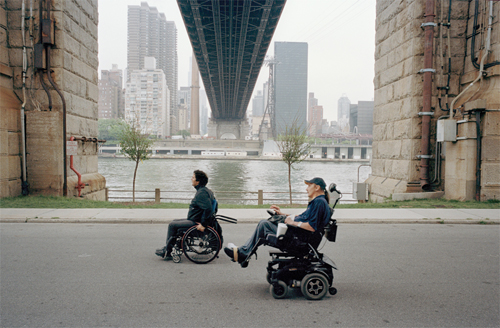
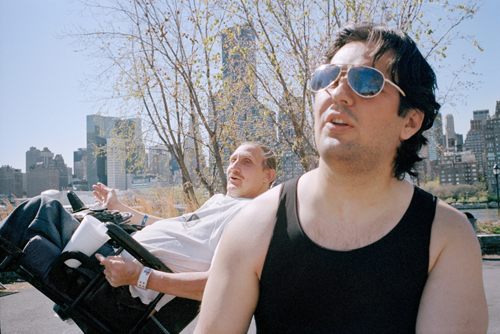
Armand Xama, 31, and Bryan Duggan, 51, are best friends. They both suffered broken necks in diving accidents. Xama and Duggan are just two of 800 patients at Goldwater Hospital, on New York’s Roosevelt Island. Almost every patient at the state-run facility is on Medicaid.
Throughout 2012, photojournalist Daniel Tepper followed Xama and Duggan through their days on and off Roosevelt Island.
In the summer of 2013, Goldwater will be closed and demolished to make way for Cornell University’s new science center. Patients have not yet been to told to where they will be relocated.
“This is a developing and underreported issue,” says Tepper. “The people who call it their home have no way to advocate for themselves and let others know what is happening to them. They are at the mercy of the city’s Health and Hospital Corporation that isn’t doing a great job in handling the closing and relocation.”
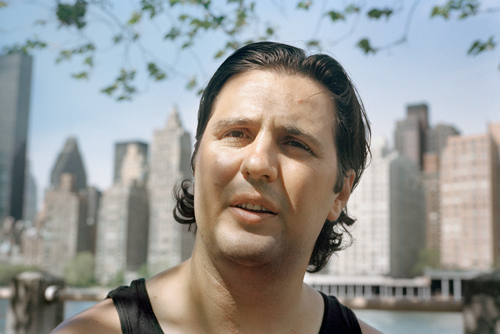
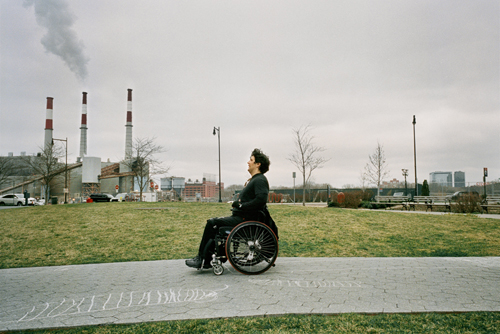
With over 400 individuals who have neck and spinal injuries, Goldwater is home to the largest community of such persons in the New York hospital system.
“The closing of Goldwater is just the tip of the iceberg,” explains Tepper. “Opponents to the science center are alarmed that the development is projected to cost $2 billion dollars and take decades to complete, especially at the time when many city workers don’t have contracts and the schools and hospitals are badly in need of funding. This is a big issue that will change everyone who lives on Roosevelt Island but the first people to feel the effects will be the patients at Goldwater.”
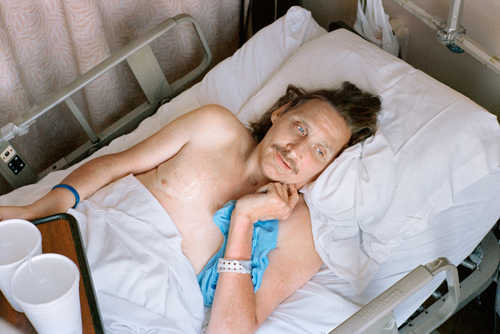
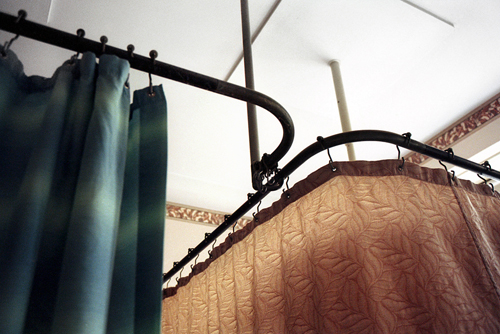

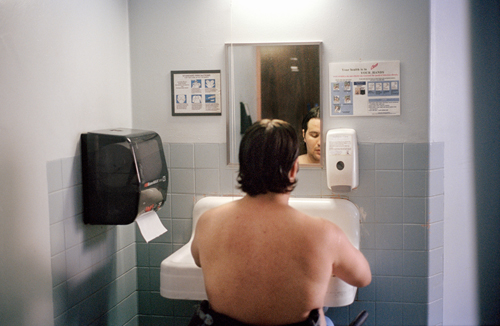
Tepper wrote for the Gothamist about the background to the Cornell science center planning.
In July 2010, the city stated that it was planning to relocate some of Goldwater’s patients and staff to a facility in Harlem.
Five months later, Mayor Bloomberg announced Goldwater’s location as a possible site in a tech campus competition. In December 2011, the mayor named Cornell and Technion universities the winners of a bid to construct a sprawling science and engineering campus where the hospital now stands. This massive, two billion dollar project will take decades to complete and cover nearly one-third of the island. It will radically transform Roosevelt Island and affect all 12,000 of its residents, but the first ones to feel the impact will be the residents of Goldwater. Cornell has said they plan on using some of the rubble from Goldwater’s demolished edifice to raise the level of their campus site out of the floodplain.
The closure of Goldwater Hospital and the imminent relocation have received little media coverage. “This is a really old story and it’s done before,” Evelyn Hernández, the director media relations for the city’s Health and Hospitals Corporation told us over the phone. “I wanted to make sure you know that the story’s been done before, a long time ago. We’ve announced it in press releases.”


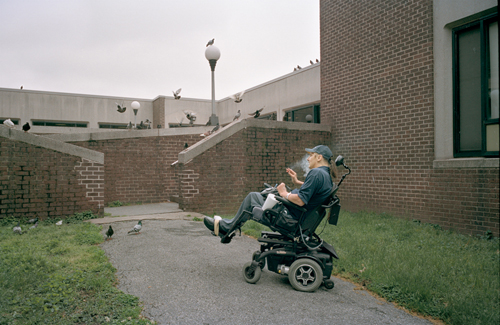

In April, 2013, Tepper returned to Goldwater to catch up with Xama and Duggan – men he now considers his ‘buddies.’
“I was struck by how little their lives have changed since I began this project last year,” reports Tepper. “The daily lives of both men has fallen into a strict routine that I think happens to most people living in a state-run facility, whether it’s a prison or hospital. A times I found myself feeling photographic deja-vu, as a scene I have already captured repeated itself in front of my camera. Both guys are still in the dark about where they will end up and when they will be moved.”
“But they are both as optimistic and good-humored as always.”


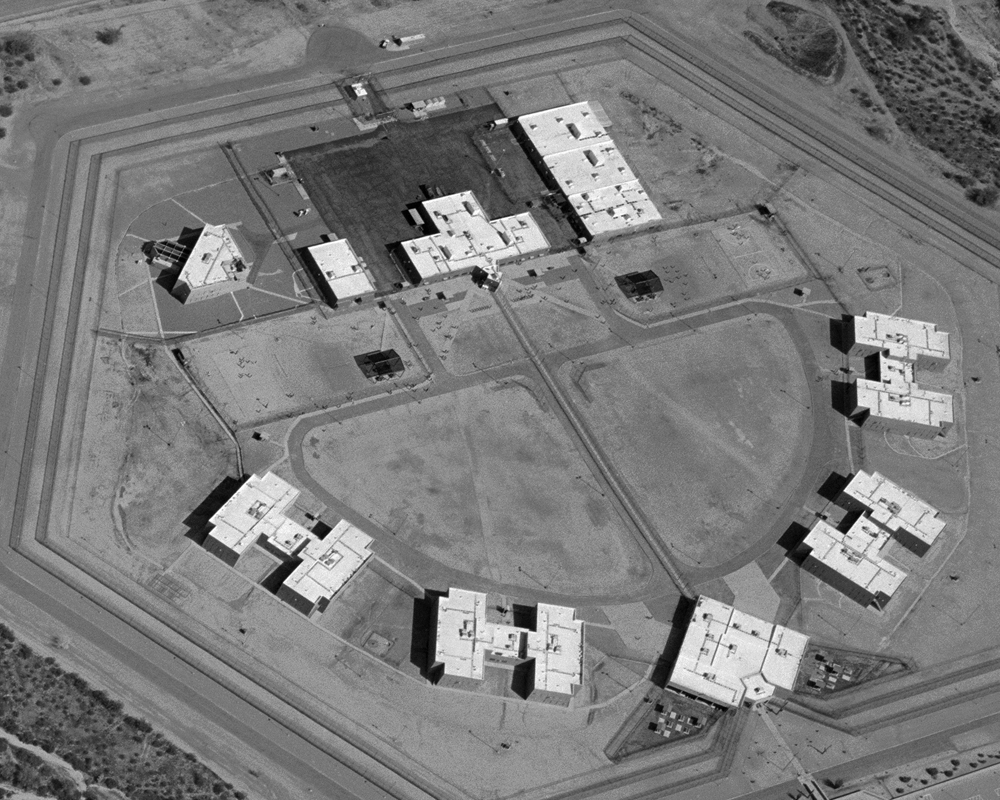
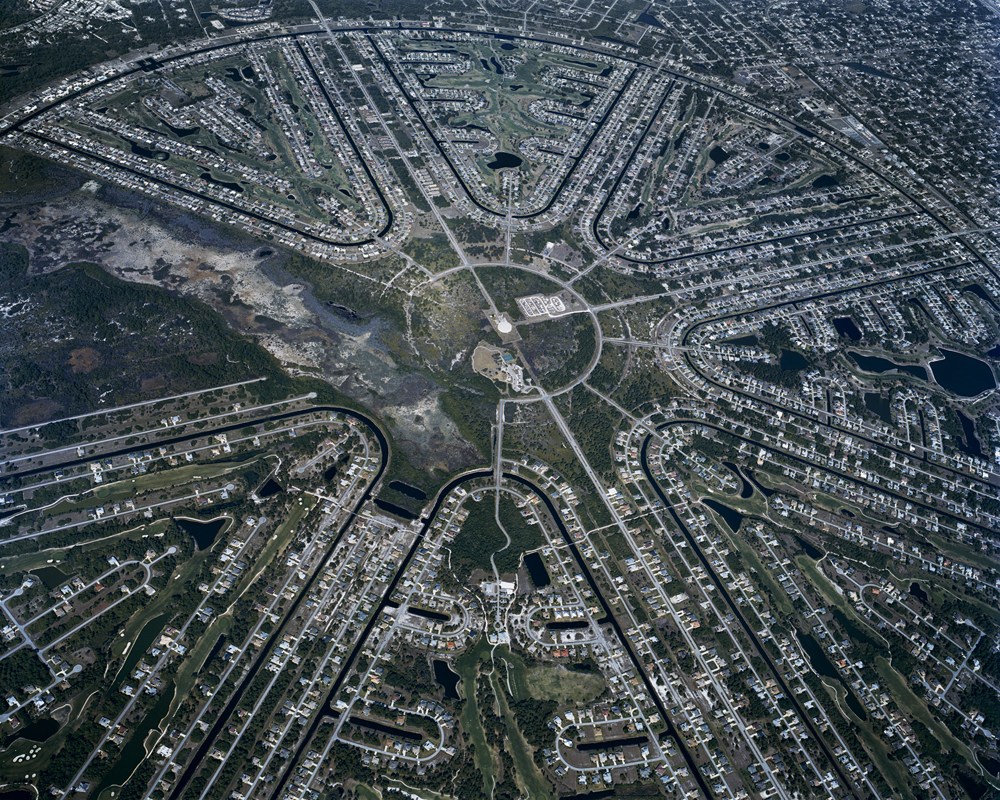
Christoph Gielen, a photographer known for his aerial views of American suburbs has chosen as his next subject super-maximum security prisons — the most controlled spaces in American prison industrial complex. Supermaxes are of particular interest as they are designed specifically for solitary confinement.
As I wrote for Wired.com, today, America has an unusual thirst for putting people in total lockdown.
In consideration of “the severe mental pain or suffering” it can cause, Juan Mendez, United Nations Special Rapporteur on torture, said that solitary confinement amounts to cruel, inhuman and degrading treatment. Mendez recommended that prisoners never be confined in solitary for more than 15 days.
However, in US prisons, stints in the hole can be longer. Much longer. The California Department of Corrections self-reports the average stay on an inmate in the Pelican Bay State Prison Secure Housing Unit (SHU) is six-and-a-half-years. Many have been in the SHU for a decade or more. In Louisiana, Herman Wallace and Albert Woodfox of the Angola 3 have been in solitary for over 30 years.
I’ve also written previously about how images of solitary confinement – despite its widespread use – are difficult to come by.
“The opportunity to visually examine these restricted locations is significant, especially at a time when journalists access is increasingly curtailed,” says Gielen.
Gielen noticed concentric patterns of equivalent interest in the Supermax prisons of Arizona whiel working on his suburbs photo series Ciphers.
American Prison Perspectives is a simple and effective presentation of these design forms. Are gated communities and caged facilities are our preferred housing solutions for the late 20th and early 21st centuries?
With 1 in 100 adults behind bars, America incarcerates more people than any other modern society. Of the 2.3 million men, women and children locked up in the U.S., 80,000 prisoners are in solitary. That number includes hundreds of children.
The rapid adoption of solitary by prison authorities as a means to discipline and segregate has led Jeremy Travis, president of John Jay College of Criminal Justice, to call it one of the “greatest social experiments of our time.” For some sociologists, the parallels that Gielen drew between housing and prisons go beyond visual similarity. Columbia University’s Spatial Information Design Lab goes so far to ask, “Have prisons and jails become the mass housing of our time?”


The debate on solitary confinement is timely. To quote myself, again:
The Illinois campaign spurred Senator Dick Durbin (D-IL) to chair the first-ever congressional hearing on solitary confinement last summer. Durbin showed up on Capitol Hill with an actual-size solitary-cell replica.
While for many, the discussion of prisons and segregation can revolve around human rights and legal justice, the issue is particularly relevant today for its economic implications. There was a successful grass-roots campaign to shutdown Illinois’ Tamms Correctional Facility, due largely to the fact that it costs more than $60,000 a year to house a prisoner in solitary confinement in Tamms, compared to an average of $22,000 for inmates in other Illinois prisons. The closure is currently stalled — held up in court following opposition from the AFSCME labor union with prison guards in its ranks.
“In America, particularly, the long view is hardly ever considered. Fiscal views are considered for on a yearly basis,” says Gielen. “Economically, the widespread use of solitary is unsustainable.”

American Prison Perspectives doesn’t end with the images. In 2014, Gielen plans launch a website devoted to the series and host a public online forums. Furthermore, Gielen foresees symposia across the U.S. with former prisoners, prison architects, legal experts, activists, correctional officer union-reps and prison administrators, along with firsthand accounts of solitary confinement and the perspectives of mental health experts on the effects of isolation.
American Prison Perspectives will illustrate how prison design and architecture reflect political discourse, economic priorities, cultural sentiments, and social insecurities, and how, in turn, these constructed environments also become statements about a society.
American Prison Perspectives is supported by Blue Earth Alliance, the Fund For Investigative Journalism and Creative Time Reports and others. You too can help spread the potential reach of the work with your own donation.
I wish Christoph the very best in this ambitious project.


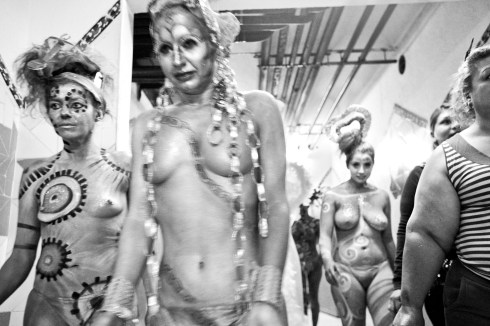
Spanish photographer, Bandia Ribeira Cendán‘s images of vibrant body-painted theatrics inside a Barcelona jail in celebration of International Women’s Day are startling. They might even encapsulate hope. Yet, as Bandia describes in our Q&A it was a fight to gain access to the jail, a struggle to achieve semblance of artistic freedom, and difficult to overcome staff skepticism. Bandia’s biggest frustration was her inability to deeply connect with the women in limiting circumstances. The paucity of support and materials, and some initial reluctance from women prisoners limited the accomplishment of her goals for her photography workshop Corners (Racons). Nevertheless, Corners was recognised as a valuable participatory arts projects at the City Of Barcelona Awards in 2012.
I’ve extolled the benefits of photography workshops in prisons and the empowerment that comes about through self-representation. My views are based somewhat on anecdotal information and also the feedback of people (photographers) always directly involved with such projects and, therefore, perhaps a narrative to perpetuate. Thus, it is pause for thought to hear Bandia say, “I don’t think that a prison is the best place for the rehabilitation […] Photography inside the jail can just be a way of evasion, a way to pass time and to avoid thinking about the own problems.”
I appreciate Bandia’s realism. I also appreciate that she has shared these images with Prison Photography as she has been rounded censored from publishing her photographs in print in Spain.
Scroll down for our conversation.

Q&A
What is the public attitude toward this prison and the women inside?
This is a “transit” prison with a special section for mothers and little babies. That means that people inside are waiting for a trial and once they got it they are sent to a “permanent” prison or they are set free.
The attitude toward the prison, as you can imagine, is not very positive. Once someone steps into a jail he or she is seen as a criminal and stigmatized by the society. Most of these women are gypsies or citizens of South American countries and the majority are here because of drug traffic, so they belong to the lowest strata of Spanish society. Most of them were victims of violence by their husbands, boyfriends or relatives and it’s not common to meet someone with an education.
I met women who couldn’t even write and had problems reading correctly. We are talking about people with really hard lifes and usually from very poor families. Victims of the social injustice.
Our society doesn’t deal with poverty and margination as a part of itself, so instead of looking for solutions we turn our eyes to another place and try not to see these kind of problems. The people in jails are excluded from our society.
You were working as a photo teacher there. Tell us about your work with the women.
It was really an enriching experience for me to share a time with the women. Initially, some of them rejected photography because it was included in their internet workshop and they didn’t see the utility of knowing how to use a reflex camera, which I understand perfectly.
But with the passage of the time, they started to go inside and enjoy it. We built the learning around a common project called “Corners” and I proposed to them to shoot the best and the worst corners of the prison, and even the good and the bad corners of themselves.
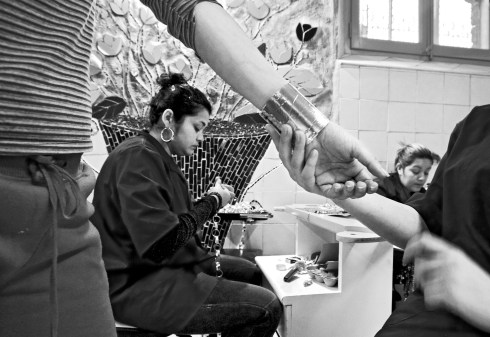
A good corner for most of them was the toilet room, where they can smoke cigarettes and chat for a while far from the eyes of the guardians. A bad corner for many of them was the playground, where they have the obligation to spend few hours every day even when it’s raining or very cold weather, and this is especially hard for those women of advanced age who suffer some form of sickness. At the end we made a little exhibition in the jail which people really enjoyed.
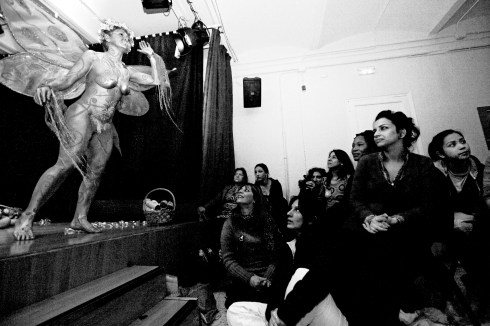
During my visits to the center the people were preparing a theatrical production with body painting. They proposed I shoot the process. I accepted with enthusiasm because I had the opportunity to make photos far from the guards’ control, limited to the jail’s hair-dressing room.


Can photography be a tool for rehabilitation?
I don’t think so. First of all, I don’t think that a prison is the best place for the rehabilitation of any single person. Photography inside the jail, in my opinion, can just be a way of evasion, a way to pass time and to avoid thinking about the own problems.
Photography is positive as a weapon of expression, but for this you must go inside the technical skill-set and we didn’t have the means and the time. We only had one camera for 10 persons. No one helped me to get more cameras for the girls. We are talking about a public institution and a NGO who gets money from the government and they were not able to buy materials for the workshop.
You were finally able to make a reportage, with all the limitations that it takes to work in this kind of places. What negotiations did you go through to take photographs inside?
It was a real mission. First of all I sent my project to the authorities of the Government of Catalunya and didn’t get any answer. I knocked on many doors. Afterwards, I got in touch with some theater companies who make workshops inside and offered to document their activities. Again, no success.
After months and months of trying and almost abandoning the idea, one of my school-mates introduced me to a woman from the Fundació per l’Innovation Social Action (FIAS) which organizes activities inside the jails in the city of Barcelona to introduce prisoners to the new technologies. Here was the key for me. She liked my ideas and proposed that if I wanted to shoot inside I had to offer something, so we decided that making a workshop of photography would be the best.
After 9 months of searching I could go inside this prison.
What celebration was occurring that led to body paint and theatre?
They were celebrating the international day of the working women, the 8th of march. Every year, they host a party in the prison. There are a few activities such as a picnic in the playground, live music, and an exhibition of photography about Africa. The women inside get really involved in this party.
Does this body painting drama take place annually?
Yes, they have done it for a few years. It’s a collaboration between the people from the hairdress workshop and the people from the fitness class; the teachers and the women make the show together. Generally, there are plenty of activities from the morning until evening; school to get a basic education and also working areas in which they earn a very minimum salary.


Are colorful activities such as those you document common in all Spanish women’s prisons?
I don’t really know but I don’t think so. This prison is very small with around 150 prisoners. The population changes frequently. I’ve been told that the tranquil ambience is an exception inside Spanish prisons. Still, when you step inside, some depressing feeling invade you and the celebrations have a touch of sadness. The women get really involved because they don’t have many similar events throughout the rest of the year.
In other prisons there’s not such an offer of activities and they use to have problems of overpopulation. Spain has the largest imprisoned population of all Western Europe, although behind other countries with biggest criminality tax. This means that in Spain the low delinquency is highly punished. And the jail is the solution, instead of the social actions.
What have been the reactions to your images from staff, women prisoners and the public?
Some of the staff didn’t like so much and they said that the images were not as “artistic” as they expected. What I understood from this reaction was that they supposed that I would “hide” more the jail situation and customise a view. However, it was my intention from the beginning to show a sad reality.
The women prisoners were happy about the photographs, and happy that I could show the images while I was working there – I know that after this there was no one from the staff who showed them the final work.
About the public, I’m not allowed to show these photos in my country.
Jail policies are so stringent that the authorities don’t want that these photos go out from the walls of the prison, even when I’m not showing anything about the life conditions inside. It looks amazing that this facts happen in a so called “western democracy”. This hermetism is unbelievable.


What are your thoughts on prison policy in Spain? What is being done correctly and what could improve rehabilitation for women prisoners?
My thoughts are not positive. First of all, the jail penalties for small delinquency are too harsh. This increases the prison population making it overcrowded. In the last 10 years, Spain’s prison population has doubled. The consequence is the deterioration of conditions and the welfare of the people inside.
Another facet [of prison management] which is denounciable is the FIES regime, an isolation regime used to condemn prisoners considered “dangerous.” This term “dangerous” sometimes gets very flexible. This isolation makes the prisoners more vulnerable and includes violent episodes from the guards and we have lots of files from humanitarian associations, like International Amnesty, denouncing FIES.
Rehabilitation is not possible when people are condemned to 20 years in FIES. They lose their identity, values and sometimes dignity as a persons; this goes against rehabilitation.
Were there any downsides to your experience?
I missed out on making very close contact with the women. We were controlled all the time by someone from the jail and it was impossible to have long conversation outside of the workshop. I listened to some stories and made surface-level inquiries but did not really get deep inside.
What happens when you’re a soldier and you are asked to fight in a war your conscience tells you is immoral?
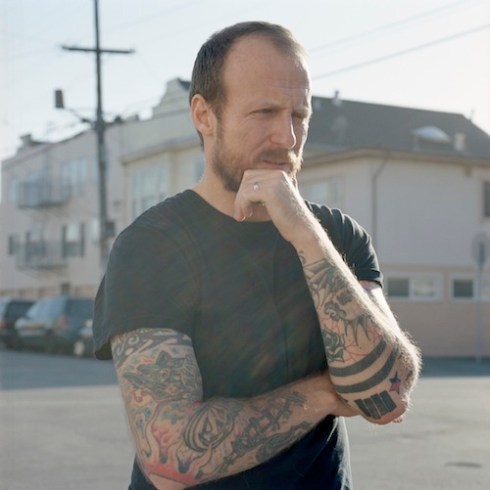
Jo Metson Scott‘s series The Grey Line and accompanying book interrogates this conundrum and those that lived – and continue to live – it.
I’m not from a military background and I always opposed the Iraq War, so it was a stretch for me to empathise with Jo’s struggling subjects who, to me, simply made – and continue to justify – rational assessments. How difficult or taxing can common sense be? To get me out my own head, I called on Jo to explain this emotional minefield of a topic.
Scroll down to read our Q&A.

Q&A
Prison Photography (PP): Where does the title come from?
JMS: The title is to try and explain the difficult position so many of the soldiers found themselves in. Nothing is ever black and white, nothing is ever as simple as right or wrong, and these people were having to make a decision between what they were contractually obliged to do and what they felt was the right thing to do. I felt The Grey Line was a way of explaining the difficult line they were choosing to walk.
PP: You say some of the soldiers were imprisoned for their views?
JMS: Actually, none of the soldiers were imprisoned for speaking out against the Iraq war. Some of the soldiers refused to fight in the Iraq war and were imprisoned for going AWOL, but not for speaking out.
Each person’s story is very different, so I’m always nervous about generalizing. So instead, I’ll give an example. Kevin Benderman was one of the older and higher rank soldiers I interviewed and he was very opposed to the Iraq war. He was deployed to Iraq for a short period. Over there his opinions really became clear and he felt strongly that being in Iraq was the wrong thing to do. When he came back he applied for Conscientious Objector status but it was denied. So he refused to go back. He was court martialed and given a 15 month prison sentence.
Kevin said he always knew that he would get a prison sentence. It was fascinating to hear how his morals were so strong he was compelled to go against the military and risk his career. It wasn’t that he was a pacifist, or had found God, he just strongly believed that what America was doing in Iraq was wrong. That’s what really impressed me about some of the people I interviewed, they really stayed true to how they felt. Kevin knew if he spoke out and refused to fight, his career would be ruined, he’d be accused of being a coward and he faced imprisonment, but he still refused to go to Iraq.
It’s like another person I met who refused to deploy to Iraq. He was openly gay, and could easily have got out through the ‘Don’t Ask Don’t Tell’ Policy, but he felt if he wanted to leave for moral reasons it would be wrong as he would see it as taking the easy option. Instead, he applied for Conscientious Objector status, which was denied, so was then imprisoned for refusing to be deployed.
Kevin Benderman can explain his situation so much more clearly that I ever will. He said to me:
“Have you heard the term, “I cannot in good conscience do that…?” Well, that’s how it was for me.
I took a look around when I got over there. We weren’t fighting an army, there were no weapons of mass destruction. None of that stuff was there. We were just bullying the civilians. We weren’t fighting soldiers; we were just kicking doors down of civilians’ houses and taking them out and that’s not what I joined the army to do. I mean, if there had been a soldier over there I would have fought a soldier, but that’s not what we were doing… not at all[…]
There was no doubt in my mind that I’d go to prison. I had to be made an example out of. I mean, I was an NCO for one. I wasn’t a young kid and they knew that if I was able to do what I was trying to do it would only strengthen my argument. They had to make an example out of me so that no one else would try it.
With all the charges they were trying to give me I could have got seventeen years. They tried to charge me with larceny, desertion, missing movement. I knew it was a bunch of bullshit. I knew they weren’t gonna be able to stick all that stuff on me. I was convicted of missing movement by design, which carried a fifteen month sentence. It was a dishonourable discharge but it was upgraded to bad conduct. But that still isn’t very good. I mean you can’t really do a whole lot with a bad conduct discharge.
I know I did the right thing but it just didn’t really change anything, you know? I invested twelve years of my life in the military. I gave that away. I gave away my retirement. I lost my home, my wife … I can’t really find a … well, I’m stuck here driving a truck.
I had more trouble with my family – sisters, brothers and brother-in-law – than with people in general.
My family didn’t even want to hear my reasons for doing what I was doing and they still don’t. Most of the ones who have openly criticised me have never served and don’t know what they’re talking about. More soldiers and veterans agree with me than my own family do. But I’m not really concerned about their opinion and that makes them mad. You know, that was part of the stress; my own family chose George Bush and his stupid ass doing something illegal over defending me, and they wouldn’t even hear my reasons why. […]
There’s still people who say I’m a hero. Well no, I’m not a hero. I was just doing what I thought was right and I really thought that people who made noises about the constitution and the law would stand up for that instead of just wanting someone to be a figurehead for them. […]
A few years ago I took a job in Afghanistan as a civilian contractor. I wanted to go back was because I know I’m a good mechanic and there’re still soldiers over there and I figured they deserved somebody who was conscientious about the work. I had given them the best vehicles that they possibly had. I didn’t leave the military to abandon the people that I served with, but I knew that it didn’t matter. Whether or not it was right to be there […] I’m a good mechanic and they’re still over there. They’re not coming back and we’re not prosecuting Bush and I wanted to make sure that they had the best possible vehicles. Should we be there? No. Are we there? Yes.


PP: Benderman’s is one story of how many? What was the number of soldiers you met?
JMS: Over the space of 5 years I met in total 45 soldiers. 29 are in the book.
PP: Has the story of conscientious objectors been adequately told?
JMS: Before I started the project, I had only associated the term Conscientious Objector to the first and second world war – to times of conscription. So I was intrigued to know why someone would need to apply for conscientious objectors status when they had willing signed up. Meeting with the veterans and doing this project made me realise that of course people who are in the military can have a change of morals and principles just like any ones else does, and some people also realise that they no longer want to be a part of war.
But not all of the people I met with were conscientious objectors. Many of them didn’t even know that the process existed. I was interested in meeting people who had moral doubts about their involvement in the Iraq war, not all were conscientious objectors.
Some people choose to whistle blow and speak out to the media about their experiences, others simply refused to fight and went AWOL. Others chose to keep quiet until they left the military and then spoke out. Speaking out from within the military is a very difficult thing to do. The quote below is from a veteran called Ryan. He was in the Marine Corp and was deployed for 7 months to Iraq. After he was honourably discharged from the military, he decided to speak out about his experiences in the military and about what he came to see as atrocities that he and his colleagues committed in Iraq.
After I made my public testimony, my brother disowned me on Facebook for everyone to see. He said I was a traitor and I wasn’t his brother anymore, that I wasn’t even a man.
Every single person that I served with in the war found out about my testimony and have publicly said that I’m a liar, a bitch, that I’m full of shit, that I’m a fucking American flag-burning, troop-hating, communist.
I understand why a lot of these guys did what they did; they’re not ready to accept that what we did was wrong … because it’s hard. It’s hard to accept that what you believed in was wrong. And not just wrong like two plus two is five, but wrong like you fucking killed somebody and that’s something you have to live with for the rest of your life. Some people just aren’t ready to live with that yet.

PP: What do you hope to communicate with The Grey Line?
JMS: Many of the people I spoke to were very torn between their duty, the bond with the people they fought with and their own belief that what they were doing was wrong. Several soldiers talked about being ordered to do things that they felt very uncomfortable about doing, but that they knew were legal.
I spoke to one soldier who had been a military Intelligence officer in Abu Ghraib. He had absolute faith in the military, but was feeling very uncomfortable with what he was being asked to do. In the quote below, he talks about his experiences of interrogating a young detainee.
He was 16; just a kid, scared to death, and skinny as a rail. We went out to get him from the ‘general population’ [prisoners who aren’t in solitary confinement] area to interrogate him. The general population area was right next to the questioning booth, but they still wanted me to put one of those sacks over his head to transport him. It wasn’t like a normal sack, it was like a plastic sand bag with sand all over it. It barely fit on his head and he was shaking as I put it over him. We used it so he couldn’t see where we were taking him, even though we could see the booth from where we were standing. We had to cuff him too, but his wrists were so skinny you couldn’t put the handcuffs on him. So he just kind of carried them instead. I felt so rotten.
The weirdest thing was when we were in the room with the kid and an MI guy came in and gave the interrogating officer a handful of Jolly Ranchers. It was meant to be put on the table like, if you talk we’ll give you some apple Jolly Ranchers, you know? The kid knew nothing. He was just this guy’s son. Originally we were supposed to interrogate his father, a general in Saddam’s regime, which was why I had agreed to be a part of it. It sounded interesting. But then when we got there, they told us that he had already been ‘broken’ and as a sort of consolation we were told we could interrogate his son.
I only found out afterwards what they had done to break his father. His son had been doused in cold water, driven around in a truck in the freezing cold night, and covered in mud. I guess, at the same time his father was being interrogated somewhere else and from what I understand they told him that they’d take a break from the interrogation and let him see his son.
So the general’s thinking he’s gonna see his son and have some kind of a reunion with him, but instead they just allowed him to see his son naked, shivering, and covered in mud.
A lot of people will probably wonder why I didn’t say something publicly right away, but it would have been pointless. Even though I thought what was happening was wrong, doesn’t mean that it was illegal anyway.

PP: What are your thoughts on the Iraq and Afghanistan wars, Jo? Was it wrong, justified, legal or illegal? Is your opinion of importance? Does it come through in the work? Or need to come through?
JMS: I was shocked when Tony Blair took my country to war. I couldn’t believe that he could go against the majority of the country’s wishes. I was shocked that he didn’t listen to the advice of the UN. Maybe it was naive of me, but that is how I felt. I think that is why I became interested in the soldiers stories. I had really believed in Tony Blair when he had come to power. I never would have dreamt he would have taken us into a war like Iraq. And that’s why I wondered how some soldiers must have felt. Many people join the military having complete faith in their government, so what happens if then the government goes into wars you think are wrong? As a soldier you have no choice.
People will always say. “You can’t have military that questions every order their given,” but on the flip side what if it was you? If it was you being asked to do something you felt in the bottom of you stomach was wrong? Something you felt went against everything you been taught? Do you ignore that feeling and carry out your contractual obligation or do you listen to your conscience?
In the end I didn’t particularly want to look at the politics of the Iraq war (though a lot of issues are raised in the book). What I wanted to explore was how an individual deals with the doubts they have in times of war. I wanted to look at the more complicated issues affecting a soldier’s decision. There are so many other things that affect one ability to make a decision – commitments to colleagues, expectations of family, financial implications, confusions of loyalty and legality. The aim of the book was to explore the complexity of their situation. There wasn’t a right way or a wrong way of doing things.
PP: How does The Grey Line fit in with your other work? You’ve recently been in Sri Lanka, you hang out with Beth Orton. I mean, to me, all your work is gentle, warm and purposeful so I’m not asking about the style or aesthetics in The Grey Line, I’m asking about its purpose for you as an artist.
JMS: I love doing commercial work and the challenges and opportunities it brings. But my approach and my purpose in doing commercial work is different to my personal work, and its difficult to compare them.
I am interested in people and because I have a camera it allows me to enter their lives in a unique way. I like to tell other peoples stories through my photographs.
For a long time now the theme of morality is something that I have questioned and explored – my own sense of morality and other people’s sense of morality, and how that affects their decisions… I think that I was unintentionally looking for way of exploring this theme with my photography, and when I first met Robert, something clicked.
PP: Can you imagine not having explored this issue? Can you imagine not having made this statement to the world?
JMS: It doesn’t really feel like I made a statement, or at least it wasn’t my statement to make. The men and women that were in the military and had the courage to question are the people making a statement.
PP: Thanks Jo.
JMS: Thank you, Pete

BOOK LAUNCH
On 20th March (6.30 -10pm) The Grey Line, published by Dewi Lewis, is having a book launch at Fishbar Gallery, 176 Dalston Lane, E8 1NG.
[Right click on the images below to view them larger.]

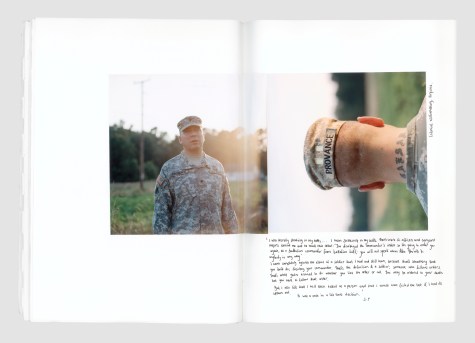

BIOGRAPHY
Jo Metson Scott is a portrait and documentary photographer whose work highlights the relationship between people and their communities. She has been commissioned by organisations including The New York Times, The Telegraph and The Photographer’s Gallery and her work has been exhibited in both the UK and Europe, including Arles Photography Festival, Nottingham Castle Art Gallery, Hereford Photography Festival and the Venice Biennale Fringe. She is repped by Webber Represents. Jo lives and works in London.

Found photo of an unknown prison cell.
Last week, I was interviewed twice – firstly, for DVAFOTO and secondly, for HERE BE MONSTERS – about Prison Photography On The Road and my activities since.
The DVAFOTO interview opens with my account of my arrest and 9 hours in jail in late 2011. The HBM podcast is about a workshop I delivered in Sing Sing State Prison, New York.
It may be ironic that I’d get locked-up during a research trip that is questioning incarceration, but it’s not funny and it’s no badge of honour. My actions were foolhardy and the police officer’s actions were over-zealous.
I’ve been thinking beyond what I think about the experience (It was stupid, bureaucratic and inconvenient), and more about how I think of the experience (What insight did I gain? What interactions did I have? Who did I meet?)
Inside the release-tank were about 15 men. They were there for different reasons. One young man faced a significant bail amount for a significant possession offense while another was brought in for cycling drunk in the wrong direction of the cycle path on a quiet road. Some men were in for DUI’s and in some cases not their first DUI. Two or three slept through the hours. Others were quiet and some told stories. The younger ones were more talkative and boastful. Several tried using the phone but only one succeeded. When they found out I was in for peeing on a tree and not answering questions they thought it was lame. Lame offense, lame arrest.
A tray of peanut butter sandwiches was brought in, but not enough. Some jumped on them, others weren’t interested. I think one person got two sandwiches.
Of the men with DUIs, I had little sympathy. They didn’t seem to acknowledge that their actions were potentially lethal. For a couple of them, cash-fines, points on their licenses and driving bans didn’t seem to be much deterrent.
A few men seemed contrite. Others seemed beaten down with either addiction or repeated arrogance.
I had huge sympathy for the drunk cyclist. Maybe in this fifties. Grey hair. He thought he was getting out until the administration realised he was a parolee. The bike-ride proved a violation and he was to be automatically rearrested and jailed for a fixed term. He had a job and children. Because of a night of excess, he was to lose those things again. Sure, his behaviour could have been better, but I think the authority’s response was of excess.
I didn’t ask what they did and they didn’t ask me. It was a small space. It was very dirty but not quite filthy. We only moved our place when others left and they did so in groups of 3 and 4 throughout the hours.
Part of me wishes I’d taken the opportunity to ask some questions, tap some opinions (I may have met a great conversationalist who’d improve my thinking as much as I hoped I might improve his). The other part of me knows only an intrusive nerd would be ask out-of-the-blue questions about personal circumstance and attitudes; especially in a temporarily-occupied cell at an unpredictable time.
No clocks.
Two weeks later: No court appearance. No charges brought.
Why is this relevant? The arrest and dismissal of charges — actually, the incomplete documentation of the arrest and dismissal — almost jeopardised my visit to Sing Sing to carry out a workshop with attentive, challenging, respectful and curious students of the education program there.
An arrest will always feature on a record, whether or not a conviction is brought, so-told me a law enforcement employee over the phone. New York Dept. Of Corrections which administers Sing Sing knew I’d been arrested but the information ceased there. I had to scramble for paperwork (that had not been given to me) to prove I had no criminal record. I wonder how much inefficiency and potential mistakes contribute to unfair and/or heightened levels of control. Frustration must be infinite in the prison industrial complex.
All in all, I’m glad I was able to teach and learn in Sing Sing and doubly happy that Jeff Emtman was able to craft a fine podcast splicing together audio of prisoners speaking, myself speaking, music and sound. Jeff conceived of the podcast titled The Other One Percent, to broadly challenge listeners to think about prisons and solutions.
The class, as a whole, discussed many images but specifically in the HBM audio, Robert Rose, Dennis Martinez, Deshawn Smalls and Jermaine Archer talk about these six images.
The first image mentioned is the one below by Brian Moss …

“Fear, I think people would think fear,” says Sing Sing prisoner, Robert Rose. “They can’t see what goes on in here, just as we can’t see much of what goes on out there.”
… then the three below by Alyse Emdur …
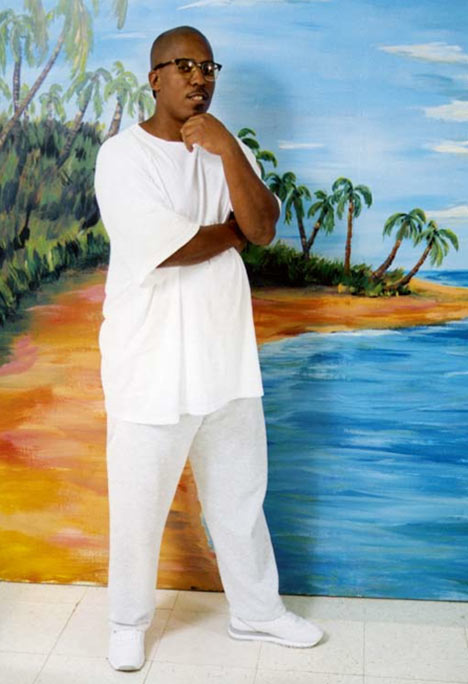

“Something needs to be said about the families who also do time. They are part of the narrative of mass incarceration, but they’re not talked about. They end up carrying the burden,” says Deshawn Smalls, Sing Sing prisoner.

… and finally, the two images below by Richard Ross of juvenile facilities.
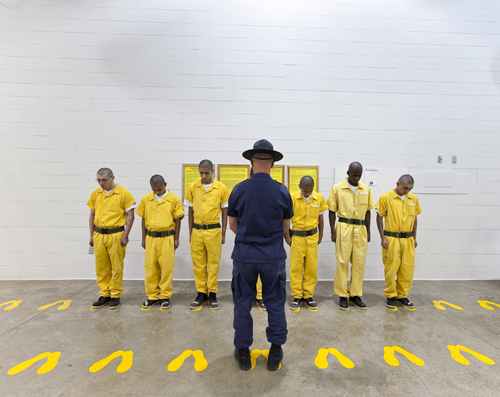
Sing Sing prisoner, Jeremy says, “You may have a man who refused [to adhere to regulations] and this is him in this picture. You probably won’t see the man at first, but he is there.”

HERE BE MONSTERS (HBM) is a podcast audio series about fear and the unknown, by Jeff Emtman, a 2012 Soundcloud Community Fellow.
HBM has previously covered Juggalo culture; placenta medicine; train-hopping; the disillusion and resignation of a favored NPR correspondent; a children’s book about a hallucinogenic trip; and the mind-made images created by the human brain when the body and the eyes experience total darkness – a condition known as ‘Prisoners Cinema.’
I like what Jeff is doing. I’m happy to share my experiences with him.
If you’re still interested in what I’m up to, I cover my immediate plans in the DVAFOTO interview. We also talk about what bloggers can do and do do.
LINKS
The Other One Percent (Here Be Monsters podcast)
Interview: Pete Brook On The Road (DVAFOTO)
“I imagined you’ve seen lots of prison everything so it’s a bit intimidating to send you anything for fear I’m just repeating,” said the anonymous tip off in my inbox. The link was to a film entirely new to me. It blew me away and will you too.
Jonathan Borofsky, famous in recent years for a bunch of monstrous sculptures of 2-D men (usually hammering the air), made Prisoners in 1985. It’s one of the best prison films I’ve seen, mainly because Prisoners doesn’t weave too persistently one particular tale or one particular journey. To be reductive, I’d argue that this is the unique artist’s treatment of the subject in stark contrast to the straight documentarian’s treatment.
Generally, prison documentaries are often about trial and adversity; they necessarily have to depict struggle and hope from all angles. In other words, documentaries are often part-advocacy and answers. Borofsky just had questions. The answers the 32 California prisoners had for him in interviews will stay with you.
Part horror testimony, part philosophy, part confession, part therapy, Borofsky’s Prisoners is a tour de force. It was made in the mid-eighties just as the era of mass incarceration took hold. Back then prisoners had the same issues – poverty, drug addiction, histories of childhood abuse and adulthoods of transgression, bad circumstance and bad choices – there were just fewer of them.
The opening of the film includes atmospheric music and cuts of the more bizarre statements. It jolts. But don’t think Borofsky is setting these men and women up for a fall. Yes, his artistic hand is all over this, but he gives each of the prisoners plenty of time to pierce through our bullshit and take us right to their reality. If it seems weird, it is probably because Borofsky’s subject live weirdness every day. Borofsky let’s them speak. He shows their common institutionalisation but does not pity them.
Hugely compelling.

 Prison Photography