
You are currently browsing the category archive for the ‘Activist Art’ category.

“Art is not a mirror held up to reality, but a hammer with which to shape it.” – Bertolt Brecht
RedBird Prison Abolition is making a call to Columbus, OH artists to participate in an art exhibition against the U.S. prison system.
The show will include art by prisoners as well as by people on the outside. Submissions should address the prison system, incarceration or the US police state.
Requirements
Include a brief artist’s statement, dimensions/space needs, and how you’d like the work to be displayed/priced. There will be a silent auction for all pieces. All media will be considered. Send JPEG image submissions to: redbirdprisonabolition@gmail.com.
RedBird Prison Abolition
A group of people in Columbus Ohio who want to see the prison system come to an end. RedBird supports prisoners through publishing their writing, setting up pen pals, hosting events and raising awareness.
Deadline
Tuesday September 25th. Decisions will be made by Sept. 28th. More information: http://redbirdprisonabolition.org/

The Prison Library Project will be having a mail art exhibition in October 2012 and invites inmates, families and those who look to improve the lives of those incarcerated to participate:
The Prison Library Project receives hundreds of letters every week from inmates across the country. These letters requesting books and dictionaries, are often beautifully illustrated. In the spirit of these talented prison artists the Postmarked show was created, using the envelope as a canvas to create and share mail art.
The art of letter writing and the use of “snail mail” is on the decline, a casualty of the electronic age. But who among us does not smile when we received a letter in our mailbox? Who doesn’t thrill to find art instead of junk mail and bills? The Postmarked show is a chance for all of us to reconnect with the magic of “snail mail” while helping a population whose voice, if heard at all, is limited to the humble envelope, letter and pen.
Interested participants may decorate, illustrate or create art on an envelope and mail it in for the Postmarked mail art exhibition and fundraiser. Send submissions to:
Postmarked 2012
Prison Library Project
112 Harvard #303
Claremont CA 91711
Entries must be postmarked by September 30, 2012.
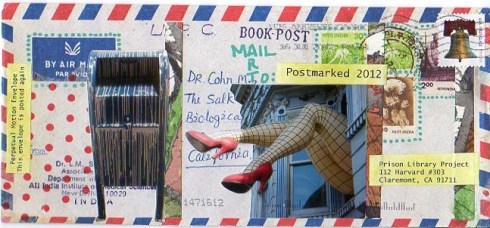

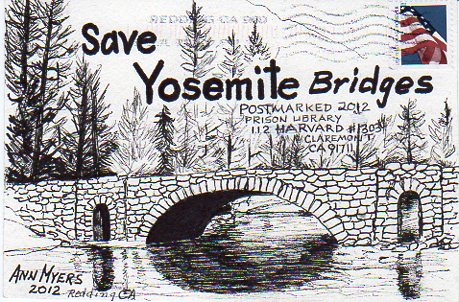

Only the side with the official USPS Postmark/barcode will be displayed. Mail art may be painted, stamped, collaged, printed, decorated or constructed. It may be any shape and size that will go through the mail and receive an official postmark.
“Mail may get worn or torn through the mail, but the handling process is an important part of the theme,” says organiser, Rachel McDonnell
Mail will be opened only by the person who purchases the art envelope.
Exhibition: October 5 – November 2 at the Claremont Forum Bookshop & Gallery. Opening Reception: Friday, October 5 Final Bid Party: Friday, November 2, 6:30 – 8:00pm
For more information, see PLP’s Postmarked blog or contact Rachel McDonnell at rachel@claremontforum.org

The Prison Library Project is a prison book and literacy program which sends thousands of books, study aids, educational and spiritual resources to inmates nationwide.

Artist’s impression of projected cellphone imagery.
ART
Stop, a video installation will put faces to the numbers – hundreds of thousands – of people who are unjustly detained by police.
Stop is proposed by New York based Dread Scott and by Joann Kushner, an artist working in Liverpool, UK. As described by Dread Scott:
“Stop will be a projection of portraits of several youth from East New York, Brooklyn and Liverpool, UK. Brooklyn will be on one wall and Liverpool will face them on the other. The life-sized projections will stand and face each other, the audience will be in the middle. Over time, each of the young adults will reveal how many times they have each been stopped by the police during their lifetime. The youth will be having a virtual “conversation” across an ocean with each other as well as with the audience.”
PHOTO
Yesterday, I posted a long conversation with Nina Berman about Stop & Frisk. Berman had not found any other fellow photographers working on the issue of Stop & Frisk. I found one other photographer (who’s work is ongoing and wishes not to publicize it yet) and one artist – Dread Scott.
Dread’s a lovely guy; I’ve written about his work on the prison industrial complex before and I interviewed him last year during PPOTR. Here’s what he says about this Stop & Frisk and this project:
“Last year, New York police stopped almost 700,000 people as part of their “Stop and Frisk” policy. The overwhelming majority, about 90%, were doing nothing wrong at the time and were completely innocent. Most were young and Black or Latino. A similar policy exists in Liverpool and developed after NY police chief William Bratton was invited to be a consultant in another UK city, Hartlepool, in 1996.”
It should be added that UK Prime Minister David Cameron wanted to appoint Bratton as Commissioner of London’s Metropolitan Police Service following the London Riots of August 2011. Cameron was later overruled by Home Secretary Theresa May, who insisted that only a British citizen should be able to run the Service.
Dread has led photography and art workshops with young adults from East NY Brooklyn (a neighborhood with one of the city’s highest police Stop and Frisk rates) and Joann has been working with similar youth in Liverpool. Using cell phones, students have made a powerful series of photographs about their neighborhoods and lives.
Stop will be exhibited in Rush Arts Gallery, NYC from September 13th, 2012.
START KICKING
Kickstarter has definitely reached its saturation point; The Onion’s take made me laugh hardest.
But you don’t even need to feel guilty about this one; Dread’s already reached his target (sure, he’d like a little extra: who doesn’t?)
What’s more important is the message of his work. Until now, I’ve never seen connections made between the US and the UK – between New York and Liverpool – over the Stop & Frisk issue. The issue is rarely framed within the context of youth; we don’t think of the victims as kids … but in many cases they are.
Stop & Frisk is a canary issue. How the controversy resolves itself will be an indication of whether we have progressed; if we are interested and involved in the welfare of others, or if we remain indifferent. It’s driven by Homeland Security dollars and it messes with peoples’ lives. It’s born out of a divided society, just as prisons were. Now the heavy-handed response is on peoples’ doorsteps.

Police stop teenagers for ID and when one can’t produce it he is put in a police van and driven away. The other has to call his mother who didn’t answer. The police were about to haul him away when his brother showed up and presented ID. © Nina Berman
STOP AND FRISK
The controversial Stop & Frisk procedures of the New York Police Department (NYPD) have been enacted for decades, but due to a phenomenal rise in figures over the past decade, the issue has recently become a hot news topic.
Civil rights advocates point out that Stop & Frisks are disproportionately experienced by minorities. The New York Civil Liberties Union (NYCLU) published a report: NYPD Stop-and-Frisk Activity in 2011/2012.
In 2002, the NYPD made 97,296 stops. In 2011, there were 685,724 stops. Not all stops result in frisks. Of the 381,704 frisks, 330,638 (89.2%) were of blacks and Latinos. By contrast, only 27,341 frisks (7.4%) were of whites.
The NYCLU reports:
“Young Black and Latino men were the targets of a hugely disproportionate number of stops. Though they account for only 4.7% of the city, black and Latino males between the ages of 14 and 24 accounted for 41.6% of stops in 2011.” …
“The number of stops of young black men exceeded the entire city population of young black men (168,126 as compared to 158,406). Ninety percent of young black and Latino men stopped were innocent.” …
“The 2011 data are striking in what they reveal about the large percentages of blacks and Latinos being stopped in precincts that have substantial percentages of white residents. For instance, the population of the 17th Precinct, which covers the East Side of Manhattan, has the lowest percentage of black and Latino residents in the city at 7.8%, yet 71.4% of those stopped in the precinct were black or Latino.“
In total, during the 10 years of the Bloomberg administration, there have been over 4,000,000 stops in New York city. The 524,873 extra stops in 2011 (as compared to 2002) recovered only 176 more guns.
In 2011, of the 381,704 frisks, 330,638 (89.2%) were of blacks and Latinos. By contrast, only 27,341 frisks (7.4%) were of whites.
Blacks and Latinos were more likely to be frisked and, among those frisked, are far less likely to be found with a weapon.
The New York Times reported last month that the NYPD has abused Stop & Frisk policies in recent years but others say the NYPD has – with officers’ routine street stops of minorities – been abusing its powers for decades.
Battle lines have been drawn. In May, NYCLU filed a lawsuit“challenging the NYPD’s unlawful practice of detaining, questioning and searching innocent New Yorkers – particularly blacks, Latinos and other non-whites.” In a counter attack, Mayor Bloomberg has called the NYCLU “dangerously wrong” and dismisses them as “no better than the NRA” for opposing the Stop & Frisk.
The Guardian just published data visualisation of NYC Stop & Frisk.
PHOTOGRAPHER’S INTEREST PIQUED
New York-based photographer Nina Berman has recently taken on the challenge of photographing this sprawling, all-encompassing issue. In the early stages of the project, she has published her forays in a couple (one and two) blog posts.
I realise this is a long conversation (possibly the longest I’ve ever published on Prison Photography) but it’s an important topic emerging in the popular consciousness right now.
Nina and I discuss how to make images of police activities and civil disobedience; talk about Nina’s motivations; pay attention to individual and group activists; and consider why attitudes about Stop & Frisk vary so wildly in the context of such controversial and stark statistics.
CONVERSATION
Why has this become a big issue recently?
Stop & Frisk has been a big issue for a long time in New York’s communities of colour. If you live in predominantly white community in New York you wouldn’t notice it because most white people are not stopped and frisked.
I think it’s a noticeable issue now because the numbers have got so high. There’s been some lawsuits and activist agitation so it has become more talked about. We’ve also seen connections made with other police aggressiveness and killings of unarmed black and brown men.
Is this just in NYC or is this indicative of issues at a national level?
It’s a national issue. A legal aid attorney, who lives in D.C., told me some months ago, that it was her feeling that it was worse in D.C. There is just a super-intense activist community here in New York who have just made it a central issue. And then there’s been lawsuits by the NYCLU and that has helped propel it into news reports. But I’ve been following it since November 2011 – at that time there was very little conversation about it. Now, it’s in the national press nearly every day.
How did it fall on to your radar?
I heard about it two years ago, either through a NYCLU or a Center for Constitutional Rights listserv. I read about lawsuits that have been put in against the NYPD. I thought that’s a huge number [of police stops]; what’s that all about?
Later, I saw a couple Stop & Frisks happen in the Bronx and it was just shocking. I started to follow some activists, who are just so dedicated; they are doing stuff everyday. The more I learned about it, the more I saw the connection between Stop & Frisks and what people are now calling the New Jim Crow; it’s not just the physical violation and potential humiliation of being stopped and searched but all the disenfranchisement that come as a result of that. That aspect has been missing in a lot of the news reports.
For instance, you may be stopped and the police officer may ask you for ID, and you may not have ID. As far as I know, there’s no ID law in New York city, but they may say, “You’re trespassing here,” and then you get a trespassing summons, or if you talk back to the officer, and ask ‘”Why are you stopping me?” you could get a disorderly conduct ticket and summons to court.
These are the kind of things that pile up. I’d like to see compiled statistics in New York city on how many disorderly conduct summons are given out, to whom they are given, and where they are given.
You said that you had witnessed a couple of Stop & Frisks?
I was in the Bronx on another project and I didn’t have my camera out. I saw a man riding a bicycle and a cop stopped him in the middle of the street. He stayed on his bicycle and he just immediately put his arms out in the air, like he knew precisely what position to assume. That’s a whole other thing that interests me; how body language for some people according to their race is a normalized gesture. For white people gestures [associated with Stop & Frisk] would be abnormal gestures.
Last summer, I saw a guy – he looked like he was 17 or 18 years old – in the Bronx and two plain-clothed cops came out and pushed him against a wall and stripped him of everything. It was intense.

What are the figures for stop and searches over the years?
Up to 700,000 in 2011. How many of those stops are also searches is unclear. Each year since 2002, stops have gone steadily up. If you calculate it for 2011, it is more than one a minute!* It is beyond comprehension.
What are the attitudes of the people in these communities who are effected?
There’s one guy in East Harlem I’ve come to know rather well. He’s been stopped and frisked his whole life and has never thought anything of it. One day, he saw his stepson stopped and searched. A light went off in his head; “What is going on here?” In another instance, his stepson was stopped and he was able to record the audio of the stop and the stuff the cops were saying was so abusive. After that, the father decided to get involved in civil disobedience and he’s out there every day involved in jail support, court support and rallying at precincts too. Many of the activists have been arrested.
Where have you been making photographs?
Outside precincts mostly; in Harlem, the Bronx, and Police Plaza downtown. Also, courthouses; mainly the Bronx criminal courthouse, the Manhattan criminal court house.
In the midst of the project, there was a police killing of a young man named Ramarley Graham. So the Stop & Frisk opposition got connected to issues around unwarranted police killings. They see it as part of the same racial profiling issue.
And the impact?
The impact has only been because of enormous amount of pressure – it’s kind of astonishing that you can have an impact at the grassroots level. Walking while Black [is the issue.] Jumaane Williams, a city councilman has stepped up and said, “I got stop and frisked, and I’m a councilman.”
The protestors I have met want an entire new style of policing; the police are not being seen as protectors, but as aggressors. Also, as part of some system – through these stops, this harassment, these summons, these stops – it just keeps people down.
If you speak to some of the parents, their concern is, “Okay, so my kid gets stopped 5 or 6 times for some bullshit thing and let’s see what happens when you seek college loan money. That’s the real fear. One of the fears. I guess the real fear is that a cop might kill your son. If he moves his hand the wrong way or something.
The Department of Justice (DOJ) is just beginning inquiries. The NYPD is not really backing down. As of a month or so ago, Mayor Bloomberg and NYPD Commissioner Ray Kelly were saying ‘This is terrific.’
Michelle Alexander’s characterization of this documenting and disciplining on the streets as well as in the prisons as “The New Jim Crow.” It seems these rapidly rising figures of Stop & Frisk support her arguments. That this racial profiling begins on the street makes the larger, national issue even more terrifying and pernicious. A lot of the time people think it is locked facilities that control populations so vigorously, but here’s evidence that racism begins in free society. Would you agree?
One of my first experiences was photographing some boys who were walking back from the gym in the Bronx. They were stopped, taken to the precinct and their mothers were called. They came to the precinct and the mothers started getting upset. The police wouldn’t let the mothers see them. One of the boys was charged with disorderly conduct because he talked back to the cops and one the mothers said. “That’s it, I sending my kid to the South. I have to protect him from the NYPD.” I learned that there’s this whole reverse migration that goes on when a boy hits his teenage years. Families in New York – and this is not the fist time I’ve heard this – want to send their boys back south to live with relative and to protect them from the NYPD! That blew my mind.
Why has the NYPD taken on this policy which is clearly flawed but also a public relations disaster?
Well, so far it hasn’t been a public relations disaster; not until this year. What kicked it off was a very visible civil disobedience action by Professor Cornell West and a bunch of other in front of the Harlem police precinct. That was the first step. Why the NYPD is doing it? I don’t know if it a money maker which would be an interesting things to find out. All these summonses carry fines.
I personally think New York city has too many cops; it is the most heavily policed city in North America. There’s 40,000 cops so they have to do something. The other factor – and this is what people say on the streets – they are too afraid to go after real gangsters so they hit up these people that are doing nothing, so they can show they are meeting quotas.

Law enforcement says there’s some good in the policy – that gang-bangers don’t bring guns on to the street, because they’re afraid of being stopped; so it is kind of a *preventative* policy.
But statistics (see graph above) don’t really support that argument.
Plus, it’s clogged up the entire court system, the holding cells. Say you’re stopped at 3pm and given a disorderly conduct summons, you may not get to the precinct till 10 o’clock at night … and then they might send you to central booking. Can you imagine what that’d do to a kid, or to anyone? If you’re on a job that says, ‘If you don’t show up you get fired [you loose your job].’ These are real stories; they are not just hypotheticals.
This is what Michelle Alexander would refer to as your way into the system.
What usually happens during a Stop & Frisk?
Legally, if a police officer stops you, you don’t have to say a word. There’s all sorts of “know your rights” trainings all over the city now. And there’s CopWatch groups. Neighborhood people are going out in teams in the community and just watching them.
What you’re supposed to do is ask, “Officer, am I under arrest?” and if the officer says no, you’re supposed to walk away. Does it usually happen like that? No. You’re scared when someone comes up to you. You say something. Each Stop & Frisk handles very differently.
If you refuse to answer questions that might cause problems.
They may throw some charge. They could say you’re obstructing justice. They’re supposed to stop you if they suspect you of something. They’re only supposes to frisk you if they suspect you are carrying a weapon.
I think this policy is going to change. I think there has been a tremendous amount of change. I don’t know what they will then do with all these police officers!?
It used to be when a municipality had budget troubles they’d think about dropping the number of cops. They don’t think that any more. It’s an untouchable.
If they pulled this stuff on 57th Street, Park Avenue or Madison Avenue, can you imagine what would happen? Could you imagine someone walking out of Barney’s New York and the NYPD stopping and frisking the person?
The NYPD does it in neighborhoods where people aren’t going to say anything.
What the most egregious case you’ve learnt about?
In my video, a young man speaks. He’s in his twenties. What was he pulled in for? He was in the subway with his girlfriend going downtown. and his girlfriends sister swiped him through on the subway. He was busted for soliciting. They claimed he asked someone to swipe him through. Well, it’s not illegal to swipe someone through. He spent a whole day in the system because of that. You see some subway stations heavy with police officers. Why? Because they have so much crime? I don’t think so.
Tell us about the groups you’ve been working with and following.
There’s a fluid group of people whop aren’t connected through any specific structure. They find each other at events. Or, someone has a problem and knows one person and they reach out to the group. The group I’ve been following is called Stop Stop & Frisk and it is a mix of Black, Hispanic and White people from Bronx, Manhattan, Brooklyn. They plan to go Staten Island, where there’s lots of problems as well.
Opponents are a mix of working class and middle class, some social workers, legal aid workers, some students and some activists. Wherever there’s some action happening they’ll try to show up and show support. There was recently an action at Lehman High School in the Bronx. Kids were being harassed; it’s a very liquid surge of people who are interested. Go to any neighborhood that is predominantly Black or Hispanic and you’ll find people working on this issue.
The NYCLU has been on the forefront of the opposition?
Yes, and there’s been different organizations that have coalesced. There’s the Police Reform Organizing Project (PROP). There is not one central group and that’s what it so amazing about it. People are waking up at the same time and saying, ‘Hey our neighborhood doesn’t have to be like this.’
How do you plan to pursue the story visually? It’s difficult, no?
I can certainly stake out more Stop & Frisks, and I’d like to do that. There’s also newly emerging surveillance infrastructure. The NYPD will roll these watch-towers into neighborhoods and watch certain places. I’d like to find a way to photograph this landscape that is constantly surveyed. You just have to figure out where these things are because they are moving all the time. And then I’m quite drawn to the mothers – the mothers who feel like they are going to lose their sons.
What do you think about this Pete?
Often material that gets to the heart of the matter is not the photography done by the well-meaning documentary photographers, but the images captured by the surveillance or official cameras. Look at the photos in the appendix of the Supreme Court ruling on the Plata vs. Brown case. The ruling established that overcrowding in California prisons led to preventable deaths, and therefore the conditions of detention for approximately 160,000 inmates was – is – cruel and unusual. Those photos were all taken by the California Department of Corrections itself.
Consider the Collateral Damage wikileaks video; it was US Army footage. The Abu Ghraib images were not taken by a journalist. Many of the photos that are central to expose are taken by those on the inside. It’s very difficult for an outsider to get that sort of access necessary.
So, I am interested in these movable NYPD watch towers. I never knew they existed.
They used them during Occupy. What Happened When I Tried to Get Some Answers About the Creepy NYPD Watchtower Monitoring OWS was a great story by Nick Turse about his encounters with the cops manning the occupy towers. Pete, you’re talking about the Prison Industrial Complex, and there’s is the Military Industrial Complex … well, this is the Homeland Security Industrial Complex. There’s money for new toys and they have to use it. They train police forces on them and they pull them out in every situation.
BUT if you’re in a residential neighborhood and you see one of these watchtowers for a few days, you wonder who’s doing the watching? Am I being watched? Maybe the person behind me is threatening? Is that what’s happening? Or am I being violated? Photographically, it’s not that easy to figure out how to cover these issues, but it’s not impossible. I think you just have to be clever; push yourself further. I feel pretty proud of myself for making the start I have, because you don’t see one photographer touching these things. I’m not patting myself on the back about this but I like the idea of engaging with these communities and the city I live in. I feel that’s important.
A couple of years ago, Fred Ritchin encouraged me to move away from purely historical survey of photography in prisons and think about how the strategies and apparatus of discipline and management developed in prisons have been implemented across free society – corporate parks, high-rise surveillance, riot and protest policing.
Your work from Homeland was subtle in how it connected Americans with the hardware for war and surveillance.
I’ve though of just parking myself in front of central booking in Bronx, in front of the courthouse. I was there for a while the other day when a cop was indicted for the killing of a young boy and I saw kid after kid being walked i n there in handcuffs. I foe want to actually photograph those numbers – and maybe you do that; it takes a day, a week, month – how many pictures can I actually make of Black kids in handcuffs? I’d make thousands.
The challenge is that so much of this you can’t see; you’re prevented from seeing. There is a former prosecutor who has become a big opponent of Stop & Frisk. He says the conditions inside the Manhattan holding cells are worse than anything he’s ever seen in his life, and that they’re designed to make you feel like an animal intentionally.
Criticism of holding cells doesn’t surprise. City jails have a more transient population. There’s a general rule of thumb that the shorter the amount of time someone stays in a cell, the less care they’ll take care of it.
Wouldn’t it be amazing to get a look inside a booking cell. Lawyers don’t even see a booking cell. I’ve thought about getting myself arrested just so I could see it and experience it for myself.
Don’t do that, Nina.
No, I don’t think so. But, it has entered my mind more than once. You see the activists who are doing it more and more. They want to get arrested. They’re so caught up in it. They want the reminder of how fucked up things are.
You said earlier that the courts and booking stations were getting backlogged, possibly because of the civil disobedience also?
Yes, apparently. Frivolous charges are clogging the system. Bobby Constantino, a former [and disillusioned] prosecutor from Boston, writes The Crown blog. He moved to New York, got himself arrested in a civil disobedience action and wrote a whole description of his arrest and booking.
Why have you ventured into video?
I realized the stories people were saying were important and they’d be really hard to capture in just stills. And to give my audience a sense of the cat-and-mouse game played out on the streets. Standing in front of a precinct screaming at police officers? People don’t just do that. People have to get to some sense of rage just to do that.
It would be interesting to speak to the District Attorney (DA) that deals with those cases and see how many cases are brought forward and how many get dropped. Often a DA doesn’t want to waste time and resources on petty charges, especially if the courts are stretched.
The thing is, a cop’s quota is still met as long as he writes the ticket. It’s not based on whether or not it goes through the court. For the cop, he doesn’t care if the case is dropped or not and this is where the reporting needs to come in. The Times, Wall Street Journal, Reuters, Daily News; there needs to be a second level of reporting [from those outlets].
What is the infrastructure driving all of this? It’s not just Michael Bloomberg and Ray Kelly saying this is a crime fighting technique. What are the contradictions? If I was an investigative reporter, that’s what I’d be looking into.
Say you have a couple of disorderly conduct summons against you and you don’t show up to court, you’re going to have a warrant against you! Then you have a record … a real record. It’ll be interesting to see how many people come out for the daily marches. Everyday, more people sign on and it could end up being thousands and thousands of people.
Where do you feel you are at with your coverage of this issue?
I like the video I’ve made and I can certainly go more on it. But how do you photograph racial profiling? Or, furthermore the impulse to racial profile? If you look at some of these situations, in particular police killings – which I think of as the result of racial profiling – the cops are operating with one world view and the communities with another. They’re gulfs apart.
– – – – – –
*There are 525949 minutes in a year. Therefore, in 2011, the NYPD stopped someone every 45 seconds.
– – – – – –
NINA BERMAN
Nina Berman is a documentary photographer with a primary interest in the American political and social landscape. She is the author of two monographs Purple Hearts – Back from Iraq and Homeland, both examining war and militarism. Her work has been recognized with awards in art and journalism from the New York Foundation for the Arts, the World Press Photo Foundation, the Open Society Institute Documentary Fund and Hasselblad among others. She has participated in more than 70 solo and group exhibitions including the Whitney Museum of American Art 2010 Biennial, the Milano Triennale, 2010 and Dublin Contemporary 2011. Her work has been featured on CBS, CNN, PBS, ABC, BBC and reviewed in the New York Times, Aperture, Art in America, Afterimage, TIME, American Photo and Photoworks. She is a member of the NOOR photo collective and is an Associate Professor at the Columbia University Graduate School of Journalism. Berman lives in New York City.
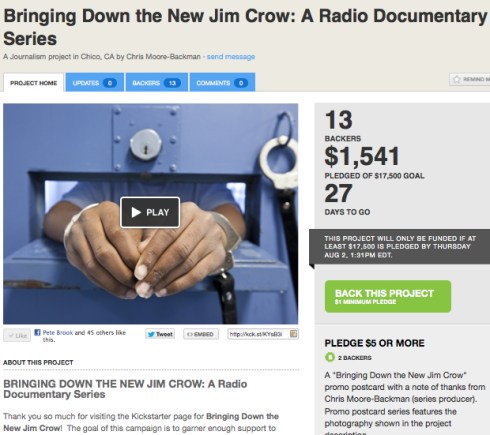
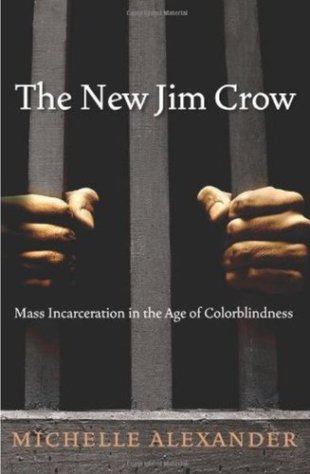
Measured by any metric, Michelle Alexander’s The New Jim Crow: Mass Incarceration in the Age of Color Blindness is a scathing and utterly contemporary critique of American laws.
Now, a crowdfunding effort wants to bring the bestseller to the airwaves.
Alexander has argued that the confluence of many new sentencing laws in recent decades has created an inescapable web of penalty, deprivation and economic traps against the poorest Americans. As we know a disproportionate number of poor Americans are black and brown. A pervasive racial bias in law, particularly Drug War legislation has hit minority groups and resulted in stark, debilitating and unjust institutional racism.
NPR set up its interview with Alexander as follows:
“Alexander argues many of the gains of the civil rights movement have been undermined by the mass incarceration of black Americans in the war on drugs. She says that although Jim Crow laws are now off the books, millions of blacks arrested for minor crimes remain marginalised and disenfranchised, trapped by a criminal justice system that has forever branded them as felons and denied them basic rights and opportunities that would allow them to become productive, law-abiding citizens.”
More here, here, here and here.
In a March OpEd for the New York Times, Alexander highlighted the story of her friend Susan Burton, a criminal justice activist and formerly incarcerated African American woman, who has suggested that defendants demand trials in order to clog up the courts system.
She’s incendiary … and she’s closer to the truth than most commentators dare to believe.
A NEW MEDIUM
Wanting to propel the message and capitalise on the unusually wide appeal of a book on criminal justice, radio documentarian Chris Moore-Backman wants to produce five radio documentaries, and to publish and promote a CD box set of the series along with a companion discussion guide.
Moore-Backman plans the following five hour long episodes for the series Bringing Down the New Jim Crow:
(1) Frat Row vs. Skid Row: The Racial/Socio-Economic Disproportionality of Drug Law Enforcement;
(2) Living with the New Jim Crow: Conversations with Loved Ones of Incarcerated Men and Women of Color;
(3) The War On Drugs: Human Rights Nightmare on Both Sides of the Border;
(4) Still At It: Veterans of the African-American Freedom Movement on the New Jim Crow;
(5) White Allyship in the Era of Mass Incarceration
KICKSTARTER
If this is something you’d like to help get off the ground and hear the product, please consider donating.
– – – –
Chris Moore-Backman is a radio documentarian, nonviolence educator/trainer, musician and father. He is based in Chico, California.
Michelle Alexander is a highly acclaimed civil rights lawyer, advocate, and legal scholar. As an associate professor of law at Stanford Law School, she directed the Civil Rights Clinic and pursued a research agenda focused on the intersection of race and criminal justice.
In 2005, Alexander won a Soros Justice Fellowship that supported the writing of The New Jim Crow and accepted a joint appointment at the Kirwan Institute for the Study of Race and Ethnicity and the Moritz College of Law at The Ohio State University. Prior to joining academia, Alexander engaged in civil rights litigation in both the private and nonprofit sector, ultimately serving as the director of the Racial Justice Project for the ACLU of Northern California, where she helped lead a national campaign against racial profiling. Currently she devotes her time to freelance writing, public speaking, consulting, and caring for her three young children.
Alexander is a graduate of Stanford Law School and Vanderbilt University. She has clerked for Justice Harry A. Blackmun on the U.S. Supreme Court and for Chief Judge Abner Mikva on the D.C. Circuit of the U.S. Court of Appeals, and has appeared as a commentator on CNN and MSNBC, among other media outlets. The New Jim Crow is her first book.
For more information, visit www.thenewjimcrow.com

“Jackson and Christian have pulled back the proverbial curtain so that all can see the American Way of Death.”
– Mumia Abu-Jamal
In the 1979, Bruce Jackson and Diane Christian, a husband-and-wife documentary and research team conducted one of the largest (photographic) surveys of prison life. Jackson and Christian used photography, film and interview to understand and illustrate life on cell block J in Ellis Unit – the Death Row of the Texas Department of Corrections.
Their new book In This Timeless Time (University of North Carolina Press) offers an unflinching commentary on the judicial system and the fates of the men they met on the Row. You can see a gallery of 20 photographs from In This Timeless Time here, and an edit of 74 on Jackson’s own website here.
In This Timeless Time includes a copy of Death Row (1979) a film made by Jackson and Christian (trailer below). In This Timeless Time is also available as an e-book.
To coincide with the release Jackson and Christian have done a couple of interviews.
The first Listen, Read: Bruce Jackson and Diane Christian on Their New Book, “In This Timeless Time,” and Jackson on Curating “Full Color Depression” is with the Center for Documentary Studies (also abridged and in the online version of Document, Spring 2012 CDS Quarterly Newsletter.)
A second, very comprehensive interview Bruce Jackson and Diane Christian discuss Death Row in America is on the website of publisher University of North Carolina Press.
THE BOOK
In This Timeless Time includes 113 duotone photos, all accompanied by explanatory text, sometimes of considerable length. The book is divided into three significant sections.
First is a survey of their work:
“Instead of just showing those men as they were then and printing in another section their words about their condition then, this book tells what happened to each of them: who was executed, who got commuted, who was paroled and who, after more than two decades on the Row, was found to be innocent,” say Jackson and Christian.
Second is a look at capital punishment across the United States since Gregg v. Georgia (1976) in which the Supreme Court ruled states could resume executions.
Third, Jackson and Christian talk about their own role as practitioners, academics and documentary makers.
“Usually with books like this, you just get a book about the subject with nothing about the intelligence that produced it, or the politics that produced it, or the work that produced it. We thought that should be part of it, too,” says Jackson.
I think this is incredibly significant inclusion. I approach photo-criticism with the assumption power is implicated in its manufacture; I want to turn the lens 180 degrees – so to speak – and investigate how those images came into existence. Jackson and Christian want to talk about relationships, want to talk about their privileged access and reinforce the issue of subjectivity. They made a body of work no one else could and others would make a body of work they could not.
This third introspective, “meta-documentary” section of the book distinguishes it from other books of prison photographs. I’ve yet to get my hands on a copy, but expect a book review in late 2012.
BIOGRAPHIES
Bruce Jackson, a writer and documentary filmmaker and photographer, is James Agee Professor of American Culture and SUNY Distinguished Professor of English at the State University of New York at Buffalo.
Diane Christian, a poet, scholar of religious literature, and documentarian, is SUNY Distinguished Teaching Professor of English at the State University of New York at Buffalo
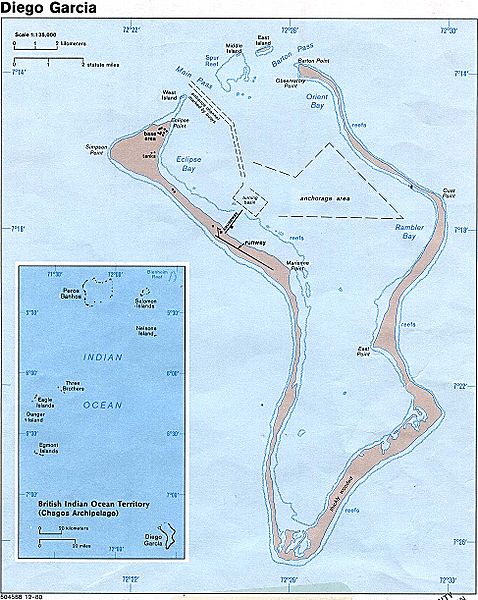
Diego Garcia Island, Indian Ocean, United Kingdom Territory. Rendition Flights Refuelled on the Island in 2002.
Two years ago, I used the above map to illustrate a piece about extraordinary rendition. Located between the east coast of Africa and the West coast of India, Diego Garcia is the largest of the Chagos Islands and until the 1960s had a permanent native population going back generations.
The United States wanted a Pacific military base and they British wanted the friendship. The Chagosians people were obstacles to the UK and US plans.
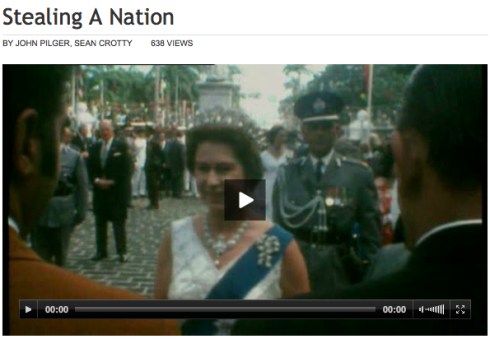
Stealing A Nation by John Pilger lays out in devastating simplicity how two of the mightiest powers lied their way into their own legal machinations in order to cheat over 2,000 people. The Chagosians were forcibly removed and those that haven’t died “of sadness” continue to live in squalor in Mauritius.
I challenge you not to be angry.
As many of you will be aware, Noorderlicht Photo Gallery and Photo Festival are threatened with closure if the Dutch government decides to go ahead with advice – by the Dutch National Advisory Board for Culture – to cut €500,000 in funding. That amount represents 50% of Noorderlicht’s annual budget.
As many of you will also be aware, I have been a public champion of Noorderlicht. Last month I described my delight with working with the professionals at Noorderlicht; the post covers all the reasons I believe Noorderlicht is unique, principled and vitally important to the documentary tradition, as well as to all discourses within photography.
I won’t repeat myself here then in this post. Instead, I’d like to look at some of the language used by both the Dutch National Advisory Board for Culture (or the The Cultural Council of The Netherlands, as it is alternatively known) and Noorderlicht.
CONTEXT

Noorderlicht has operated since 1980. It’s history and growth is impressive. There can be no mistake, Noorderlicht is of international importance. This is a fact, I think, the Dutch National Advisory Board for Culture has paid least attention to. The Dutch are known for their exception book design, but in Noorderlicht they have an international pioneer in the genre of socially engaged documentary.
Unfortunately, that is part of the problem. The Dutch National Advisory Board for Culture characterises Noorderlicht as having to heavy a focus on documentary work and not enough participation in “the art discourse, theoretical reflection and experimental development.”
Noorderlicht has publicly responded to the recommendations twice (one, two).
Up front and to the point, Noorderlicht quotes the Dutch National Advisory Board for Culture, listing the most direct of criticisms:
‘The figures for fund raising and sponsoring give evidence of limited insight.’ ‘Disappointing income of their own.’ ‘Because of the complex character it draws only a small audience.’ ‘Conveyance of information by discourse appears to weigh more heavily than visual qualities.’ ‘The number of visitors was very low.’ ‘Concrete plans in the area of education and an outreach to a wider public are lacking.’ ‘There is a concern that the peripheral programming with debates and publications is being privileged at the expense of appealing presentations.’
Noorderlicht does this in order to respond square on:
“Noorderlicht reaches a wider public than institutions that did receive a positive recommendation, has remained critical and self-critical, has generated great enthusiasm and earned an international reputation that the whole of The Netherlands can be proud of. That must not be allowed to be lost.”
Noorderlicht’s overall rebuttal goes into details of how it has “met all criteria.”
Ton Broekhuis, Noorderlicht director, wrote in an open letter to Joop Daalmeijer, president of the Dutch National Advisory Board for Culture:
“I dare to say that the Cultural Council’s final verdict on Noorderlicht was made on the wrong grounds; by this I mean purely theoretical, and certainly in terms of the interpretation of our quantitative data. You advise some whose requests were accepted to generate larger audiences and work on their business model. Noorderlicht has already accomplished these things. And yes, that was at the expense of the elitist, hothouse art debate.”
The politics of funding must also be examined. Noorderlicht argue regional inequalities and bias are at play:
Of the thirteen Northern institutions that several years ago were still financed wholly or in part by national disbursements, only four remain. Certainly in Groningen, where for instance all dance and all visual art is being scrapped, the clear fell is complete. A region where 17% of the country’s population lives is being palmed off with a disproportionately small share in national subsidies. The Council has clearly chosen for the Randstad (the conglomerate of big cities in the west of the Netherlands) and for a number of big players. In itself, this is not surprising: when only 10% of all the advisors come from outside the Randstad, a certain Randstad myopia is built into the process.
Dutch National Advisory Board for Culture also criticised Noorderlicht for not collaborating enough across the Netherlands. Noorderlicht’s response:
Why should Noorderlicht, as an autonomous institution which has set itself the task of operating internationally from the North of The Netherlands, have to show how it works with other institutions in the country? Are institutions in the Randstad also asked how they work together with national institutions in the region? How often do Randstad institutions present their products in Groningen?
Noorderlicht concludes with its view on the recommendation to cease funding:
“[…] The council is making a clear first move in a debate that has become urgently necessary. For whom is art? What is the role of art in society? In any case, Noorderlicht has a less narrow view on this than the Council does.”
This is all very punchy stuff and part of what is now undeniably a noteworthy, frank and public debate.
HAVE YOUR SAY
Noorderlicht has asked supporters to record video messages of support Send the file to Noorderlicht and they’ll post it on the Noorderlicht Youtube page. You have a spare minute?
Ed Kashi, on Noorderlicht Photo Gallery and Photo Festival: “National Jewel […] It is unthinkable to think that Noorderlicht would disappear.”
Other ways to support.
SEE ALSO
– Joerg Colberg’s Open letter in support of Noorderlicht: “Noorderlicht [has been] an important member of the photographic community for many years, a community that extends beyond regional or national borders.”
– Noorderlicht Photofestival faces closure, British Journal of Photography, 22 May 2012.

 Prison Photography