
You are currently browsing the category archive for the ‘Activist Art’ category.

Black Book of Aggressors I 17 THE HEAVY CABLE WIRE. Selma Waldman. Black Book of Aggressors 2005 – 2007, charcoal, pastel, on black paper, 8 1/2 x 11″
“The perpetration of violence takes away an individual’s humanity, abuser and victim are locked in one energy field, that is like sex, they join together with energy, but in [Waldman’s] energy field, they are killing and being killed.”
– Susan Noyes Platt (Source)
Selma Waldman (1932-2008) is one of the great American artists of the 20th and 21st centuries. Unfortunately for the American public, her work has been more widely exhibited in other parts of the world, particularly in Germany.
Just as I insisted when I wrote about Daniel Heyman’s Portraits of Iraqis, it’s often worthwhile to look non-photographic work. As with Heyman’s work, I was introduced to Waldman’s work through Susan Noyes Platt’s vital book Art and Politics Now.
During Waldman’s lifetime, Noyes Platt was a vocal cheerleader for her work. Following Waldman’s death, Noyes Platt reconstructed her studio in a Seattle gallery space.
One of her final projects, Waldman’s Black Book of Aggressors explores her life long exploration of personal abuse between humans set in the milieu of widespread terror. The work is clearly to be understood within the context of the Abu Ghraib images but Waldman’s use of pastel extends the horror and successfully creates something significantly different and more nuanced. (I point people towards Antonin Kratochvil’s Homage to Abu Ghraib as an example of how photography can fail in it’s response to atrocity.)
Waldman conjures violent sexual depravity that represents any torture scenario, but because of global events, we know she is passing commentary on the U.S. military. It is difficult work … even for the art establishment.
Of Black Book of Aggressors Noyes Platt says:
“No museum will touch her potent work that exposes the intersection of sex, war, and torture. Her most recent series is on black paper with chalk lines in blue, red, yellow. It is a tangle of passionate fury that ensnarls interrogators and victims in a process that has no moral parameters. She declares in the brochure “War is the Crime, Naked/Aggression is the work”
In as much as the artistic process can mimic the mayhem of torture, I think Waldman succeeds and viewers are mired in what she described as “the pornography of power”.
I don’t repeat the phrase “the pornography of power” lightly. Particularly in photography circles there have been recent re-examinations of what it actually means to describe an image as pornographic. See David Campbell’s excellent essay The Problem with Regarding Photography of Suffering as ‘Pornographic’ as an introduction to the topic.
But with Waldman’s work we’re dealing with pastels and not photos.
One of the challenges to the lazy use of the term ‘pornography’ is that it is often applied specifically to photography, and as such infers something innately violating about photography. Susan Sontag is the often quoted name when people want to discuss photography and violation.
To determine what Waldman achieved with her work and also what we experience as viewers, it is worth considering Campbell’s summary of the term ‘pornographic’:
As a signifier of responses to bodily suffering, ‘pornography’ has come to mean the violation of dignity, cultural degradation, taking things out of context, exploitation, objectification, putting misery and horror on display, the encouragement of voyeurism, the construction of desire, unacceptable sexuality, moral and political perversion, and a fair number more.
Most of these are present in Waldman’s work and yet because she has created a scene and expressed it in pastel, the artworks are essentially invitations to join the artist in protest.
We know that Waldman was not present as the torture and perversions occurred. With photography, on the other hand, we cannot escape the fact that along with the camera there is (usually) the camera operator.
Photography “places us” in the violent space of the original act, whereas painting often puts us in the artist’s imagination. When we engage with a photograph and substitute the camera operator with ourselves, we are repulsed. Often we’ll look away and often we ask, how could they take such a photograph?
Painted art is rarely in the position to be so closely associated with the violence of the act it depicts. When we note Waldman’s violent brushstrokes we celebrate them as conceptually consistent. When we note that a button on a camera was pushed, we may think, “Why didn’t the photographer intervene.” The answers are many and the interventions not as easy as we might hope.
Under the Websters entry for ‘pornography’ the third of three definitions reads:
The depiction of acts in a sensational manner so as to arouse a quick intense emotional reaction, i.e. the pornography of violence.
So, the issue is not that depictions of violence shouldn’t be referred to as pornographic, the issue is that too often images – and particularly photographs – of violence are referred to wrongly as pornographic.
Perhaps the most licentious element of pornographic photos is that of voyeurism. As much as people who consider photography like to discuss the contradictions and layers of meaning within photography, it seems to me, in this comparative case at least, that Waldman’s simpler direct pastel-works are a more substantive experience for the audience. They cannot be dismissed as cheap voyeurism.
Think about it. If we are shown photographs of violence then we must automatically denounce the violence. Simultaneously, the presumption is we are also repulsed. Yes, we can be made to look away, but does that mean we never look back?
A photograph holds within it a never-ending capacity for voyeurism. It is a literal depiction and (I might get in trouble for saying this) it is closer to representational truth than any painting is.
Waldman’s pastels truly are the pornography of power; it is an appropriate phrase for her work. It’s a pornography we can look at and possibly learn from. Waldman depicts the perversions of imperial power without implicating our perversions. Her artwork severs the view of the aggressor from our own view.
In Black Book of Aggressors, you don’t find the voyeuristic tension that exists in photography. It’s powerful, relevant and persistent art.

Black Book of Aggressors, NAKED/AGGRESSION. Selma Waldman. Black Book of Aggressors 2005 – 2007, charcoal, pastel, on black paper, 8 1/2 x 11″

Black Book of Aggressors I. CHAINS OF COMMAND. Selma Waldman Black Book of Aggressors 2005 – 2007, charcoal, pastel, on black paper, 8 1/2 x 11″
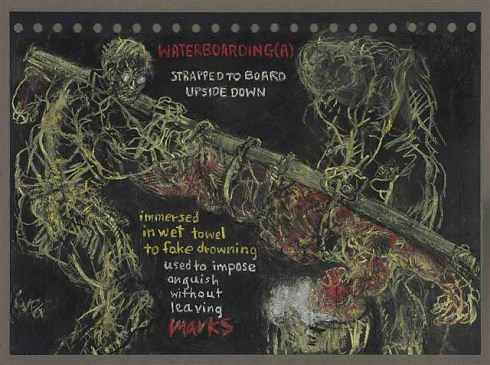
Black Book of Aggressors IV 35 WATERBOARDING. Selma Waldman Black Book of Aggressors 2005 – 2007, charcoal, pastel, on black paper, 8 1/2 x 11″

Black Book of aggresors IV WATERBOARDING. Selma Waldman Black Book of Aggressors 2005 – 2007, charcoal, pastel, on black paper, 8 1/2 x 11″
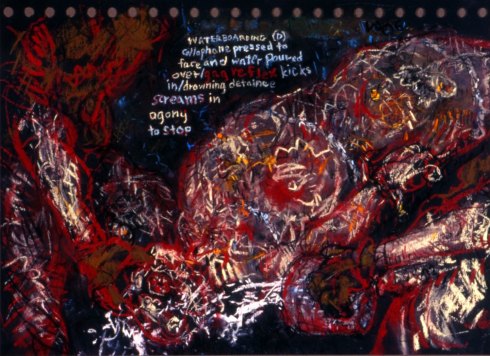
Selma Waldman. Black Book of Aggressors 2005 – 2007, charcoal, pastel, on black paper, 8 1/2 x 11″
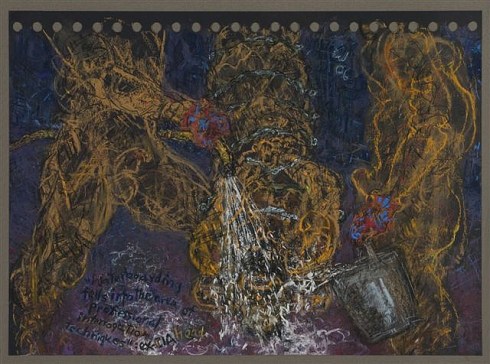
Black Book of Aggressors IV 39 WATERBOARDING PROFESSIONAL. Selma Waldman. Black Book of Aggressors 2005 – 2007, charcoal, pastel, on black paper, 8 1/2 x 11″
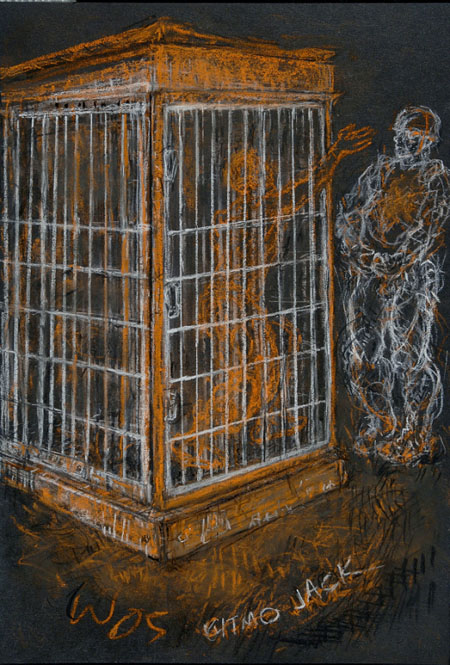
GITMO JACK, NAKED AGGRESSION. Selma Waldman. Black Book of Aggressors 2005 – 2007, charcoal, pastel, on black paper, 8 1/2 x 11″

Much of the work in the forthcoming Cruel and Unusual exhibition will be exhibited in Europe for the first time. Some of the photographers I have interviewed for Prison Photography before, but not Jane Lindsay.
I met Jane at Arizona State University, where she studies for an MFA and teaches the undergrads. With a warm heart, she’s talented, conscientious and new on the scene. I’m proud to showcase her work.

Jane’s series Gems gives back – to men and women arrested in Sheriff Joe Arpaio’s jurisdiction – the dignity he tries his best to strip from them. She is disgusted by Arpaio’s website Mugshot of the Day which publishes the booking photos of people taken into Maricopa County Jail, AZ. The site allows members of the public to gawp, laugh, and vote for their preferred “mugshot of the day.”
It’s public humiliation. It’s also an abuse of power. As Jane points out, many of the people booked into jail suffer with mental-illness, addiction, disability and may be victims of domestic violence or other abuse themselves. Sheriff Arpaio’s response? Insert them into his sideshow-freakshow.
Arpaio encourages us to be callous in our judgement of fellow humans. To be these ugly referees we must stop giving a damn about circumstance or story; we must suspend an interest in time and it’s ability to heal and change things; we must embrace the most lazy understanding of images.
Arpaio wants us to join him in his class-severed world of contempt and mockery. Jane Lindsay refuses.
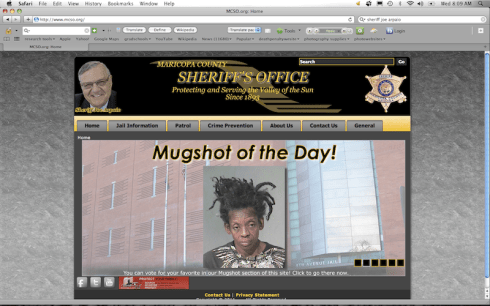

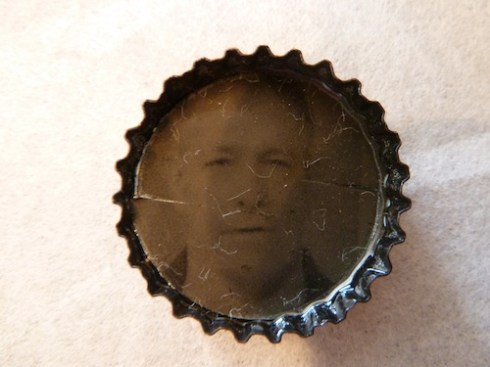
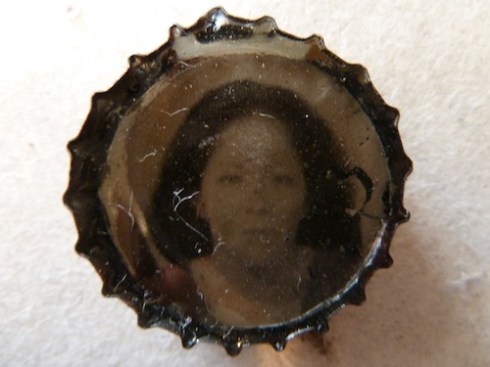
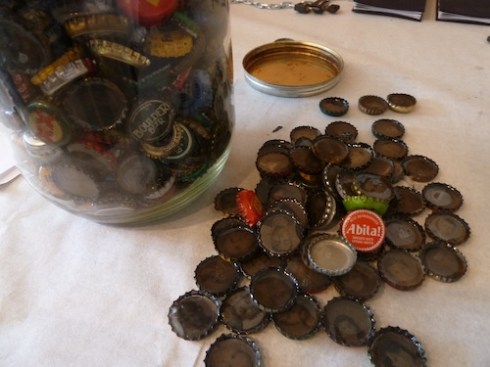
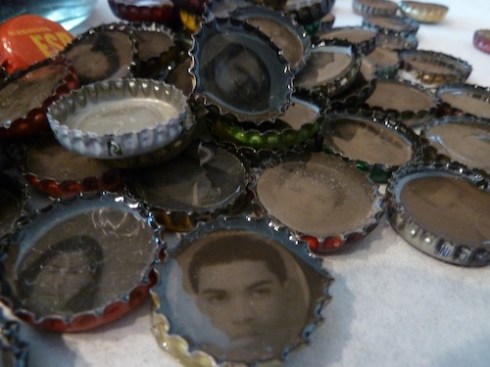
Screengrabs from the Mugshot of the Day website are transferred onto transparencies from which Jane makes a tiny tintype of each portrait. To date, she’s made over 6,000.
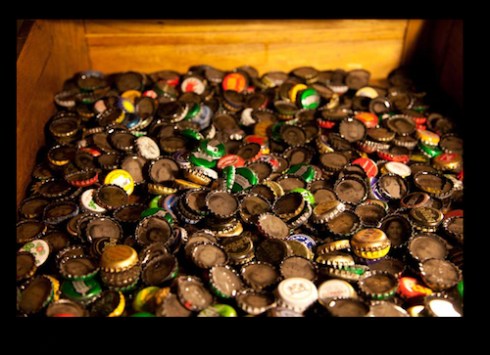
Within the hollow of a bottle cap she inserts a tintype and seals it with resin. These objects, to be held, mimic the eighteenth & nineteenth century devotion objects loved ones shared with each other. Like the contents of a locket without the chain.
Jane doesn’t even want to display them linearly as if to repeat the humiliation of Arpaio’s grid. So she gives them strength in numbers in a purpose-made box. When a viewer is ready they can dip in their hand, select one and spend some time with an individual.
Beautiful.

Jane Lindsay’s website is currently under construction.



















I hadn’t planned to interrupt my PPOTR coverage, but when something this important arises then to hell with convention.
You may be familiar with the name Jeffrey Stockbridge, and you’re probably well aware of his Taylor Wessing Portrait Prize shortlisted double-portrait of Tic Tac and Tootise.
Stockbridge has been photographing in Philadelphia for years with a focus on the Kensington Avenue neighbourhood, which Stockbridge describes:
Kensington Avenue is a hot spot for drugs and prostitution located in North Philadelphia. Populated by cheap bars, pawnshops, and check cashing businesses, the Avenue is also the major business corridor in the neighborhood.
Kensington Blues is not just another dip-your-toe-in-poverty photo project; Stockbridge has spent considerable time befriending many of his subjects. He gives them dignity, and with his designated website Kensington Blues, Stockbridge – through audio and transcription – gives each subject a voice.
I am quickly coming to value any photographer’s approach that, above all else, connects the subject to the photographer … and thus the subject to ourselves. Stockbridge’s Kensington Blues pays that attention to human connection.
BIOGRAPHY
Jeffrey Stockbridge is a photographer based in Philadelphia, Pennsylvania. In 2005, he placed runner up in the New York Times Magazine “Capture the Times” college photography contest. Stockbridge is well known for his projects documenting drugs, prostitution and urban blight in Philadelphia for which he has received several grants and awards. Stockbridge is a recipient of a Pennsylvania Council on the Arts Grant, Independence Foundation Fellowship in the Arts Grant and a Center For Emerging Visual Artists Fellowship. His work has been widely exhibited nationally and internationally. Selected exhibitions include The National Portrait Gallery in London, The Philadelphia Museum of Art, The Fleisher Art Memorial, The Delaware Art Museum, The Delaware Center for the Contemporary Arts and J. Cacciola Gallery. Stockbridge was recently awarded 3rd Prize in the 2010 Taylor-Wessing Photographic Portrait Prize at The National Portrait Gallery in London. Upcoming exhibitions include Galerie Huit Photography Open Salon 2011 in Arles, France and a solo exhibition of Stockbridge’s work is scheduled for July 2011 at The Wapping Project Bankside in London. (Source)

Matt Bor‘s statement is just terrific and pointed.
I’ve had a few conversation on my travels with people about the Occupy movement. For it to really drive the national agenda and to mold presidential candidates who will not be able to ignore the 99% the cause will need to unite workers, unions, students but most importantly the poverty-stricken.
The poor lose the most in a society where a select few control the majority of wealth.
I suspect poor folk might be more concerned with holding things together in their own neighbourhoods than having the time and incentives to join open-ended demonstrations in the downtown precincts of American cities.
But for a truly important Occupy movement the voices of the most disenfranchised are essential.
I’m left to wonder what the 2.3 million Americans behind bars (who obviously can’t pitch a tent or picket a capitol building) might think of the involvement of the people from their (usually the economically ravaged) communities. In fact I’m wondering what the incarcerated masses think of the Occupy movement generally.*
Despite the figure of incarcerated folk being actually about .7% of all Americans, we should note that 1 in 100 American adults are in prison or jail, and that 7 million American (approx 2% of the total population) are in custody, on parole or under other forms of supervision.
Matt Bor does a great job in confusing our presumptions about ‘freedom of assembly.’
I, for one, would appreciate seeing actual protest signs with this mantra at Occupy gatherings.
Check out Matt Bor’s blog and buy a copy of the cartoon here.
*Anecdotally, many prisoners I’ve worked with as an educator sympathise most with Republican notions of “freedom” and are suspicious of government “meddling”.

Editor’s note: I’ve broken with the PPOTR chronology to bring you Dispatch #12. The decision was made because of the time sensitivity of the issue at hand – California’s Prisoner Hunger Strike. Dispatches 6 to 11 will follow shortly.
“I think the tragedy of this situation is not the prisoners willingness to give up their lives, I think the tragedy is that the CDCR does not see them as human beings,” says Isaac Ontiveros, Communications Director for Critical Resistance and part of the press team for the Prisoner Hunger Strike Solidarity (PHSS) coalition.
The PHSS is made up of grassroots organizations & community members committed to amplifying the voices of hunger strikers.
The strike originally ran from July 1st – July 22nd. It was suspended briefly to investigate the viability of concessions made by the California Department of Corrections and Rehabilitation. These were unsatisfactory and the strike resumed September 26th.
LISTEN TO OUR CONVERSATION AT THE PRISON PHOTOGRAPHY ON THE ROAD PODBEAN PAGE
Ontiveros and I spoke on October 11th, day 15 of the resumed hunger strike.
TIMELINE OF THE CALIFORNIA PRISONERS’ HUNGER STRIKE
For three weeks in the month of July, 6,600 California prisoners* took on a hunger strike against the conditions of solitary confinement at Pelican Bay & other prisons. The strikers made five demands: access to programs, nutritious food, an end to collective punishment, compliance with the US Commission on Safety and Abuse (2006), and an end to the “debriefing” practice that affiliates prisoners to gangs; a process vulnerable to manipulation and false evidence.
Late in July, the strike was suspended but due to the slow and “inadequate” response of the California Department of Corrections and Rehabilitation’s response it was clear there was a need for the protest to resume. On September 26th the strikers refused meals once more.
On October 15th, after nearly three weeks, the prisoners at Pelican Bay ended the resumed strike.
The prisoners cited a memo from the California Department of Corrections and Rehabilitation (CDCR) detailing a comprehensive review of every Security Housing Unit (SHU) prisoner in California whose SHU sentence is related to gang validation. The review will evaluate the prisoners’ gang validation under new criteria and could start as early as the beginning of next year. “This is something the prisoners have been asking for and it is the first significant step we’ve seen from the CDCR to address the hunger strikers’ demands,” says Carol Strickman, a lawyer with Legal Services for Prisoners with Children, “But as you know, the proof is in the pudding. We’ll see if the CDCR keeps its word regarding this new process.” (Source)
Ontiveros and I discuss the history of hunger strikes, the unprecedented scope of the strike in the U.S., the necessity of the demands, late summer negotiations and retaliations by the CDCR and the need for continued awareness of this still developing struggle.
In the context of the sit-in within the Georgia prison system in December of last year, the California hunger strike indicates a growing political awareness of U.S. prisoners to their conditions and invisibility. “Our bodies are all we have left,” says Ontiveros assuming the position of an incarcerated striker.
Generally, prison strikes can be played down by authorities and overlooked by national mainstream media. As our discussion proves, awareness of the details in cases such as this are critical. We cannot wait for deaths to be knowledgable of the issue. Please watch developments in California to see if meaningful results for the CDCR and prisoners can be agreed upon and shared.
*6,600 is an official estimate, and the lowest possible figure. Some reports put the figure at nearly double that at 12,000.
PRISONER HUNGER STRIKE SOLIDARITY
Coalition partners include: Legal Services for Prisoners with Children, All of Us or None, Campaign to End the Death Penalty, California Prison Focus, Prison Activist Resource Center, Critical Resistance, Kersplebedeb, California Coalition for Women Prisoners, American Friends Service Committee, BarNone Arcata and a number of individuals throughout the United States and Canada. For more info on these organizations, visit PHSS’ resources page.
CRITICAL RESISTANCE
Critical Resistance seeks to build an international movement to end the Prison Industrial Complex by challenging the belief that caging and controlling people makes us safe. We believe that basic necessities such as food, shelter, and freedom are what really make our communities secure. As such, our work is part of global struggles against inequality and powerlessness. The success of the movement requires that it reflect communities most affected by the PIC. Because we seek to abolish the PIC, we cannot support any work that extends its life or scope.

Danny Lyon, Guns Are Passed to the Picket Tower, Ferguson Unit, Midway, Texas, 1968
During a brief speech made upon receiving the Missouri Honor Medal in Journalism, documentary photographer Danny Lyon made an astonishing call for insurgency in America:
“There, I said it, ” he added.
Lyon evokes the blood spilt as matter of course to forward the campaigns of the American revolution, the civil rights movement, and the anti-Vietnam protests.
I cannot argue with his politics but I am not ready to make a call for “blood on the streets.” Maybe, I am not brave enough; maybe I am still hopeful that meaningful change can occur in America through non-violent means. I just know if a right-winger made similar calls, I’d be repelled.
I bring this up because Lyon and I are scheduled for an interview in December and his comments must be revisited and tested.
For the benefit of the media, Lyon penned an 11-point “laundry list” of issues he wishes to see addressed – jail terms for the bankers responsible for the economic crash; rights for immigrant workers; jobs to enrich the environment. Items 9 and 10 caught my eye:
9) Abolition of the American prison system as it stands.
10) Immediate reviews and interviews inside state or federal prisons by public committees and parole boards with any inmates that have been inside prison for twenty calender years.
Prisons have grown as a result of social division, greed and flawed abstract notions of justice – seemingly, the same damaging forces in *free* society to which Lyon responds.
The Attica Prison Uprising occurred at the Attica Correctional Facility in Attica, New York, United States in 1971. The riot was based in part upon prisoners’ demands for better living conditions, and was led in large part by a small band of political revolutionaries.
On September 9, 1971, responding to the death of prisoner George Jackson, a black radical activist prisoner shot dead on August 21 by correctional officers in California’s San Quentin Prison, about 1,000 of Attica prison’s approximately 2,200 prisoners rioted and seized control of the prison. They took 33 staff hostage and began negotiations with the state. Governor Rockefeller refused to visit the site and sanctioned the taking of Attica Prison by force.
At 9:46am on Monday, September 13, tear gas was dropped into the yard and New York State Police troopers opened fire non-stop for two minutes into the smoke.
In total there were 39 deaths during the Attica Rebellion; 29 of which were prisoners and ten were guards held hostage.

 Prison Photography