
You are currently browsing the category archive for the ‘Activist Art’ category.
An artist’s use of photography to stick it to the man
Asim Rafiqui brings to our attention the response of Hasan Elahi, a Bangaldeshi-born American citizen, to government suspicion and the FBI’s unwillingness to remove him from the “watch-list”.
Since 2002, Elahi has monitored his own movements on his website Trackingtranscience.net
Rafiqui:
Elahi posts his day, every single mundane aspect of it. A globe-trotting Professor of media, he posts all his activities, complete with GPS coordinates and the date/time stamps at the site, effectively monitoring his daily life. His meals, toilet breaks, airport waits and almost all the mundane acts that define 99% of what constitutes modern life. His server logs reveal that the Pentagon, and even the Executive Office of The President have clicked in while the FBI continue to monitor his activities through this site itself. Our tax payer’s money at work.
Pictured below, Elahi’s toilet breaks.

Two years ago, Elahi appeared on the Colbert Report and explained that if 300 million Americans did this, the FBI would have to employ millions of agents just to keep up with the data flood. Subversive, funny and the best type of protest … except he’s left with no privacy.
HASAN ELAHI
Hasan M. Elahi is an interdisciplinary media artist with an emphasis on technology and media and their social implications. His research interests include issues of surveillance, sousveillance, simulated time, transport systems, and borders and frontiers. Elahi is currently an Associate Professor at the University of Maryland. He previously taught at San Jose State University; Rutgers; the University of South Florida in Tampa, Florida; West Virginia University; Wanganui School of Design, in Wanganui, New Zealand; and also in Houston, Texas.
Elahi’s own site – http://elahi.umd.edu/
The Visible Man: An FBI Target Puts His Whole Life Online, Wired.com, by Clive Thompson, 05.22.07.
– – – – – – –
Found via Andrew Jackson’s Writtenbylight blog

As part of the ongoing OPEN-i project, Edmund Clark and I discussed Ed’s latest project Guantanamo: If the Light Goes Out.
Ed’s nuanced work from on Guantanamo began with his documenting the domestic interiors of released British detainees. As Ed progressed he realised he needed to go to the US base on Cuba. The project deliberately jumps between these environments of “residence”, forcing the viewer to consider the personal as opposed media representations we otherwise rely on.
Ed’s work deliberately excludes portraits of detainees, partly because he feels those images are widespread but also due to a belief that audiences react to “images of bearded men” with unavoidable prejudice.
Ed also looks at the leisure spaces on Guantanamo that US military personnel inhabit during down time. The juxtapositions are poignant.

The photographs in the book Guantanamo: If the Light Goes Out wrap around letters received by detainee Omar Deghayes during his time in Gitmo. Except they are not letters, they are copies, processed, redacted, re-processed, copied again. If he received a colour copy it was a rare treat. Some of the correspondence is so bizarre, Deghayes wondered if the were genuine or if they were props to the mind games played by his captors.
My family has been urging me for years to talk more quickly, and having heard myself here I get their point. The only excuse I have is that it was early in the morning here on the Pacific Coast when we sat down for the webinar.
Ed, on the other hand, talks wonderfully about the images and their situation in our shared GWOT visual landscape.
PHOTOGRAPHS AS IMPLEMENTS OF TORTURE
The book, Guantanamo: If the Light Goes Out concludes with an essay by Dr. Julian Stallabrass. He describes a rather pernicious and Luddite use of photographs in psychological torture at Guantanamo:
Al-Qahtani was repeatedly shown photographs of scantily dressed women, along with images of 9/11, particularly pictures of children who had died that day, had the pictures taped to his body, and to ensure that he had paid them close attention, he was induced to answer questions about them.
This is a practice of interrogation of which I was not aware and is obviously troubling; a deliberate use of imagery to vex and agitate and an example of the power of photography as applied in an abusive context.
OPEN-i
Thanks to OPEN-i coordinator Paul Lowe for inviting me back once again. It’s an honour to speak with a photographer at the top of his game. OPEN-i is a global network hosting monthly live discussions on critical issues relevant to documentary photography and visual storytelling.
EDMUND CLARK
Edmund Clark is winner of the 2010 International Photography Awards (The Lucies), 2009 British Journal of Photography International Photography Award, and the 2008 Terry O’Neill/IPG Award for Contemporary British Photography for his book ‘Still Life Killing Time’. His work is in several collections including The National Portrait Gallery, London, and the Museum of Fine Arts, Houston.

GITMO – OTHER READINGS
Prison Photography archive of posts referring to Guantanamo.
The Prison Photography Guantanamo: Directory of Photographic and Visual Resources (May 2009)

The Hell of Copper (L'Enfer du Cuivre). Series: The Hell of Copper. 1800x1200. January-November 2008. Accra, Ghana. © Nyaba Leon Ouedraogo
 Burkina Faso-born Nyaba Leon Ouedraogo is one of the twelve shortlisted photographers for the Prix Pictet.
Ouedraogo’s ‘The Hell of Copper’ (L’Enfer du Cuivre) depicts the Aglobloshie Dump in Accra, Ghana. “From dawn to dusk, dozens of young Ghanians, from 10 to 25 years of age, exhaust themselves […] seven days a week. Their mission is to disassemble the old computers and burn certain plastic or rubber components to cull the precious copper, which will then be resold. Everything is done by hand or with iron bars, makeshift tools found among the refuse. They have neither masks nor gloves. There are not even any functioning toilets,” says Ouedraogo.
Ouedraogo quotes a 2008 Greenpeace report on toxic substances at the site:
– lead: in cathode tubes and monitors, harms the nervous, reproductive, and circulatory systems.
– mercury: in flat screens, harms the nervous system and the brain, especially in young children.
– cadmium: in computer batteries, dangerous for the kidneys and the bones.
– PVC: this plastic used to insulate electrical wires, when burned, gives off carcinogenic chemical substances that can cause respiratory, cardiovascular and dermatological problems.
Ouedraogo’s pictures are good, but I don’t think they are good enough. The story is vital but the images don’t live up to its importance (presuming the 10 images edit for the Prix Pictet are his best works.)
In truth, I don’t want to criticise the work of a photographer from Burkina Faso. When was the last time a photographer from Western, Eastern or Central Africa was shortlisted for a major photography prize? We should be celebrating the recognition. But Ouedraogo shouldn’t win; the project is not polished enough.
For the record, I don’t think big-guns like Taryn Simon or Ed Burtynsky should win either: they don’t need the exposure and their work is familiar, a bit dated and easy to digest.
I hope either Stéphane Couturier or Vera Lutter win.
INTRODUCING PIETER HUGO
Back to Aglobloshie. It’s a familiar subject to us photo-nerds, not least because Pieter Hugo’s Permanent Error about Aglobloshie did the rounds a few months back.
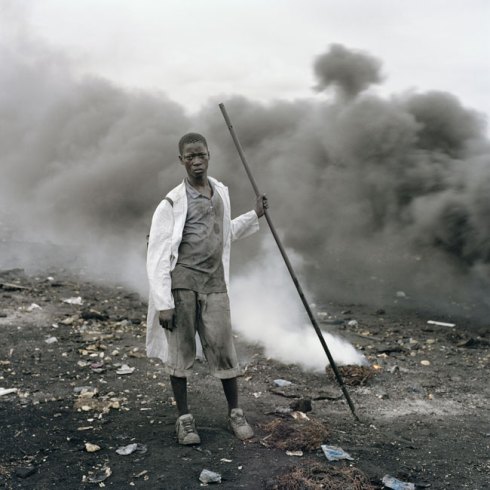
Abdulai Yahaya, Agbogbloshie Market, Accra, Ghana. 2010. @ Pieter Hugo
Hugo was very quick at turning his images round. They were distributed within months of his 2010 visit to Aglobloshie. Yet, it was Ouedraogo who went to the toxic site first; in 2008, a full two years before Hugo set up his camera.
Hugo has been the centre of debates on race and representation before, so it is with even more reluctance I draw the comparison to Ouedraogo. Hugo’s portfolio contains dozens of images and so it can boast a wider view of the poisoned micro-environment. This works in Hugo’s favour.
Both photographers emphasise the prevalence of child labour, the presence of grazing livestock and the use of found tools and noxious open fires to extract copper from the scraps. If you look at the statements by Ouedraogo and Hugo they contain virtually the same info.
Again, it is the story that is of primary importance, here.
The ultimate question then, is which portfolio is best likely to capture the attention and imagination of viewers enough for them to shift their worldview of politics, consumption and globally connected “growth”? (“Growth” is the theme of the Prix Pictet this year.)
Hugo’s work sells in galleries and it made for those gallery sales. It’s also a bleak look at the conspicuous consumerism. Ouedraogo’s work is uses photojournalist angles, some portraits and shots of the expanses of computer carcasses. Ouedraogo’s work is less cohesive. And for some reason I want to say it peels away.
I’m not really convinced by either, but I’d still err reluctantly to the foggy Hugo square.
The one thing Hugo’s work lacks is the sentiment (and hope?) of the picture below, with which Ouedraogo closes his portfolio.

The Hell of Copper (L'Enfer du Cuivre). Series: The Hell of Copper. 1800x1200. January-November 2008. Accra, Ghana. © Nyaba Leon Ouedraogo
The other eleven finalists for the Prix Pictet are Christian Als (Denmark); Edward Burtynsky (Canada); Stéphane Couturier (France); Mitch Epstein (US); Chris Jordan (US); Yeondoo Jung (Korea); Vera Lutter (Germany); Taryn Simon (US); Thomas Struth (Germany); Guy Tillim (South Africa); Michael Wolf (Germany). Biographies here.
UPDATE 11.12.2010, 12.30pm PST: Forsell didn’t win. Announced 11.12.2010 in Bristol, UK Yvonne Venegas won for her portrayal of Maria Elvia de Hank, millionaire wife of an eccentric former mayor of Tijuana. Julian Roeder and Rob Hornstra also made the final three.
This will not put me off making predictions in the future. I’ll just have to adopt unpredictable criteria and decision making to mirror the many diverse jury panels. And I stand by everything I said about Forsell’s ‘Life’s a Blast’.
– – – – –
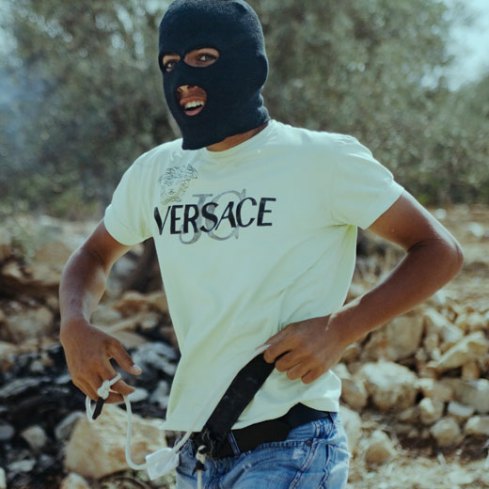
© Linda Forsell
I’ll admit to being rather deflated after looking over the shortlisted photographers for this years Magnum Expressions Award. Many of the portfolios of 15 images had only one or two photographs that held my attention.
The Magnum Expressions Award is in reaction to the brave new world photographers face; new communities, new audiences, new distribution channels and bold ways of working. It is an award designed – so it says – to reward young photographers surfing the shifting sands beneath the industries footings.
It should be said that most of the 19 shortlisted artists have hunted down engaging subjects. Bepi Ghiotti‘s Sources is an enigmatic thesis on man and nature. Yvonne Venegas’ fly-off-the-wall study of Maria Elvia De Hank wife of an eccentric millionaire and former Tijuana mayor bristles with ambivalence toward the subject.
I was pleasantly surprised to see the presence of two photographers who’ve briefly pricked my attentions. Anastasia Taylor-Lind and Irina Rosovsky both deliver strong entries. (On PP, Taylor-Lind, here and Rosovsky here).
These would be my 3rd through 6th placed finalists, but who’s listening to me, eh?
In at second is Jenn Ackerman. This high finish has little to do with my interest in photography that exposes the shortcomings of the US prison system and everything to do with the excellent way Jenn portrays the daily battles and extreme stress of a prison operating as a makeshift and unsuitable lock-up for men with severe mental health disorders – Trapped: Mental Illness in America’s Prisons. (I’ve featured Jenn’s work here on PP before.)

© Linda Forsell
‘LIFE’S A BLAST‘ BLOWS THE COMPETITION AWAY
And, winning by a country mile is Linda Forsell. Gold star.
Forsell’s Life’s a Blast is the sweetest, never-escaping-bitter view of Palestine, Gaza & Israel I’ve ever clapped my eyes on. It’s about family more than ideology, but it is never glib. It is work as conscious of history as it is the mores of fashion photography. It’s a slow-ride through the lives of people associated by a larger conflict but not solely defined by it; a stunning presentation of gazes drenched in humanity.
Against all odds, Forsell forces the viewer to think on the stories of her subjects; on the seconds before the shutter snapped and the years yet to come. I have not seen a single project that so swiftly dismantles many of the entrenched tropes of conflict photography. Life’s a Blast shifts perceptions like only the very best of photography can.
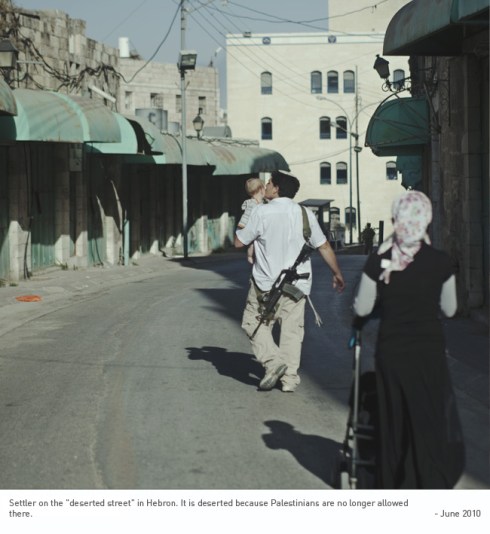
© Linda Forsell
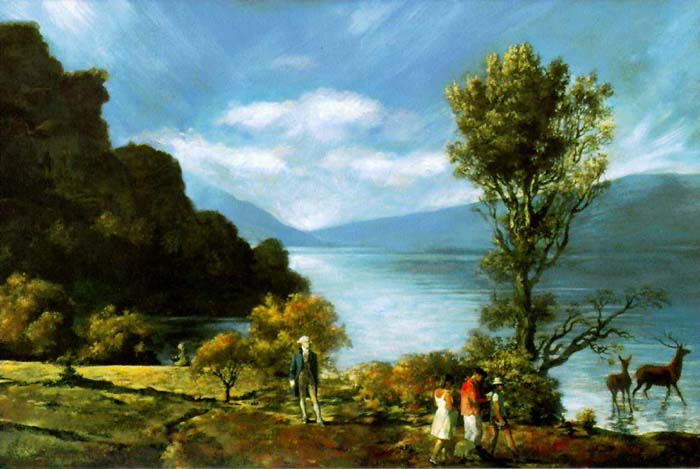
Komar & Melamid UNITED STATES: MOST WANTED PAINTING.
I am not asking here about photographs of America’s Most Wanted, I am asking quite literally about what photograph America most wants.
This question has virtually nothing to do with the most expensive photographs, as that list only tells us the dollars put behind one person or groups’ well-heeled want.
The question is not so ridiculous, nor should it be totally subjective. In 1994, Russian artists Komar and Melamid embarked via online survey to discover the appearance of the most and least wanted/desired paintings for people across different countries. George Washington chilling with three kids and a couple of wading deers (above) is – according to the science – America’s most wanted painting.
Komar and Melamid asked preferences toward colours, modern or traditional styles, old or new subjects, wild or domestic animals, natural or portrait, outdoor or indoor, realistic or different looking (if different whether exaggerations of real objects or imaginary objects were better).
They asked whether paintings should teach a lesson, relate to religion, be relaxing. They asked if paintings should be textured or flat, colors blended or separate, brush strokes or smooth paint, serious or festive, busy or simple, large or small. They asked if the painting should include geometric or random patterns. If the painting was of people should they be famous or ordinary, nude or clothed, working or at leisure, historic or recent figures, single people or groups.
Komar and Melamid asked for opinions on Picasso, Pollock, Dali, Monet, Rembrandt and Warhol. They also asked if they preferred black and white or colour.
[By the by, the letters about the survey are hilarious!]
If we were to do the same with photography on what criteria would we canvas response? As you think on that you may want to listen to America’s Most Wanted Song, as determined by a similar Komar and Melamid survey. If that doesn’t convince you about the wisdom of crowds then America’s Least Wanted Song will. We can, it seem, all agree on what is terrible!

I really would like to develop a list of criteria for defining what we want from a photograph:
B&W or colour; celebrity or ordinary people; pets or wild animals; square or rectangle shaped; people that look like you or people that look different to you; street or interior; with caption or no caption; candid or posed; family and friends or strangers; part of a story or single image; realism or abstract; In focus or blurry; historical or recent scenes; with or without border/sprocket holes; large objects or fine detail, obvious or hidden objects; visual pun or dry as a bone, film or digital, pixels or no pixels, starving or healthy environments?
Should a photograph be amusing, moralistic, quick to understand or engaging over time; deliver a message, educate, allow the viewer to escape, assist with dreams, show you things you know or things you don’t.
As for the touchstone photographs to gauge taste by? Opinions on the works of Steichen, Leibowitz, Apollo mission photographers, photobooths, Matthew Brady, school portraits, war photographers’ works, Joel Sternfeld, newspaper or magazine photographers, Gerhard Richter, Miroslav Tichy, porn videographers’ stills?
What would be – what is – America’s Most Wanted Photograph?
Below, for your viewing pleasure are the most wanted paintings of various other countries.
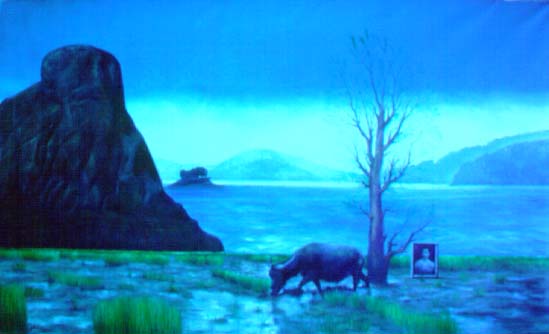
Komar & Melamid CHINA: MOST WANTED PAINTING
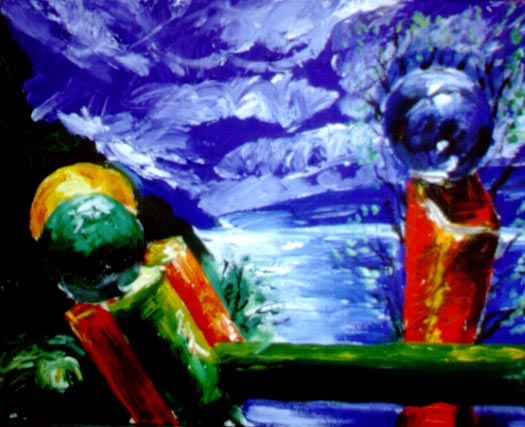
Komar & Melamid ITALY: MOST WANTED PAINTING
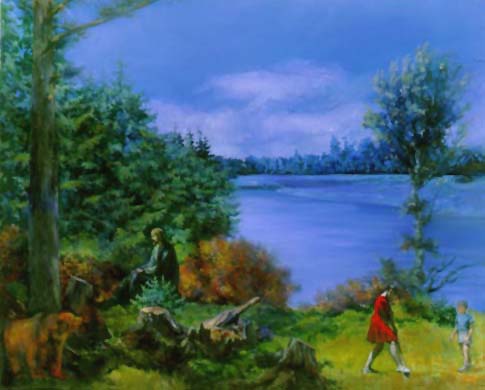
Komar & Melamid RUSSIA: MOST WANTED PAINTING
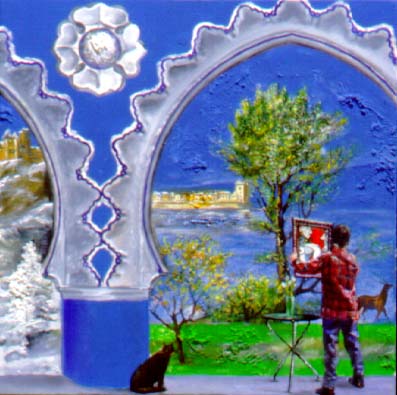
Komar & Melamid GERMANY: MOST WANTED PAINTING

Komar & Melamid FRANCE: MOST WANTED PAINTING
Painting by Numbers: Komar and Melamid’s Scientific Guide to Art, JoAnn Wypijewski (Editor) is available at all good thrift stores (and Amazon)
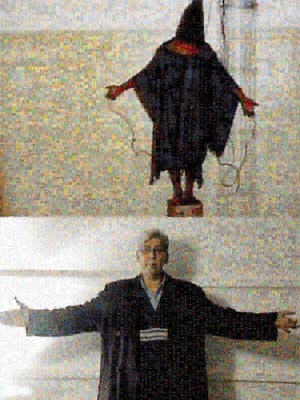
Joan Fontcuberta describes his work as “anti-authoritarian.” He is a self-taught artist and former journalist who has adopted the tricks and issues of media manipulation/propaganda into his work.
Fontcuberta’s Googlegrams are “large, colorful photo-mosaics that construct a metaphor for the internet-era’s liaisons between mass media and our collective consciousness. Using Google to blindly cull images from the internet by controlling only the search engine criteria, Fontcuberta then assembles them by another computer program into a larger photomosaic image of Fontcuberta’s choosing.” (Source)
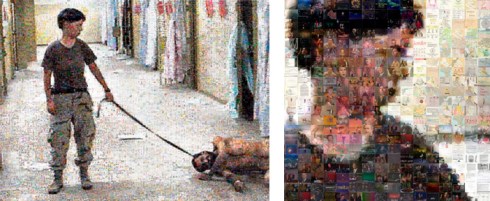
Fontcuberta’s an iconoclast, a philosopher and doesn’t trust the image. He encourages people to distrust, but ultimately recognises that people must believe: “people need information.” (Which may relate to the necessary reinsertion into – and commitment to – the image Joerg’s calling for.)
It’s all about healthy skepticism and filtering. He’s the furthest thing from a pessimist; he teaches photographic history and adores the medium. But he is not a sap.
Fontcuberta’s work deliberately fictionalises and questions. Jim Casper’s well-metred audio interview and VICE‘s interview flesh out his approach and motives.
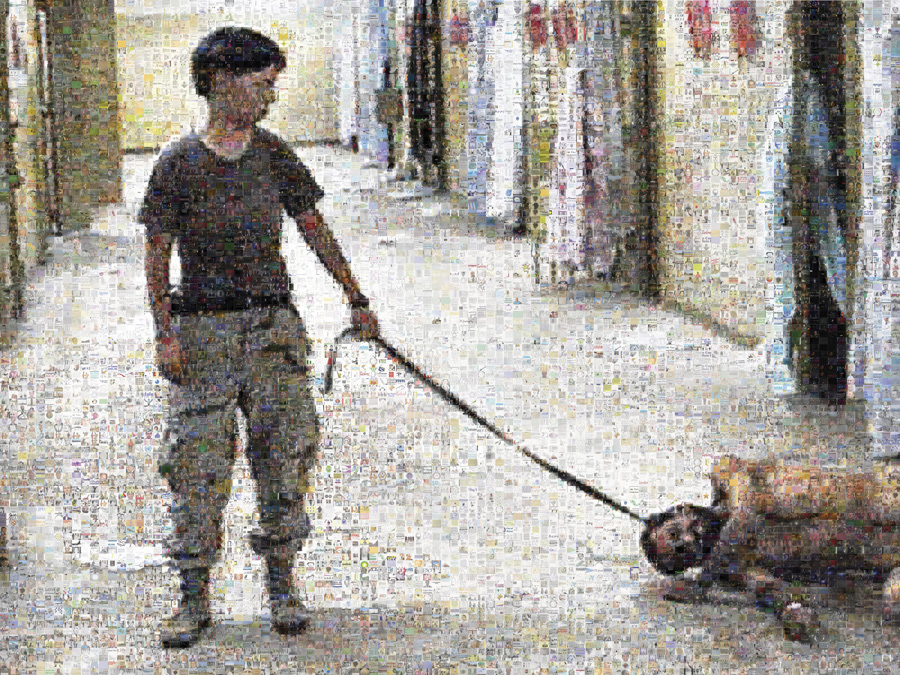
What I admire about Fontcuberta is that having abandoned the urge to fight against the crimes of photoshop, advertising and image politics, he plays them at their own game. His ideas are uninhibited; it doesn’t matter if the lost Japanese soldiers of WWII in the Philippines jungle that he went in search of exist or not. Fontcuberta puts the exploration of an idea before the pressure to produce an end product. “The look of my work is not important,” he says.
Fontcuberta is playful and really jolly. I’d love to see him take on a cryptozoology expedition!
BIO
Joan Fontcuberta was born in 1955 in Barcelona, where he continues to live and work. He has exhibited extensively at museums and galleries in the U.S., Europe, and Japan, and has been associated with Zabriskie Gallery since 1981. His work is in numerous institutions, including the New York Museum of Modern Art, the San Francisco Museum of Modern Art, and the Art Institute of Chicago. He contributes regularly to scholarly journals and has published many books, including Fauna, Sputnik and Miracles and Co.
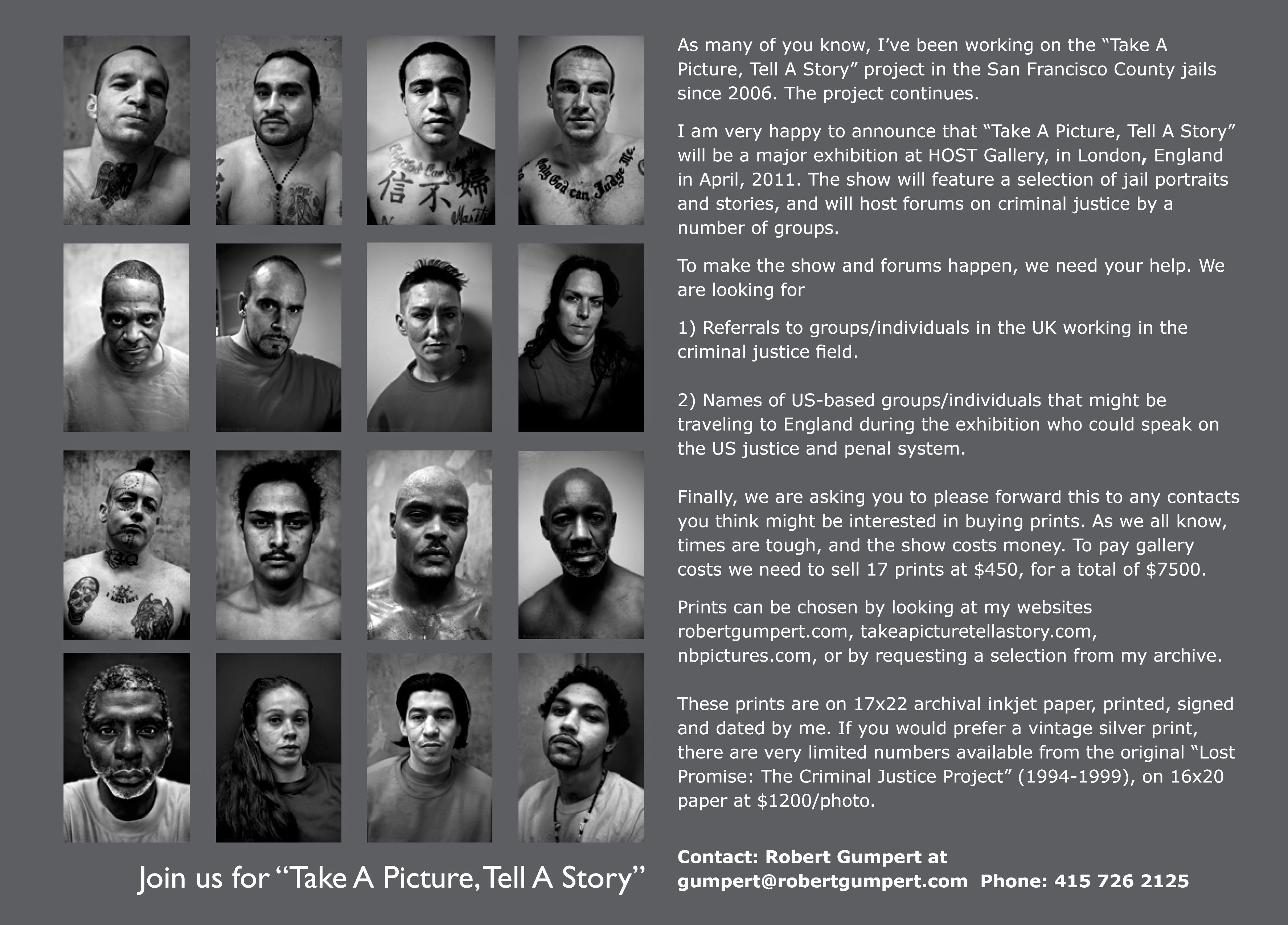
Good friend Bob Gumpert will be showing his portraiture from the San Francisco and San Bruno county jails at HOST gallery in London in April of next year.
From Bob’s email this week:
As many of you know I’ve been working since 2006 on the “Take A Picture, Tell A Story” project in the San Francisco County jails. The project continues. I go into the jails about three times a month and post to takeapicturetellastory.com as time and stories allow.
The show will host forums on criminal justice by a number of groups. To make the show and outreach happen we need your help with the following:
1) Referrals with groups/individuals in the UK working in the criminal justice field.
2) Names at US based groups/individuals that might be traveling to England during the exhibit who could speak on the US system.
3) Forwarding this note and flyer to your any of your contacts that might be able to help with contacts or might be able to help with funding by purchasing a print.
Obviously, I have a wild bias in seeing work such as Bob’s getting a wide audience.
Yet, photography from prisons/jails tests the theory that photography shows and delivers stories we otherwise would not see. Bob’s portraits and audio gives voice to the marginalised. Whatever the reasons for their incarceration, no one deserves to be made invisible. Bob’s work empowers his subjects and reveals the limitations of our criminal justice systems.
So, friends stateside and over there in Blighty, get your thinking caps on and see if you can help spread the word and find him some allies (and cash?)


Golf Five Zero watchtower. Crossmaglen, South Armagh, Northern Ireland, UK. © Jonathan Olley.
Last month, I had a jolly nice chat with a jolly nice chap about what all this means at Prison Photography. Where’s this open journal taking me?
I said if I took this whole thing to the academy, it could be as simple as a historic survey: The Uses of Photography to Represent, Control and Surveil Prison, Prisoners and Publics in the United States (1945 – 2010).
I was encouraged to ditch the historical view and engage the modern. Ask myself, why should anyone care about prisons? Only a small minority care now and that status quo has remained for many reasons tied up in the antagonisms of capitalism. Would a historical survey change minds and attitudes or just lay out on paper the distinctions most people have already made between themselves and those in prison?
Perhaps people would care more if the abuse of human rights that exists within the criminal justice system of America were shown to impinge on everyone, not only on those caught in its cogs?*
What if we consider the methods and philosophies of management used by prisons and identify where they overlap with management of citizens in the “free” society. Think corporate parks, protest policing, anti-photography laws, stop and search, street surveillance, wire taps, CCTV.
My contention has always been that there was no moral division or severance of social contract over and through prison walls. For me it’s never been us & them; it is us & others among us put in a particular institution we call prison.
But, now I am seeing also, there is an ever decreasing division of tactics either side of prison walls. Strategies of management and technologies of discipline perfected in prisons have crept into daily routine.
What has this emphasis on containment and of monitoring – at the expense of education and social justice – done to our society and to our expectations of society?
SURVEILLANCE/CCTV IN PHOTOGRAPHY
And now for the tie in with photography…
Thinking about surveillance, obviously we have the big show at Tate from this Summer, Exposed: Voyeurism, Surveillance & the Camera with its devoted section to CCTV. (Jonathan Olley‘s work from Northern Ireland is the standout.)
But I always think back to Tom Wichelow‘s series Whitehawk CCTV (1999), possibly because he insists it is not a criticism of CCTV just a look at the politicisation of the human subject viewed through its lens.
Most remarkable in the series is the trio of images of the tragic site of a murder. They reveal to us that looking and bearing witness can be an act of respect as much as that of curiosity as much as an act of control. We are all compelled to look, but some observers are recording the feed and have a disciplinary apparatus to back it up.

Untitled (CCTV footage). Young family visits murder site. Brighton 1999. © Tom Wichelow

Untitled. Friends of murdered boy visit the site. Brighton 1999. © Tom Wichelow

Untitled. Resident reveals murder site outside her bungalow window. Brighton 1999. © Tom Wichelow
– – –
*There’s a simple argument that we all suffer because our tax dollars support a broken system that makes us no safer.

 Prison Photography