
You are currently browsing the category archive for the ‘Activist Art’ category.
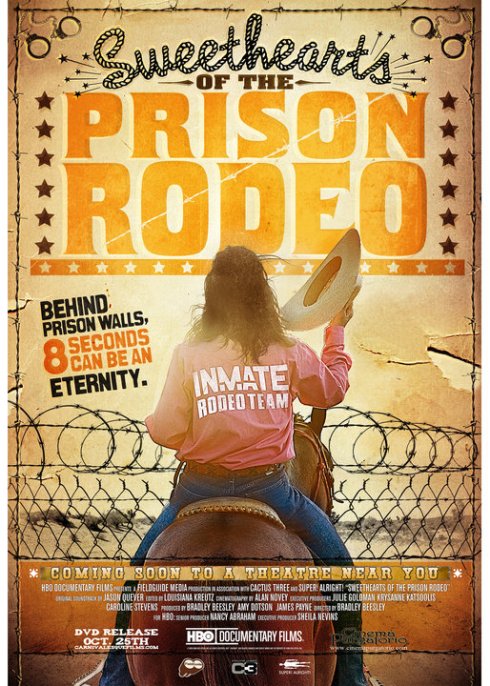
Filmmaker Bradley Beesley and his team admit beginning the project “mostly informed by the cultural lore of prison through film and music such as Cool Hand Luke, Stir Crazy, and Folsom Prison Blues.” That quickly changed. Sweethearts of the Prison Rodeo was released Friday.
I’ve talked about prison rodeos before (Damon Winter, Tim McKulka and Gary Winogrand). The Oklahoma State Penitentiary Rodeo is new to me; didn’t know it existed. It’s the largest “Behind the Walls” rodeo in the US.
From the synopsis, “In 2006, female inmates were allowed to participate in the rodeo for the first time. In a state with the highest female incarceration rate in the country, these women share common experiences such as broken homes, drug abuse and alienation from their children. Since 1940, the Oklahoma State Penitentiary has held an annual ‘Prison Rodeo’. Part Wild West show and part coliseum-esque spectacle, it’s one of the last of its kind – a relic of the American penal system […] Within this strange arena the prisoners become the heroes while the public and guards applaud.”
I was also happy to find a Q&A with three ladies from Sweethearts of the Prison Rodeo at SXSW 2009. They’d been out a year at the time. They are optimistic and they are role models.
Since last year, Sweethearts of the Prison Rodeo has shown around the world and inside prisons.
The self-respect gained by the ladies necessarily tempers my reservations toward prison rodeos. It seems like they’ve genuinely benefited from the activity, but this could have as much to do with the film-making around the activity. The entire package was a program in team building, setting and achieving goals.
The film also has a much needed outreach component:
“We’d like to use this documentary and the stories of the people connected with the film to help recognize the lives of inmates and those re-integrating into society. We’d like to create grassroots dialogue to improve awareness of issues and create opportunities. In addition, Sweethearts of the Prison Rodeo is establishing a Scholarship for inmates attending college while incarcerated.”
Bravo, bravo … I don’t want an encore though. I want the ladies to keep kicking recidivism rates into touch.
Anyone interested in tertiary education in prisons should go to the Higher Education in Prisons: Strategies for Action, a symposium hosted by The Education Justice Project, University of Illinois at Urbana-Champaign.
A very impressive line up of leaders in college level educational programming plan to be there.

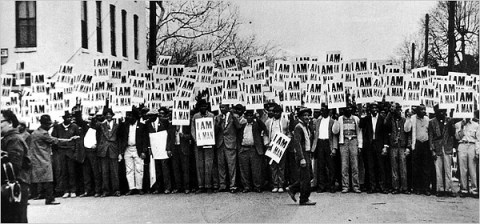
Two stories that broke this week demonstrate the levels to which everything is never as it seems.
The New York Observer describes links between Leslie Deak and funders of the controversial mosque, the CIA and U.S. military establishment have gone unacknowledged.
Meanwhile, The Commercial Appeal in Tennessee reports famed and revered Civil Rights Photographer Ernest Withers doubled as FBI informant to spy on civil rights movement.
Democracy now states, “Withers’s alleged involvement was revealed because the FBI forgot to redact his name in declassified records discussing his collaboration.”
Withers died in 2007.

Thanks to Stan for the tip off.

© Evan Bissell
Artist Evan Bissell brought together a group of teens who had not known each other previously, but shared a common circumstance; they were children of men incarcerated at San Francisco County Jail.
The project, What Cannot Be Taken Away: Families and Prisons Project, spanned 9 months.
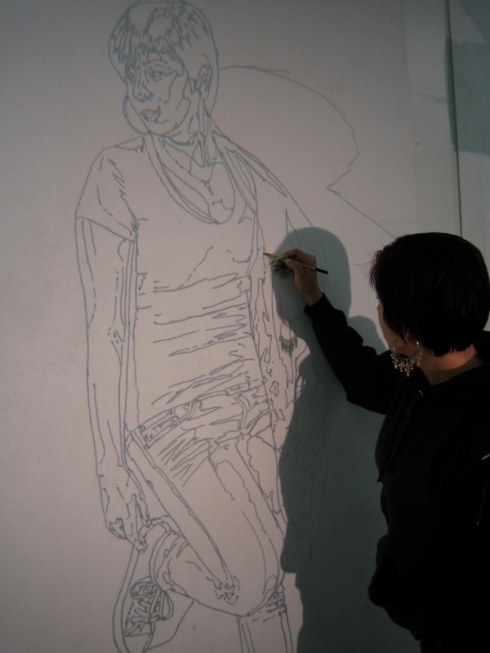
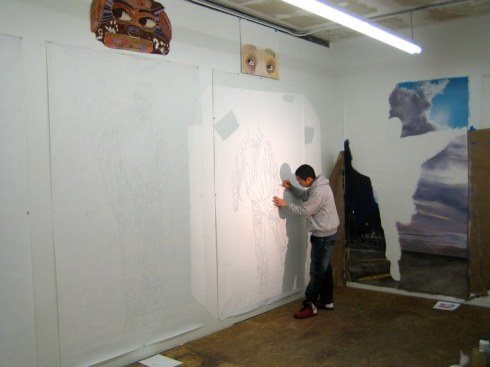
Bissell and the teens shared writings and audio to establish themes for their work. Later they would visit family in SF County Jail and take photographic portraits to work from. Eventual they mounted a show at SOMArts in San Francisco.
I am a little unsure as to the ultimate claim the students have on the final product. Evidently, they decided the elements and the design, but every piece is finished with the polished painting skills of Bissell’s brush. But of course, it wasn’t only these large portraits on view; exploratory/experiential paintings of the students were displayed and the centre-piece of the show was an installation piece.
Despite the apparent dominance by Bissell over the final product, the intangibles of the collaborative project – including but not limited to discussion, new ideas, “healing & justice”, friendship, self esteem – far outweigh a critic’s (my) reserve.
I highly recommend you download the PDF time-line; it offers an impression of the shared politics of the project. Also the process describes the engagement between teacher and student.
PHOTOGRAPHY?
The tie in comes from a quote by Bissell, “I was unfortunately not allowed to photograph our workshops in the jail, so all of the pictures come from our meetings with the youth.”
© Evan Bissell
© Evan Bissell

© SOMArts
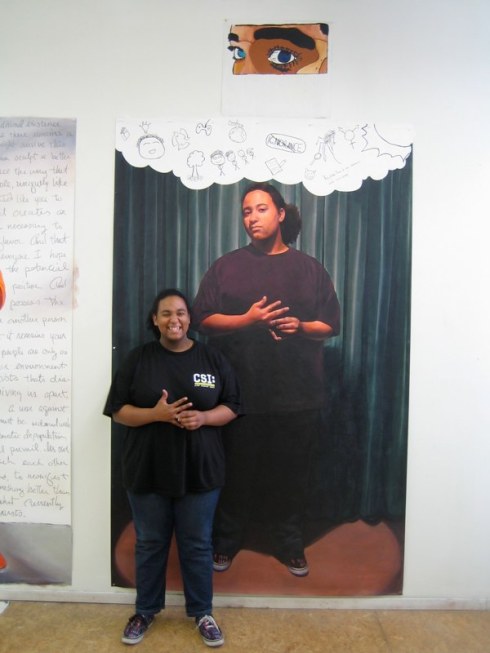
© Evan Bissell

© Evan Bissell
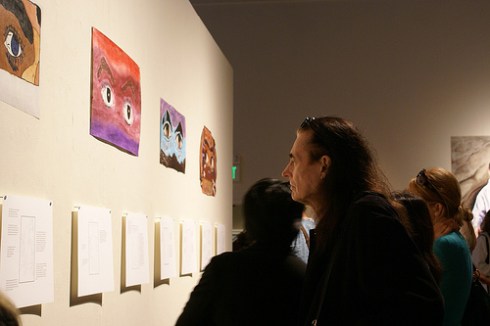
© SOMArts

© SOMArts
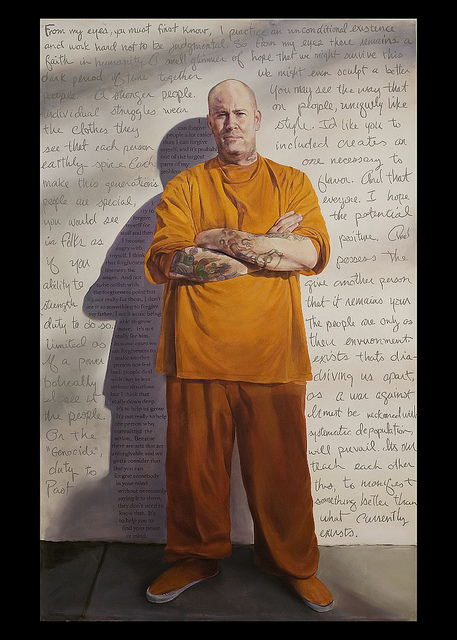
Image credit: Joe, by Evan Bissell, acrylic paint on board. © SOMArts
What Cannot Be Taken Away: Families and Prisons Project. Closing September 19th 12:00-2:00 at SOMArts – 934 Brannan St. in San Francisco (at 8th Street).
All images from Bissell’s WCBTA website and SOMArts Flickr.
UPDATE: For more visuals go to:
http://www.flickr.com/photos/8883932@N02/4027649839/in/photostream/
http://www.speakingloudandsayingnothing.blogspot.com/
– – – –
If JR went to Navajo land, he’d hang out with James “Chip” Thomas.
Just love this guy.
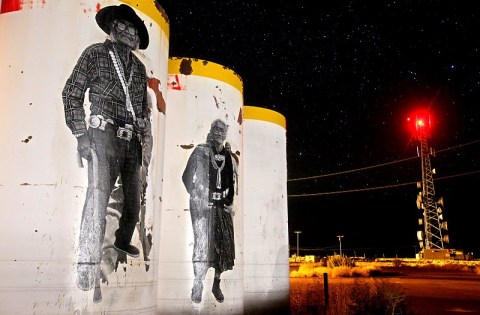
Grey Mountain, artwork by Chip Thomas © Erika Schultz
Just got in from the NW Photojournalism meet. Room chock full of talent including Matt Lutton (of Dvafoto fame) Theo Stroomer, Tim Matsui, Ken Lambert, David Ryder and John Malsbary.
Let me track back a week though.
SOME THOUGHTS AND CONTEXT ON NAVAJO GRAFFITI
A friend of mine who I’ve seen only twice in two years visited Seattle last weekend. He’s Native American … what white folks would call Navajo, but what he refers to as Dineh or Dine (pronounced d-Nay). We were talking about youth culture on the reservation and I mentioned passing through Window Rock (a junction with two gas stations, some vernacular murals and loose packs of dogs). He tells me I was in the wrong part of Navajo Reservation …
Anyway, the murals had me thinking. I saw graffiti on Navajo land – some of it good, some of it terrible; some of it lazy tags, some of it a bit more invested – and I wondered about the social context of these scrawls, paintings and artwork. I proposed to him that a long term photography project NAVAJO GRAFFITI could capture these temporary art interventions. The project would include interviews about the grafs and the social strata from which they emerge. It seemed like it could be a meaningful, novel photography project, a stellar book. Maybe?
In my mind (a place I often invent projects I’d like to see and promote) I envisioned image-making that could incorporate the narratives of a marginalised people without relying on cliches of documentary photography. The grafs could be photographed in the medium format stillness that is all too often wasted on garages, topiary and mall parking lots.
Just a thought.
Thinking on, my friend was as stumped as I to think of any photography work that the Navajo had been able to present, let alone self-represent.
BACK TO NW PHOTOJOURNALISM
The co-organiser of NW Photojournalism is Erika Schultz a PJ at the Seattle Times. When I got home, I checked out her blog. On which, I was blown away to find graffiti on Navajo land. I’d call it street art, except there’s only the open Black Mesa surrounding.

Grey Mountain, artwork by Chip Thomas © Erika Schultz
The work is by Chip Thomas an artist, self taught photographer and Health Services Physician who has lived on Navajo land for 16 years or more. He may not be Navajo by blood but I can be quite certain he has the rights of the Navajo/Dineh people close to his pounding heart.
I want to see more of this. I am not a photographer. Why aren’t photogs out on Native American lands finding more nuanced ways of telling the stories of the people?
The only Native American photographer I’ve identified is Tom Jones of the Ho Chunk Nation, and he is a long, long ways from the Western Deserts; of a different people.
So, two things: 1) Tell me about more Native American photographers (I want to stand corrected) and 2.) Somebody consider a project along the lines of NAVAJO GRAFFITI (I would if I could, but I don’t know cameras).
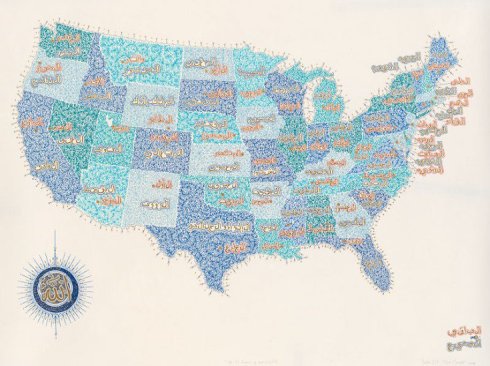
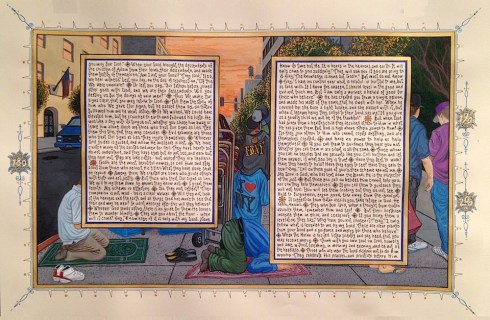
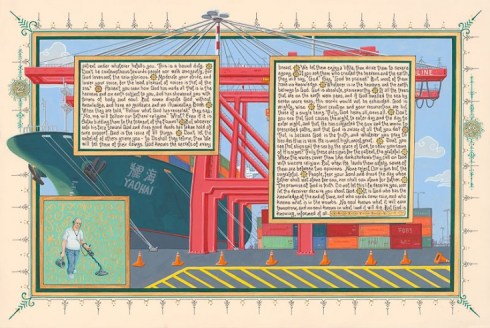
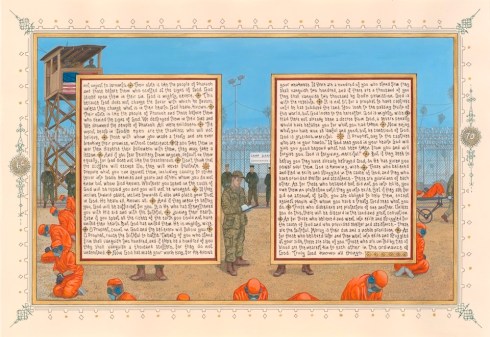
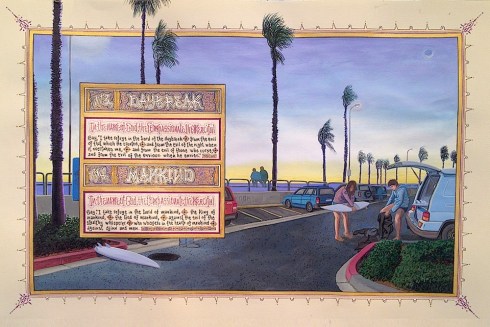
“Through the American Qur’an series, Birk presents a new version of this holy book that is more accessible and also shows how the teachings can be applied to the daily experiences of American life.” (Source)
Not photography, not prisons, but very timely; Sandow Birk’s American Qur’an.
Since 2004 Birk has been transcribing the entire Qur’an into English, illustrating each sura (or chapter) with paintings evoking Persian miniatures, but depicting everyday scenes in America. According to the press release, the Detroit-born, California-based artist “hopes to reflect how consistent the similarities are in the teachings of Islam, Judaism and Christianity. To bring this to light enables more understanding and compassion, versus fear of the unknown … ” (Source)
This is the type of reflection that should be made in our current times, instead of this nutter and his offensive fetish for fire. Thankfully, the AP will not distribute images of idiots burning Qu’rans, during the so-called International Qu’ran Burning Day. Ugh.
– – – – –
To my mind, Sandow Birk is the greatest working political illustrator. His clever manipulation of the landscape genre for his Prisonation series was an intelligent, elegiac take on California’s 33 facility prison industrial complex. (I referenced his work reviewing the recent and excellent City Lights publication PRISON/CULTURE.)
– – – – –





… is the Gursky that got the Poster Boy treatment.

 Prison Photography