
You are currently browsing the category archive for the ‘Activist Art’ category.
Sometimes the simplest ideas are the best. With the aid of inmate Renata Abramson (pictured in sceengrab below), Detective Kim Bogucki and Photographer/Film Director Kathlyn Horan co-founded The IF Project and asked ladies at the Washington Corrections Center for Women a single simple question:
“If there was something someone could have said or done that would have changed the path that led you here, what would it have been?”
Simply, the filmed testimonies (also here) and over 300 essays give the public an open line on the difficult lives these ladies have lived.
The lazy definition of ‘choice’ that everybody falls back on to justify punishments meted out upon the disadvantaged in our society – “they chose to do their crime, they do the time” – is exposed by these ladies’ stories. Many of them had no choice, at least not choice that would be obvious to an unloved teenager without any support, example or love.
I also know that The IF Project has expanded into men’s prisons in Washington State. Wonderful news.
IF you wouldn’t have noticed, the lady in the top image is cutting out the Washington Department of Corrections uniform badge.
IF you do anything today, spare 13 minutes for The IF Project trailer.
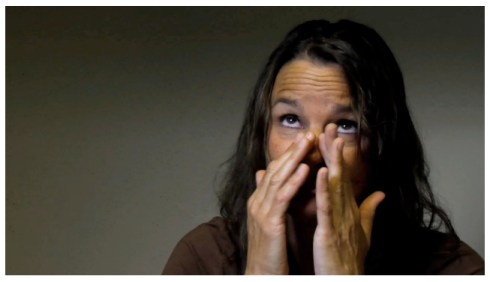
The IF Project Trailer, Screengrab

Photograph: Benjamin Sklar for the Guardian
It’s just a brief account of his time in solitary and his time since the overturning of his conviction. 29 years in 24/7 lock-down is a long time for anyone, is it worse for someones who’s innocent?
“I didn’t realise how permanently the experience of solitary would mark me. Even now my sight is impaired. I find it very difficult to judge long distances – a result of living in such a small space.”
I came across Julie Adnan‘s Born in Jail series at Bite Magazine. I wanted to know more about the women and of the social backdrop of criminal justice within Northern Iraq. I was happy that Adnan could answer a few questions.

This woman was imprisoned on 8 Feb. 2009. The child was born in prison; he is 6 months old. She, an Arab from Mosul, was arrested for prostitution. At the time of the photograph, she had been imprisoned for 18 months. © Julie Adnan
CONVERSATION
Why did you choose this subject?
I choose this subject because there are many children in the prison without having committed any criminal offence; there only because they’re children of those who may (or may not) have done something wrong. Nobody thinks about what the children will remember when they grow up.
What prison is this?
This is the Arbil prison for women, in the city of Arbil (also written Erbil or Irbil or Arbela) in Kurdistan of Iraq.
How long were you on assignment?
It took a long time to gain permission from the government, but after [getting permission] I took the photographs in two different visits over two weeks.

This child was born in prison. He is 8 months old. His mother was imprisoned on 29 Jan. 2009, sentenced to a year in prison for illegal sex with another person. She is from Erbil. © Julie Adnan
What were the reactions of staff, women and children to your photography?
The children thought it was game and they loved it, but the women was so afraid of the camera and of the photographs. As you can see, they do not want their faces to appear.
Did the families ever see or receive prints?
Unfortunately, I did not send any photos to them and I do not know if they’ve seen the photographs anywhere.
Do you plan to return to this subject or any other stories within prisons?
Yes, but not with photography. I want to document their letters to their families in a booklet.
Five of the eight women are in prison for prostitution. What sort of sentence does that carry?
It depends on their crime. It could range from a few months to five years.
Is there ever a notion that a prostitute might be a victim?
Because Islamic law rules prostitution as a crime, the government and other people can not say anything about them. Prostitution is something in the culture they cannot accept, however we have some people now who allow [make accommodations] for them but they cannot really change or do anything.
One lady was imprisoned for sex outside of marriage. Is a prison sentence common for such a transgression?
Within traditions here, a woman’s family may kill her for that [sex outside of management]. Sometimes, a woman’s stay in the prison is necessary as a secure place or a shelter.

This female gypsy was sentenced to 15 months in prison for robbery. She prefers her daughter to be with her in prison. Her daughter was 1 year, 8 months old at the time of the portrait. © Julie Adnan
MORE READING
Julie Adnan maintains a Lightstalker profile and a Flickr photostream. Her work has been featured at Greater Middle East Photo (a blog I highly recommend).
This article, Life in a Womens’ Shelter, Erbil perhaps more than any other relates the dangers for women should they compromise their families “honour”. It talks about shelters and prisons as being alternative institutions to family homes which – in extreme cases – can harbour the real threat of murder.
BIOGRAPHY
Adnan, from Kirkuk in Iraq, is a 25 year old freelance photographer, and currently a student at the art academy of Sulemanyah University in Iraq. Adnan has worked for a number of agencies newspapers and websites including The New York Times, Reuters, National Geographic, Al-Sharql Awsat, The Washington Post, Jordan Times, Taw photography magazine, Kakh magazine, Kurdistani New, Aso newspaper, Institute for War and Peace Reporting (IWPR), Driknews agency, World News Network, BBC World Website, IO Donna magazine of Italy and L’Express of France.
“The whole trouble lies in the fact that people think that there are conditions excluding the necessity of love in their intercourse with man, but such conditions do not exist. Things may be treated without love; one may chop wood, make bricks, forge iron without love; but one can no more deal with people without love than one can handle bees without care.”
Tolstoy, Resurrection (pt. ii, ch. xxv)
Tolstoy called for the presence of love within the Russian criminal justice system. Resurrection (1899) was Tolstoy’s last novel, and intended as an exposition of injustice of man-made laws.
From Harpers: “Resurrection is at its heart an engagement with justice, both with the criminal-justice system and with justice as a concept with essential social, political, and religious aspects. Its author has grown weary of a political debate that pits conservative upholders of autocratic rule against liberal reformers convinced they can shape a just system by issuing laws and regulations. He looks with somewhat more bemusement, even admiration, at those who take a revolutionary perspective—who are convinced of the fundamental injustice of the Russian system and who are committed not to reforming it but to sweeping it away.”
TOLSTOY TODAY?
It is impossible to argue for mass decarceration, let alone abolition, in the US today without being quickly boxed as a lunatic. And yet, one must be clearly delusional if they’re willing to flee logic, waste tax dollars and ignore discrimination to maintain the prison industrial complex. If the two ends of the spectrum are madness what does that tell us?
Single figure percentage decreases won’t make a amends for the damage mass incarceration has wrought upon the soul of America.
Let’s be radical and put more love in the system. Let’s put more love in society. Let’s build schools not prisons. It’s easier to make good men than to repair broken ones.

Melanie McWhorter has really taken on the ongoing photobook discussion, archives, exposure, and championing and made it her own.
So far, she’s published three discussions about photography on newsprint. Wonderful stuff!
Newsprint and the Contemporary Photobook, Part 1: Alec Soth and Andrew Roth
Newsprint and the Contemporary Photobook, Part 2: Nicholas Gottlund and Grant Willing
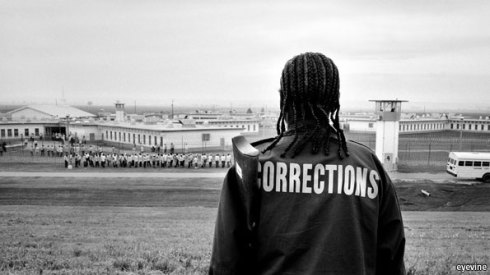
© Eyevine / Lori Waselchuk
Last weeks article, Rough Justice in America, by The Economist repeats many truths of America’s broken prison system we know already, here summarised:
“The system has three big flaws, say criminologists. First, it puts too many people away for too long. Second, it criminalises acts that need not be criminalised. Third, it is unpredictable. Many laws, especially federal ones, are so vaguely written that people cannot easily tell whether they have broken them.”
As expected the arguments made against mass incarceration here are on based on financial sustainability and fortunately such thinking is melding with the notion of social sustainability. The stories of George Norris and Michelle Collette form the anchor to the piece which posits that “Never in the civilised world have so many been locked up for so little.”
LORI WASELCHUK
I recognise the photographs as those of Lori Waselchuk whose work Grace Before Dying from the Angola Prison Hospice should not be missed. For it, Waselchuk won a Soros Documentary Photography Grant (2007), a Photolucida Critical Mass Top50 (2008). Here’s a great interview with her by Nicole Pasulka of the Morning News.
– – – –
Thanks to Joerg for the link

Today, 26th July 2010, Kaing Guek Eav, commonly known as Comrade Duch, who is charged with war crimes and for his part in the deaths of up to 12,000 Cambodians will face a final verdict.
In 2003, Masaru Goto photographed ten survivors of the Khmer Rouge regime.
Goto: “The Khmer Rouge regime is remembered for the deaths of an estimated 1.7 million people (from an estimated 1972 population of 7.1 million) under its regime, through execution, starvation and forced labor. Directly responsible for the death of about 750,000, the policies of the Khmer Rouge led, mainly through starvation and displacement, to the death of more than 1 million more people. In terms of the number of people killed as a proportion of the population of the country it ruled, it was one of the most lethal regimes of the 20th century.”

 Prison Photography