
You are currently browsing the category archive for the ‘Commercial’ category.

READ THIS: Anna Pickard’s review of Gaga’s latest production-laden video says it all. Pickard uses screenshots and the driest of commentary.
“Lady Gaga has out-sexied the entire world and for this crime she’s landed in a semi-nudist jail. Luckily she has a well-known brand of mobile, and her friend Beyoncé, on hand to help,” says Pickard.
“In minute four this happens, Gaga touching herself, wrapped in police tape in a medium to maximum security prison … and that’s intercut with pics of her planning her escape with the help of some really high-profile product placements.”
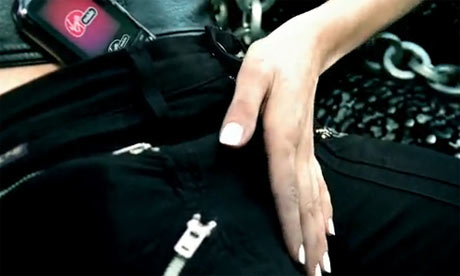
PRISON PHONES
Apart from the ridiculous fetishistic portrayal of jail, the violent skirmish greeted with laughs and the sell-out crotch-rub, the most offensive thing about the video is Gaga’s frustration at the phone line breaking-up.
Families across the United States have been fighting legal battles to break up the monopoly and racket that is prison telephone contracts. You can sign a petition here against MCI/Global Tel Link.
Unfortunately, many lawsuits have fallen away, but as the New York Times reported last November the public attention of lawsuits has brought about significant reform and lowered prices in a “terribly unfair system.”
I’m not saying that prison or jail inmates and families would necessarily be offended by a multimillion-dollar-pop-thing using a failing jail payphone as a prop for her next breast-thrusting million, I am saying that I am.

PRISONS IN MUSIC VIDEOS
This is not the first time I’ve been confused with popstars appropriating prisons for their music videos. Michael Jackson put on the full crotch-grabbing show in a prison chow-hall for his video They Don’t Really Care About Us.

Susan Wright. © Matthew Rainwaters
Matthew Rainwaters‘ Offender, an assignment for Esquire and Texas Monthly, depicts “two very different inmates inside the Texas Department of Corrections.”
The first is some bloke with a history of fraud and a penchant for escape.
I am more interested in juxtaposing Rainwaters’ portraits of a husband-killer and the prosecution attorney.
LADIES
Susan Wright was convicted of murder after stabbing her husband 193 times. She was recently granted an appeal and may be released after re-sentencing.
Prosecuting attorney Kelly Preistner doesn’t buy the battered woman’s syndrome defense. During closing arguments she reenacted stabbing her assistant 193 times for the jury.

Kelly Priestner. © Matthew Rainwaters
COMMERCIAL PHOTOGRAPHY
Generally, I don’t know what to make of commercial work and portraiture done inside prisons. I think I’ve only featured it once before on Prison Photography with a nod to Andrew Hetherington’s work for Wired on a story about cell phones and security breaches.
Evidently, Rainwaters’ is motivated to go beyond the requirements of assignment; he’s got the prison photography bug!
In an interview over at electronic beats he describes the fortune of the two stories coming at once, but that they catalysed a body of work upon which he wants to expand:
Rainwaters goes onto explain he hopes to photograph at Guantanamo. This leap is remarkable. I would not expect a commercial or editorial photographer to make such a transition. For me it stands to reason that one discusses Guantanamo and illegal US prisons in the same context as homeland penitentiaries, but I don’t expect others to always hold the same opinion. That a photographer is pressing this line is intriguing.
I’ll be eager to show Rainwaters’ Guantanamo work when it surfaces.
– – –
You can also see the selection of Rainwaters’ work at Behance.
Thanks to Scott for the tip.

I am a huge fan of the Flickr Commons Project.
I have published on The Hidden Gems of Flickr Commons for Wired‘s photography blog Raw File.
For their documents of (early) 20th century fishing & skiing; industry & leisure; mountains and deserts of the Pacific Northwest, my favourite institutions are The Oregon State University and the Commons’ newest member, The University of Washington!
I have always been taken by the photographic sets out of the London School of Economics. The LSE archive has great emphasis on its department faculty; administrative staff; extra-curricula activities; student events; laboratory tableaux; campus vistas; college anniversaries; and guests of the famed school. It’s an archive with a likable and unpretentious institutional identity.
The LSE Library set contains dozens of portraits of the library scientists and staff.


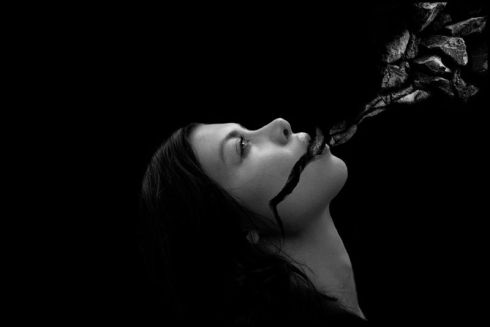
© Zoriah Miller. Model Laura Peterson's negative sandwiched with an image of devastation in Lebanon after the 34-Day Summer War.
CHANGING DIRECTION
Zoriah Miller has put aside his photojournalist work to pursue photocollage full time.
Zoriah’s statement declared photojournalism “rigid and stagnant … obsessed with rules, hiding behind “ethics” in order to produce nothing but formulaic, generic press photography.”
“What if you could create works of art that would not only stun people visually, but also educate people about a subject that they may otherwise ignore or find too depressing to pay attention to?” asks Zoriah.
Zoriah explains that he has been “shooting models and celebrities to work on creating composite images of beauty, sex and fame mixed with conflict, crisis and disasters.”
Zoriah and all models and celebrities involved in the project donated their time and the proceeds from the project will benefit refugees of conflict.
HOW TO POSITION THE WORK?
Judging by the example offered above the composite results will be incongruous mixtures of elements. Seemingly, Zoriah has traded his prior claims toward humanitarianism for the language of Dada.
Zoriah’s position is conflicted. The way in which he suggests putting images together is antagonistic, which is fine if you’re willing to argue away meaning as many agitators do, but Zoriah is trying to bring about attention to the issues surrounding the images of death which he then obscures with images of sex appeal. Do you see his problem?
Anyone want to have a stab at throwing these two images together on photoshop?*
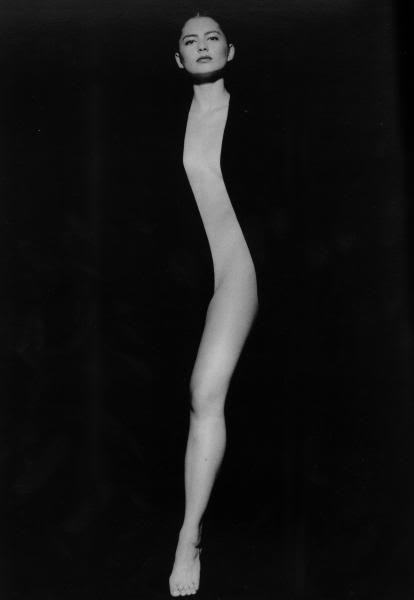
© Tono Stano, 'Sense'

© Yannis Behrakis/Reuters. A Palestinian worker repairs a bullet-ridden wall damaged during the three-week offensive Israel launched last December, at a factory in the northern Gaza Strip November 2, 2009.
If one experiments often enough fusing images together visually intriguing results will ensue. However, visual interest is cheap these days so it alone is not enough to prove an image ethical (I use that word knowingly) and/or effective.
I can see what Zoriah plans. It just doesn’t make a lot of sense.
QUICK THOUGHTS
1. Following the Haitian workshops debacle and in the face of unforgiving and acerbic name-calling, I think Zoriah argued his early corner quite well. To unleash this bizarre move is either total stupidity or unrelenting self-confidence. Either way, I would have liked to have heard and seen more works and reaction from Haiti and from his students before this.
2. Whether or not photojournalism is in a pickle – as Zoriah insists – the questionable cocktail of “sex and fame mixed with conflict, crisis and disasters” is, in my opinion, not the answer.
3. Likely, Zoriah’s future claims of being a journalist will be met only with derision.
4. Zoriah’s efforts at a thanaphilic fashion photography are not without precedent. Zoolander’s poor-taste DERELICTE fashion collection, a homeless aesthetic wrapped in the glitz and lights of the catwalk was great satire. So good it inspired Vivienne Westwood and the late Alexander McQueen. Etnies also had a good go at bad taste with its Hobo Ad campaign. I suppose Vice readers have been getting off on photographs of blood stained victims for years now?…
5. The greatest problem with this issue is that is inflates the importance of photography as an agent of change. No matter how much we recognise a need to raise attention about global issues, photography is not the sole answer, nor is photojournalism. The mode of photography Zoriah suggests is an unholy marriage. Who is the audience for this hybrid approach? What does he expect audience reactions to be? It would seem to me that consumers of images are turned on and off by visual cues. It is very easy to hook them with slick tried-and-tested commercial cliches. It is one thing grabbing a viewers attention for a second or two, it is another mutating that into a long and complex engagement with the real issues.
6. As offensive as this manouver may be to some folk, it isn’t the first time (and won’t be the last) a photographer oversteps logic and accepted practice with great hopes to change the cultural landscape.
7. I suspect there’s a reason why the worlds of fashion and photojournalism are distinctly separate. I can also think of many other more subtle ways in which art and marketing has been used as part of photojournalist careerism.
8. Given the consumer climate in America it is not unlikely that Zoriah will succeed in raising substantial funds. Ultimately, it will become an issue of the project’s branding and delivery.
9. If all else fails, it’s a good start for an Onion feature, right?
What do you make of all this? The “Leave a comment” button is at the top of the post.
*NB. Zoriah is using Negative Sandwiching
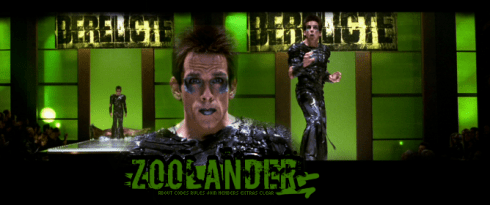
Derek Zoolander launches the DERELICTE collection. Image source: http://www.uninvitedgrace.com/zoolander/
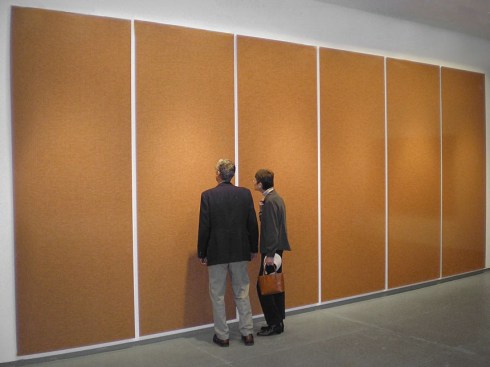
Chris Jordan. Prison Uniforms, 2007. Installed at the Von Lintel Gallery, NY, June 2007.
Chris Jordan‘s populist brand of socio-enviro-photography deserves our respect. The skills necessary to direct (what I presume) is a team to composite his images, is small fries compared to his ability to sell his brand. He brings to surface issues as varied as breast augmentation for teenagers, deaths by smoking, prescription drug overdoses and airline plastic cup wastage.
Jordan argues that all these issues are tied together by our collective denial and connected by our search for a global view obscured by the massive numbers (billions, trillions) which we cannot realistically fathom. Jordan reckons his illustrations help us feel, and thus have us consider and alter own behaviours.
Critics would say that Jordan plucks issues at will, and given their variance, he might just be a fraud. Aren’t we supposed to specialise in our advocacy? Don’t we pick one topic?
I’d be sympathetic to this view if I thought Jordan was picking the latest cause célèbre, but he isn’t. Jordan represented the 2.3million US prisoners with 2.3million prison uniforms (I discussed this before).
Prison reform has never been sexy. Prisoners rights are rarely considered and that is because many of us suspend our emotions toward those put behind bars. Heck, even rape is considered humorous when it is put in a prison setting.
Whatever your take on Jordan’s craft and motives, his research and discussion of issues is passionately informed. For me, most of the time Jordan trumps my cynical view that he’s just selling a cute visual idea.

The closing two minutes of this well-circulated TEDtalk is convincing enough. Yet, I’d forgive people who thought of him as a sellout.
Jordan’s assertion that US citizens are in denial about their prison system is dead on.
Thanks to Stephen Sidlo for the reminder of Jordan’s work.
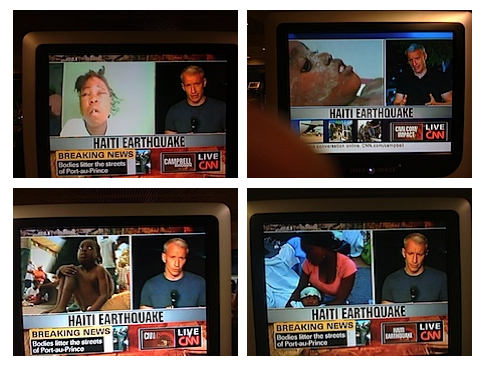
It one thing having foolish and clumsy media commentary of flash-in-the-pan (US) regional stories. It is another when CNN and Anderson Cooper use that same approach covering a humanitarian disaster.
As folk interested in media we should speak out when we see offensive framing and “reporting”.
Anderson Cooper’s bravado is only slightly more insulting than other major networks, but if we picket Cooper and his CNN editors maybe we’ll make a dent large enough that other major networks will also take note.
Michael Shaw just emailed this to concerned social media types. I am behind his sentiment:
I’m writing because I’ve just done a post at BAGnewsNotes that I think is extremely important.
It’s an appeal to readers to contact CNN, or tweet them (@andersoncooper @CNN – PLEASE STOP visually exploiting the Haitians! http://bit.ly/8R1DGc) about the way Anderson Cooper/CNN is visually exploiting the Haitians.
What Cooper has been doing is a complete affront, and it’s time we pushed back in a more systematic way. Haiti is going through a completely sub-human experience as it is, and the humanitarian effort, and dignity for its people, should absolutely extend to the media sphere.
Thanks so much for putting your eyes on this, and being part of the response.
Here’s hoping.

2Double (day dooblay), a 21 year old rap kreyol artist, records a track in the Koze Kreyol studio in Port au Prince, Haiti, on July 18th, 2008. The rapper has had some recent success and local recognition but continues to live in the notorious Cite Soliel slum with his mother and 3 year old son. He says he hopes to use his music to get his family to a better environment. © David Zentz/Aurora Photos
Just two weeks ago 100Eyes launched a new issue Gade, Haiti. Who at that time would have knwon that the world’s attention would sear down upon that previously abused, cliched far away nation?
Today Andy Levin put out the following call:
“Shoot for 100Eyes: Gade, Haiti!
The situation in Haiti has brought a tremendous many talented photographers to Haiti, with many more on the way. We would like to find a way to broaden the picture of Haiti that is currently in the news, by combining work with the disaster area with work from the rest of the nation.
If you are going to Haiti and will be there in February, I am asking photographers to spread out around the country and to spend day or two photographing something other than the earthquake ravaged area, to be included in a special issue of 100Eyes on Haiti.
I am hopeful that photographers can use the same resourcefulness in getting around Haiti as they have in getting to the disaster area … and I know that there are many stories to be told beyond what we are currently seeing, many struggles that happen on a daily basis. There is beauty, there is laughter as well.
We believe that the effort made by photographers in doing this would more than make up for the relative small resources going into the project, by helping to create a broader picture of Haitian life, and to put the horrific, and important, images that are currently being taken in Port au Prince in context.
As part of the project we will be having Haitian children and students take pictures to show the events through their own eyes, an effort that was planned before the tragedy. In addition we ask that each photographer try and bring a compact digital camera and find a Haitian child to work with in whatever area of the country that you are working in.
Depending on the amount of work received we may have needs for volunteer editors and coordinators as well. For those more interested in a structured environment I am going be extending the 100Eyes Workshop in Haiti through the end of the month and possibly beyond.
For details on this please contact me through our workshop page for Haiti, here.”
If I was a photographer I’d be anxiously looking for an avenue to broaden the media coverage away from only disaster consumption. This seems like the best opportunity; Structured, purposeful and community based.
We have seen the terrifying images, now let’s get past them to action. If you’ve got money give it, if you’ve got a camera get involved.
DAVID ZENTZ
I picked the image above out from the selection at 100 Eyes. David Zentz has done two series on Haiti, Saut D’eau and 2Double.
David’s work at Verve, 100Eyes and Aurora Photos. David also has a blog, Your Moment of Zentz.
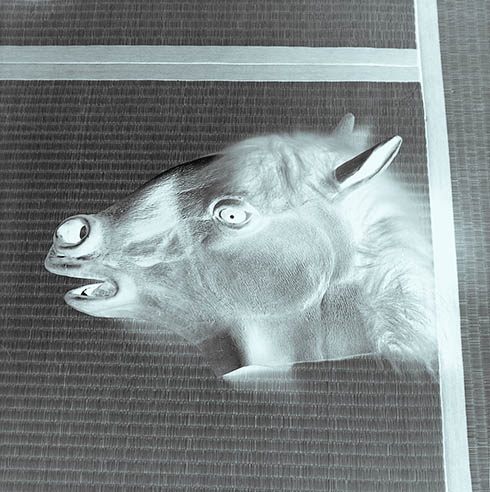
Horsehead © James Luckett
After I conveyed some fascination for the cold and unknown profession of forensic photography, friend and photographer, James Luckett contacted me to tell me that he used to work in a lab specialising in the production of prints for various legal companies and civic departments.
While not prison photography, James dealt with the photography of crimes and accidents. The negatives he worked on could eventually send people to, or spares them of, prison. Equally, his prints as evidence likely helped secure millions in lawsuit damages.
James’ writing is dry, candid and the toll that this line of work eventually took should be enough for anyone to pause for thought. Highly recommended reading.
The image above is not from the lab. It is negative version of one of James’ own.
You should follow James’ idiosyncratic blog, consumptive. It has some of the best curated links of any blog out there. He doesn’t waste your time. Here’s a great portrait of how James may have looked when he worked at the lab. He’s got shorter hair now and might not thank me for pointing this one out! James’ Flickr stream is worth a look too.

 Prison Photography