
You are currently browsing the category archive for the ‘Commercial’ category.

Aside the Coca-cola vending machines and Cheetos, portraits and photo-keepsakes are probably the most ubiquitous objects in prison visiting rooms.
I have speculated before about a massive, dispersed collection-without-walls made up of the millions of prison Polaroids; a sprawling, bittersweet and neglected vernacular photo-archive of true American experience.
Polaroid cameras are still the standard for prison visiting rooms as they provide instant results and they don’t have the “security issues” associated with he transferability of digital files. No matter the format, Friends Beyond the Walls will help construct your photo-idyll:
There is plenty of scope here to pour scorn upon the low-brow photo-manipulation, and there is (justifiable) reason to question the financial gains of the company involved in providing such a basic service, but I won’t go there.
People aren’t stupid. They won’t invest their emotions in “Composite Magic” if they don’t want to. But if someone does make use of this service then so be it – we all spend silly money on items foreign and bizarre to one another.


I will say this: prisoners and their families develop fast and hardened interactions with correctional authority. The procedures of the visit become as routine as picking up the paper or grabbing a morning coffee. It makes sense that some of that population would take the opportunity to leave that dictated reality behind and reclaim (visual) identifiers that don’t belong to departments of corrections and criminal justice.
Therefore, the only real way to discuss this niche photo-aesthetic and grow a legitimate appreciation would be to talk to the sitters, consumers and owners of this niche photo-aesthetic. That could be the territory for anthropologists and sociologists or, as easily, it could be the chatter of ordinary people who still take an interest in other ordinary people.



It is interesting that of all the Playboy covers over the years, the recent Marge Simpson cover mimics Darine Stern’s.
Darine was the first African American woman to feature on a Playboy cover.
Qiana Mestrich – whose blog I highly recommend – alerted us all to this fact and goes into more detail about Stern’s life and death.

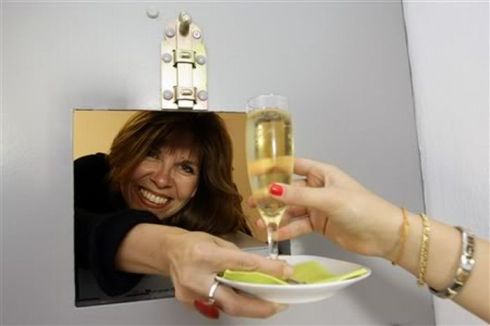
Jolted by photographs from this ludicrous Alcatraz Hotel in Kaiserslauten, Germany I recalled an article about prisons & jails converted to tourist accommodations. I guess it makes sense to convert solid and culture-worn stone fortresses into chic hotels such as at the Charles Street Jail/Liberty Hotel, Boston (it seems a shame to waste all that cool masonry) but a prison-theme is downright tacky.
I like the no-nonsense approach of Mount Gambier Jail in Australia which “markets its rooms as budget accommodations for cheapskates and backpackers”. Oxford Castle/Malmaison Hotel in the UK retained the open cell tiers of the prison, just adding some mood uplights for the new plastered ceiling.

Here’s an article on “Slumber Slammers” which points to the larger tawdry scene of architecture-as-theatre for those wantaway tourists whose appetite for the early 21st century now fails them.
Not to be outshone, the Japanese go the farthest in recreating the prison-spectacle with handcuffs, dungeon-krunk, lethally injected cocktails and salads that refer to incest?! Don’t quite understand the link for that last one …
I’d like to begin a discussion here about recuperation, but that is presuming there was ever an element of resistance or meaningful political opposition from these various sites. All we can say for certain is the current histories of these spaces are gradually erasing those of the past.
The illicit manufacture of tools by prisoner piqued Marc Steinmetz‘s curiosity. He called around German prisons to inquire if they were still in possession of particularly ingenious contraband tools and escape devices.
Santa Fu, Celle, Wolfenbuttel and Ludwigsburg prisons all welcomed Steinmetz to view their collections. (The historical objects of Stammheim and Hohenasperg prisons were part of the Ludwigsburg collection.)
Steinmetz’s photographs were used in a German magazine editorial, but I have seen similar series of object types displayed as fine art.
When photographers set up objects (food, seeds, dead birds, insects, fish, etc) it is usually to draw extended attention to common characteristics and impose drama upon ‘the ordinary’. Against a white backdrop and removed form the clutter of daily life, it is intended that these objects can (if only briefly) transcend their functional purpose and be appreciated within the discourses of beauty and/or high art.
Steimetz wanted to highlight the ingenuity and intelligent design of these objects, and I’d like to do the same.
I have included some weapons here and omitted others. I deliberately omitted crude weapons for this post as they are hardly novel … anything with any weight becomes a dangerous weapon, right? On the other hand, I included guns and rifles as I never thought they could be manufactured from scratch. I was particularly impressed by the electrical items.
Below are Prison Photography‘s pick of the bunch with Steinmetz’s own captions. Thereafter is a brief Q & A with Steinmetz.

DOUBLE-BARRELED PISTOL This gun was found along with other homemade firearms in the cell of two Celle prison inmates on November 15, 1984. The weapons had been made in the prison’s metal workshop. They were loaded with pieces of steel and match-heads.

TATTOOING NEEDLE made from a toothbrush handle, a ball pen and an electric motor; confiscated in ‘Santa Fu’ prison in Hamburg, Germany. Tattooing instruments are a popular and common source of income among inmates but are banned as ‘illegal objects’ due to the danger of infection (Aids, Hepatitis, etc.).
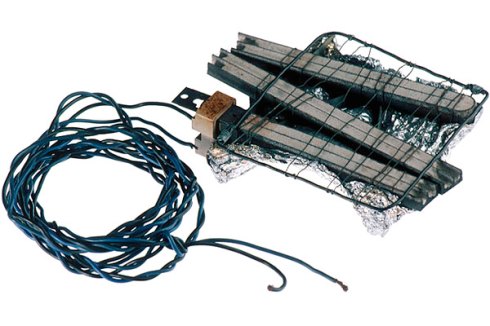
STOVE / GRILL / TOASTER An inmate of Ludwigsburg prison, Germany, botched together this multi-purpose tool from wire, a broken heating rod and some tin foil. It was found in his cell and confiscated sometime in the mid-eighties.
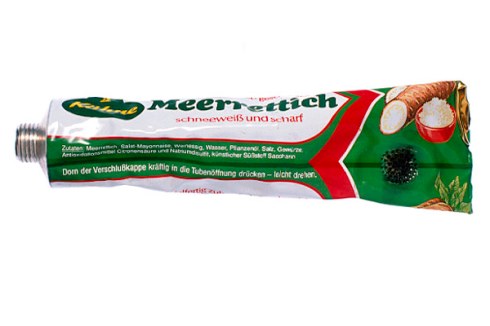
HASH PIPE fashioned from an empty horseradish tube; confiscated in ‘Santa Fu’ prison in Hamburg, Germany. Bongs are the most common of all forbidden items in prisons. The range of materials they are made of mirrors the inmates’ great imagination. And their prior needs.

RADIO TRANSMITTER / BUG made of radio recorder parts by an inmate of Wolfenbüttel prison, Germany (battery is missing). Prisoners occasionally manage to install gizmos like this one in guard-rooms to be prepared for upcoming cell searches. Also suitable as a means of cell-to-cell communication among inmates. A standard radio serves as a receiver.

IMMERSION HEATER made from razor blades; found in a cell in ‘Santa Fu’ jail in Hamburg, Germany. Jailbirds use these tools to distil alcoholic beverages forbidden in prisons. Your typical inmate’s moonshine still includes a plastic can containing fermented fruit mash or juice, an immersion coil of some sort, a rubber hose, and a plastic receptacle for the booze.

RADIO RECEIVER Sometime in the seventies an inmate of Ludwigsburg prison, Germany, built this radio on the sly and hid it inside an encyclopedia. It was probably commissioned by another inmate who had no electronic expertise himself.
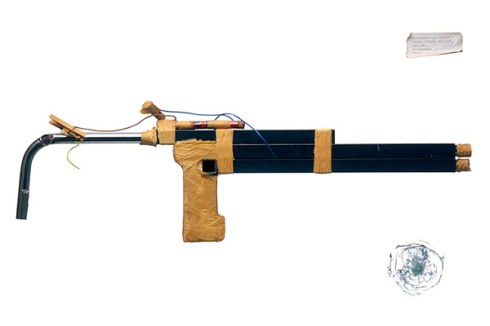
SHOTGUN made from iron bedposts; charge made of pieces of lead from curtain tape and match-heads, to be ignited by AA batteries and a broken light bulb. On May 21, 1984 two inmates of a prison in Celle, Germany, took a jailer as a hostage, showed off their fire power by letting go at a pane of bullet-proof glass, and escaped by car.
________________________________________________________
Q & A
When did you complete this project and why did you take on this subject?
I shot the whole project in April and May 1999. I had read a magazine article about a prisoner in Berlin who had whittled a key to his cell from a toilet seat. Unfortunately, prison officials in Berlin weren’t cooperative, so I wasn’t allowed to take a picture of that key for ‘security reasons’. (Can you believe that?).
But it nevertheless provided the key to the story and got me interested. Süddeutsche Zeitung Magazine editors [provided a catalyst] too – they bought the story.
The objects range in date from the 70s through to the mid 90s and from multiple German prisons. How and where did you source the objects?
Prisons often have a collection of items which were secured from inmates’ cells or after attempts at escape.
I did my research exclusively by phone and located a handful of prisons which seemed worth a visit. I decided then and there which objects to photograph.
Much of your previous photography has been about complex scientific experimentation and grand research. Was this project a departure?
Not at all. I have always been interested in the uncommon or even bizarre.
What about the objects is of interest to you?
Ingenuity of improvisation. Intelligence. Purposefulness.
In my work, not everything depends on meticulous planning, but to a great extent on chance and my ability to improvise. Therefore I can relate to these escape tools. I admire their no-nonsense design, their simplicity. Even if their escape attempts fail, these guys cross boundaries in that they find uses for things other than what they were made for.
What do your photographs of the objects add to the stories objects?
To me, they communicate intelligence and the flexibility of the human mind under adverse conditions. I wanted to share my surprise: ‘What the … ?’
Did this project inform or reflect your understanding of German prisons, prison history and/or current prison politics?
Not really. I wasn’t interested in the political or social aspects of the subject matter. It was an interesting experience, though, to get to peek inside these facilities even though I had no contact with any of the inmates.
To compensate for that and to communicate credibility, I tried to collect as much information about the objects as I could. I felt they should be preserved the same way that archaeological artifacts are.
What are you working on now?
Currently, I am working on an independent project which is called ‘Toter Winkel’. I am still searching for an international title which works both in German and English, even though I focus exclusively on Germany.
I started wondering about what cars have done to our cities. I ended up doing night shots of elevated roads with a 4×5″ field camera. It’s hard to believe what monstrosities have been erected for the sake of misconceived mobility!
But this is more of a long-term fine art project than an editorial piece. Fieldwork is completed, but post-production will take a few more months, I’m afraid.
Thank you, Marc
________________________________________________________
Marc Steinmetz is a photographer specialising in Science and Technology stories. Prison Photography recommends his work on Plasticination, Karakarum – The Archaeology of Genghis Kahn’s Empire and his series on Drinking Water. An extended interview with Marc, is here.

DUMMY PISTOL from blackened cardboard; found on June 23, 1988, in an inmate’s cell in Stammheim prison, Germany, after a fellow prisoner tipped off the jailers. The dummy was hidden in an empty milk pack and was most probably intended to be used for taking hostages in an escape attempt.
________________________________________________________
All images © Marc Steinmetz.
I originally came across Steinmetz’s work at Accidental Mysteries – a blog I highly recommend for its polished curatorial eye of surprising, inventive and humourous human interventions.

Reading the Goethe-Institut Fashion Scene article about Haeftling designers in Berlin, I thought it was an Onion style send up. “Prisoner chic” sounds like something straight out of satire, but I guess I was snoozing when this hit the news wires in 2003.
Haeftling (translated as ‘Prisoner’) employs inmates across Europe to manufacture clothing and housewares inspired (they say) by prison life, “The garments are highly functional and have a classic and timeless cut. Only high-grade, rugged fabrics are used in manufacturing.”
Well, whatever you say. I actually don’t mind how they market it, I am just pleased they support prison reform, the abolition of the death penalty, political prisoners rights and a philosophy of rehabilitative justice.
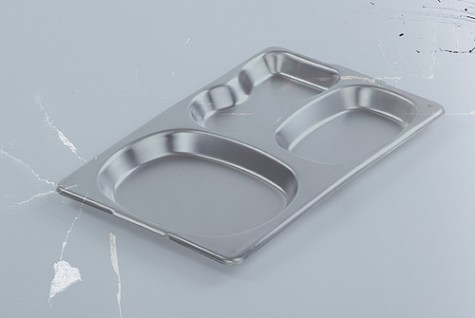
Haeftling Tray
But let’s not kid ourselves. This project was borne of commercial interests. “It began in the JVA (Justizvollzugsanstalt/prison) Tegel and developed into an international undertaking. More and more prisons have joined and today production is even taking place elsewhere in Europe. One Bavarian prison supplies honey from its own two colonies of bees; a prison in Switzerland even has its own vineyard and exports its own red (Pinot Noir) and white wine (Müller Turgau).” (source)
Karola Schoewe, Haeftling’s PR & communications manager says, “On the whole, the prisons are all very helpful,” says “There are some prisons that have very good production capacities for making homeware.”
Schoewe then marries the business speak to social responsibility speak, “Through its production, Haeftling is creating measures that help to support rehabilitation processes.”
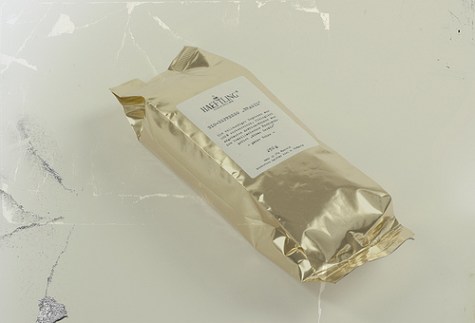
Haeftling Espresso
Without seeing Haeftling’s account-books or sitting in on a board meeting, I have no way to tell if resources and profits are divvied up in a way that benefits prisoners more then in the state run prison industries. This was the situation in July 2003
(Author’s Note: €12.50 is substantial pay compared to American prisons.)
Prison industries are a divisive issue. For some they are the perfect use of prisoners’ time and energies developing job skills, work community & self-esteem. To others prison industries are a modern slave labor exploiting societies’ self-created incarcerated class.
Both viewpoints have legitimacy, but the first makes a prior assumption that could be misleading – that work programs are the only means to provide skills, community or self-worth. Education does this too.
But educating someone instead of putting them to work is going to cost a prison authority rather than generate it wealth.

Generally, I am unnerved by the disconnect between the reality of incarceration and its representation to consumers,
Then again, Klaus-Dieter Blank, of Berlin’s Tegel Prison states the success of the label’s online store has meant that people are beginning to understand “what goes on behind the walls”. Haeftling features on the Tegel Prison website.
Is there too much space here for consumers to create their own version of prison life? What is included and/or played down in the minds of consumers? Are they being coerced and sold a disingenuous view along with that ‘rugged’ product?

"Justiz 82" Scratchy Blanket. Haeftling Product
We can assess this a number of ways – rehabilitative worth, public awareness worth, benefits to state finances, tax-payer savings, external benefits of development in social entrepreneurship.
But essentially, we must ask, “Does this enterprise help reduce prison populations by reducing recidivism? It MUST be compared to other rehabilitative programs. The purpose of prisons the world over should be to create societies where prisons are no longer necessary.
How do you judge this type of enterprise?

 Prison Photography