
You are currently browsing the category archive for the ‘Documentary’ category.
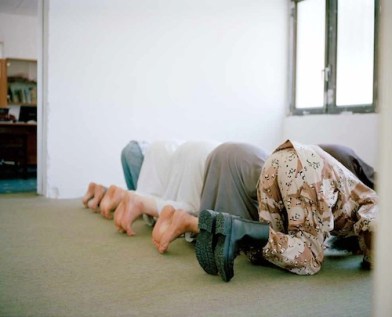
The Prison Governor of the Huda Foundation for prison and Reform, Misrata, prays with colleagues. © Louis Quail
Louis Quail makes a habit of going to zones that have been hit hard by human or natural emergency. He does so after said emergencies have tempered down and the world’s media has generally moved on. I celebrated his close and slow study of Haitians in May, 2010, a full four months after the devastating earthquake.
In the year since the end of the war, Quail has been in Libya. A small selection (seven) of his portraits were featured on the Guardian website yesterday. Quail has 25 images including candid, landscape and street shots on his website. The full body of work (I’ve viewed a PDF) comprises 25 interviews and 58 images.
Included in Quail’s series are three images from a prison.
“The model for the prison is an Islamic one where the prisoners are treated like their brothers, security is minimal with only one gate and a few guards. There is a strong sense of mutual respect and focus on Islam,” writes Quail.
Here I post two images and extended quotes that Quail recorded.
“We respect human rights here,” says a prison guard. “We repair them psychologically and think about how to make them good people – to turn them from fighters into civilians. Gadaffi taught them no respect. He told them they were better than other Libyans.”
“We want all prisons to be like this – if we don’t deal with the prisoners properly we will store up problems for the future – but it’s not popular with the government. It’s not a vote winner.”
“We are under-resourced at the moment. Our doctors and nurses are prisoners who have been trained by Medicine sans Frontiers and volunteers. We have 25 guards and access to 25 katibers outside, but even the prisoners tell us they will not run away because it’s much safer here for them here.”
But forgiveness and forward thinking is difficult when transition and immediate history has been so violent.
“We can’t deny there have been some human rights abuses, deaths in custody, torture in the revolutionary stages,” says a prison guard. “The families here in Misrata have seen their members killed and the girls raped. […] We have some mercenaries [in the prison] but to be honest, most died in the war. There was very little sympathy for them, there were many executions. They were from places like Darfur and Sudan, often on drugs or drunk. The doctors reported 700 cases of rape in Misrata, 132 of them on civilians aged between 12 and 15 years old.”
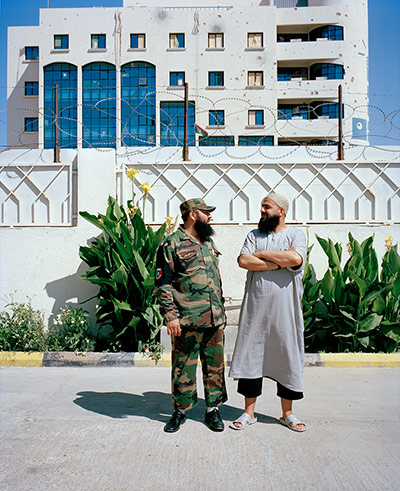
Omar, a previous Gadaffi militia member, talks to one of the prison guards at The Huda Foundation for Prison and Reform, in Misrata. © Louis Quail
“I was an elite fighter in Regiment 32 ran by Gadaffi’s son,” says Omar, a former Gadaffi loyalist. “In April 2011, I was fighting in Misrata, many people were dying and injured and I was shot in the legs, unable to move and was caught. It’s ok here. It’s very calm, they treat us like brothers. I have heard about other prisons where It’s not so good. After spending time here I no longer want to be a fighter, now we have to forgive each other and move on.”

Mercedes Smith, a formerly incarcerated person, reads a letter from her currently imprisoned son, at a relatives house where she lives after working all day on July 13, 2012, in Manhattan New York. Ms. Smith is not allowed to live with her family while she is on bail because her mother still lives in the same building as where the crime took place. Ms. Smith served 20 years for 2nd degree manslaughter and was released in 2010. (Photo by Ashley Gilbertson / VII)
– – – – – – – – – – – – – – – – – – – – – – – – – – – – – – – – – – – – –
Think Outside The Cell, a NYC based advocacy group, and VII Photo Agency recently collaborated to create a media campaign to educate the public about the continued struggles for felons post-release. This conversation with Ashley Gilbertson is the final part of a five part series, ‘Ending The Stigma Of Incarceration.’
(Part One): Think Outside The Cell / VII Photo Partnership
(Part Two): A Conversation With Ron Haviv
(Part Three): A Conversation With Ed Kashi
(Part Four): A Conversation Wtih Jessica Dimmock
– – – – – – – – – – – – – – – – – – – – – – – – – – – – – – – – – – – – –
This text has been edited from longer conversation.
– – – – – – – – – – – – – – – – – – – – – – – – – – – – – – – – – – – – –
PP: In part four I spoke with your colleague Jessica Dimmock. How was it working with her?
AG: It was easy. Jess is a photographer as a primary, so she knows how photographers move. We went back to Mercedes’ home one night and Mercedes went into her room and opened a letter. I looked through the door and I saw that it was a handwritten letter and I knew that her son was in prison. It was from her son. She started reading, I took some frames and moved out the way and Jess could shoot. That was an isolating scene that was very poignant – reading a letter from your son, while you are on parole, in a house that you’re trying to get out of.
PP: Why should we care about prisons and their aftermath?
AG: In the aftermath of prison, ideally, prisoners are changed members of society. Prisons are a place where people can at least try to signify to society that they have made recompense for crimes they’ve committed. Why is it important that we pay attention? The size of it. Until I met Mercedes Smith, I had no idea of the intensity of the problems former prisoners are facing.
PP: What type of problems?
AG: Housing. Mercedes living with a family member in housing projects in Manhattan. She wants to move on from that, but housing is so expensive that for her to actually afford something is really hard. And this is where all these elements that former prisoners face come together; she’s working two jobs part time and she’s looking for a third job. But it is very difficult for her to find any type of third job because she has curfew hours. Getting back to her apartment after curfew means she’ll break her terms of parole and potentially face going back to prison. For her to get an apartment she needs a third job.
Say if she wanted to move to New Jersey where housing is cheaper, she can’t. Her terms of parole require her to stay in New York State.
PP: Does she have good support?
AG: She was in a fortunate position because when she came out of prison to a very supportive and loving family. It is not quite accurate to say that Mercedes is fortunate because, in fact, she has worked very hard to get to where she is. Her children had been cared for by her mother and they visited her regularly while she was in prison and they had relationships. So, even after having done 20 years in prison, she had a warm and supportive environment to come back to and that’s something that – as I came to understand the issue better – a lot of people are lacking.
Mercedes is a really supportive mother who is doing everything she possibly can for her children. Two of her children live with her mother, one is down South and one is in prison. I saw her speaking a couple of times with her son that is in prison and it was a really warm and loving exchange – the tone of conversation that we all wish we could have with our mum.
PP: What did Mercedes hope of the project? Why did she go in front of cameras?
AG: Mercedes never said she felt like a role model, but she has figured out how to get out of the hole and she wants to save other women time and energy as they try to do so.
Both of Mercedes’ jobs work around her existence today as a parolee and as a former prisoner. She works with Women On The Rise Telling HerStory (WORTH), a group that lobbies for women who are imprisoned and particularly women who are giving birth in prison. The work plays directly into Mercedes’ experience, as she gave birth to her youngest child in prison, I believe.
Her other job is working with women just out of prison and giving them advice about what they have at their disposal; what organizations that might get in touch with. It is a mentor role. And she works at that second job with her own mentor.
PP: Your work is always about America.
AG: I research ideas and become interested in issues at a concept level, then I’ll start meeting people – community leaders in Pontiac, Michigan, for example, or in the case of Bedrooms Of The Fallen, family members. Everything I do is about America.
I see America as this sort of social experiment. I grew up in Australia; in the Commonwealth. I’ve lived in America for nine years, yes, but it remains so foreign to me. I hadn’t met a large group of Americans until 2003 when they marched into Iraq. I learnt more about America in Iraq than I did in America over those first few years [of the War on Iraq].
Working on different issues, here in America, is to continue to look at this experiment. The way Americans wave flags. It’s the same as how Australians wave flags, but in many ways it is very different.
The way Americans carry guns, the way they incarcerate people – it’s the world leader in so many poor statistics, but then in many great statistics too. I find it so bizarre to work here. There’s just an endless wealth of material. I don’t work on things I have a passing interest in. I have to be actively engaged … and, usually, angry.
Each aspect of American culture I look at, whether that’s politics, incarceration, war, treatment of veterans at home, suicide, post traumatic stress disorder, the auto industry, the economy – each thing adds to this tapestry that I’m trying to understand, and I want to, I just don’t know if I ever will.
PP: Why has VII pursued a partnership with TOTC?
AG: This partnership appealed because it was looking at a project in a way that offered solutions, with stories of people who were actively getting out of the problem, trying to create solutions to it. That is compelling.
I’d say it is a traditional approach to go to a prison and photograph the scenes and problems there. Or, to go to “convict alley” in Harlem, where there is the highest concentration of parolees living within a certain numbers of blocks in Harlem.
I was reading about speech-writing the other day and they were saying at the end of strong speech is a call to action. Both Ronald Day and Mercedes stand as a call to action. It doesn’t matter that they’ve been convicted of crimes because they’ve gotten beyond that and turned into people who empower those around them.
PP: VII wants to extend the project. Do you think you’ll continue involvement?
AG: I hope very much that the project goes on, and that it goes national. Think Outside The Cell is an incredibly powerful approach to this problem, so to see it produced on a national level would be compelling. I’d like to be involved, but I’d like more to see other photographers brought in.
It turned from an issue that I cared about into something that I all of a sudden became involved in. For a lot of us working in the press, it takes a significant amount for us to be shocked by certain things we see people come up against.
The opportunity that I’ve had to meet these inspiring people who are working to get out of this rut and try to change it at a policy level – that should be regarded by as wide a swathe of people as is possible.
– – – – – – – – – – – – – – – – – – – – – – – – – – – – – – – – – – – – –

The dining room. © Mariam Amurvelashvili
Mariam Amurvelashvili, a Georgian photographer has been documenting lives inside Georgia’s prisons since 2004.
She has not, however, the author of images of beatings and rape that surfaced in the past month, sparked protests among horrified citizens, forced the resignation of Georgia’s senior prison official, and rocked Mikheil Saakashvili’s government.
DOCUMENTARY vs. EXPOSE
I’ve argued in the past that the photo and video footage that changes a system is rarely that made by a documentarian. It is the expose, the surveillance tape, the illicit and leaked images that reveal to wider society the worst acts of closed institutions. Amurvelashvili’s work is interesting, concerned, but it doesn’t have a pointed edge.
This is by no way a criticism; it’s just worth considering how we think about images. I made a similar plea a couple of weeks ago when I asked how we should compare Michal Chelbin’s portraiture with mobile phone camera shots taken by Russian juvenile prisoners.
ABUSE REPLACES ABUSE
Amurvelashvili’s basic position is a simple one – that the deprivation of liberty by imprisonment is the greatest measure by which one man can punish another. I agree with her. Furthermore, the prison should not degrade the prisoner nor violate human rights with poor conditions, inadequate food or abuse of any kind. In 2004, Amurvelashvili reports, a Tbilisi prison held over ten times the prisoners than its design capacity allowed.
When Amurvelashvili began photographing Georgian prisons I expect she thought she was photographing the end of an era. The new prisons of a newly democratic Georgia could cleanse itself of it’s communist past and notorious prison archipelago. Unfortunately, the new super jails have engendered a more-exacted breed of violence.
Journalist Gavin Slade argues the roots to the abuse scandal are the associated policies of zero tolerance and mass incarceration pursued recently in Georgia which has one of the highest incarceration rates in the world – 531 prisoners per every 100,000 people.
Problems, summarised here, have long been rife throughout Georgia’s prison system. Beginning in late 2010, reports emerged of physical abuse. Ksani prison was under scrutiny by the Georgian Public Defender’s Office in 2011 for poor treatment of inmates.
Newer facilities such as Ksani prison, says Amurvelashvili, were designed to be sanitary, have adequate healthcare, libraries and family visitation. And yet, last month’s torture scandal within Ksani proves that care for prisoners extends far past concerns about conditions and to the philosophy of leadership and the break-down of discipline among the staff. Ksani was a hell hole.
Listen to this interview with a prisoner who was beaten and electrocuted in Ksani Prison.
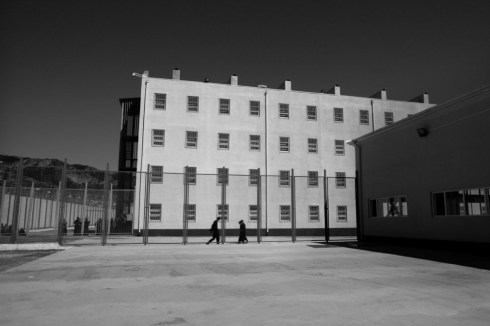
Ksani prison. © Mariam Amurvelashvili
If an authority cannot control nor redirect its prison population into productive activities, the prison is likely too large. It is probably overcrowded, too. State authorities need to understand that better conditions in prisons reduces crime. Reduce populations and pursue alternatives to incarceration. And find leaders with moral fibre.
AMURVELASHVILI ELSEWHERE
Bigger images here, and featured portfolios on Georgian Photographers website here.
Conscientious likes Amurvelashvili’s Dukhobors a portrayal of a Christian sect in Georgia/Russia. Fotovisura has a gallery of her photos of animal sacrifice and behind bars.

For Three Strike, Northern Irish photographer Adam Patterson made portraits of men who had been sentenced to term-to-life sentences under Three Strikes Laws. The men have in common the fact all their releases were secured due to the work of the Stanford Three Strikes Project.
Patterson writes, “In 1997, William Anderson stole a dollar in loose change from a parked car. He was arrested and sentenced under California’s voter-approved “three strikes and you’re out” law. Mr Anderson’s two previous convictions of daylight residential burglary in 1985 now accounted for his first two strikes, allowing his petty theft from the car to trigger the hammer blow—the third strike. He was sentenced to 25 years to life in state prison. A number of states in the US have the three strikes law, under which criminals who persistently offend are given increasing penalties. Yet in California there remains one glaring difference that many believe is a catalyst for continued injustice. While the first two strikes must be “serious or violent” crimes, the third strike does not. This discrepancy has allowed criminal prosecutors to press for a variety of life-crippling sentences for the most minor of offences.”
Three Strike is four images.
VIDEO
Journalists Kelly Duane de la Vega and Katie Galloway‘s must-see multimedia documentary Three Strikes Of Injustice appeared on the New York Times website recently.
Three Strikes Of Injustice opens with an apology by Judge Howard Broadman, made to Shane Taylor. Broadman sentenced Taylor to 25-to-life for a non-violent offense fifteen years ago. It was Taylor’s third conviction. Taylor speaks from prison over the telephone and his family is interviewed. It’s very hard to disagree with Taylor’s tearful 19-year-old daughter who observes the absurdity of a 25-to-life sentence.
Duane and Galloway had long standing interest interest in prisons (they released Prison Town in 2007) but like Patterson was drawn to the work of the Stanford Three Strikes Project and specifically their 2010 study that showed that more than 4,000 inmates in California are serving life sentences for nonviolent offenses under the three-strikes law.
BIOGRAPHIES
Adam Patterson (b. 1982), received a postgraduate bursary in 2008 from the Royal Photographic Society to undertake a project on youth gang culture in London. He holds an MA in Photojournalism and Documentary Photography from the London College of Communication. He has worked with the BBC Panorama documentary team in Dubai, Chile and the UK and on documentary projects addressing issues such as the slave labor trade in Dubai and the rise of cheap heroin in Wales. He helped smuggle a digital camera to Chilean miner Edison Pena, who then photographed underground conditions while trapped during the Copiapó mining accident between August and October 2010,
– – – – – – – – – – – – – – – – – – – – – – – – – – – – – – – – – – – – –
Kelly Duane de la Vega and Katie Galloway received the best documentary screenplay award this year from the Writers Guild of America, West, and the Gotham Independent Film Award for best documentary last year, for their film Better This World.
Three Strikes Of Injustice was partly funded by David W. Mills, a Stanford law professor who supports Proposition 36 and has advocated reform of California’s three-strikes law.

Ronald Day en route to work, NYC. © Ed Kashi / VII Photo
– – – – – – – – – – – – – – – – – – – – – – – – – – – – – – –
Think Outside The Cell, a NYC based advocacy group, and VII Photo Agency recently collaborated to make and distribute a media campaign to educate the public about the continued struggles for felons post-release. This is the third of a five part series, ‘Ending The Stigma Of Incarceration.’
(Part One): Think Outside The Cell / VII Photo Partnership
(Part Two): A Conversation With Ron Haviv
Part Four: A Conversation With Jessica Dimmock
Part Five: A Conversation With Ashley Gilbertson
Ed Kashi, together with Ron Haviv, photographed and videoed Ronald Day‘s story. Ed and I chatted about his experience and the issues at stake.
– – – – – – – – – – – – – – – – – – – – – – – – – – – – – – –
Editor’s note: On September 27, 2012, Ronald Day was discharged from parole. He has since obtained his passport and registered to vote. On November 6, he will vote for the first time in his life. These interviews were conducted prior to September 27.
– – – – – – – – – – – – – – – – – – – – – – – – – – – – – – –
Prison Photography (PP): When the idea of this partnership cropped up, how was it that yourself, Ron, Ash and Jess became the first four photographers?
Ed Kashi (EK): To some degree we were chosen on proximity to the subjects. Proximity to New York … and budget. We sense that we’ll expand this work dramatically into a bigger documentary series – not only in terms of going more in depth with our two subjects but with two more subjects.
EK: I’ve done a lot of work on prisons and similar subject matter. I don’t know about the other three. I am driven by examining social and political issues and increasingly it is frustrating to be able to do that for publications and the editorial world. I can speak confidently for all four of us and say our hearts lie in examining social and political issues, but it is so hard to get the funding let alone the interest and the buy-in of the editorial world, so whenever the chance to partner with NGOs or foundations or organizations and go out in the world and do honest and good visual reporting and know that the work will be used in an effective way to advocate for these issues, we take it.
PP: Can you give us a brief background on those stories you’ve done on prisons before?
EK: The first project that I did was in the late 80s. I pursued a personal project on the issue of private prisons looking at Corrections Corporation of America (CCA) based in Nashville. I was fascinated back then by the issue of privatization that began under Reagan and Bush Snr. I was concerned that we were privatizing such a critical function of society. I went to four facilities around the country.
Over the years, I’ve also had assignments to go to San Quentin or Folsom to do one or two day shoots for TIME magazine, that kind of thing.
The next really big encounter with prisons was during my aging project. During the very first stage of what became an eight-year project on how America is growing old, I did a story on aging prisoners. I went to a couple of prisons with dedicated geriatric facilities. I did the fieldwork in 96 and 97 and the story eventually ran in the New York Times Magazine in 1997. It seems to be an issue I’m always bumping up against in one way or another.
PP: Compared to most photographers, your experience with and within prisons is incredibly wide and involved. Most photographers if they touch on the subject – and sometimes it might be accidental – might do do only once. Repeated visits to prison across the states is unusual. Access to private prisons is very unusual.
EK: I’d be amazed if CCA would give me or another photographer access again. They let me go to a juvenile facility in Nashville, an immigration facility in Houston, a maximum security prison in Santa Fe, New Mexico and a prison in Panama City in Florida. That the early operating years of CCA and maybe they were seeing it as a PR/marketing effort. I mean, I wasn’t even on assignment. To think that CCA would allow in the late eighties a freelance photographer from San Francisco to photograph in their facilities figuring, ‘Well, we’ve not had bad publicity yet, we’re just getting started, this is a way for people to know what’s going on.’ In the state of California, years ago I believe, they set down a policy in which journalists are not allowed in any of their facilities. More and more today, things are really shutting down. Access is in general shutting down for journalists in many ways. We’re perceived as having lost our neutrality and are now considered partisans!
PP: Well, we hear the term “liberal media” constantly. It is one of the most meaningless slurs I can think of. NPR is not liberal.; it’s journalism organization and it is neutral.
EK: The fact that anyone would call Obama a socialist is ridiculous. You should be sent back to school!
In terms of media, the type of person to go in to journalism should have an open and progressive mind. And I don’t mean progressive in a political sense; I mean you’re looking at the world trying to find out what’s going on; trying to figure out how to move forward; seeing the problems and then looking for where there may be solutions. By the nature of this work, you should be progressive and open minded, but unfortunately that has been translated into, ‘You’re Liberal.’
Quite frankly, I think there is something much more venal and dangerous this represents. What we’re now experiencing is something that was begun under the Nixon White House in the sixties and Pat Buchanan was very much behind it … and truthfully Cheney and Rumsfeld and the older Bush were part of it. It is in many ways, no different to what fascist and authoritarian regimes have done – which is to debunk and attack the media. If you don’t kill them physically, you delegitimate them. Really, that’s my very firm feeling of how these political movements work and it is very sad to me to see that this is happening in America.
I don’t see it happening in Europe, but America is such a huge country, a huge swathe is under-educated or naive. I think it is the nature of a large country. It is not that these are bad people, it’s just that they are not educated. It pisses me off and it scares me.
PP: Let’s talk about how that relates to this partnership. Does that landscape you just described, does that imperil the way potential this work and it’s products could be seen, interpreted or understood? Or do you look at it another way, a more positive way, that there wouldn’t have been a pressing need in the past to reach down and give a helping hand to a young, fledgling NGO. How does VII Photo, Think Outside the Cell and Sheila Rule anticipate that this work will be consumed?
EK: The way I look at this advocacy journalism, which is what I call it, is we gain access to subject we would otherwise have trouble getting access to. That’s number one. Number two, we’re doing it in cooperation with an organization that we know will disseminate the product to the policy makers and the people and organizations who can make a real difference and drive change – be it on a legislation for funding level.
Then, VII or the photographer can take that work and have a free hand to distribute it in the media landscape. The difference is that in the past I’d have to convince New York Times magazine or whoever it is [ahead of time] to give me time and money to go and do the work. Theoretically, I’d have been able to gain access because of the guarantor of a reputable organization and then the work would be funneled through that media organization for good or bad effect. In a sense, I prefer this [way of doing things] which sounds kind of weird. Just so you understand, on a process level, I’d rather just be working all the time for New York Times magazine or National Geographic or whomever, just because I love that being a journalist and having the support and protection of a media organization, but given the way things have changed and given the reality – both economically, politically and structurally of media in our society today, this is an exciting development that is taking place. As long as it is done in the correct way, where there is no slanted or biased reporting.
PP: You’ve been liberated but not compromised? And you use the phrase ‘advocacy journalism’ which is the most fitting term I’ve heard.
EK: On a deeper level – and this is definitely a product of my age and the stage I am in my life. Being mid career in terms of my work and certainly being mid career in terms of my life span and being a parent of teenagers and being engaged with the world not just as a journalist but as a citizen – I want this goddamn work to make a difference.
It’s not just about, ‘Hey, look, I got the cover of National Geographic magazine’ or ‘Hey, I’m on assignment for the New York Times Magazine.’ Its not that those things don’t have value any more, it’s that they are not the purpose. The purpose is, ‘How do I make work that makes a difference. How do I make work that can be utilized to make positive change?’ I think it is critical for us to find ways to tell stories that give optimism and a belief that there’s a way forward. We need to bear witness to the worst things that are going on in the world and not sugarcoat them. Obviously we need that objective first hand view of things. Whenever we can tell a story that exposes a problem but proposes a solution, I think that is the height of journalism.

Ronald Day at his home in the Bronx, during a Father’s Day barbecue, held on June 17, 2012 in New York City. © Ed Kashi/VII Photo.
PP: That’s what you want out of it. What do you think your subject, Ronald Day, wanted out of it?
EK: That’s a great question because it cuts through to the potential naked ambition of the photographer or the journalist. You’re getting points by shooting in a prison because it is gritty and it is edgy and it is tough and cool. You know what I mean? Characterized in that warped way the professional can work. Whereas, I am at a point now where I wouldn’t want to go into a prison or do a story on Ronald or anyone if I were to hurt the subject in any way.
What does Ronald want? I think he wants his story to be told, and it is common among people who agree to cooperate with journalists – it’s a little bit of vanity and a little bit of hope. At the very least, their situation will improve and for those who are a little more magnanimous, telling their story may help others in similar positions. I believe Ronald is a selfless man. He’s a pretty brilliant dude; he’s a smart and totally impressive. He is a poster-child for this particular issue. He is not your average ex-prisoner. I left the project missing him.
PP: How long have you lived in New Jersey?
EK: I moved here Christmas 2004, so eight years. I was born in New York city and raised in the New York area. In 1979, I moved out to the Bay Area.
PP: What did you learn, as a resident of the region, about New York State? VII and Think Outside the Cell intend to expand the initiative to other states. At that point the stories will change because each state carries different laws. But did you learn anything through Ronald peculiar to New York State when it comes to the stigma of reentry.
EK: I was surprised to learn about how a one size-fits-all nature of bureaucracy ends up shafting extraordinary guys like Ronald. The probation rules are a central theme of Ronald’s psyche and story.
PP: I’m presuming you think he should’ve had a faster track through probation and been able to take on student loans and start his PhD and make international travel.
EK: Yes, and for instance, now he is in this position where because of the job he has and the teaching at night, it forces him to break his curfew rules. He has to get up a 5 in the morning, to catch the bus to the train at 6:30, so he gets to Brooklyn in time for his work, but technically he’s not supposed to be out of his house until 7am. He could potentially be penalized for that. Or he has to go to some event in the evening, where he is teaching or speaking or taking a class and technically then he’ll get back home after his curfew. I understand that with tens of thousands of parolees in the state of New York you can’t have tens of thousands of different sets of rules, but it would be great to find a way to bend and accommodate for people when it is so clear they are on the right path. That might seem like a minor thing, but it is not minor to him.
PP: Anything else?
EK: I don’t know if I expressed this adequately but ultimately the goal of this work is to further break down the stigma of people who have been in prison and – as is the case with any journalism – to educate people. We have to look at the formerly incarcerated in a different light and in a sense we need to look at how the structures of our society deal with the formerly incarcerated. At a functional level, that is more important for former prisoners – so that when they go for housing or employment, they don’t face hurdles that basically leave them in a self perpetuating negative cycle.
PP: Do you think your media of choice, photo and video, are entirely appropriate? Inasmuch that you are battling stereotypes and many misleading stereotypes that have been created through mass media images, TV and film.
EK: That’s where this partnership with Think Outside The Cell is different. In a perfect world scenario, the work gets presented through big outlets, but ultimately this work will be used by Sheila Rule and her organization to advocate in the trenches. Progress occurs when a few minds who actually have some influence on the system are changed. So, they go into their next hearings, congressional meetings or classrooms and they open up others’ eyes. It is something I believe in – even despite all the cynicism and the over-mediated world we are living in, I absolutely believe in that, because I’ve seen it happen. You change one mind and then there is a ripple effect.
PP: Hear, hear. Thanks Ed.
EK: Thank you, Pete.

Ronald Day at home getting ready to go to work. © Ron Haviv/VII Photo
– – – – – – – – – – – – – – – – – – – – – – – – – – – – – – – – – – – – – – – – – – – – – –
Think Outside The Cell, a NYC based advocacy group, and VII Photo Agency recently collaborated to make and distribute a media campaign to educate the public about the continued struggles for felons post-release. This is part-two of a five part series, Ending The Stigma Of Incarceration.
Part One: Think Outside The Cell / VII Photo Partnership
Part Three: A Conversation With Ed Kashi
Part Four: A Conversation With Jessica Dimmock
Part Five: A Conversation With Ashley Gilbertson
Ron Haviv, one of four photographers on the project, was kind enough to take a Skype call from me. Ron and Ed Kashi photographed and videoed Ronald Day‘s story.
– – – – – – – – – – – – – – – – – – – – – – – – – – – – – – – – – – – – – – – – – – – – – –
Prison Photography (PP): How did you become one of the four photographers for the VII Photo/Think Outside The Cell partnership.
Ron Haviv (RH): Ed, Jessica, Ashley and I were brought in after the project was agreed and secured. To be honest with you, we hope this project to be a long term and expansive project going beyond New York.
PP: You want to cover the issue all over the country. Why is that necessary?
RH: It’s important that not all the subjects look alike or sound alike. We must emphasize this is not a New York problem; the stigma of incarceration is a national problem. So, it is imperative that we look to … maybe not in all fifty states … but we look to get to a number of states in order to give the audience a real variety of ideas and illustrate different problems that former prisoners are going through. Some of those problems are going to be state specific; that variety is going to be an important aspect for people to understand.
PP: Let’s talk about your subject, Ronald Day. He works in advocacy and service. He has earned a Masters degree since release. He teaches at John Jay College. He has started his PhD program in Criminal Justice at CUNY/John Jay. This guy is a success story. What sort of a relationship did you develop with Ronald?
RH: Before we started photographing, we went to meet him and he was incredibly open about his life – from very basic things to personal details. When we asked him questions he was very forthcoming.
He is an incredibly articulate and smart man as proven by what he has done inside and outside of prison. Ed and I couldn’t have asked for someone better through whom to illustrate some of the issues. To think that someone of his caliber struggles, means that people that don’t have that same skill set must really struggle.

Ronald Day on his way home after work and a lecture to students. © Ron Haviv/VII Photo
PP: What did Ronald want out of the multimedia piece?
RH: Well, his job is in helping others acclimate to society; people who’ve gone through the same things that he has gone through. His whole life is directed toward helping and informing people; people like myself who know very little about the stigma that felons deal with.
Ronald is informing the public and hopefully trying to have some impact on policy-makers and lawmakers. That being said, he is absolutely not the type to sit down and preach to you. He’s more like, ‘Look at what I’m going through, look at all the hoops through which I’ve had jump to get to where I am,’ and showing us by example [what is practicable], not just railing against the system.
It’s interesting. Usually a photographer will learn about their topic, in this case criminal justice and parole, through research and secondary sources, but here, in Ronald, we had the best resource, a primary resource, someone who has lived and is living the issues wrapped up in reentry to society after incarceration.
I think he is for sure remorseful and recognizes the mistakes he made. It’s not as if he claims he is innocent or was framed, but at the same time, he sees that was a very different person who went to prison 18 years ago. He’s a different man now. He has a son who is very important to him and a mother and a sister and her kids and they’re all living in a three story home in the Bronx – a very lovely place. So he has the family components that are all vital to a successful life.

Ronald Day at home celebrating Father’s Day with family and friends. © Ron Haviv/VII Photo
PP: How often did you photograph Ronald?
RH: We did a week with him over the course of six weeks.
To be perfectly honest, we didn’t spend huge amounts of time with Ronald. We’d see him at work and in the home and for different events but there was no huge emotional crisis that Ronald was going through that Ed or I had to witness or deal with. We were there for fathers day which was lovely – lots of friends and family at his house.
PP: You were paired with Ed Kashi – you making stills and Ed making video. Similarly, Jessica [Dimmock] and Ashley [Gilbertson] followed Mercedes Smith, the female subject. Had you and Ed worked closely on anything before?
RH: No, but obviously, we are business partners in VII. This was our first collaboration, the result of which will be a mixed media piece.
PP: You said before that the issue of stigma among the formerly incarcerated hadn’t been on your radar.
RH: Correct.
PP: What have you learned?
RH: Society *says* that if you commit a crime, you pay for it by time in prison and then, once you are released you are supposed to be able to continue your life.
I’m amazed that prison continues to haunt the people coming out to the point of often driving them back because they can’t get a job or they can’t get housing or it’s very difficult for them to go to school. That was very surprising to me.
With voting [disenfranchisement], you hear a lot about whether felons can vote or not, but I didn’t realize that if you’re filling out an application to rent an apartment or trying to get just a basic job, at McDonald’s for example, that there are boxes felons must check. As soon as they do [check that box], they’re out.
There’s no home, there’s no basic job, and so when you talk about recidivism in America, well, it is very obvious why a large part of it is happening; it is because there is no way to survive on the outside. For me, that was very disturbing and something that on many levels this country needs to deal with.
PP: How did we get to this state of affairs? Is America an unforgiving society? Is it bad policy put in place by misinformed politicians and voters? Let’s be frank, many of these laws have come about recently. How is it we treat the 700,000 released prisoners per year like this?
RH: It’s a combination of a number of things. In New York, the drug laws that were passed were, are, harsh and absurd in relation to the actual crime.
Plus, the break down of the family. Parents going to prison breaks up families. Children who grow up without a father have a much higher chance of going to prison. That’s not a problem for which the system must be blamed. That comes down to individual responsibility and must be taken a lot more seriously. I think it is incredibly important but not something we discuss.
Obviously, there are laws that are causing problems but a huge reality of it is people not being responsible for their children, basically. That is not the main cause but it is a large cause. And that applies to the white community, the Black community, the Hispanic community; it’s not a racial thing, but it is definitely a gender thing. Men are just not stepping up. That’s my personal position.
PP: Do you suspect there is a crisis among men in America? Is there an issue with male identity?
RH: Absolutely. There’s a lot of factors … but, men carry a huge responsibility. It’s probably controversial [to say] but I think there’s a real problem with the use of, and ideas surrounding, birth control.
I don’t understand why people are having so many children or why fathers are so proud to say, “I’ve got three kids with that girl and two kids with that girl.” It’s ridiculous and I’m not sure what the reason for it is but it really comes down to personal responsibility. If you’re going to have children then you need to be able to take responsibility for them, and if not then there are ways to not have children.
PP: Did you have any ideas how you would shoot this story? This is an issue about emotions somewhat but also about intransigent rules. How do you photograph someone being denied food-stamps or housing? How do you photograph bureaucracy?
RH: That’s exactly why Ed’s video element of this is incredibly important. There’s certainly ways to photograph the frustrations that Ronald and other people go through but by having multiple components where you’re going to see him in action, share his voice and hear him not just reading a caption but having a conversation. The combination of audio, video and stills makes it much more powerful and dynamic – compared to a straight up photo essay with captions.
PP: I think it interesting that VII has focused specifically on reentry. My position is to look at prisons and those invisible sites and think exactly how and what power is being played out, whereas reentry goes on in “free” society and so the assumption might be it is a subject more accessible for the photographer.
PP: Is this one of the major, ongoing initiatives at VII?
RH: We have a number of different partnerships, from projects with the United Nations, to Médecins Sans Frontières, to traditional media partners – TIME, the New York Times and Vanity Fair for example, but this is definitely something we think is extremely important and we’re very excited to hopefully take it further. Right now, it is just the beginning.
PP: It sounds like you’d be interested in doing a second stint on the project?
RH: Yes, and I’m also interested in following Ronald some more. I hope to see how he does at university. We’re not going to let him go! We’re going to continue to follow his story.
– – – – – – – – – – – – – – – – – – – – – – – – – – – – – – – – – – – – – – – – – – – – – –
VII Photo: “The United States imprisons more people than any other nation in the world. For the first time US history, more than one in 100 American adults are in prison. China is second, with 1.5 million people behind bars. An estimated 700,000 people are released from prison in the United States every year. Where do they all go?”
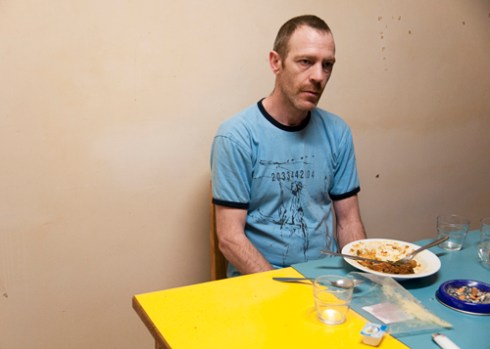
Laure Geerts and Sébastien van Malleghem, two members of the photo collective Caravane, have been photographing in Belgium’s prisons for a little under two years. They went to seven prisons including Marneffe, an open prison; Nivelles; Paifve, a prison for the mentally ill; and the now-demolished Verviers Prison.
The series is called Destination Carcerale.
This is the second of a two-parter; yesterday, I published Belgian Prison in Grayscale a Q&A with Sébastien van Malleghem. I know very little about Belgian prisons so I asked them both some questions.
Prison Photography: Why look at prisons?
Laure Geerts: I have always been interested in people, particularly people who live on the margins of society. I want to know more about their reality.
In Belgium, we hear news every week about prisons: overcrowding, unsanitary conditions, strikes, escapes and “famous” prisoners that no one wants to see released. It’s quite a hot topic but you don’t see much documentary on that. The known images are always the same press photo with doors, big keys, guardians and prisoners with the face hidden. I am interested about the psychological aspects of a men being kept between the walls.
So, it is not the problems related to the prison, but the human side, the life stories that interest me. The issue of the prison is complex. Each individual reacts very differently to the deprivation of liberty.

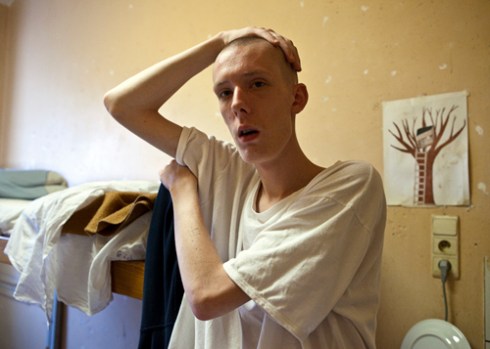
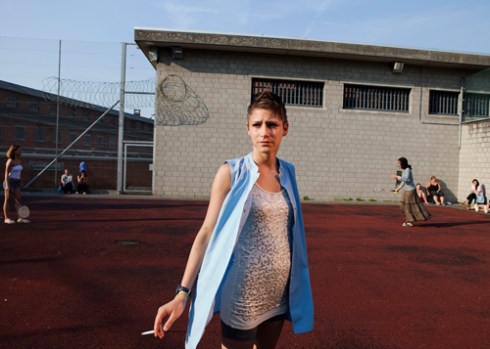
PP: Despite the vibrant colours, your photographs are quite still in a way. Does the prison move slow?
LG: Yes, the prison moves slow. Everything is regulated, organized, timed … everything turns around the schedule, daily or weekly tasks to perform. This leaves little room for spontaneity, freedom of movement. It is not possible to take meals or to wash when desired. Officers dictate the rhythm with calls, opening and closing doors, distributing meals and various movements to workshops, playground or visits. If the prisoners do not get a job or a training, they stay in cell watching television, sleeping or playing with video games. Many know drugs, depression, violence and isolation. Taking drugs and medicines allows them to escape their reality and keep calm.
PP: The look of many of your images suggest you had conversations about composition and positioning of your subjects, which could almost be considered a collaboration. Do you think of your work in those terms?
LG: The images, built my way, express the deprivation of movement & freedom, but even more the loneliness of the people. I must say, that when we arrived on a cell wing or in a working area, we explained our project and those who agreed to be photographed sign an authorization. That meant we spend a lot of time talking before taking pictures. I also recorded sounds of the prison and what the prisoners and staff are eager to tell me, to share. The images come before, during or after the discussion.
They do not pose especially. In any case, I do not direct them. I try to capture what they give to me. So they talk and I listen and sometimes everything is just in front my lens. An important thing for me is a trust. When trust is mutual, I feel comfortable and I feel free to take any picture. It’s funny because first I though it would be more difficult; I feel less comfortable in other contexts and working with other subjects in other communities.
PP: Why the collaboration with Sébastien?
LG: We’re part of the same collective of photographers, named Caravane. We wanted to work together on a topic. His interest in prisons is, of course, a logical continuation of his work on the police. He wanted to push the analysis one step further and investigate what happens to people in prison following an arrest.
I am interested in closed universes and masculine spaces. In prison, it is the human and psychological aspects of the prisoners that I wanted to see. How does a prisoner feel during his incarceration? What links remain with the outside world? How is the social network in that closed universe ? I do not remember if it was Sébastien or I that talked about it first, but it is true that rather than taking separate steps, we could join forces. The exchange of ideas and pictures enriches the subject.
Working in the same field, we ask for good organization and good understanding of each other. We meet the same people, we visit the same places, but at the end our images are very different. Sébastien works in black and white, when I need color in photography. Sometimes I can spend time with a person while Sébastien seeks more action with a small group else where. We do not shoot at the same time at all. Given our different personalities, some inmates will go more easily to one or the other. It is also rich to share our impressions directly or in the car the way home and then see the pictures chosen by each of us.

PP: What did the prisoners expect of your photography and presence?
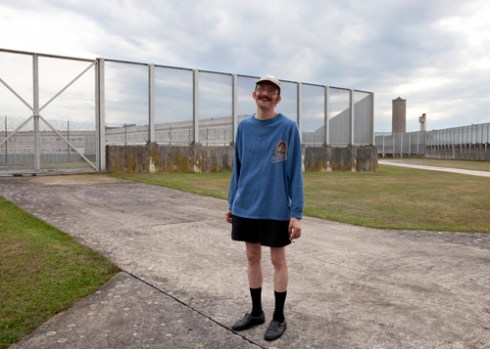
LG: Those who wanted to talk do not hesitate to criticize the system, their living conditions, daily problems and the lack of care. They took advantage of our presence to be recognized and to have a voice. Some are rather pessimistic and do not believe that our work is useful.
PP: What did the staff expect of your photography and presence?
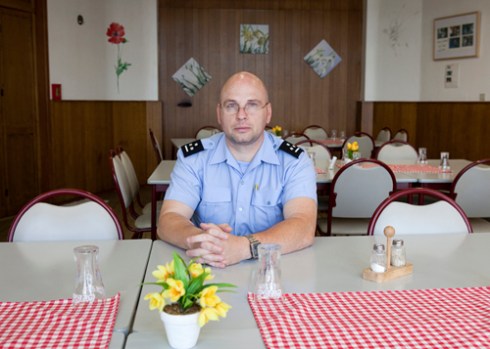
LG: Inside the jails, we meet as many inmates, officers and social workers. Officers guided us and they sometimes talked about their work. Often the staff do not want to tell us about their experience or appear on the photos. They are often more cautious than the prisoners themselves. Those who do not accept to talk seem to be afraid of criticism and think they are victims of the bad image prison-guards may have to the public.
For them, they are seen as gatekeepers who spend the day playing cards, drinking coffee and being bored. Their everyday life is not very fun; they are somehow locked up and must also undergo regular staff shortages and insecurity. Their role is facing many limitations. They end up closing their eyes to illegal practices lacking real methods of control. Some are even tempted by little traffics to win a bit more money at the end of the month. These ones avoid us, of course, but we hear and see many things.
PP: What are your attitudes towards prisons?
LG: As in our discussions with prisoners, staff and having visited seven prisons very different in size and operation, my impressions and feelings are quite mixed. Generally, the prisons did not help to make men and women better or ready for reintegration. There are too few efforts to work in depth with everyone, to help them realize the gravity of the act for which they were punished, and especially how not to reoffend.
Society believes that to enclose a human being and deprive him of freedom for a while will be a good lesson and he will get back on track. It is complex because each person has a personal story, each case is different and it is difficult to propose a single method. Given the rate of recidivism and what I’ve seen, the prison today is not the solution. I have met very few inmates confessing to realize they had taken a wrong path, and that every day they had a thought for their victims.
Some are determined to use this time to learn a maximum of things through trainings, education or reading books. Others also get back in touch with religion. It takes a more prominent place than outside. They take some time to focus on God, to discover or rediscover their faith and prayers. And when the family remains, this is an essential support for the inmate. Otherwise, for the majority of the prisoners it is for them only waiting, complaining and dealing to improve the daily life (drugs, food, gaming & phones).
There is not enough psychological attention, motivation and education to young people and many of them do not see a bright future. Rehabilitation is difficult and the label “prison” rather indelible.


PP: Have your attitudes changed during your time working on the project?
LG: Maybe yes. It’s interesting to hear stories of many different persons and to see so many different jails. I have talked a bit with families. It’s another piece of the subject, but quite important also.
PP: Anything else you’d like to add?
LG: I would like to add a few extracts from sound recordings (translated from French):
”Look at me right in the heart. A train line in the dark. I am neither inside nor outside. It is as if I walked a life without you. I’m jealous that you are there in the country. I’m here all alone with four walls. All this time should make you forget you love me. I think about you all the time. I cry for love and boredom your face there in my head you’re very pretty nicely this is adorable. I rage and I write to you darling who are there with your great happiness when I get out of my hell but you know I love you so I would not want to seem sad but I have no sorrows not have you next to me.”
— Poem by a patient of the psychiatric prison.
“What is the most beautiful thing, the most comfortable? It is having a place in the heart of your mom. No? You’ll always get the support of your mom. Always.”
— Patient of the psychiatric prison.
”I would say there are cheaters and non cheaters, I am one of the non cheaters. In my head, I’m just a kid.”
— Patient of the psychiatric prison.
“It’s been 6 months since I arrived here. I have 69 months in total. When I have served 2/3 of my sentence, I will have 24 months until release. Otherwise, here, it goes rather well. I’m training in mathematics, computer science, French and cooking. We have two hours of yard per day. We can go to church here. I am a Catholic. I am 25 years old, this is my 4th time in prison. Here you can go to the gym, there is also table tennis, football, otherwise watch television. Most of the time, we remain locked in the cell. I have not told my parents. As this is the fourth time I do not want my parents to come here again. The first time they came often. I am at war with my father-in-law so I did not phone when I returned back here. The only people who are aware, it is two or three friends of mine and as they have a criminal record, they have no right to come here to visit me in prison. I’m all alone, but I came here with a friend.
I keep the spirit, even having no visits. I do not need to see my family to feel good. As I know they think of me, I am okay. It is not too hard either. The guards are friendly. I get on well with them, we laugh often. Keep up, we must say to ourselves everything okay, and we do some sport. Two years will pass quickly, I think.
Otherwise, I’m doing two or three small trainings: cooking, accounting so that when I get out I’ll try to find a job. Otherwise, I’m doing the paperwork to get an apartment . I wrote several letters, called a few places and now I’m waiting for answers.
We try to get released as soon as possible with the right conditions. I do not want to repeat the same mistakes that I made in other prisons. In other prisons, I was doing nothing I was just waiting for my pain, I got free and then I started again the bad things. Now, I have a longer sentence to do, I’ll take the time to think about what I want out for that I would not come back here again. I’m 25, I go out of here for my 27 years. I need to stop my bullshit. Otherwise, it will not be okay for my future. I want to have a wife, children and all. So I try to reinsert correctly. “
— Young prisoner in Nivelles.
“There are so many things that are officially banned in prison. There are things that are prohibited with reason, and things without reason. Forbidden things, but they are more than tolerated and demonstrate the terrible hypocrisy of the system. This is what disgusts me in prison. Here in this department, it is not very much prison. We have the doors open. We have a good comfort in our cell. I’ve lived outside with less comfort than this. Here we have everything. I have two hot plates, fridge & TV. But that gives us what? We have nothing. We are not punished, it’s true. You can live 50 years like that, we have everything we need.
That’s the hypocrisy of the system, we are put aside for a number of years. We are totally and ridiculously useless. We serve no purpose to the system, we cost money to the system. The system is not protected as when we go out, we are worse than when we got in. I’ve been in prison since 1995. I’ve seen a lot happen. I escaped. I’ve never seen anyone or very few people who amend and become nice sheep because they have been in prison. I think the system is hypocritical. Drugs are prohibited, but it is more than tolerated. Many guards – though they’d never admit it – prefer to see people smoking a joint to avoid problems. The drugs enter. I know a lot of people that do not touch any drugs outside, not even a joint or alcohol. But here they are down with hard drugs. They are not drug addicts that fall in jail but the prison can makes them addicts. Drugs are is much easier to find here than outside. “
— Prisoner in Verviers.
“What I have noticed in jail is that different social relationships we can have in jail, it creates a psychology. Most people are always stuck together, and it becomes a group. And this group has the same psychology. They all have the same social links and that’s what creates people who still hold the same discourse: officers are bad, the state is the bastard and we are the victims. And it is those people who are getting out, come back, leave, and so on.
The officers are now trained to be more social with prisoners. Before they were executioners. You have those who do not care about the prisoners, you have those who are serious and those without emotion, that do the job to get their money. “
— Young prisoner in Ittre.
BIOGRAPHY
Laure Geerts (b. 1978, Belgium) is a founding member of Belgian photo collective, Caravane. Laure studied commercial sciences in Brussels, before moving into photography in 2006 to study at the Contrast photography studio. She went from spinning images to making and challenging them and found it easier to approach strangers and subjects she’d not before encountered. Laure has exhibited at group shows in Cork, Paris, Brussels, Lille, Liege, and Bamako in Mali.
Follow Laure on Twitter and Caravane Collectif on Facebook.

An agent is looking on his colleague during the visit of the food storage in Forest, Brussels, Belgium on Oct. 10, 2011. © Sébastien van Malleghem
Sébastien van Malleghem and Laure Geerts, two members of the photo collective Caravane, have been photographing in Belgium’s prisons for a little under two years. They went to seven prisons including Marneffe, an open prison; Nivelles; Paifve, a prison for the mentally ill; and the now-demolished Verviers Prison. The series is called Destination Carcerale.
This is the first of a two-parter – see Belgian Prison in Polychrome, Laure’s photographs and Q&A also Prison Photography.
I know very little about Belgian prisons so I asked them both some questions.
Q & A
Prison Photography (PP): Your B&W documentary approach to photography is different to Laure’s way of shooting.
Sébastien van Malleghem (SvM): Yes. I chose this approach to photography several years ago. I’m concerned by the world that surrounds us. I like to go deeper into stories and take time to do them.
PP: Why did you and Laure decide to collaborate on this project on Belgian prisons?
SvM: We’re part of a collective. Initially, we talked a lot about doing something together in photography. Laure as always been interested by strong universe (sic)*, and I wanted to continue to work on stories about criminal justice after my long documentary work, Police. (Interview about Police in French.)
It’s a challenge to do reportage together but we wanted to share a vision, and ask ourselves questions about the ways we can create photo documentary. Many documentaries are done alone. After months, it’s interesting to see the difference between our works, especially as we were at the same place all the time – Laure’s colors pictures are different to mine. So, we are questioning objectivity in photojournalism, also.
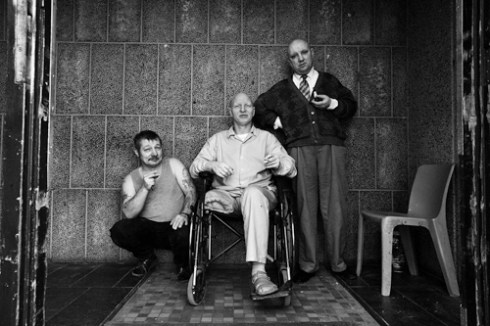
Three patients smoking at the entrance of their ‘block’ in Paifve, Liège on Feb. 16, 2011. © Sébastien van Malleghem.
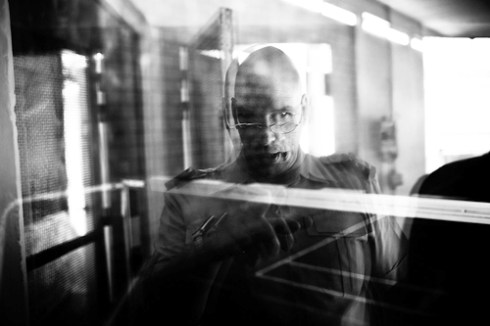
A guard is speaking behind a safety glass in Verviers, Belgium on May 6, 2011. © Sébastien van Malleghem
PP: What did the staff expect of your photography and your presence?
SvM: At first, they didn’t seem very interested in the fact we’d received the authorization of the Head Director of the Belgian Prisons, so every director at every single prison would begrudgingly say, “Okay, if you got the authorization, it’s fine.” Then, after few weeks some prison administrations became very interested in our pictures. Some directors began showing us everything inside inside their prisons as if to say, “Look how can we work in these conditions.” So we got some great access and different points of view.
PP: What did the prisoners expect of your photography and your presence?
SvM: Honestly, I don’t think that they expected anything from us. Some of them didn’t want to be seen. Some of them are playing the game of honesty [for the camera]. They expected that the prison conditions may improve. They were interested by our work because we were/are speaking about their present universe. We are showing the reality inside the prison which is not so good. In fact worse than ever in Belgium.
PP: This is a long-term and committed project. What do you hope to achieve with its completion?
SvM: We’re giving a real and true alarm signal to the authorities and to the government; they are looking on our work and they will certainly watch it in the press. That’s will create another debate.
And maybe, with a deep and concrete story, and by showing this work to the public and show why there are so many problems in our prisons, maybe they will get access to a more telling information than that in the daily news-feed?
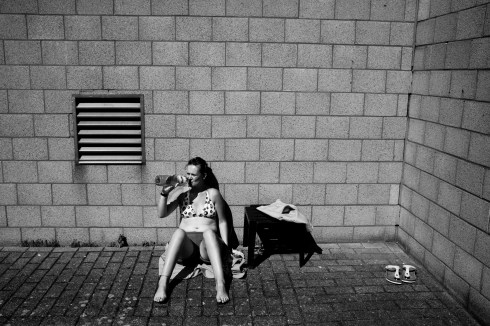
A woman is sunbathing inside the prison for women of Berkendaele on July 25, 2012. © Sébastien van Malleghem.

Women are dancing in their cells inside the prison for women in Berkendaele on July 25, 2012 © Sébastien van Malleghem.
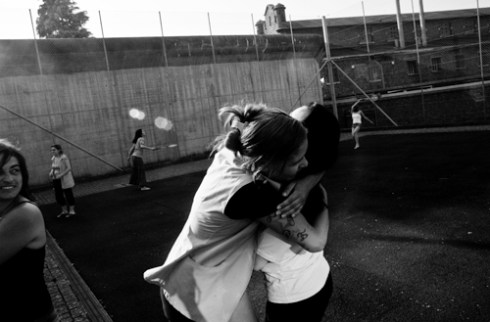
Cuddle in the courtyard of the prison for women in Berkendaele on July 25, 2012. © Sébastien van Malleghem.

View from the window of the prison in Verviers, Belgium on May 6, 2011. Verviers is one of the oldest prisons in Belgium and is currently being destroyed due to the collapsing of the walls © Sébastien van Malleghem
PP: You depict a prison being demolished. Are there more or less prisons being built/occupied in Belgium currently?
SvM: The government is destroying old prisons like Verviers and building new prisons in the north and the south of the country. The prison was not maintained during years because of budget problems. There is certainly not enough space. Inside the prisons, every inmate is a victim of our society, which is another sign of the actual crisis in our country.
PP: Anything else you’d like to add?
SvM: We should think about the ways we punish criminals in the 21st century and to help victims of crime more too. Currently, we are running with an old system of exile which doesn’t benefit anyone. The authorities remove the prisoners away from the society but put them in the middle of nothing which, seems to me, is another way to torture the spirit. They lock the gates but they are not trying to understand crime, or allieve it.
PP: Thank you Sébastien
SvM: Thanks!
– – – – – – – – – – – – – – – – – – – – – – – – – – – – – – – – – – – – – – – – – – – –
BOOK
van Malleghem’s forthcoming book Police by Yellow Now Editions (Belgium) is released in Belgium in November and will be available internationally from December onwards.

A patient inside his cell, in Paifve, Liège, Belgium on Feb.16, 2011. © Sébastien van Malleghem

Four prisoners are seen inside a cell debating reentry into society after prison. Marneffe, Belgium on Feb. 27, 2011. © Sébastien van Malleghem.
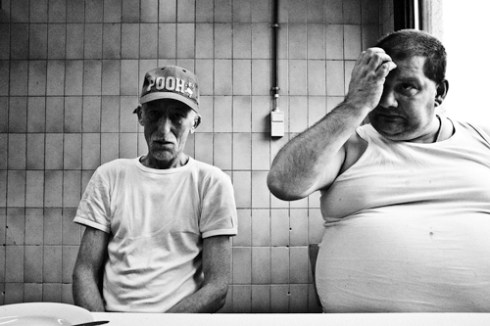
Two patients are eating their meal in the kitchen of the prison of Paifve, Liège, Belgium on March 3, 2011. © Sébastien van Malleghem

Writings made with a lighter on the ceiling are seen in a cell of Forest prison, Brussels, Belgium on Oct. 10, 2011 © Sébastien van Malleghem.

A patient pushed down the courtyard by his roommates in Paifve, Liège, Belgium on Jul. 12, 2011. © Sébastien van Malleghem.

The prisoners of Marneffe have the opportunity to play music in a band. The repetitions takes place inside a chapel inside the prison of Marneffe, Belgium on Dec. 8, 2011. © Sébastien van Malleghem
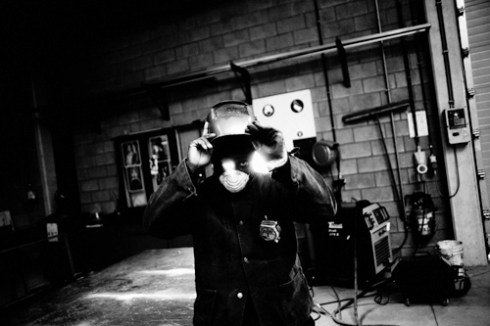
A prisoner during his daily work: preparing pieces of metal in Marneffe, Belgium on Feb. 27 2012 © Sébastien van Malleghem.

Toilet for the prisoners inside the prison of Forest, Brussels, Belgium on Oct.7, 2011. © Sébastien van Malleghem.
– – – – – – – – – – – – – – – – – – – – – – – – – – – – – – – – – – – – – – – – – – – –
BIOGRAPHY
Sébastien van Malleghem is a freelance photographer (b. 1986, Belgium) who studied photography at the Ecole Superieure Des Arts De L’Image Le 75 in Brussels from 2006 to 2009. He is working on a major project about Belgian police and in line with his interest in criminal justice began documenting the Belgian prisons in January 2011.
Sébastien is a member of CARAVANE photographic collective and is personal assistant to Tomas Van Houtryve/VII. In October 2010, he was selected for the Eddie Adams Workshop, Barnstorm XXIII, and in August 2012, was an artist in residence at Halsnoy Kloster, Norway. Sébastien was awarded
the Jeune Artiste Plasticien for his work Police.
– – – – – – – – – – – – – – – – – – – – – – – – – – – – – – – – – – – – – – – – – – – –

 Prison Photography