
You are currently browsing the category archive for the ‘Documentary’ category.

Ex-Clandestine Centre for Detention, Torture and Extermination Automotores Orletti, Buenos Aires. Plug used for the picana eléctrica (cattle prods) in the torture chamber. © Erica Canepa
The Remaining by Erica Canepa is mostly interior photographs of the sites used for detention and torture during Argentina’s Dirty War (1976-1983). Also included are a few portraits of survivors, notably Victor Basterra whose photos taken while he was prisoner have been used in trials for crimes that occurred at the main prison, The School of Naval Mechanics (ESMA).
Canepa’s title for the series comes from a quote by Basterra:
“The military dictatorship began with the idea of culturally changing Argentinian people. It has been a progressive change towards a more individualist, selfish and insensitive society that reached its apogee during the Nineties, but where the basis was brutally planted during the dictatorship era. What you see outside the window is what’s remaining, what we are left with. It is today’s Argentina, that shows the indelible marks of genocide, but in which I can still see the ideals that we fought for.”
– Victor Basterra, ex detainee of the Clandestine Centre for Detention, Torture and Extermination ESMA, 2011.
Though not apparent in the photographs alone, Canepa’s project is not just a tribute to the students, university professors, intellectuals, artists, sports men, workers and others who opposed the Jorge Rafael Videla military dictatorship, but also a call for us to view the aftermath of extreme political violence. It is about the acknowledgement and attachment – or not – of subsequent generations.
Canepa’s work is laudable but the photographs are surely just an entry point to the massive and terrifying details of the Dirty War (1976-1983), a terror that “disappeared” over 30,000 Argentinians. Canepa’s lengthy accompanying text would suggest she is aware of the limitations of photography:
The junta did not achieve its goal, the deletion of a generation’s ideals. The lives of the ex-desaparecidos are living proof of this. […] Sometimes, a smell takes them back to the horror, sometimes a tear rolls down their cheek. They cannot explain the reason why they survived and they ask themselves this question every day. They are alive, and they feel the responsibility to help justice make its course. […] The country is rebuilding the truth and owning it, learning how not to commit the same mistakes, learning how to live without fear. The scar left by the military dictatorship is painful, but not crippling. The survivors are no longer victims. They resisted: they went back to school, they now have families and they have careers.
What you can see outside the window, what you can read in people’s eyes is the strength and the courage to believe in a fresh start.
What you can see outside the window is ‘the remaining’: it’s today’s Argentina.
If you are interested by this topic you should look also at the photographs of Paula Luttringer and Joao Pina.
Sin Olvido is an archive of photographs and descriptions of 3,400 victims of the Dirty War.

IT just went up a notch.
The opinionated and fiercely political legendary photojournalist/writer Danny Lyon has just boosted the fundraising efforts of Prison Photography on the Road (PPOTR) by offering a modern print that would usually go for about three or four thousand dollars. You can buy it.
Danny emailed:
“This is a 1995 modern print made by Kelton. The negative was made by me in 1968. Ramsey Prison Cell Block, Texas Prison, 1968 was published on p.121 of [the book] Conversations with the Dead with the caption ‘Six Wing Cell Block’. List the selling price as $1,750.00. The whole point is to get money for your project.”
Quite the endorsement of PPOTR and a gesture of great generosity.
ANTICIPATION
I’ll be meeting Danny in November during PPOTR. Judging by the frankness and wit of this interview, it’ll be a fierce and fun dialogue. Danny on the Civil Rights movement:
“The Civil Rights movement is now regarded as a turning point in our history. I was there in the midst of it, and I was still a student, only 20 years old at the time. My parents were both immigrants, and the Russian side, which had participated in the first and second Russian Revolutions, were very vocal about justice, history and what we now call human rights. So I went. In retrospect, it was one of the more intelligent decisions of my life. Let this be absolutely clear: My parents did not encourage this, it frightened them. My teachers did not encourage this, they wanted me to stay in school and earn a degree. The Civil Rights movement was not popular; it was unpopular. And it was illegal. Almost everything the early Civil Rights movement did, and the group I joined did, was illegal. That is why [we] were being arrested. Present-day Congressman John Lewis, who was my roommate in Atlanta in 1963, was arrested forty times. He was arrested because he was breaking the law. This was exciting, it was visually powerful [and] it was “news” ─ though few national news outlets realized this when I began ─ and it was history, unfolding right in front of me. I was a history student and a photographer. I went.”
And when asked to give young photographers some advice:
“Leave school and go out and do something and stay away from New York City.”
ACQUISITION
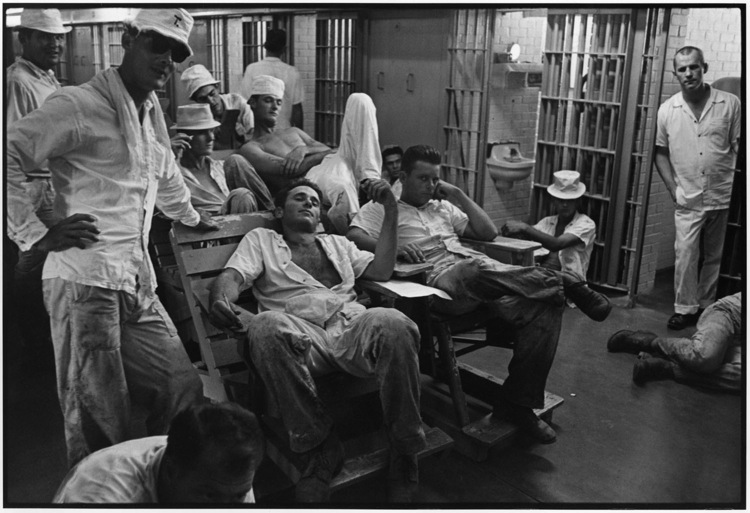
Photographer: Danny Lyon
Title: ‘Ramsey Prison Cell Block, Texas Prison, 1968’
Year: Neg. made 1968, printed 1995.
Size: 11″x14″
B/W modern-print, signed (verso)
Print, PLUS postcard, mixtape and self-published book – $1,750 – BUY NOW
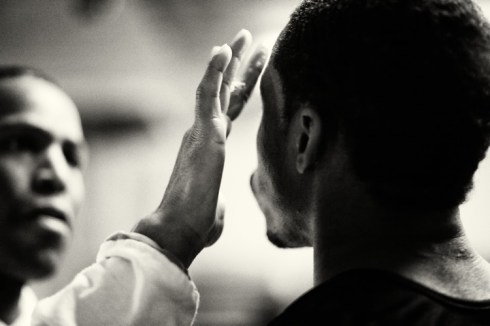
Another day, another Kickstarter incentive to peddle.
Frank McMains‘ B&W digital print on archival paper (8″x12″) is available at the $100 funding level. And I’ll throw in a postcard from the road and the PPOTR mixtape (CD). BUY NOW.
You can read more about Frank and the AABA in Exclusive: Photos of the Angola Amateur Boxing Association, Louisiana State Penitentiary, previously on Prison Photography.
Visit Frank’s website Lemons and Beans to read more about his time photographing the AABA.

Untitled #1, by Steve Davis. From his ‘Captured Youth’ series. 8×10 on a 10×12 heavyweight archival paper, for $300. Signed. Special Edition of 4.
Steve Davis is an old buddy. I shouldn’t have been surprised he quadrupled-down on the generosity. He’s kindly offered a selection of prints to sell in order to raise money for my Prison Photography on the Road Kickstarter project.
Our conversation went something like this:
Pete: I didn’t want to ask, because I don’t want to interview you. You’ve answered everything I can think to ask. I mean we could talk about photography non-stop, but about prisons … (tails off)
Steve: What do you need?
Pete: Well, ideally some mid-level incentives, something around $300.
Steve: No problem, I’ll find some images, probably a couple that have not been seen before. We’ll print them small in a special edition of four, four of each, that way you can offer “a choice of one from four”.
Pete: Thanks Steve.
Steve: No problem.
Pete: No, really, thanks Steve.
Steve: No, really, no problem Pete.
– – – – – – – – – – – – – –
A Steve Davis print PLUS a postcard, a mixtape and a self-published book – going for $300. BUY NOW.
– – – – – – – – – – – – – –
CLICK ON IMAGES FOR LARGER VIEW
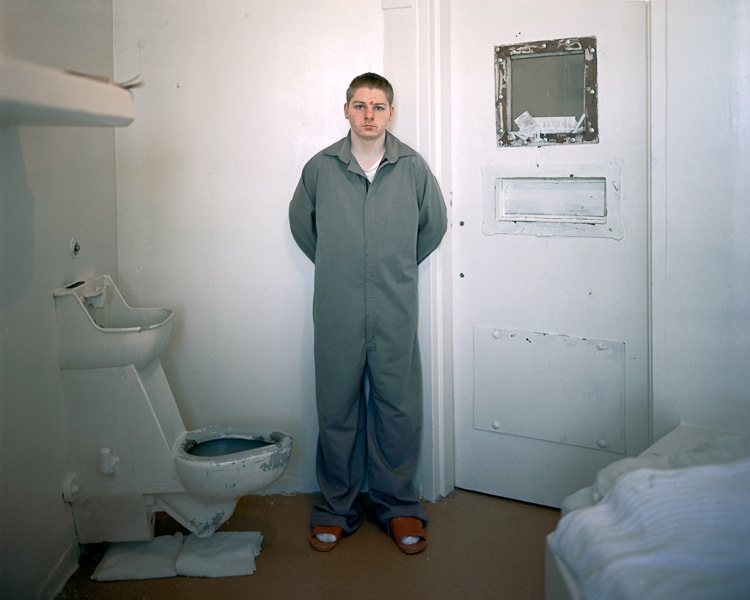
Untitled #2, by Steve Davis. From his ‘Captured Youth’ series. 8×10 on a 10×12 heavyweight archival paper. Signed. Special Edition of 4.

Untitled #3, by Steve Davis. From his ‘Captured Youth’ series. 8×10 on a 10×12 heavyweight archival paper. Signed. Special Edition of 4.
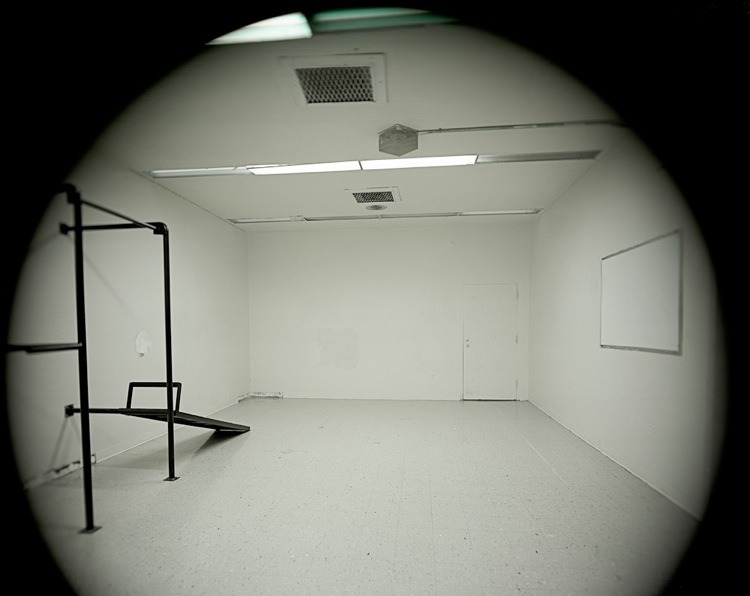
Untitled #4, by Steve Davis. From his ‘Captured Youth’ series. 8×10 on a 10×12 heavyweight archival paper. Signed. Special Edition of 4.
A Steve Davis print PLUS a postcard, a mixtape and a self-published book – going for $300. BUY NOW.
– – – – – – – – – – – –
See all available prints as part of my Kickstarter fundraising campaign.

The subjects of The Living Road, Noel Jabbour‘s portrait of prostitution on the Italian roadside, are not anonymous like those women in Mishka Henner, Paolo Patrizi and Txema Salvans‘ photography.
Other notable projects in Jabbour’s portfolio are Palestina, Palestinian Interiors and One Million $ Homes.
Thanks to Hester for the tip off.
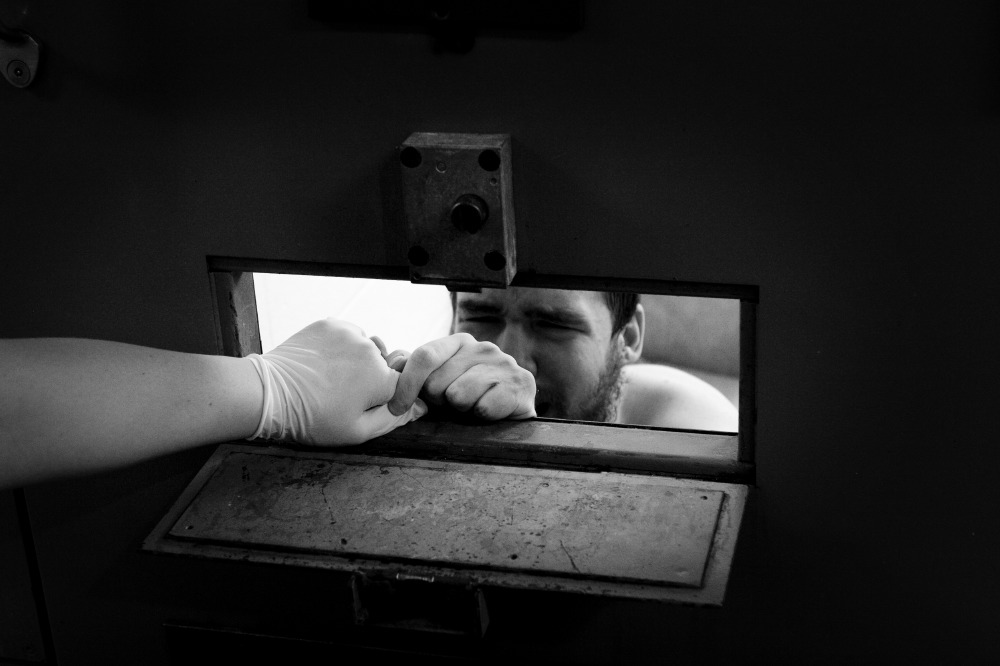
Julia Lish, a correctional officer, comforts an inmate during one his psychotic episodes. “Its going to be OK,” she repeats as he cries and yells to the voices in his head. © Jenn Ackermann
Jenn Ackerman: ‘A Hand to Hold’ (2008) from the series, Trapped.
11×14. B&W, archival matte.
Edition #2 of an edition of 25.
Signed.
Print PLUS, self-published book, postcard and mixtape = $600.
– – – – – – – – – – – – –
It’s still the very early stages of Prison Photography on the Road, my Kickstarter project, and I’m super pleased and humbled by the generosity of folks.
I won’t lie, it’s been a lot of work to co-ordinate all the information among potential interviewees, and the photographers who’ve donated prints, and those practitioners whose will be included in the self published book.
Info on half a dozen prints (available to funders of the project) is still outstanding. No fear, I’ll turn a negative to a positive and feature the photographs and the print info here on the blog as and when it arrives. At the same time, I can make repeated calls for support.
The Minneapolis based wunder-couple Jenn and Tim – a.k.a. Ackerman Gruber Images – were the first photographers to respond to my early inquiries about collaboration. Then there was silence. They’re a little late to the party because they’re down in Brazil on assignment. No worries guys.
I’ve written about Jenn’s series Trapped here on Prison Photography before. Tim and I have played email tag for two years trying to conjure a nice format to discuss his series Served Out.
Below are the prints Jenn and Tim kindly donated. Available on my Kickstarter page.
– – – – – – – – – – – – –
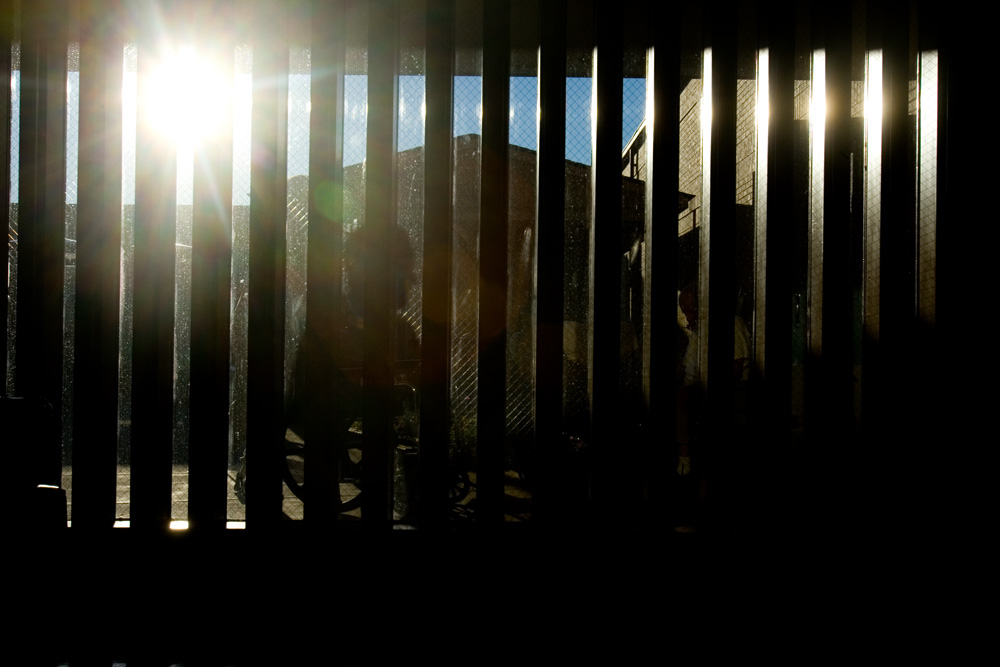
The sun breaks through the bars of the Nursing and Hospice Care Unit at the Kentucky State Reformatory, as part of the series ‘Served Out.’ © Tim Gruber
Tim Gruber: ‘Sunset Behind Bars’ (2008).
14×11″ B&W, archival pigment print on matte paper.
Edition #1 of an edition of 25.
Signed.
Print PLUS, self-published book, postcard and mixtape = $500.
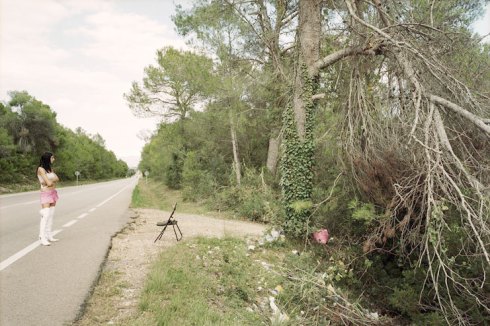
Following on from my comparative analysis of Mishka Henner and Paolo Patrizi’s documenting of Italian roadside prostitutes, a reader directed me to Txema Salvans‘ Spanish Roads.
I wanted to alert you of this series and suggest that the impact of this work and that of Henner and Patrizi for American (and in my case, British) audiences is the shock of the new. It is a surprise to see scenes of prostitution in public and plain view. The juxtaposition of illicit activity and wide open vistas is jarring and it corrects the over-romanticisation of Mediterranean culture that often occurs in the U.S.
Indeed, with Salvans’ work, one can begins to think that roadside prostitution may not be an uncommon part of the contemporary southern European landscape. From Salvans’ statement:
“These are the beings we fleetingly glimpse when our comings and goings in our safe cars allow us to perceive the scars of a landscape where both the city and the country disappear; uncertain scenarios that expose the cruelty of a breakneck productive culture that invents uninhabitable spaces that are nonetheless lived in.”


All images © Txema Salvans

© Paolo Patrizi, from the series Migration
This week, I wrote two pieces for Wired on Google Street View. The first was a gallery of the various projects spawned by GSV, and the second was a piece about authorship and the repetition of nine scenes in two of the most well known GSV projects (Jon Rafman’s Nine Eyes and Michael Wolf’s A Series of Unfortunate Events and FY.)
Anecdotally, the photo-thinkers out there are converging on Doug Rickard’s A New American Picture as the most robust work. A close contender though is the relatively new No Man’s Land by Mishka Henner.
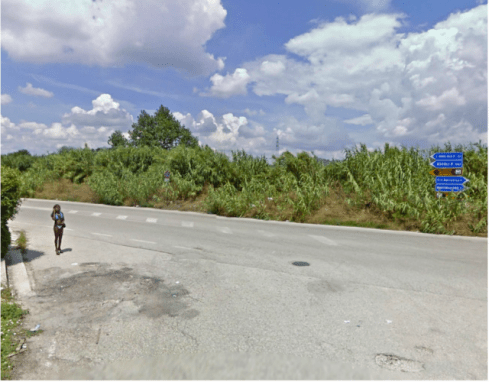
© Mishka Henner
No Man’s Land (more images here) is a disturbingly large selection of GSV screen-grabs of (presumably) prostitutes awaiting customers on the back roads of Italy. Henner says:
I came across communities using Street View to trade information on where to find sex workers. I thought that was the subject to work with. Much of my work is really about photography and this subject tapped into so many aspects of it; The fact the women’s faces are blurred by the software, that they look at the car with the same curiosity that we have when looking at them, and finally, that the liminal spaces they occupy are in the countryside or on the edge of our cities – it all has such great symbolism for our time. And that’s aside from the fact these women have occupied a central place in the history of documentary photography.
But for traditionalists, No Man’s Land is a long way from the spirit of documentary photography. Of Henner’s work and of all GSV series generally, the ever-outspoken Alan Chin says:
“Google Street Views is a navigational tool, an educational resource, and sure, it can reveal a lot about a place and a scene at a given moment in time. But if you, the artist, are really so interested, then go there and take some pictures yourself. This is about as interesting as cutting out adverts from magazines that have some connection and then presenting your edit as a work of art. Post-modern post-structuralist post-whatever denizens of of the art world and academia love this shit. Which is well and good for the university-press industry. But it has little to do with actual reporting and actual documentary work in the field.”
Well, just last week, I came across Paolo Patrizi documentary photographer that actually took himself to those byways.
For Migration, Patrizi has keenly researched where these women have come from and where, if anywhere, they may be going. From the project statement:
“The phenomenon of foreign women, who line the roadsides of Italy, has become a notorious fact of Italian life. These women work in sub-human conditions; they are sent out without any hope of regularizing their legal status and can be easily transferred into criminal networks. […] For nearly twenty years the women of Benin City, a town in the state of Edo in the south-central part of Nigeria, have been going to Italy to work in the sex trade and every year successful ones have been recruiting younger girls to follow them. […] Most migrant women, including those who end up in the sex industry, have made a clear decision to leave home and take their chances overseas. […] Working abroad is therefore often seen as the best strategy for escaping poverty. The success of many Italos, as these women are called, is evident in Edo. For many girls prostitution in Italy has become an entirely acceptable trade and the legend of their success makes the fight against sex traffickers all the more difficult.”
Patrizi is interviewed on the Dead Porcupine blog and talks about the unchanging situation, the pain experienced by the women, their reactions to him, and the destruction of woodland by authorities in attempts to literally expose the illicit encounters. It’s a must read.
The images in Migrations are inescapably bleak; therein lies their power.
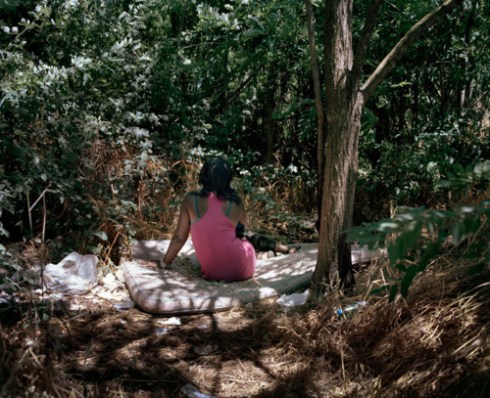
© Paolo Patrizi

© Paolo Patrizi

© Paolo Patrizi

© Paolo Patrizi
Patrizi’s Migration induces a visceral shock; images of the littered make-shift sex-camps turn the stomach. When human fluids are dumped, it is not usual that humans continue to function in and around them. These workstead pits of dirt, tarps and abuse are shrines to the shortcomings of globalisation and the social safety net.
By contrast, Henner’s work allows us to keep a safe distance. He even saves us the trouble of finding these scenes on our own computer screens; we’re detached one step beyond. We are cheap consumers.
Patrizi’s photography with its clear evidence of his boots on the ground don’t allow us to share Henner and Google’s amoral and disinterested eye.
On Henner’s virtual tour, we cruise, at 50mph. We don’t stop, we don’t get out the car and we don’t get too close. We might as well be in another country … which of course we are. Patrizi’s work walks us by hand to the edge of the soiled mattresses and piles of discarded condoms.
Patrizi’s images counter the washed out colours, the flattening effect of wide-angle lenses, and the perpendicular viewpoint of GSV. Instead, they involve texture, depth, legitimate colour, details and different focal points along different sight-lines. In other words, Patrizi’s Migration engages the senses and the basics of human experience. Patrizi’s photographs return us to the shocking fact that that these women are human and not just bit-parts in the difficult social narratives of contemporary society. Works full of threat, fear, flesh and blood.
By comparison, Henner’s screen-grabs are anaemic.
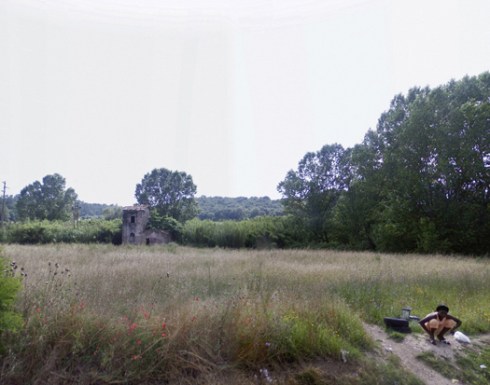
Via del Ponte Pisano, Rome, Italy. © Mishka Henner
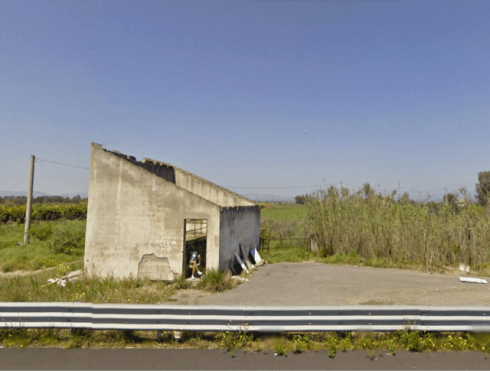
© Mishka Henner

Carretera de Ganda, Oliva, Spain. © Mishka Henner


 Prison Photography