
You are currently browsing the category archive for the ‘Documentary’ category.
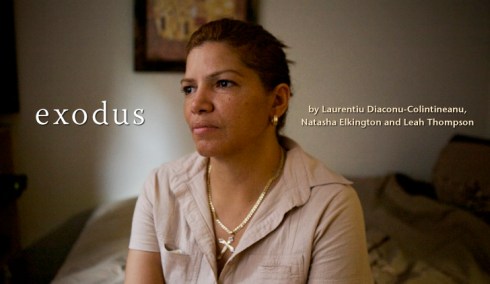
Always lots of good stuff on MediaStorm and many of the projects from their workshops and training belie the relative “inexperience” of their creators.
Exodus tells the story of Diana Ortiz, 45, who spent over half her life in prison. She says it saved her.
Diana dropped out of high school at 18 to live with a man twice her age. To pay for their drug habit, her boyfriend devised a scheme to lure a man into a secluded Coney Island parking lot and rob him.
In the early hours of August 20, 1983, the robbery veered off-course and two men were shot. One was killed. Though Diana was not at the scene of the shooting, she was sentenced to 17 years to life for her role in the murder.
She served twenty-two and a half years.
While behind bars Diana earned her master’s degree, developed a strong identity and self confidence. She is now an inspiration for other inmates, helping them to rebuild their lives.
This workshop story was inspired by the New York Times story about Diana Ortiz titled Convicted of Murder as Teenager and Paroled at 41. (Which I mentioned here on PP before)
Credits
Photography, audio and video: Laurentiu Diaconu-Colintineanu, Natasha Elkington, Leah Thompson
Producer: Jennifer Redfearn
Executive Producer: Brian Storm
Graphics: Tim Klimowicz
Transcription: Avi Tharoor-Menon
I came across Julie Adnan‘s Born in Jail series at Bite Magazine. I wanted to know more about the women and of the social backdrop of criminal justice within Northern Iraq. I was happy that Adnan could answer a few questions.

This woman was imprisoned on 8 Feb. 2009. The child was born in prison; he is 6 months old. She, an Arab from Mosul, was arrested for prostitution. At the time of the photograph, she had been imprisoned for 18 months. © Julie Adnan
CONVERSATION
Why did you choose this subject?
I choose this subject because there are many children in the prison without having committed any criminal offence; there only because they’re children of those who may (or may not) have done something wrong. Nobody thinks about what the children will remember when they grow up.
What prison is this?
This is the Arbil prison for women, in the city of Arbil (also written Erbil or Irbil or Arbela) in Kurdistan of Iraq.
How long were you on assignment?
It took a long time to gain permission from the government, but after [getting permission] I took the photographs in two different visits over two weeks.

This child was born in prison. He is 8 months old. His mother was imprisoned on 29 Jan. 2009, sentenced to a year in prison for illegal sex with another person. She is from Erbil. © Julie Adnan
What were the reactions of staff, women and children to your photography?
The children thought it was game and they loved it, but the women was so afraid of the camera and of the photographs. As you can see, they do not want their faces to appear.
Did the families ever see or receive prints?
Unfortunately, I did not send any photos to them and I do not know if they’ve seen the photographs anywhere.
Do you plan to return to this subject or any other stories within prisons?
Yes, but not with photography. I want to document their letters to their families in a booklet.
Five of the eight women are in prison for prostitution. What sort of sentence does that carry?
It depends on their crime. It could range from a few months to five years.
Is there ever a notion that a prostitute might be a victim?
Because Islamic law rules prostitution as a crime, the government and other people can not say anything about them. Prostitution is something in the culture they cannot accept, however we have some people now who allow [make accommodations] for them but they cannot really change or do anything.
One lady was imprisoned for sex outside of marriage. Is a prison sentence common for such a transgression?
Within traditions here, a woman’s family may kill her for that [sex outside of management]. Sometimes, a woman’s stay in the prison is necessary as a secure place or a shelter.

This female gypsy was sentenced to 15 months in prison for robbery. She prefers her daughter to be with her in prison. Her daughter was 1 year, 8 months old at the time of the portrait. © Julie Adnan
MORE READING
Julie Adnan maintains a Lightstalker profile and a Flickr photostream. Her work has been featured at Greater Middle East Photo (a blog I highly recommend).
This article, Life in a Womens’ Shelter, Erbil perhaps more than any other relates the dangers for women should they compromise their families “honour”. It talks about shelters and prisons as being alternative institutions to family homes which – in extreme cases – can harbour the real threat of murder.
BIOGRAPHY
Adnan, from Kirkuk in Iraq, is a 25 year old freelance photographer, and currently a student at the art academy of Sulemanyah University in Iraq. Adnan has worked for a number of agencies newspapers and websites including The New York Times, Reuters, National Geographic, Al-Sharql Awsat, The Washington Post, Jordan Times, Taw photography magazine, Kakh magazine, Kurdistani New, Aso newspaper, Institute for War and Peace Reporting (IWPR), Driknews agency, World News Network, BBC World Website, IO Donna magazine of Italy and L’Express of France.

Singing the national anthem. © Ben Quinton
Perhaps it is just because I taught in a Kenyan High School in the Rift Valley a decade ago and it remains one of the most formative experiences of my life that I am so taken with Ben Quinton‘s art-docu series, The British Abroad.
By comparison, St Andrews School, which Quinton depicts is better equipped than the schools I visited (the swimming pool being the big giveaway).
The evocation of weather, multiple generations, institutional routine, the mix but not a clash per se of cultures and the vestiges of colonialism all make this an interesting portfolio.
I’d be interested to know if others enjoyed The British Abroad as much as I.
Found in the current issue of Seesaw Magazine.
The Center for Documentary Studies (CDS) at Duke University has awarded the twentieth Dorothea Lange-Paul Taylor Prize to photographer Tiana Markova-Gold and writer Sarah Dohrmann.
With the money ‘Markova-Gold and Dohrmann plan to spend three months in Morocco, “living with and documenting the lives of sex workers whose clients are not sex tourists, but are instead fellow Moroccan men.” They will focus on women in prostitution from different economic levels and backgrounds as they engage with them in their homes and in the hotels, clubs, cafes, and streets where they work. While intimate in their approach, it is their hope that the work will portray Morocco—with its unique position as a bridge between Europe and Africa, its role within the MENA region and Islamic society, and as a developing nation grappling with the economic impacts of globalization—within a larger context of the particular vulnerability of women and girls worldwide.’
No small task. Good luck to them.
OTHER PEOPLE’S DIRTY LAUNDRY

"I think the ten minute foot rub I give is a major key to my success . . . If I were to teach Sex Work 101, this would be Lesson One and I wish I had learned it years earlier in my career." Miami Beach 2007. Photograph by Tiana Markova-Gold from the project Other People's Dirty Laundry (Sex Workers Project / Jenna).
Because the work is yet to be embarked upon, CDS presents images from Markova-Gold’s 2007/08 project Other People’s Dirty Laundry and You Must Not Know ‘Bout Me…
The two projects contrast the addictions & abuses, hygiene & preparations of sex workers servicing clients of vastly different economic means and in very different environments; Miami Beach and Washington D.C. contrast frighteningly with the South Bronx and East Harlem.
HOW CLOSE?
The intimacy the photographer has forged here with the sex workers is remarkable but not unique – Scot Sothern, Mimi Chakarova and Dana Popa have all produced projects recently that suggest a trust with their subjects and provide windows into very troubled worlds, especially in the case of Chakarova and Popa who deal with sex-trafficking in Eastern Europe.
This discussion that must necessarily follow the viewing of these projects is complex and difficult and I don’t pretend to have any answers. I only expect an honest discussion.
‘700 psychiatric patients live chained together in pairs, and are forced to tend more than one million chickens at the largest chicken farm in Taiwan. Portraits of the players in this real yet surreal drama were photographed with kindness, respect and compassion by Magnum photographer Chien-Chi Chang.’
Lens Culture

From DLK: ‘Chien-Chi Chang makes portraits of pairs of mental patients at the Long Fa Tang Temple, where a stable patient is chained together with one with more severe problems in an unorthodox kind of bonding therapy.’
‘Chang appears to have neither permanent gallery representation in the US nor any meaningful secondary market history. My guess is the only option for interested collectors is to follow up directly via Magnum to inquire about potential prints for sale. That said, I think that either a mini-retrospective/survey show or a focused exhibit of portraits from The Chain should to be undertaken by some gallery in New York, as this work clearly merits being shown more broadly in the world of contemporary photography.’
Yes, it does.
Further reading: C-Arts here, and a book review of The Chain here.
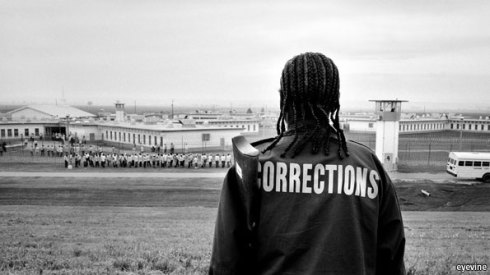
© Eyevine / Lori Waselchuk
Last weeks article, Rough Justice in America, by The Economist repeats many truths of America’s broken prison system we know already, here summarised:
“The system has three big flaws, say criminologists. First, it puts too many people away for too long. Second, it criminalises acts that need not be criminalised. Third, it is unpredictable. Many laws, especially federal ones, are so vaguely written that people cannot easily tell whether they have broken them.”
As expected the arguments made against mass incarceration here are on based on financial sustainability and fortunately such thinking is melding with the notion of social sustainability. The stories of George Norris and Michelle Collette form the anchor to the piece which posits that “Never in the civilised world have so many been locked up for so little.”
LORI WASELCHUK
I recognise the photographs as those of Lori Waselchuk whose work Grace Before Dying from the Angola Prison Hospice should not be missed. For it, Waselchuk won a Soros Documentary Photography Grant (2007), a Photolucida Critical Mass Top50 (2008). Here’s a great interview with her by Nicole Pasulka of the Morning News.
– – – –
Thanks to Joerg for the link

Caption: Mahmod Berghote stands with one of Marah Zoo’s world famous painted donkeys. The zoo’s two white donkeys caused an international media frenzy after Mahmod and his brother spent three days painting stripes onto them using black hair dye. Unable to find an animal trader to bring a real zebra through the tunnels from Egypt, the Berghote family decided to make a fake pair using white donkeys. The story was reported all over the world as a feel good news piece and often used as an example of the Palestinian people’s resourcefulness during the siege of Gaza.
Anastasia Taylor-Lind for VII Photo published a remarkable photo essay about the zoos of Gaza.
The idea that imprisoned people can make a business out of smuggling, locking up, and exhibiting animals is deeply ironic. There are about a dozen zoos in Gaza and their story is intertwined with world politics in a way that would be unimaginable anywhere else.
In 2005, Dr. Saud Shawa, a veterinarian, decided to establish Palestine’s National Zoo. For Shawa, this was about education and showing people how to care for animals. Supported by international donors, he built a spacious compound with big cages, a theatre, a library and research centre – Gaza Zoo, the first one ever in the strip.
Gaza zoo opened in January 2006, the same month Hamas, the radical Islamist movement, won elections in Gaza. The border was closed and the initiative was halted before it could get started.
As of today, not a single zoo has been profitable. In fact, there is only one person in the Gaza strip who benefits from the business: Abu Nadal Khalid, an animal trader. He has animals drugged and smuggled through the infamous system of tunnels leading from Egypt into the strip.

Nuclear Residues Repacking Glovebox, Building 440, Rocky Flats Nuclear Weapons Plant, 2002. © A.W. Thompson
A.W. Thompson‘s largest single project, “Incendiary Iconography” addresses Cold War-era nuclear sites in the United States that are in the process of public reclamation and/or transformation under the Defense Environmental Restoration Program.
The Rocky Flats Nuclear Weapons Plant sat at the foot of the Front Range of the Rocky Mountains overlooking the high plains of eastern Colorado. Boulder is ten miles to the north, Denver’s two million residents just 16 miles downwind and downstream to the east. The plant operated from 1952 to 1992, and since then the suburbs of Denver have extended to the border of what was a 25 square mile top-secret facility.
Thompson says, “The plant produced plutonium “pits,” for the nation’s nuclear weapons stockpile. A pit, or primary, is a plutonium fission bomb like the one dropped on Nagasaki, and is used to start the fusion reaction in a hydrogen bomb which has over 1000 times the power of a fission bomb. Plutonium is a man-made element which is highly toxic in addition to being radioactive.”
On June 6th, 1989, as part of an investigation into allegations of environmental crimes the Federal Bureau of Investigation, Environmental Protection Agency, and the Department of Energy’s Office of Inspector General raided The Rocky Flats Nuclear Weapons Plant. The raid led to the eventual decision to tear down Rocky Flats.
Again, Thompson, “In 1995 the U.S. Department of Energy labeled Rocky Flats the most dangerous weapons plant in the nation because of the health and safety risks it posed to the plant workers and the surrounding area. Although the search warrant documents were released in 1989, the full text of the grand jury investigation and findings remains sealed, despite efforts by members of the gagged grand jury to make them public. The former Rocky Flats Nuclear Weapons Plant site was officially designated a National Wildlife Refuge with the completion of decontamination and deconstruction activities in October 2005. The wildlife designation was chosen because it afforded the lowest level of cleanup standards. Debate continues among former workers and local citizens about the adequacy of the cleanup.”
“Rocky Flats was the only nuclear pit facility in the U.S. The Department of Energy announced plans to develop a new hydrogen bomb on March 2, 2007. Site location for a new multi-billion dollar pit facility is currently underway without significant public debate about the need, or the long-term financial, environmental, and security costs of a revived nuclear weapons production program, which many believe, will start a new nuclear arms race.”
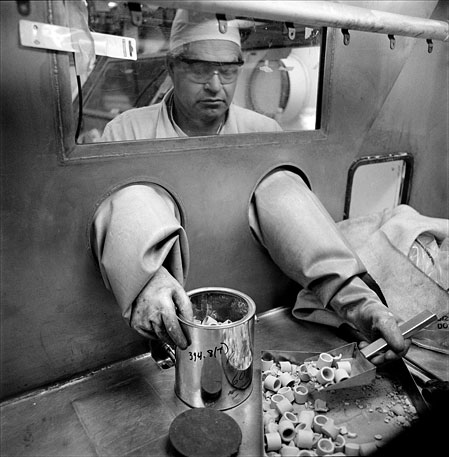
Characterizing Legacy Residues in Plutonium Building 771, Rocky Flats Nuclear Weapons Plant, 2001. © A.W.Thompson
BIOGRAPHY
Thompson (born in Colorado) is the Director of the School of Communications and an Associate Professor of Photography and Visual/Media studies at Grand Valley State University, Michigan. He earned his B.S. in Physics from the University of Dallas and his M.F.A. in Photography from Washington University in Saint Louis.
Thompson has lived and worked in Rome, Italy and across the Midwest as a freelance and commercial advertising photographer. His work is about “the meanings attributed to, or derived from, experiences of place and/or technology, and the relationship of art and science as ways of knowing.”

 Prison Photography