
You are currently browsing the category archive for the ‘Documentary’ category.

Texas Prison Rodeo, Huntsville, 1964. © Garry Winogrand
In 1964, with the support of a Guggenheim fellowship, Garry Winogrand traveled over four months to fourteen states and recorded an America in transition.
The result was WINOGRAND 1964. Here’s a review by Ned Higgins.
– – – – – –
AmericanSuburbX has republished Carl Chiarenza‘s “Standing on the Corner – Reflections Upon Garry Winogrand’s Photographic Gaze – Mirror of Self or World? Pt. I” (1991) originally in IMAGE Magazine: Journal of Photography and Motion Pictures of the International Museum of Photography at George Eastman House, Volume 34, Number 3–4, Fall–Winter, 1991.
Including this statement: “The 1964 Guggenheim Fellowship was awarded to Winogrand to provide him with time to make “photographic studies of American life.” This fact inevitably recalls Robert Frank’s Guggenheim odyssey of a decade earlier. Something to think about—one wants to make comparisons. One wishes there were a Winogrand book comparable to Frank’s The Americans. But there is no such book.”
Think on.

I enjoy reading interviews, but I enjoy more listening to a photographer speak while their photographs scroll.
I also love being able to mount a knowledge of British photography of the second half of the 20th century; an activity that is not quite the fabrication of nostalgia, but I’ll admit it is close (I was born in the eighties … just).

In October of last year, when I posted on Jane Evelyn Atwood‘s documentary work from women’s prisons across the globe, the pictures and the message were well received.
Better still, is to listen to Atwood discuss the her photography and its lessons for us all. Her common observation across all women’s prisons is women are very often incarcerated because of the men in their life. They are abused, pimped into prostitution, inducted into crime, manipulated emotionally, and backed into corners – from which retaliatory violence is their only remaining option.
Persevere through the irritating, news-studio interview formula and you’ll be rewarded with Atwood’s insight.
Atwood is currently campaigning on behalf of Gaile Owens, the only woman on death row in Tennessee. During the original trial Owens did not testify to the full degree of the domestic abuse she suffered; she wanted to protect her children from the truth. The result was the absense of mitigating circumstances during consideration of the verdict.
Owens’ execution date has been set for September 18th, 2010. A movement is underway to see her death sentence commuted to life without parole. Visit http://www.friendsofgaile.com/ for all the information on the case and the opportunity to sign a petition.
Atwood is emotionally submerged in her work, close to her subjects. Any distinction between photographer and subject maybe unwanted; “Gaile is a battered woman on death row. And she needs our support.” This statement, as with Atwood’s work, goes to the heart of the most urgent advocacy – that which is motivated by empathy and kinship.
Watch Atwood’s France24 TV interview.

The Fault Lines programme on English Al-Jazeera looks at America’s aging prison population. Reporter Josh Rushing gets exclusive access across the US, but the most astounding footage is from the Geriatric Unit of the Joseph Harp Correction Center, Lexington, Oklahoma.
Fault Lines also visits the Mabel Bassett Correction Center, Oklahoma’s largest women’s prison.
NOTES
* At the time of filming, Oklahoma’s prison system was operating at 75% staffing, referred to by administration as “warehouse mode”; housing but not rehabilitating prisoners.
* Check out Sherman Parker’s situation beginning at 9.38. Sherman is 100 years old. He is cared for by Seth Anderson, another inmate convicted for kidnap and drug and weapon possession. Anderson speaks frankly about the hospice care at the Dick Conner Correctional Center, Oklahoma.
* Prisoners over 55 years account for the fastest growing class of inmates in America.
* Only three out of every 100 inmates over 55 years return to prison after release, compared to the national average of over 60%.
* Fishkill Correctional Facility, 70 miles north of New York is the nations first purpose-built unit for the cognitively impaired. The average age is 63 and many prisoners suffer from Alzheimer’s and other conditions of dementia.
From CONTACT blog:
James Mackay‘s project ‘Even Though I’m Free I am Not’ is a confrontational investigation into Burma’s political prisoners. Travelling across the globe, Mackay documents Burma’s former political prisoners.
Visit CONTACT for an interview with James about the project.
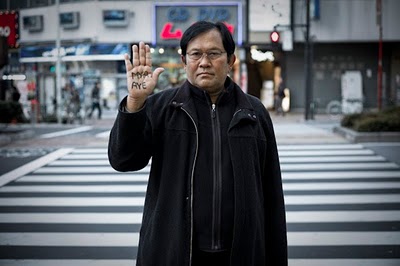
Dr Aye Chan, Insein Prison, Tharawaddy Prison, 7 years © James Mackay
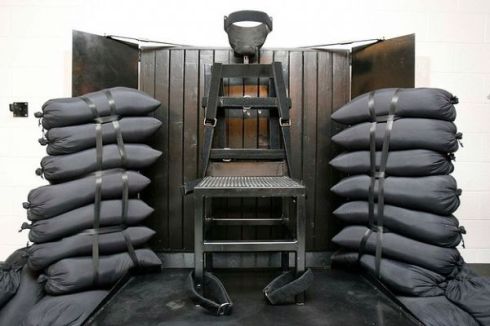
© Trent Nelson/AP - Pool
BagNewsNotes ran the above photograph with commentary. It goes without saying that I am opposed to the death penalty, which is nothing more than foolish symbolic act in our political economy.
Four bullets passed through Ronnie Lee Gardner. In this photograph, three bullet-holes are visible in the wood. Photographer, Trent Nelson presented a six-part series on his coverage of the case, appeals and execution in Utah. Part six is titled ‘The End’:
I’m told that I can only bring one camera, no camera bag, and I must have a lens cap on my lens. That changes things. I grab a body with a 16-35, stick a flash on top, pop in my most reliable battery and an 8 gigabyte card. It’s an uncomfortably light kit for such a big assignment.
The photographs and text are a detailed account of a surreal event:
Immediately there are disagreements about details. Standing at the window of the execution chamber after Gardner was shot, one reporter had drawn a sketch of the target on Gardner’s heart indicating the four bullet marks. He insists his sketch of the target is accurate, while another reporter disputes it, saying that two shots were actually on the left not the right.
and
Reporters are soon climbing all over the chair, pointing at the bullet holes, poking their fingers in them.
In this execution chamber, in this prison, the media record the evidence and in so doing confirm the deed done. Very surreal.
UPDATE: Matt emailed me to let me know of the second chapter in this story. View it here.
THE ROMA

A young man in the Stara Gazela camp. © Matt Lutton
Friend Matt Lutton has presented words and images in the latest Lens Culture (Issue #26). His story is about the destruction of a settlement in Belgrade and the subsequent relocation of the Roma inhabitants.
I know that Matt has been working on this story for a long time and it matters very much to him. In September of last year, Matt put together a small edit of the work with a caveat that he was still working through the project. Matt recommended this local Serbian article for background on the issue.
Matt’s words:
Gazela was an isolated community of over 200 Roma families living abjectly difficult lives under the Gazela road bridge in Belgrade, Serbia. They made their living from the recycling of metals and refuse, and the landscape around their homes was filled with toxic mounds of rotting waste. It was a ghetto split on the banks of one of the region’s most important rivers and on premium real estate eyed by the elites. This photo story begins with the community living under the bridge before its destruction and partial relocation on August 31, 2009.
The people living there, depending on their legal status, would either be given a new container to live in on the outskirts of the city, free transport back to their villages or if they had no papers, an unceremonious trip to the curb and likely a home in another improvised camp.

A girl runs through smoke near a suspected arson in an abandoned home in Nova Gazela, a camp on the New Belgrade side of the Sava River. The fire happened on the day before the relocation and destruction of the settlement. © Matt Lutton
Matt’s task, if he is to compete with other storytellers is tough. The Roma people exist across Europe and have fascinated generations of photographers. The bar was set high by Josef Koudelka upon the 1975 publication of Gypsies.
ROMA ACROSS NATIONS
In recent years, Carlo Gianferro‘s Roma Interiors showed us wealthy Roma residences.
Over seven years, Danish photographer, Joakim Eskildsen, traveled with writer, Cia Rinne, through seven Roma countries (Hungary, India, Greece, Romania, France, Russia, and Finland). Resulting in the book, The Roma Journeys. (Elizabeth Avedon write up).
Amanda Rivkin travelled to Slovakia to photograph Roma theatre productions.
Hungarian, Zsuzsanna Ardó, photographed the Roma travellers in her home country. (Video, via The Rights Exposure)
Similarly to Matt, Sanja Knezevic documented Roma people in Belgrade.
Marco Baroncini (whose work I’ve noted before) photographed the Roma in Italian capital Rome. Most of the 15,000 Roma are immigrants from the Balkans. This work impressed James Estrin and thus received Lens blog exposure.
Most recently, some Roma youth have taken up cameras empowering themselves to self-representat. Greg Ruffing gave a very good summary of the Chacipe Project:
“One project in particular this year has really intrigued me — Chacipe: An Exploration of Roma Images and Identity, which features selected images from the Chacipe Youth Photography Contest. The contest was organized by OSI’s Roma Initiatives and the Open Society Archives as part of the Decade of Roma Inclusion 2005-2015, an international initiative to bring together governments, NGOs and Roma civil society to work towards improving the welfare of Roma communities.”
CONCLUSIONS
If you are Matt, flourish in this rich photographic heritage. If you are not Matt, follow his work!
These two bicycle culture anthropologists stop, chat with and photograph cyclists.
“The Bicycle Portraits project was initiated by Stan Engelbrecht (Cape Town, South Africa) and Nic Grobler (Johannesburg, South Africa) early in 2010. Whenever they can, together or separately, they’re on the lookout for fellow commuters, and people who use bicycles as part of their everyday work, to meet and photograph.”


 Prison Photography