
You are currently browsing the category archive for the ‘Fine Art’ category.
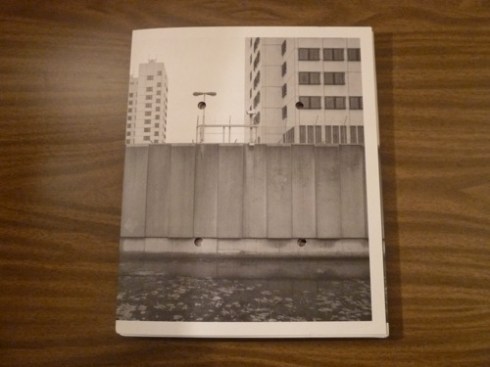
Nico Bick‘s work had been on my radar since Fotodok’s 2010 exhibition State of Prison. Between 2006 and 2009, Bick photographed the Bijlmerbajes prison in Amsterdam. In the past, Bick and I had played email tag, so it was nice to finally meet him last month in his native Netherlands and talk shop.
Q&A
Where were the inmates when you were taking your photographs?
Right behind me. It all looks very serene and quiet but there’s lots of noise behind me. I had to ask permission of each prisoner before photographing their cell.
Did the prisoners care about your artistic vision?
Not really. Obviously, those that refused permission to photograph their cell really weren’t interested. Some thought it was worthwhile. Most wondered, “Why take a picture of a prison?”
Yes, why? Are you an architectural photographer?
No. I do take pictures of space, but not architecture. I hardly ever do commissions for architects. I’m interested in the tension between public space and spaces more secluded. The prison embodies this tension.
In the Netherlands, prison is a public space. It’s not like in the U.S. where there exist private facilities. The government runs all prisons here, so in that regard they are a public space. The inside is not visible but it is owned by the state, funded by the public.
How did you get access?
Initially, I sent a letter to the director. But I never got a reply. I had a friend who said she might know someone who worked at Bijlmerbajes. It was a different path to try. I sent a letter to her, she dropped it on the right desk and someone called me (laughs).
This was only the first hurdle. During my work on P.I. I liaised with four different communication officers. All had a different approach in their willingness to cooperate in the project.
I won’t try to pronounce the prison’s name. Is the complex iconic?
The Bijlmerbajes? Yes, it is. Designed in the late 60’s and put into use in 1978, this prison is an architectural embodiment of the prevailing social-reformist ideas of that time. The architects tried to escaped the traditional ‘prison architectural design’.
Six towers, divided in units and connected by corridors, are constructed with respect to individual needs of ‘social’ comfort. The windows for instance featured no metal bars initially. However, the thick ‘unbreakable’ glass was found not resistant enough and had to be reinforced with metal bars.
Bijlmerbajes is not its official name. The name comes from the ‘Bijlmer’ part of Bijlmermeer which is a nearby neighbourhood (built at the same time as the prison) plus the word ‘bajes’ which is Dutch slang for ‘prison’. Bijlmermeer is well known for its high rises.
The official name of the prison is Penitentiaire Inrichting Over-Amstel – which is really difficult to pronounce!
Does its looming architecture represent “A prison” for the majority of Dutch people?
No, it does not. Situated near a rail road station it is often first looked upon as a social housing project. As usual, people do not look properly because with such a large perimeter wall and fence it is unquestionably a prison.
For years, there have been plans to move the prison to another location. Emphasis on plans. Nothing definitive has been decided. Possibly a move to the north but the ‘Not In My Back Yard’ crowd don’t want it. I was discussing this recently with a friend and he told me that in the U.S. town and cities welcome prisons because they provide jobs. This is not the case in the Netherlands; it’s not a deciding factor [on a prison’s location]. Dutch prisons are not considered as big jobs machines.
Bijlmerbajes was built as a “humane” prison. It is architecture along philosophical lines. Given the plans to replace it, do you think the next architectural solution for a prison will be driven by social ideals?
My feeling is that it will not. The replacement may not be as humane. Ideas today are not like the 60s and 70s. New prisons will have economic considerations within them. I won’t rule out that Dutch prisons may be privatized in the future. That’s the political climate we’re in.
How are prisons discussed in the Netherlands?
Generally, people talk about the legal system and not the prison system and they think that the legal system is okay; that the punishments handed out are correct and proportionate.
Unfortunately, there is – especially with that horrendous right wing cabinet we now have in the Netherlands – a discourse on how luxurious our prisons are. Of course, this is all perception.
Why have Dutch politics swung to the right?
In the Dutch parliament, 24 of the 150 seats are in the hands of the far right. So that’s about 15%. We feel the effects of the embrace of neo-liberalism in the 90’s by almost all political parties. As a result, votes shifted to the far right and left. The center is a wasteland. But bear in mind that the right-wing government in the Netherlands only has a majority of one seat in parliament.
Some people in the Netherlands think multiculturalism has failed?
Personally, I don’t think multiculturalism has failed. It is something that is here and it works. I see different types of people from all over the world around me everyday. I am aware of issues that immigration brings but [the far right leader] Wilders plays with feelings of fear and insecurity. People just need to give it time. Within a society that demands immediate solutions this is very difficult.


What does you book title P.I. refer to?
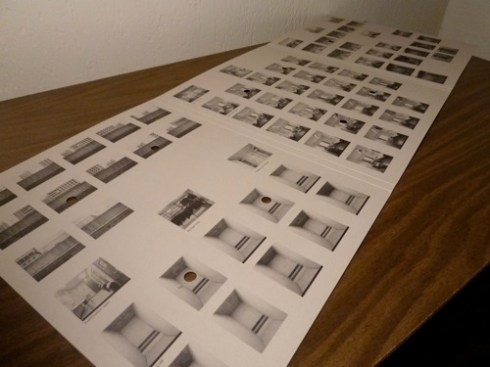
P.I. stands for Penitentiary Institution. I choose this title because the book is a metaphor for the universal notion of ‘prison’ and prison architecture in general.
How do you hope P.I. will influence discussion?
Besides the notion of a ‘hotel-like’ prison, another widespread stereotyped image of the prison is a dark, over-populated construction. With my book I try to nuance this opinion.
What is your audience for the book?
An audience with an interest in art and photography. Additionally, an audience interested in the social aspects of architecture, philosophy, ethics and cultural heritage. Obviously, with an edition limited to 400 copies my audience shall not be very large.
P.I. is not a bound book but a collection of sequenced offset prints. Why did you choose this book-portfolio design?
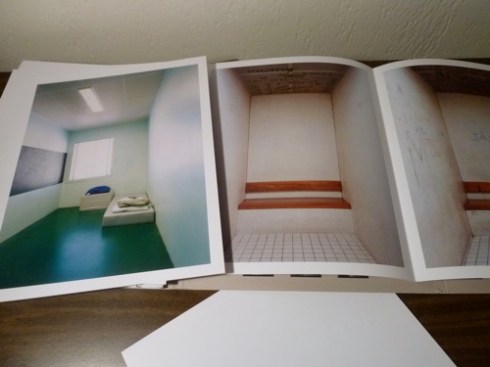
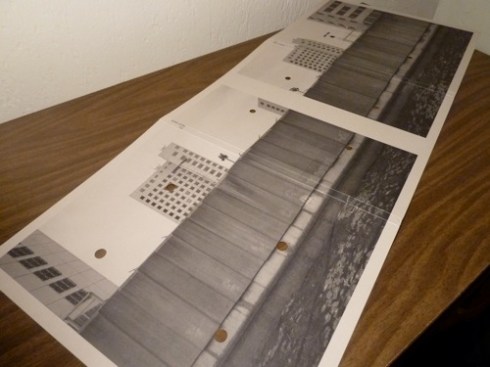
P.I. as a project contains more images then the ones printed as colour plates in the book. The photo index on the inside of the cover shows the series as a whole. It also shows what is available; images with no hierarchical ordering, just locations. Because the series consist of identically photographed interiors. Each series, each interior, is processed in the book as a separate set of pages. By taking this set of pages apart, you have an excellent way to compare the interiors with each other.
The publication concept of P.I. is that it is to be associated with a dossier. But at the same time – in terms of book typologies – it is to be associated with what I must define as the deconstructed book.
Deconstructed books are unbound, half bound, perforated or unfinished and, as such, emphasize the physical aspect of the book. It is this type of book that suits best my methodology and my description of a specific type of public space.
The graphic design of the book does not impose a narrative structure on the reader; by comparing the images, the story unravels. This kind of unfinished book, which even lacks ordering demands active readership.


It seems like P.I. is both fine art project and historical document?
Yes. Fine art project first but an historical document too. In terms of art strategy I am primarily interested in studying the use of public spaces.
Tell me about order, numerics and sequence in the architecture of Bijlmerbajes.
Six towers are connected by the main corridor. A tower contains five units. There are 24 single cells within every unit. Every unit has its own control room (no longer in use). A tower has a separate top floor with three isolation cells and six air cells. Each tower has two communal yards, a large one and a smaller one. Every tower has its own control room – all of which are controlled by the main control room.
Upon entering the Bijlmerbajes one is placed temporarily in one of the holding cells.
Does your book represent a single tower?
Yes, although it is pieced together from photographs of cells and spaces from all the towers. It wasn’t possible to photograph a single tower in its entirety. There are 12 photographs of cells in P.I. to represent the 24 in a single unit.
You showed the work at the Fotodok exhibition State of Prison.
Raimond Wouda, curator for State of Prison wrote about my photography during as part of his year of reviews for Fotodok. To conclude the yearlong “residency”, he mounted an exhibition. He chose the subject of photography in prisons and my project was a starting point for the exhibit.
Has photography changed the public debate on prison issues?
It’s difficult to measure. I’m interested in the Bijlmerbajes in particular but I’m not a prison expert, nor do I aspire to be the “prison photographer of the Netherlands”. I looked at one prison in isolation.
After prison, where do you go?
I’m interested in Parliaments of the European Union – 28 national parliaments plus the two European parliaments in Bruxelles & Strasbourg. Again they are public spaces and simultaneously they are not. Parliaments have notions of democracy for the people and of being seen. Prisons and parliaments; both make access difficult.

BIOGRAPHY
Nico Bick (Arnhem, 1964) studied photography at the Royal Academy of Art in The Hague (1986-1991). Characteristic of his work is a preference for inconspicuous places that appear to be so familiar that nobody seems to notice them anymore. He specifically direct his view at spaces with a tangible tension between the public and the private domain. With patience and careful observation he creates highly detailed images, in the absence of its users, to focus the attention to both the space itself and the meaning of these places. Nico Bick lives and works in Amsterdam.
P.I.
Photographs Nico Bick
Text Frits Gierstberg
Design Joost Grootens
Published by Nico Bick, Amsterdam 2011.
ISBN 9789081428217
Edition: 400 copies with an English text on a supplementary sheet. Offset, folded, 64 pages, 32 colour photos, 24x30cm. 35 euro.
Special edition. 25 copies. Signed and numbered with an additional original photograph (C-print, 24x30cm). 160 euro
Available through Bick’s website.
MORE
At eyecurious
At Buffet
P.I. on Facebook
The Cruel and Unusual exhibition newspaper has a review of P.I. by Arno Haijtema in English translation. Purchase here. View here.
– – –
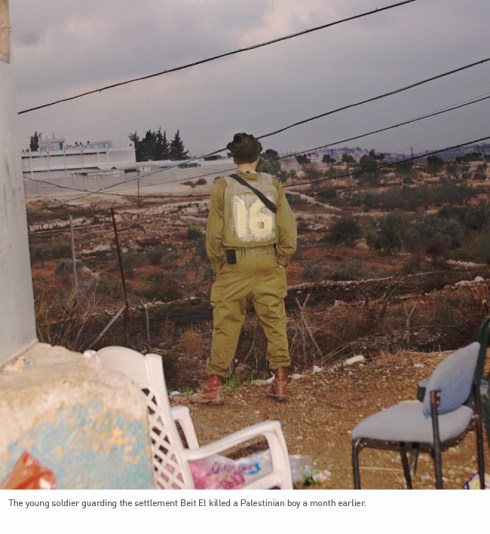
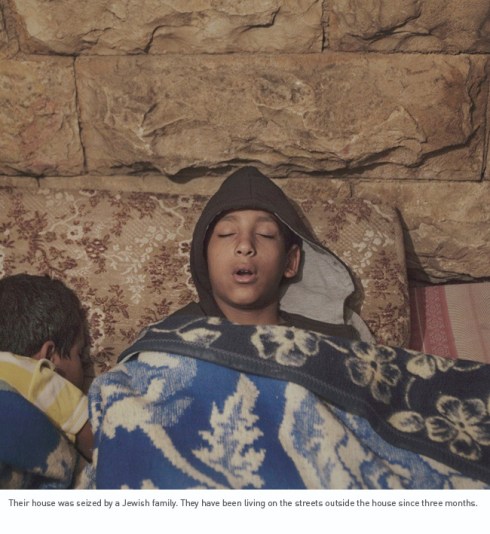
Life’s A Blast is a personal meditation on Israel and Palestine as seen through the lens of a young Swedish visitor. Linda Forsell visited Israel, Gaza and the West Bank several times between 2008 and 2010. She returned with a selection of images that read like a journal.
I first became aware of Forsell’s work when Life’s A Blast was shortlisted for the 2010 Magnum Expressions Award. I’m a big fan. I, therefore, did not hesitate to write a foreword when invited to do so by Linda. Below, punctuated by Linda’s images, is the I essay I wrote the new-release book Life’s A Blast.
– – –

– – –
“He lowered the glasses and pulled down the cotton mask from his face and wiped his nose on the back of his wrist and then glassed the country again. Then he just sat there holding the binoculars and watching the ashen daylight congeal over the land. He knew only that the child was his warrant. He said: If he is not the word of God, God never spoke.”
— Cormac McCarthy, The Road
It’s fair to speculate that all photography surfacing from Israel and Palestine is about land. Knowing what we do about land disputes, settlements and segregation in the region, it’s difficult not to ascribe images a political position favoring the land claims of either the Israelis or Palestinians. This is understandable in a climate of contemporary opinion that has roundly rejected the idea of photography and photographer as objective agents.
Linda Forsell’s photographs are not landscape photographs in the traditional sense. However, the beguiling vignettes within the pages of this book do return us to issues of land, and to the discomfiting realisation that no one in Israel or Palestine has a grounded or reliable relationship to the land.
In considering the surety of land-claims – claims backed with violence – in Israel and the Palestinian Territories, it may seem absurd to describe peoples’ connections to land as without root. Perhaps, the word ‘ambiguous’ more faithfully describes the disconnect. Between the certainty of established political positions and the uncertainty of physical existence in the region there exists a vast gulf of ambiguity.
Life’s A Blast is a challenge to convention and photographic authority, a sustained and deliberate visual wobble.
Within a photograph of an older man teetering atop a wall, the wobble is literal. In the photographs of children wielding weapons and playing among destroyed buildings, the imbalance is allegorical. Men, women and children in Forsell’s work maintain relationships among themselves, but struggle to find their feet.
The tropes of photography – particularly photojournalism – in Israel and Palestine are well known; the checkpoint; the rock-slinging youth; the huddled mother; the wall; the distant settlements on a desert hillside; the coffin raised high at a funeral; and – perhaps with most appearances on international newspaper front pages – the flag. The flag is often accompanied by some billowing smoke.
These tropes persist because, within the boundaries of a news story, these scenes are the illustrative of the quote/unquote action. As consumers of images, we must keep at the forefront of our minds that living in Israel and Palestine goes on outside the boundaries of news column inches.
– – –


– – –
We have begun to see a small but noticeable response by contemporary photographers who have consciously moved away from “crisis photography” – I’m thinking here of recent work and publications by Irina Rozovsky and Yael Ben Zion – toward subtler observations of subtler gestures.
Forsell’s concern for the individual is noticeably different to the drawn back and almost cartographical response by celebrated photographers such as Sophie Ristelbuehler, Willie Doherty, Paul Seawright, Simon Norfolk and Richard Mosse. Of this group, curator and critic Charlotte Cotton says:
“Rather than being caught up in the chaotic midst of an event, or at close quarters to individual pain and suffering, photographers choose instead to represent what is left behind in the wake of such tragedies, often doing so with styles that purpose a qualifying perspective.” [1]
Equally committed to ideas of scarification and dislocation, Forsell, by contrast, takes us closer to people, not further away. In so doing, we encounter the personal and psychological; a soldier who doesn’t want to be there, an old man perplexed by border-point paperwork, the laughter of military-men, a side-street pat down and the confused glances of children. There’s vanity amid the daze and haze, too, in the form of rock-throwing demonstrators that look like they’re dressed for a violent-chic photoshoot. It’s only disconcerting if you accept there are no easy answers for the people of Israel and Palestine.
Too often, repeated news images provide us the excuse to think that events don’t change and can’t change. Worse still, is the trap to think that Israelis and Palestinians are different from us. Such thinking allows us to rationalise ongoing abuses. In discussing atrocities generally, lawyer and feminist scholar Catherine McKinnon characterises attitudes:
“If the events are socially considered unusual, the fact that they happened is denied in specific instances; if they are regarded as usual the fact that they are violating is denied; if it is happening, it’s not so bad, and if it’s really bad, it isn’t happening,” [2]
McKinnon describes the trap and illogic of apathy. The exit door from denial is to first see the victims of abuse as humans. To identify common emotions and thus ourselves in Forsell’s subjects is our responsibility to them … and her gift to us. Turning these pages is to shake the foundations of our excusatory logic.
Life’s A Blast is a significant contribution to the visual discourse of Israel and Palestine. It abandons literal depiction of the region and, instead, looks toward emotional territories.
It is the prior exploration of these emotional lands that will provide the most reliable base on which to stand for those who desire to debate the geopolitics of the region’s contested borders, laws and land.
– – –
1. Charlotte Cotton, ‘The Photograph as Contemporary Art’, p.167. Thames & Hudson, October, 2004.
2. Catharine McKinnon, ‘Are Women Human?: And Other International Dialogues’, p.3, Belknap Press, 2007.
– – –


– – –
Life’s a Blast (106 pages) 10 x 13 inches.
Published by Premiss Förlag.
Printed by Elanders Fälth & Hässler.
ISBN: 9789186743055
Available at the Premiss Förlag website.
Life’s a Blast does not yet have U.S. distribution, so if you want to buy a copy in cold-hard-cash-dollars you’ll have to email Linda and ask nicely: linda@lindaforsell.com
– – –
Amy Elkins invited me to curate an online exhibit for Women in Photography, a group now under the umbrella of the Humble Arts Foundation.
My choice of twelve female photographers – Jenn Ackerman, Araminta de Clermont, Alyse Emdur, Christiane Feser, Cheryl Hanna-Truscott, Deborah Luster, Britney Anne Majure, Nathalie Mohadjer, Yana Payusova, Julia Rendleman, Marilyn Suriani, and Kristen S. Wilkins – are a eclectic mix of artists with different approaches to photography in sites of incarceration. Among their works you’ll find fine art documentary, found photography, alternative process, painted photographs, collaborative portraiture, dreamy landscape, photojournalist dispatches and social activism.
Some ladies’ work I’ve featured before on Prison Photography; some are relatively new discoveries; others I met during Prison Photography on the Road; and a few are included in the ongoing Cruel and Unusual show at Noorderlicht.
Thanks to WIPNYC co-founders Amy and Cara Phillips for providing an avenue with which to disseminate photography that counters stereotypes and informs audiences of lives behind bars. Thanks also to Megan Charland for formatting the exhibition.
From my curatorial statement
In the past 40 years, America’s prison population has more than quadrupled from under 500,000 to over 2.3 million. This program of mass incarceration is unprecedented in human history. Women have born the brunt of this disastrous growth. Within that fourfold increase, the female prison population has increased eightfold. You heard right: women are incarcerated today at eight times the number they were in the early 1970s. Are women really eight times more dangerous as they were two generations ago?
Please, browse the gallery, bios and linked portfolios.


PRINTED MATTERS
For the upcoming Cruel and Unusual exhibition, Hester Keijser and I opted for a newsprint catalogue. We did this for several reasons.
Firstly, the message behind the exhibition is one that calls for political thought and hopefully political change. Shifts in attitudes come about through public education; it made sense to distribute information as far and wide as was possible. Not everyone can afford a photobook/catalogue, but 4,000 free copies of a newspaper nullifies the issue. Some might call the newspaper medium democratic, but I just call the solution common sense. 
Secondly, we had a lot of photographers to feature. 32 pages of a tabloid-sized newspaper is a sizable amount of column inches with which to fairly deal with the many issues in the photographers’ works.
And third, Hester and I wanted to bring attention to the fact that [photo]bloggers continue to shape, react to, and distort new media economies. As we say in our curatorial statement:
“Cruel and Unusual looks at the utility of freelance online publishing. As bloggers with academic backgrounds, we happily invest time and intellectual capital in our research and writing. Our blogs and those of colleagues have become resources – almost contemporary libraries – that others utilize and perhaps even capitalise upon. For a host of reasons, printed journalism is in decline. Simultaneously, bloggers refine their messages unhindered. Related, but not necessarily causal, we want to acknowledge these two trends and the disruption at hand.”
We aren’t particularly worried about not knowing what the future holds, because for now we are propelled by opportunities to create things in the present.
SOME OTHER NEWSPRINT PHOTO PUBLICATIONS
Most people are probably aware of Alec Soth’s Last Days of W. President Bush was a constant source of partisan news stories, and Op-Ed’s on Bush were divided and divisive. Given that Bush was a leader who orbited world events without necessarily controlling them and given that he was a Commander-in-Chief whose war cabinet tried to warp media to its own message, Soth’s use of a newspaper is ironic and appropriate. Jeff Ladd noted that Soth’s subjects look worn out and exhausted as if reflecting the American psyche after eight years of Bush. A newspaper will soon yellow and show aging – perhaps Soth hoped his newspaper would be short lived like the memory of Bush and the reparations required following his presidency?
Recently, Harry Hardie at HERE has collaborated on two newsprint photo publications.
CAIRO DIVIDED (32 pages) sequences the photos of Jason Larkin with an authoritative essay (in both English and Arabic) by Jack Shenker about suburbanization around Egypt’s capital. Since January 25th of 2011, Egypt has not been out the news, and yet this project is not about revolution. It is however about poverty, wealth and class stratification and as such provides a good context for the revolution in Egypt. Excellent design with eye-opening photographs. Highly recommended. More info here.
Guy Martin’s The Missing is borne of a collaboration between Panos Pictures, HERE and Martin’s alma mater The University of Falmouth. Each of its 48 pages has a large image of a missing poster photographed by Guy Martin. The posters “adorned the walls of the courthouse and justice rooms on Benghazi’s seafront.” Martin estimates that in Libya, 30,000 men are missing after the 8 month conflict. As such, the quasi-legal vernacular documents he re-photographed in-situ were the making of “communal place of memory and mourning.” The newspaper acts as a bulletin existing somewhere between the makeshift and the permanent; between memory and knowing; and – as with those pictured – in ambiguous flux with time. More info here.
Shifting gears, Portrait Salon 11 is not about political events. It is, however, a political stand against institutional exclusion. In the tradition of the 1863 French Salon des Refuses, the London-based Portrait Salon is a curated showcase of photographs that were submitted but not selected for the prestigious Taylor Wessing Photographic Portrait Prize. The use of a newspaper is a mischievous challenge to the immobility of a gallery exhibition that chose 60 works from 6,000 submissions; the newspaper can move cheaply and in large quantities beyond gallery walls. Furthermore, the accompanying Portrait Salon exhibition projected portraits in order to include more photography and not be limited by physical space. The exhibition and newspaper were organised by Miranda Gavin, Wayne Ford and others. For purchase.
I’ve highlighted these projects and in each case tried to justify why the choice of newsprint was appropriate and theoretically consistent. I believe that the Cruel and Unusual newspaper is those things too.
CRUEL AND UNUSUAL: AVAILABLE ONLINE
A non-printable, non-downloadable, non-alterable screen-preview version is available online.
Starting February 18, the newspaper is also available for free in the Noorderlicht Photogallery and for sale in the webshop.
The exhibition is split into two sections: 1, a traditional presentation of 11 photographers, and 2, a heady mayhemic wall of work-prints, background material contact sheets from Prison Photography on the Road (PPOTR).
Similarly, the newspaper is divided into two sections. A 20 page PPOTR pullout is enveloped in 12 pages of descriptions of the photographers in the main part of the exhibition.
Below are the opening page and the back page of the PPOTR pullout. The portrait on the opening page was made by Tim Matsui who documented my workshop at Sing Sing Prison.

The back page is a list of 32 of our favourite international photography blogs with QR codes linking to their websites. This was our cheeky riff on the classifieds section of newspapers!

And below are two pairings of PDF pages and Hester’s photographs of the actual printed object. The paper is really beautiful … so Hester tells me; I’ve not held one yet! I would like to thank the designer Pierre Derks who worked with Hester and I. He has expertise, patience and put in some hard graft.


Much of the work in the forthcoming Cruel and Unusual exhibition will be exhibited in Europe for the first time. Some of the photographers I have interviewed for Prison Photography before, but not Jane Lindsay.
I met Jane at Arizona State University, where she studies for an MFA and teaches the undergrads. With a warm heart, she’s talented, conscientious and new on the scene. I’m proud to showcase her work.

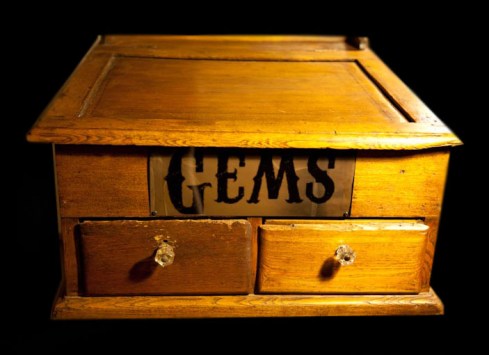
Jane’s series Gems gives back – to men and women arrested in Sheriff Joe Arpaio’s jurisdiction – the dignity he tries his best to strip from them. She is disgusted by Arpaio’s website Mugshot of the Day which publishes the booking photos of people taken into Maricopa County Jail, AZ. The site allows members of the public to gawp, laugh, and vote for their preferred “mugshot of the day.”
It’s public humiliation. It’s also an abuse of power. As Jane points out, many of the people booked into jail suffer with mental-illness, addiction, disability and may be victims of domestic violence or other abuse themselves. Sheriff Arpaio’s response? Insert them into his sideshow-freakshow.
Arpaio encourages us to be callous in our judgement of fellow humans. To be these ugly referees we must stop giving a damn about circumstance or story; we must suspend an interest in time and it’s ability to heal and change things; we must embrace the most lazy understanding of images.
Arpaio wants us to join him in his class-severed world of contempt and mockery. Jane Lindsay refuses.
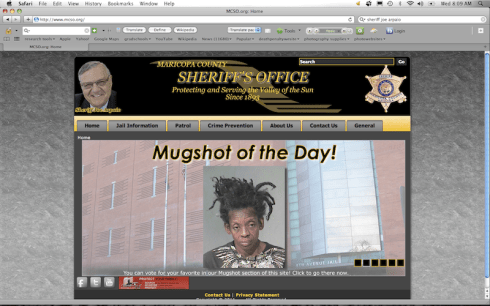

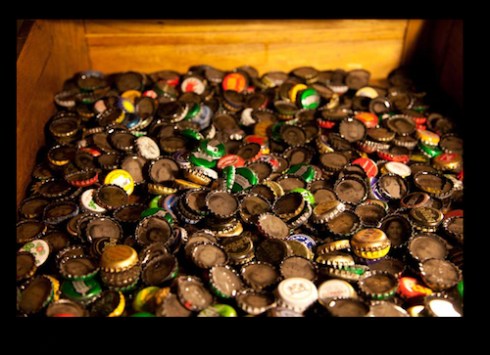
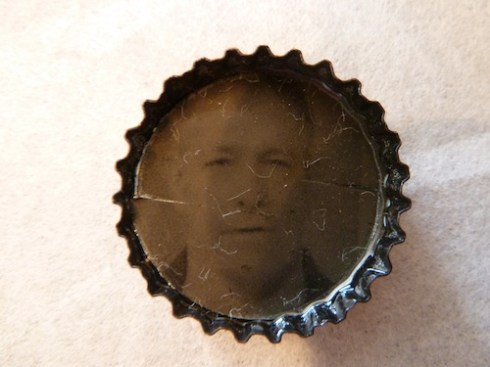
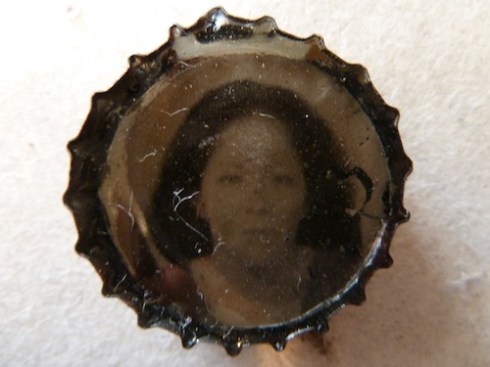
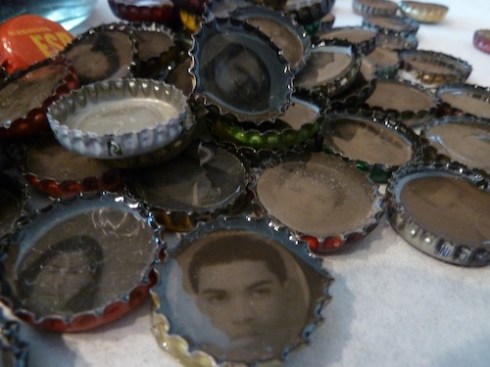
Screengrabs from the Mugshot of the Day website are transferred onto transparencies from which Jane makes a tiny tintype of each portrait. To date, she’s made over 6,000.
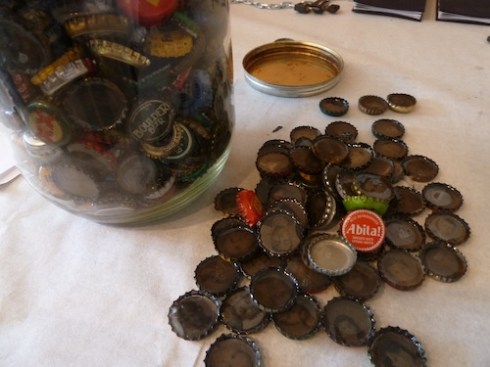
Within the hollow of a bottle cap she inserts a tintype and seals it with resin. These objects, to be held, mimic the eighteenth & nineteenth century devotion objects loved ones shared with each other. Like the contents of a locket without the chain.
Jane doesn’t even want to display them linearly as if to repeat the humiliation of Arpaio’s grid. So she gives them strength in numbers in a purpose-made box. When a viewer is ready they can dip in their hand, select one and spend some time with an individual.
Beautiful.

Jane Lindsay’s website is currently under construction.

DOC#: 312197
DOB: 11.25.1964
POB: North Kingston, RI
Sentence: 5 years
Work: Floor Worker
Pamela Winfield, Easter Bunny, Children’s Visiting Day, Louisiana Correctional Institute for Women, St. Gabriel, Louisiana. © Deborah Luster. Courtesy Jack Shainman Gallery.
ANNOUNCEMENT: CRUEL AND UNUSUAL
With a big lump of pride in my belly and knowledge of known unknowns, I am pleased to announce Cruel and Unusual, an exhibition of prison photography Hester Keijser and I are curating at Noorderlicht Gallery, Groningen, Holland.
Hester contacted me just before I set out on Prison Photography on the Road (PPOTR) and asked if I’d co-curate a show; she wanted to tap the prison photo landscape and tell Europeans about the mass-incarceration looming on the horizon should their governments repeat the bottom-line economics and unforgiving approach of American policy-makers.
Hester writes why she invited a curatorial novice like me to collaborate, here.
CURATORIAL DECISION MAKING
Just as I got out from behind the desk for PPOTR, to make in-person connections and audio recordings, so an exhibition is another new way for me to present photography of our hidden carceral spaces, and, in so doing, stoke the fires of the reform debates.
As you can imagine, we had scores of photographers from which to choose. Hester distilled some thoughts, guided me by the hand when necessary, and we plumped for eleven stellar photographers: Araminta de Clermont, Amy Elkins, Alyse Emdur, Christiane Feser, Jane Lindsay, Deborah Luster, Nathalie Mohadjer, Yana Payusova, Lizzie Sadin and Lori Waselchuk.

Anwar, from the series ‘Life After’ © Araminta de Clermont

Inmate volunteers at the Angola Prison Hospice massage a dying patients limbs. © Lori Waselchuk

From the series ‘Dungeon’. © Nathalie Mohadjer
The eleven photographers employ a variety of strategies in order to challenge prevailing stereotypes about crime and incarceration. Vernacular photography, found materials, alternative processes, painted photos, digital manipulations and straight black and white documentary will all be in evidence.
A TOUCH OF PPOTR
Alongside an orthodox(ish) presentation of the eleven main photographers, I wanted also to capture the chaos, interactions and visual excitement I saw in photographers’ studios, contact-sheets and home-towns while on the road.
Along one wall of the exhibition, we’re mounting a hectic presentation of work-prints, behind-the-scenes images and rough text culled from photographers archives. Photographers included are Scott Houston, Adam Shemper, Sye Williams, Jon Lowenstein, Joseph Rodriguez, Ara Oshagan, Jeff Barnet-Winsby, Lloyd Degrane, Harvey Finkle, Sean Kernan, Tim Gruber, Jenn Ackerman, and Steve Davis. Tim Matsui, Jack Jeffries and Frank McMains provide the b-roll.
This parlays nicely into the fact we’re producing a newspaper format catalogue … in a run of 3,000 copies!
The digital age has simultaneously brought about the decline of printed journalism and the rise of freelancers (bloggers) who publish their own content and worldview at will. Related, but not necessarily causal, we wanted to acknowledge these two trends and the disruption at hand.
Every which way I look at it, Cruel and Unusual is an experiment. It feels good to be trying something new and risking mistakes. Hopefully, our presentation does the subject matter justice.
DETAILS
‘Cruel and Unusual’
18 February – 1 April, 2012
Stichting Fotografie Noorderlicht
Akerkhof 12
9711 JB Groningen
Netherlands
Opening hours: Wed–Sun: 12–6pm
Admission: FREE
Telephone: +31 (0) 50 3182227
Email: info@noorderlicht.com
Opening reception: 17th February
Curators talk: 18th February
Installation shot, Gems, by Jane Lindsay. Bottle cap, resin.
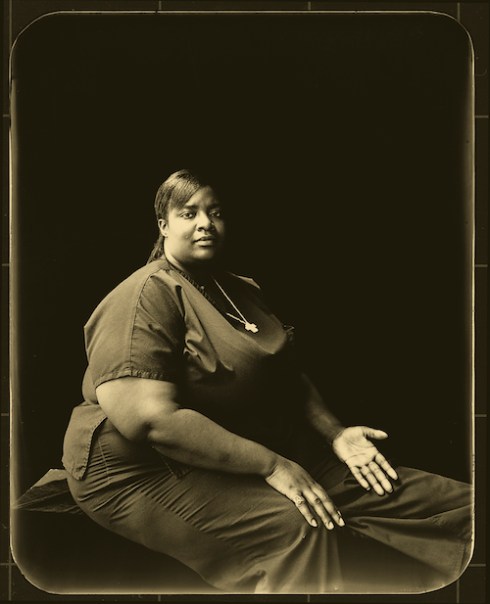
DOC: #335957
DOB: 8.23.1963
POB: Mississippi
Sentence: 4 years
Children: 3
Work: Housekeeping
Louisiana Correctional Institute for Women, St. Gabriel, Louisiana © Deborah Luster. Courtesy Jack Shainman Gallery.

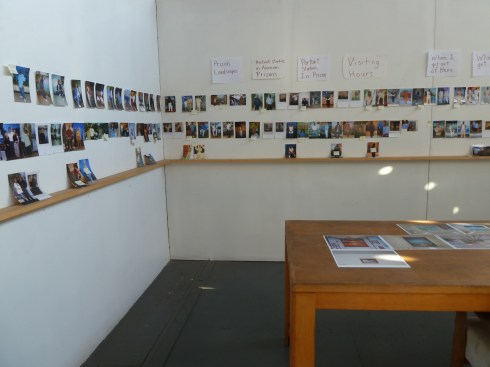
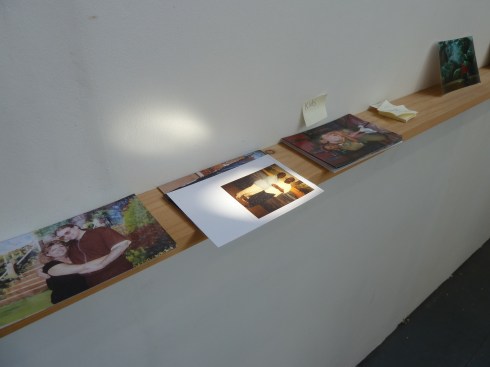
In 2005, Alyse Emdur unearthed a photograph (above) of her visiting her older brother in prison. She recalls, even as a 5 year old, her confusion and discomfit with the tropical beach scene to her back.
To Alyse, these garishly coloured corners of the prison visiting rooms are analogous with commercial photo portrait studios, “If you weren’t familiar with prisons, you might think these were prom photos or made in community centres. They’re very ambiguous,” says Alyse.

Fascinated by the obscure and closeted mural works in prisons across the U.S., Alyse meditated upon them in her MFA grad show (she even commissioned a prison artist to paint a mural on parachute canvas). She is now bringing hundreds of authentic American prison visiting room portraits from her Prison Landscapes project together in a book to be released later this year.
Alyse contacted over 300 prisoners via prison penpal and dating websites. Just over 150 agreed to be part of the project.
In the past, I’ve argued that visiting room portraits may constitute the largest type of American vernacular photography not seen by the majority public. I’ve also noted how companies will manipulate these portraits and, at the request of the owner, photoshop out the prison environment. Photoshop “services” such as these are the post-production equivalent of the denial existent in the original works.
If these idyllic landscapes are about escape it might not just be in an emotional sense, “They are a security feature,” says Alyse. “The backdrops are there to control the type of imagery that is being exported out of the institution. To be specific, the administration doesn’t want images of the inside of the prison to circulate outside of the prison because the thinking is that those images could help an inmate escape. That’s what makes these images slippery and interesting; they also create an escape for the poser and for the [family member] who receives the photo.”
How or why does this discussion matter? Well, essentially these are images about control. Cameras are considered a security hazard by prison authorities. Prisoners have no opportunity to self-represent (bar some very exceptional prison photo workshops). After their mugshot, these visiting room portraits are the only chance America’s 2.3 million prisoners have to achieve something that approximates self-representation. These are highly mediated images and they are often a performance that belies the hardship of prison life.
Alyse and I talk about the regionalism of the backdrop murals; the dearth of research on this quirky and hidden aspect of American visual culture; and Alyse notes how the artistry of mural painting is disappearing as acrylic and enamel paint is replaced by large photo-printed screens.
LISTEN TO OUR DISCUSSION ON THE PRISON PHOTOGRAPHY PODBEAN PAGE



Alyse Emdur (b. NJ, USA 1983) works with photography, video, research, social engagement, and drawing. Her work has been exhibited at Printed Matter and the Lambent Foundation in New York; the University of Texas Visual Arts Center in Austin; Bezalel University in Tel Aviv, Israel; the Lab in San Francisco; La Montagne Gallery in Boston; Laura Bartlett Gallery in London, England; Spacibar in Oslo, Norway; In Situ in Paris, France, and Kunststichting Artis in Hertogenbosch, Netherlands.
In Spring 2012, a book of her project Prison Landscapes will be published by Four Corners Books (London).
Download an interview with Niels Van Tomme published in the Fall 2011 Issue of Art Papers Magazine, here (PDF)
Download an excerpt of Prison Landscapes published in Issue 37 of Cabinet Magazine, here (PDF)

I hadn’t planned to interrupt my PPOTR coverage, but when something this important arises then to hell with convention.
You may be familiar with the name Jeffrey Stockbridge, and you’re probably well aware of his Taylor Wessing Portrait Prize shortlisted double-portrait of Tic Tac and Tootise.
Stockbridge has been photographing in Philadelphia for years with a focus on the Kensington Avenue neighbourhood, which Stockbridge describes:
Kensington Avenue is a hot spot for drugs and prostitution located in North Philadelphia. Populated by cheap bars, pawnshops, and check cashing businesses, the Avenue is also the major business corridor in the neighborhood.
Kensington Blues is not just another dip-your-toe-in-poverty photo project; Stockbridge has spent considerable time befriending many of his subjects. He gives them dignity, and with his designated website Kensington Blues, Stockbridge – through audio and transcription – gives each subject a voice.
I am quickly coming to value any photographer’s approach that, above all else, connects the subject to the photographer … and thus the subject to ourselves. Stockbridge’s Kensington Blues pays that attention to human connection.
BIOGRAPHY
Jeffrey Stockbridge is a photographer based in Philadelphia, Pennsylvania. In 2005, he placed runner up in the New York Times Magazine “Capture the Times” college photography contest. Stockbridge is well known for his projects documenting drugs, prostitution and urban blight in Philadelphia for which he has received several grants and awards. Stockbridge is a recipient of a Pennsylvania Council on the Arts Grant, Independence Foundation Fellowship in the Arts Grant and a Center For Emerging Visual Artists Fellowship. His work has been widely exhibited nationally and internationally. Selected exhibitions include The National Portrait Gallery in London, The Philadelphia Museum of Art, The Fleisher Art Memorial, The Delaware Art Museum, The Delaware Center for the Contemporary Arts and J. Cacciola Gallery. Stockbridge was recently awarded 3rd Prize in the 2010 Taylor-Wessing Photographic Portrait Prize at The National Portrait Gallery in London. Upcoming exhibitions include Galerie Huit Photography Open Salon 2011 in Arles, France and a solo exhibition of Stockbridge’s work is scheduled for July 2011 at The Wapping Project Bankside in London. (Source)

 Prison Photography