
You are currently browsing the category archive for the ‘Fine Art’ category.

I’ve spoken about artist Jeff Barnett-Winsby and his various photography projects in a Lansing prison, here and here. The main tangible object from JBW’s prison photography is the book Mark West and Molly Rose.
JBW is beginning a big push promoting Mark West and Molly Rose, starting with a book-signing at the International Center of Photography, 1133, Ave of the Americas #1A, NYC, on 6th May (6:00pm – 7:30pm).
From J&L Books:
Barnett-Winsby’s attraction to persons exiled to the fringes of society led him to photograph in Lansing Prison, in Lansing, Kansas. A year into his project, he found out that in February 2006, a convicted killer named John Manard had escaped from the prison, concealed inside a dog crate, with the help of a volunteer who worked at the facility named Toby Young. Manard and Young, operating under the aliases Mark West and Molly Rose, were captured two weeks later, after a high-speed chase, in Tennessee. Illustrated in color and black and white, this book is a collection of Barnett-Winsby’s photographs of and correspondence with the two lovers, both before and after the escape, and a unique record of an extraordinary tale of escape. “I have always been fascinated with loneliness and the outsider in society,” Barnett-Winsby writes, of his attraction to West and Rose’s extraordinary story. “Growing up, I felt pretty out of it (who doesn’t?) and was always in trouble for something.” His reconstructed narrative of their tale constitutes a highly original portrait.
ELSEWHERES
Week 38: Jeff Barnett-Winsby, Too Much Chocolate
Q & A : Jeff Barnett-Winsby, Providence, Feature Shoot

This weekend I’m in Portland, Oregon for Photolucida. I pored through the catalogue of participants and found about twenty photographers whose work I am keen to learn more about. In that group is Jesse Louttit.
Louttit is right on the money when he says “the intimate details of our everyday lives can still be completely foreign to those who know us outside our work, even to our closest loved ones.”
Employees Only is a clever selection of quiet moments in the workplace with some psychological tension and eye-pleasing balance.
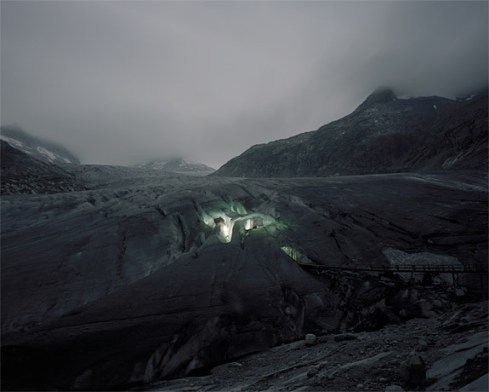
Corinne Vionnet has had a lot of coverage recently for Photo Opportunities, for which she stacked hundreds of culled internet images of tourist sites . I rather like her Du Glacier du Rhone au Lac Leman (From the Rhone Glacier to Lake Geneva) aswell
Du Glacier du Rhone au Lac Leman (From the Rhone Glacier to Lake Geneva) has a variety of strong but distinct images. The example above takes care of the cool landscape aesthetic (for a Sigur Ros generation) while the portrait below ticks the box for quirky stranger … it also plays nicely on this famous image.


Comstock, NY State Prison. © Stephen Tourlentes
Tom Griggs, the man at the helm at Fototazo has just published an interview with Stephen Tourlentes.
Aware of two earlier interviews with Tourlentes by Jess T. Dugan and myself, Griggs proposed he stitch information from those together with new questions and answers to fill the gaps and bring the reader up to date. The result is a very comprehensive, crowdsourced Q&A about Tourlentes’ photography and politics.
“[We must] find better ways to deal with poverty, education and human rights. The prison system in the US has grown at the expense of funding education, public health and investing long term in sustainable community initiatives that combat crime.”
“In my view we have an extremely complicated history in the US. Contradictions abound. Along with brilliant success and economic power we have built a prison system that holds 24% of the world prison population even though the US represents only 5% of the worlds population. In a country that holds it’s constitutional freedoms so dear we are the best in the world at locking people up.”
FOTOTAZO
Fototazo is a new philanthropic venture on the block. It raises funds to purchase equipment for young, emerging photographers from economically disadvantaged backgrounds from around the globe.
Fototazo will snag your interest with in-depth interviews and portfolios of new work by selected contemporary photographers. Hopefully, you’ll reciprocate with some spare change for the grants, the monies of which go to those building careers in photography and whose development is limited by an inability to purchase necessary equipment.
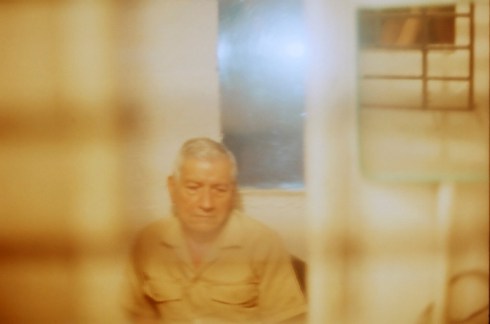
© Natalia Lopera
John Holbrook‘s Death Row portraits (2008) were taken in the Polunsky and Gatesville units, Texas.
The portraits serve two functions – they are the products of Holbrook’s own therapeutic journey and they are didactic props for the families of victims of murder.
“I want to teach the victims this liberating truth that I have learned,” says Holbrook. “The only way we can truly stop suffering is to love and forgive those who have caused the suffering.”

Seemingly, Death Row was propelled by Holbrook’s interpretation of Christian forgiveness and his need to psychologically heal after seeing images of violence during his work.
For 17 years, Holbrook worked as a private investigator on capital murder cases in Texas. In 1995, he was assigned to a case involving the double homicide of a teenage couple for which he spent many hours examining crime-scene evidence and graphic photographs.
Years later, Holbrook began suffering anxious episodes.
“A psychologist determined that my photographs of that time of homeless and social outcasts shown in a spiritual light, were subconscious attempts to correct the ‘bad pictures’ I saw while working the capital murder case,” says Holbrook.
“Ultimately, I learned that I could overcome PTSD by forgiving those who had caused it.”
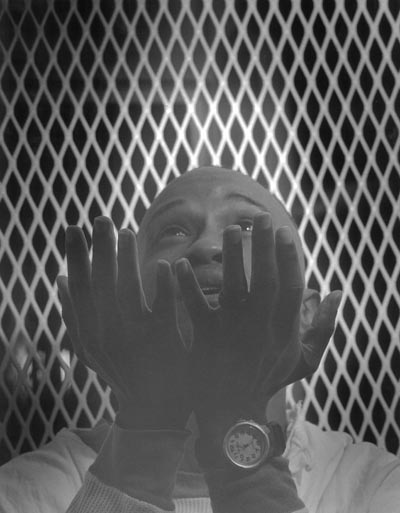
As he photographed through windows of prison visiting-room booths, Holbrook directed his subjects in spiritual gestures. The video (below) mirrors the artist’s rationale and is sympathetic to his needs. It bothers me a little that Holbrook feels he is the one to bestow forgiveness. He was a professional in his work. It was work that carried extreme emotional trauma after the fact, and I understand why Holbrook responded outwardly with conviction and a project as strong as his prior distress, but it could be argued Holbrook’s dragged prisoners into his healing process. If a university wanted to interview death-row prisoners they’d need ethics approval from a human subjects research board. I’d like to know about Holbrook’s preparations for the project.
That said, the prisoners he worked with (on the evidence of the video below) are engaged in the project and undoubtedly moved by the Holbrook’s portraits. I assume they were extremely grateful for the visits and discussion with Holbrook.
The stresses of criminal justice work lead to many responses by professionals and while Holbrook’s methods may be unorthodox, it seems he’s gone about them in good faith (pun intended). Better this outward healing than the slow degradation of family life and health that can impact police and prison personnel.
At its core, Holbrook’s work is a call to victims’ loved ones – who have significant sway in the death penalty debate – to oppose state murder.
“In order to get a death penalty, a Texas prosecutor will argue that the victim’s loved ones endorse the death of the accused. It is said that the surviving loved ones, “need closure”. Through my pictures, I argue that this disables the survivor’s ability to forgive the accused. To me, execution is a grave injustice done to the loved ones, ultimately denying survivors the ability to stop suffering.”
We mustn’t forget that Holbrook’s invocation of Christian teachings will help many Americans connect with his work. The work is anti-death penalty and Holbrook’s American audience vote.
I have not come across any project similar to this and I’d be very interested to get the views of the prisoners involved. I think only then can we begin to weigh the value of Holbrook’s works. Who knows, several of Holbrook’s subject may have already been executed?
The overt Christian imagery can be regarded as talking point, for some, maybe a noble purity, but for me it is suffocating. There are sociological causes to crime and there can be political responses. That is not to say I don’t believe in forgiveness; it is just to insist that forgiveness needn’t be monopolised by faith groups but instead incorporated into secular policy, restorative justice programs and sentencing laws that are not overly-retributive.
Forgiveness is an essential part of understanding the causes and cycles of crime. Unfortunately, too often “forgiveness” hinges upon a final apology of the condemned before we fry them anyway.

Peter Hoffman‘s representation of life at Bryan House is one of sanctuary and everyday tasks. It is the sort of normality and calm you expect many of the refugees depicted have sought for a long time. Bryan House is in Aurora, Illinois, where legally established refugees are allowed to reside for periods of a year or more at a time while saving up for a new home, college tuition or other life progressing steps.
Support the Bryan House organization by purchasing Hoffman’s self-published book. You can also buy a limited edition print at Collect.Give. All profits go directly to Bryan House.
(Found via La Pura Vida)

“I was have always paid attention to how artists worked in the world, especially with the form known as the Artist Talk where the artist is invited to present his/her works. This form remains intriguing to me. It always seems to involve the following elements: A podium or table; A slide or video projector; Table with glass or bottle of water; A (most of time) inadequate introduction followed by a lecture which is inevitably interrupted by some technical problem that may or may not be resolved; End of lecture; Enthusiastic, polite, or no applause; Someone announces that the artist is willing to answer questions from the audience; Moment of silence; Artists fear and wishes that no questions are forthcoming; Audiences fears and wishes that no questions are forthcoming; Some daring soul inevitably raises his/her hand to ask a good or bad question; artists give good or bad answers; Someone mentions that time has run out; Audience leave while a few people approach the artist to ask him/her more questions; Everyone is escorted out; Artists is invited for a drink or dinner where a polite conversation takes place; Email coordinates are exchanged; Artist is dropped off at a mediocre hotel with an equally mediocre and expensive internet connection.” (Source)
Walid Ra’ad is the recipient of the 2011 Hasselblad Award and founder of the Atlas Group.
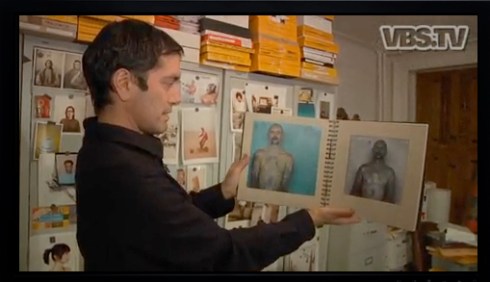
I was interested to discover that photographs of San Quentin inmates played a formative role in Stefan Ruiz‘s career. At 4:45mins, Ruiz talks about his position as an art teacher at San Quentin and his compulsion to make portraits.
From a battered Fujifilm box held together with gaffer tape, Ruiz pulls out a wire bound album of prison portraits:
“I really wanted to take pictures of them so I started taking all these photos. I put this whole little notebook together … and I would carry this box [everywhere]. This was before laptops. I used to bring this to Europe all the time and I’d show this. This was what got me jobs.“
Ruiz goes on to explain that he was employed by Caterpillar to imitate the look of those San Quentin portraits. Ruiz’s contact at Caterpillar then moved to Camper and the relationship continued. After Camper Ruiz went to COLORS Magazine as Creative Director (Issues 55 – 60, April 2003 – April 2004). All the while, Ruiz was perfecting his “well-lit” and “polished” style.
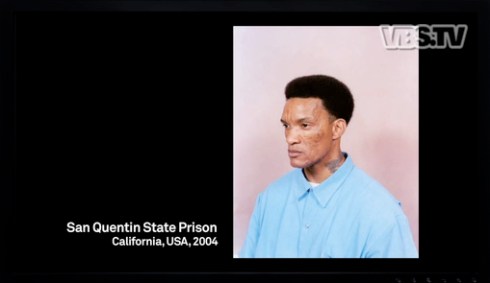

Some observers are turned off by the fusion of art/documentary/fashion employed by Ruiz. Common criticism of this multi-genre work is that it can depict poverty as glamorous, violence as eye-candy, and people as consumable props in a visual world obsessed with surface.
The flaw to these dismissive crits is that cinema has been forging this type of imagery for decades; yet, we expect slick augmented reality in the moving image. Ruiz’s use of lights instead of B&W film and the blur of a Leica is hardly an attack on documentary and certainly not on realism (since when has photography ever plausibly claimed a monopoly on realism, anyway?).
Ruiz’s portraits have a solid footing in reality; they are devoid of photojournalist cliche and require participation from the subject. And as far as commercialism is concerned – at least in the case of COLORS – the relationship of money to Ruiz’s aesthetic experiments is acknowledged.
Ruiz likes to “work with the person.” From telenovela actors to hospital patients and clinicians and from rodeo queens to refugees, Ruiz has connected with his subjects through a transparent discussion about what they can achieve together with a device that records and stores their likeness.

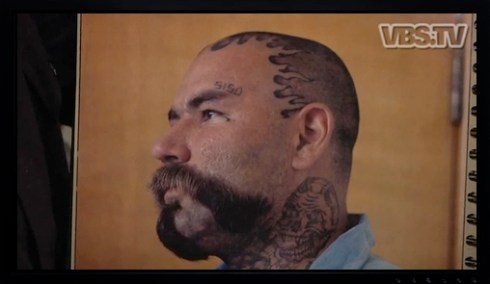
The VBS profile of Stefan Ruiz* is a great introduction to his past, present and future trajectory. Highly recommended.

 Prison Photography