
You are currently browsing the category archive for the ‘Fine Art’ category.
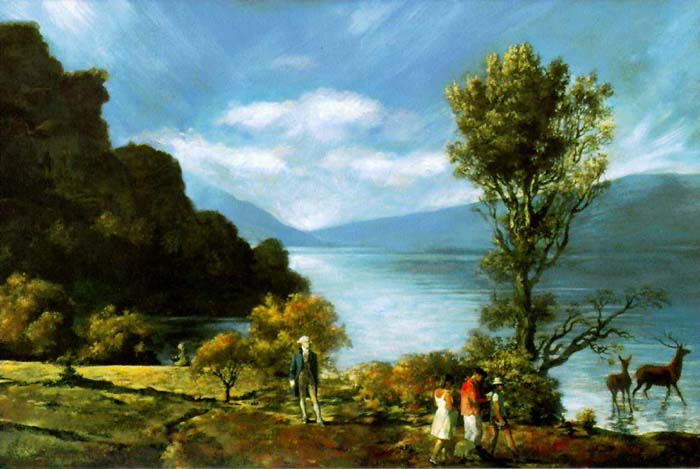
Komar & Melamid UNITED STATES: MOST WANTED PAINTING.
I am not asking here about photographs of America’s Most Wanted, I am asking quite literally about what photograph America most wants.
This question has virtually nothing to do with the most expensive photographs, as that list only tells us the dollars put behind one person or groups’ well-heeled want.
The question is not so ridiculous, nor should it be totally subjective. In 1994, Russian artists Komar and Melamid embarked via online survey to discover the appearance of the most and least wanted/desired paintings for people across different countries. George Washington chilling with three kids and a couple of wading deers (above) is – according to the science – America’s most wanted painting.
Komar and Melamid asked preferences toward colours, modern or traditional styles, old or new subjects, wild or domestic animals, natural or portrait, outdoor or indoor, realistic or different looking (if different whether exaggerations of real objects or imaginary objects were better).
They asked whether paintings should teach a lesson, relate to religion, be relaxing. They asked if paintings should be textured or flat, colors blended or separate, brush strokes or smooth paint, serious or festive, busy or simple, large or small. They asked if the painting should include geometric or random patterns. If the painting was of people should they be famous or ordinary, nude or clothed, working or at leisure, historic or recent figures, single people or groups.
Komar and Melamid asked for opinions on Picasso, Pollock, Dali, Monet, Rembrandt and Warhol. They also asked if they preferred black and white or colour.
[By the by, the letters about the survey are hilarious!]
If we were to do the same with photography on what criteria would we canvas response? As you think on that you may want to listen to America’s Most Wanted Song, as determined by a similar Komar and Melamid survey. If that doesn’t convince you about the wisdom of crowds then America’s Least Wanted Song will. We can, it seem, all agree on what is terrible!

I really would like to develop a list of criteria for defining what we want from a photograph:
B&W or colour; celebrity or ordinary people; pets or wild animals; square or rectangle shaped; people that look like you or people that look different to you; street or interior; with caption or no caption; candid or posed; family and friends or strangers; part of a story or single image; realism or abstract; In focus or blurry; historical or recent scenes; with or without border/sprocket holes; large objects or fine detail, obvious or hidden objects; visual pun or dry as a bone, film or digital, pixels or no pixels, starving or healthy environments?
Should a photograph be amusing, moralistic, quick to understand or engaging over time; deliver a message, educate, allow the viewer to escape, assist with dreams, show you things you know or things you don’t.
As for the touchstone photographs to gauge taste by? Opinions on the works of Steichen, Leibowitz, Apollo mission photographers, photobooths, Matthew Brady, school portraits, war photographers’ works, Joel Sternfeld, newspaper or magazine photographers, Gerhard Richter, Miroslav Tichy, porn videographers’ stills?
What would be – what is – America’s Most Wanted Photograph?
Below, for your viewing pleasure are the most wanted paintings of various other countries.
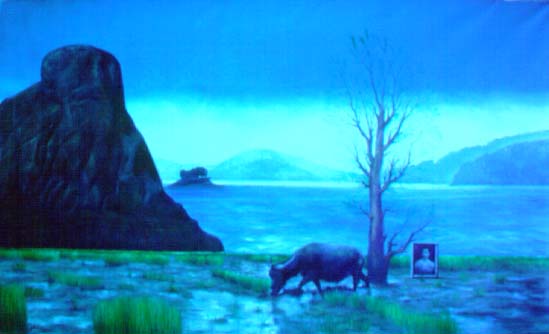
Komar & Melamid CHINA: MOST WANTED PAINTING
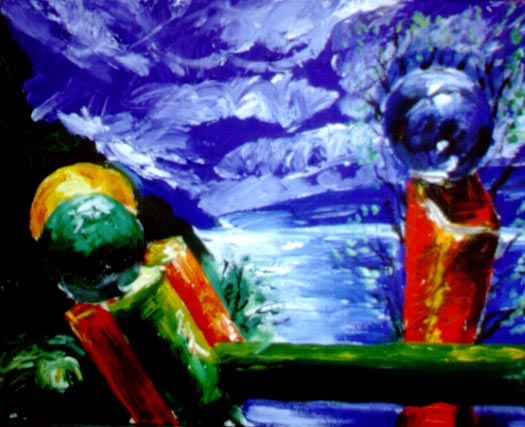
Komar & Melamid ITALY: MOST WANTED PAINTING
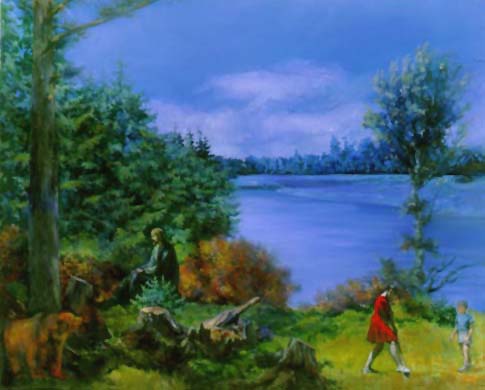
Komar & Melamid RUSSIA: MOST WANTED PAINTING
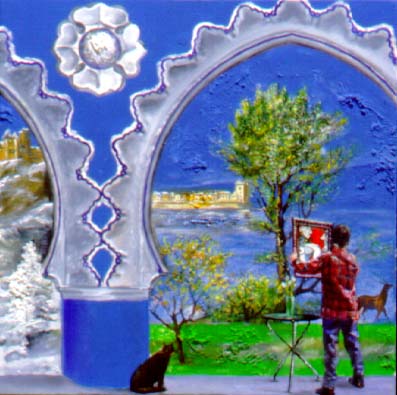
Komar & Melamid GERMANY: MOST WANTED PAINTING

Komar & Melamid FRANCE: MOST WANTED PAINTING
Painting by Numbers: Komar and Melamid’s Scientific Guide to Art, JoAnn Wypijewski (Editor) is available at all good thrift stores (and Amazon)
The pile is my system. Sort and pile. Sort and pile. Until the piles have disappeared.
– Kristan Horton
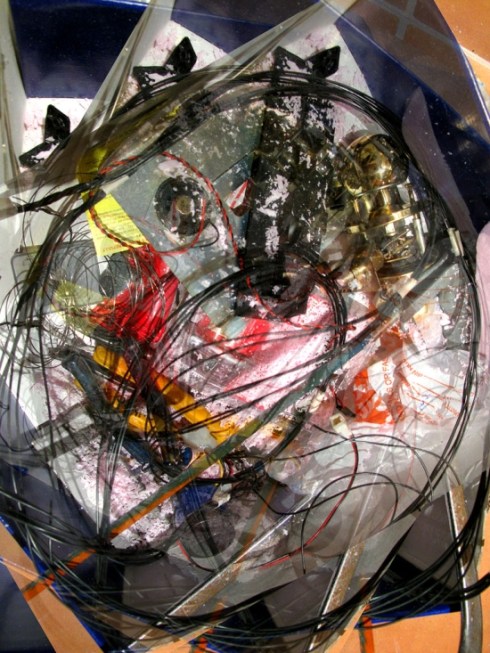
Orbit (doorknob), 2009. Digital colour photograph, Ed. 5. 134.5 x 101.5cm/ 53 x 40in. © Kristan Horton
Well, I guess this announcement saves me the review I was going to post … er, in a way. Kristan Horton has won the Grange Prize.
Earlier this week, I spent a couple of hours looking over the four shortlisted artists and watching the Grange Prize directed videos on youtube. I also had a listen to this slightly unsatisfying panel discussion among the artists.
Alongside Moyra Davey, Horton was my joint favourite. Josh Brand will make some important work with his photogram experiments but his time is yet to come. Leslie Hewitt‘s photography was not personal enough for me – her statements on history were far more expansive than Horton’s more personal musings about time. I think that subtle difference may endeared Horton to the voting public.
Oh, by the way, what should we think of a $50,000 prize for photography voted for entirely by the public?
Back to Horton. I dig his nervous energy, I dig the fact he’s not a “trained” photographer, and quite simply I like the composite-prints he has made of piles of stuff in his studio. I think they are nice objects.
What intrigued me about this prize was that the shortlisted artists were all gentle thinkers and their work was quite solitary. Maybe the humour in Horton’s sugar lump and popcorn models for Dr. Strangelove, Dr. Strangelove also swayed my preference?
All in all, the shortlisted works by the four artists were quite inaccessible required a lot of digestion (which, isn’t really a criticism). The videos and the audio also proved to me that sometimes artists are not the best people to speak about their work. They are so close they see and speak every nuance which can get in the way of immediate appreciation.
Sometimes objects can speak for themselves, which I think Horton’s do.
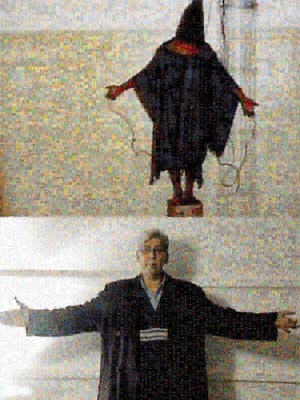
Joan Fontcuberta describes his work as “anti-authoritarian.” He is a self-taught artist and former journalist who has adopted the tricks and issues of media manipulation/propaganda into his work.
Fontcuberta’s Googlegrams are “large, colorful photo-mosaics that construct a metaphor for the internet-era’s liaisons between mass media and our collective consciousness. Using Google to blindly cull images from the internet by controlling only the search engine criteria, Fontcuberta then assembles them by another computer program into a larger photomosaic image of Fontcuberta’s choosing.” (Source)
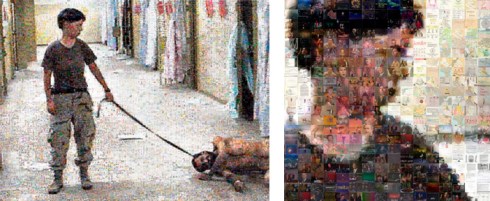
Fontcuberta’s an iconoclast, a philosopher and doesn’t trust the image. He encourages people to distrust, but ultimately recognises that people must believe: “people need information.” (Which may relate to the necessary reinsertion into – and commitment to – the image Joerg’s calling for.)
It’s all about healthy skepticism and filtering. He’s the furthest thing from a pessimist; he teaches photographic history and adores the medium. But he is not a sap.
Fontcuberta’s work deliberately fictionalises and questions. Jim Casper’s well-metred audio interview and VICE‘s interview flesh out his approach and motives.
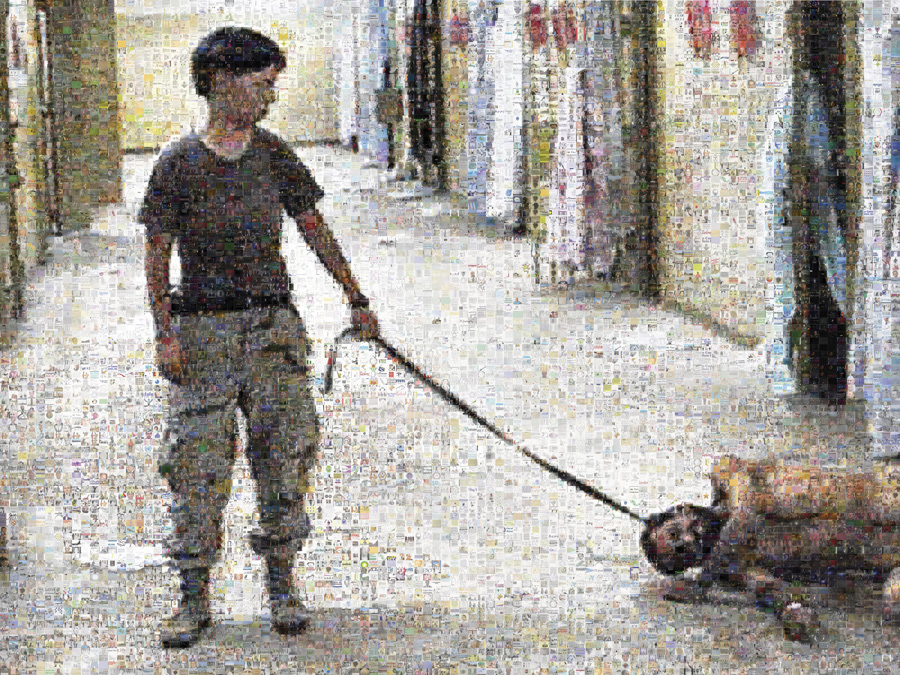
What I admire about Fontcuberta is that having abandoned the urge to fight against the crimes of photoshop, advertising and image politics, he plays them at their own game. His ideas are uninhibited; it doesn’t matter if the lost Japanese soldiers of WWII in the Philippines jungle that he went in search of exist or not. Fontcuberta puts the exploration of an idea before the pressure to produce an end product. “The look of my work is not important,” he says.
Fontcuberta is playful and really jolly. I’d love to see him take on a cryptozoology expedition!
BIO
Joan Fontcuberta was born in 1955 in Barcelona, where he continues to live and work. He has exhibited extensively at museums and galleries in the U.S., Europe, and Japan, and has been associated with Zabriskie Gallery since 1981. His work is in numerous institutions, including the New York Museum of Modern Art, the San Francisco Museum of Modern Art, and the Art Institute of Chicago. He contributes regularly to scholarly journals and has published many books, including Fauna, Sputnik and Miracles and Co.
Former Vietnam veteran, prison inmate and junkie (“once the needle goes in it never comes out”), Clark has a kind of coiled, unpredictable energy.
– Tobias Grey (‘Photographer Larry Clark’s muses’, Financial Times, Oct. 30, 2010)

Billy Mann 1963. © Larry Clark/Luhring Augustine, New York and Simon Lee Gallery, London.
Printed on the salmon-pink pages of the FT (the global leader in financial news), Larry Clark‘s latest interview about his counterculture subjects and his casual anti-commercial philosophy carries some irony.
Then again, perhaps not. Clark’s refusal to market and remarket his books and prints has led to scarcity – the result? Prices have been driven up:
“Clark refused to let either of his most famous books, the harrowing and explicit Tulsa and Teenage Lust, be republished. He finally did a couple of print-runs with Tulsa 10 years ago, but Teenage Lust is still out of circulation and as such a valuable collector’s item. Earlier this year, at an auction at Sotheby’s in London, a single print from Teenage Lust sold for £7,800.”
In his fifties, Clark learnt to skate to keep up with his cast for Kids. He believes that to photograph a youth culture you have to be in it. It must be difficult for Clark to have the city hall in Paris ban under-18s from entry to Kiss the Past Hello, his exhibition at Musée d’Art Moderne, “I think it’s just the stupidest thing in the world,” says Clark. “I think it’s an attack on youth and on teenagers in general.”
It’s difficult to argue against Clark’s indelible mark on American visual culture. Every hipster, skater, urban-wannabee and romantic sees their lives through the American-Apparel-Levi’s-Ryan-McGinley-Dash-Snow-Hamburger-Eyes-Zoolander-Derelicte images that advertisers, Polaroid & film enthusiasts create as facsimiles to Clark’s seductive and brutal works.
Again, irony reigns as advertisers define a slightly mucky but not diseased world in which they can place their products; a world that looks like Clark’s but is some distance from it. With that in mind, I think Tobias Grey‘s point has some weight:
“As a contemporary and admirer of Diane Arbus and W Eugene Smith, Clark is perhaps the last survivor to bridge the classic era of black-and-white photography and the present.”
Clark has ran and defined the continuum.
Read the article. Clark’s closing empathy for childhood movie stars is surprising and honest; he made collages to honor them.
‘Kiss the Past Hello’, Musée d’Art Moderne de la Ville de Paris, until January 2 2011.
PHOTOGRAPHY COVERAGE IN THE FINANCIAL TIMES
Like last weeks FT article on Leibowitz’s interaction with the market, this portrayal of Clark and his motives is well-written, even endearing. The FT Weekend has had articles on Martin Parr and Cameraless Photography in recent weeks too.
It was a mandatory choice of an airmiles-earned printed daily that brought the FT to my door, but I’ll admit I’m looking forward to my Saturday morning reads more and more.

Last month, I published a piece for Wired.com about Philipp Lohöfener‘s photographs from the Stasi Prison Museum in Berlin.
I make the point that “the prison has been the subject for other photographers including Martin Roemers, Daniel & Geo Fuchs and Daniel Etter, but Lohoefener’s work is the most cohesive essay in describing the cold horror of the site.”
I am a big fan of former prisons that have been reconstituted as sites for education; they will inform about the specifics of the political era in question, but they will also usually double as sites of pedagogy against oppression of human rights applying the narrative at a global level.

Golf Five Zero watchtower. Crossmaglen, South Armagh, Northern Ireland, UK. © Jonathan Olley.
Last month, I had a jolly nice chat with a jolly nice chap about what all this means at Prison Photography. Where’s this open journal taking me?
I said if I took this whole thing to the academy, it could be as simple as a historic survey: The Uses of Photography to Represent, Control and Surveil Prison, Prisoners and Publics in the United States (1945 – 2010).
I was encouraged to ditch the historical view and engage the modern. Ask myself, why should anyone care about prisons? Only a small minority care now and that status quo has remained for many reasons tied up in the antagonisms of capitalism. Would a historical survey change minds and attitudes or just lay out on paper the distinctions most people have already made between themselves and those in prison?
Perhaps people would care more if the abuse of human rights that exists within the criminal justice system of America were shown to impinge on everyone, not only on those caught in its cogs?*
What if we consider the methods and philosophies of management used by prisons and identify where they overlap with management of citizens in the “free” society. Think corporate parks, protest policing, anti-photography laws, stop and search, street surveillance, wire taps, CCTV.
My contention has always been that there was no moral division or severance of social contract over and through prison walls. For me it’s never been us & them; it is us & others among us put in a particular institution we call prison.
But, now I am seeing also, there is an ever decreasing division of tactics either side of prison walls. Strategies of management and technologies of discipline perfected in prisons have crept into daily routine.
What has this emphasis on containment and of monitoring – at the expense of education and social justice – done to our society and to our expectations of society?
SURVEILLANCE/CCTV IN PHOTOGRAPHY
And now for the tie in with photography…
Thinking about surveillance, obviously we have the big show at Tate from this Summer, Exposed: Voyeurism, Surveillance & the Camera with its devoted section to CCTV. (Jonathan Olley‘s work from Northern Ireland is the standout.)
But I always think back to Tom Wichelow‘s series Whitehawk CCTV (1999), possibly because he insists it is not a criticism of CCTV just a look at the politicisation of the human subject viewed through its lens.
Most remarkable in the series is the trio of images of the tragic site of a murder. They reveal to us that looking and bearing witness can be an act of respect as much as that of curiosity as much as an act of control. We are all compelled to look, but some observers are recording the feed and have a disciplinary apparatus to back it up.

Untitled (CCTV footage). Young family visits murder site. Brighton 1999. © Tom Wichelow

Untitled. Friends of murdered boy visit the site. Brighton 1999. © Tom Wichelow

Untitled. Resident reveals murder site outside her bungalow window. Brighton 1999. © Tom Wichelow
– – –
*There’s a simple argument that we all suffer because our tax dollars support a broken system that makes us no safer.
‘I never talk to them… I don’t ask their permission. I don’t pay them… And eventually…I got into trouble’
– Philip-Lorca DiCorcia

I’ve been thinking about surveillance a lot recently.
Philip-Lorca DiCorcia leans on the ubiquity of CCTV to exempt him of guilt for taking portraits without the subjects’ knowledge. It’s a fair point; he worked in public space. Below he talks about his Heads series.
I know the drill, Got cells to burn,
I’m dressed to kill, A mortal coil,
And time is still, On secret soil.
Yeah pay the bills, Cells to burn, Mouths to fill
On Boeing jets, In the sunset make glowing threats.
Yes shall we take a spin again in business,
This time is fixed lets sweeten our facilities,
It took all the man in me.
Lyrics from Massive Attack’s Atlas Air
The animated video for Massive Attack’s Atlas Air, directed by Edouard Salier is a tour de force.
Rampaging and amorphous, what can only be described as a Donnie Darkoesque were-bunny, rips it way through and across blackened territories of prismatic violence. Against and allied, it runs with commercial jets into explosions. Apparently, this is a second appearance for the satanic leporid; it previously romped around Massive Attack’s last video Splitting the Atom.
The randomness of it all, sometimes seen through a gun-sight, recalls the Wikileaks Apache Attack video. But other things are going on too – burning oil fields (the first Gulf War); shattering buildings (9/11); Prestwick airport gets a mention (not the most well known airport but it was the site of a botched car-bomb attack in 2007).
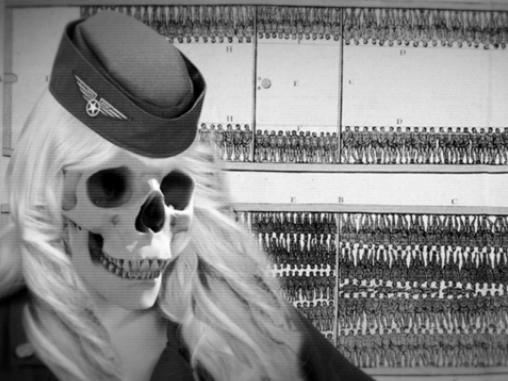
Ultimately, this is a video about extrajudicial rendition flights, the absence of law and the suspension of human rights. The screen grab above – which flashes by so quickly you’ll be forgiven for missing it – deals quite clearly with the involuntary movement of humans, only in this case that of slavery.
Just as the 9/11 plotters usurped commercial airliners for their ideology, the US military adopted commercial jets for its murky logistics. Salier doesn’t miss the opportunity to point out the hypocrisy in the visuals. 737’s get a mention in Atlas Air‘s lyrics.
Salier shows us the negation of order and, perversely, the power-distorted dominance and slick allure of disorder.
By strangling any reason out the compressed annihilation, the Atlas Air video is, for me, one of the finest visualisations of REAL terror. Massive Attack and Salier are not describing anything that relates to the rhetorical usage of the word ‘terror’ pushed on us by war-mongering politicians; they are dealing with pure destructive force as and when it is sent out against an equal force.
This is not a narrative of us against them or of us against them and their allies, or even us and our allies against them and their allies, it is about how fucked it all is … and about the terrifying, beyond-human-scale to which violence escalates. By relying on images of man made cities and theatres of war, Salier reminds us that these crushing vortexes are of our own creation and our own instigation.
I’ve admired Massive Attack’s intelligent use of video before.

 Prison Photography