
You are currently browsing the category archive for the ‘Fine Art’ category.

Private Residence (Owners Deceased). South Philadelphia. November 4, 2008. Copyright © 2010 Ryan Donnell. All Rights Reserved.
Ryan Donnell‘s ‘Behind The Curtain‘ is just fantastic and surprising.
There is a long interview about the series on Eat The Darkness blog.
“When the 2008 election came around I was feeling a little weird since I wasn’t doing anything of importance photographically or journalistically, and it was such an IMPORTANT election (remember that feeling?). So I felt I should participate somehow. I started researching some of the more unusual sounding polling places in the city. The Philadelphia Elections Board actually posts a list of all the polling stations and every place has a small description next to the address, such as “Residence” or “Storefront” or “Water Department Laboratory.” So I made a list of the weirdest sounding places, packed-up my Hassy, tripod and film in my car and basically just drove all over the city of Philadelphia for about 10 hours on Election Day. I’ve done that every election since Nov. 2008.”

Prison, Castaic, CA, 2007. Stephen Tourlentes
Stephen Tourlentes‘ work is without doubt one of the most significant photographic responses to American landscape. If Ansel Adams had lived in an era of mass incarceration, I am certain the discard of persons, nature and sustainability in prisons would have captured his activist streak as much as that of our beloved National Parks.
Eighteen months ago, I interviewed Tourlentes, and that contribution to photographic discourse remains one of my proudest moments. Recently, Tourlentes launched his own website.
His work is of yesterday, for today and hopefully of a changed future.
The nocturnal glow of prisons is his subject; it is a subject we own and the weight of its injustices is ours. Across States, we voted for the mass warehousing of human lives. Tourlentes’ prison-scapes capture the “feedback of exile.”
Thirty years ago, Tourlentes would have no subject, but today he presents us with the spectres of our sprawling and unforgiving prison industrial complex. Glowing bright at night, he shows us sites usually lost on the horizon in daytime heat and haze.
Tourlentes has photographed many different prisons, but has now focused his series on the institutions of that accommodate the State execution chamber – he refers to these prisons as “death houses”. Many new (and superior) works are included in his newly presented portfolio. Tourlentes calls the project Of Lengths and Measures:
These institutions tend to sit on the periphery of a society’s consciousness. Many older prisons are situated in towns or along rivers and reflect the use of the land at the time of their construction. By comparison newly opened “Super Max” prisons utilize modern high technology to control their population and offers an updated contrast to the stone castles that preceded them. The rapid construction of new prisons is a result of overcrowding caused by tough new sentencing laws, as well as an economic program to help depressed communities that vie to host them. The land that these prisons sit on is never allowed to go dark. The use of light and surveillance technology has changed the architecture of confinement. The tools of electronic surveillance and computer technology are used as the new keys inside the modern corrections system.
Photographer Mohamed Bourouissa asked a friend – known only as JC – detained in a French prison to share the banality of his confinement via cell phones pictures and over 300 SMS messages.
Bourouissa’s exhibition ‘Temps Mort’ (‘Time Out’ or ‘Dead Time’) which closed at the Galerie Kamel Mennour today featured nine images and an 18 minute film montage of the correspondence.
Earlier this year, Algerian-born Bourouissa gained significant attention in the US with his show Périphéries at Yossi Milo Gallery which depicted the lives of youth in the depressed banlieue neighbourhoods on the outskirts of Paris. (Reviews here and here.) ‘Temps Mort’ confirms Bourouissa’s commitment to the underprivileged in French society.

JC and Bourouissa worked together over a period of 6 months. Initially Bourouissa had to instruct JC closely describing the shots he was looking for. Bourouissa broke down the boundary between the imprisoned JC and himself as a free man by filming repeated actions outside the walls on his own camera phone – at one point in the film the JC’s steps on a jail corridor blur into Bourouissa’s steps through snow in the free world. (I concede this blog post cannot come close to describing the mood of the finished video.)
For exhibition, nine pixelated images were blown-up; the degraded resolution mocking the Parisian preoccupations with Impressionism and Pointilism. As Bourouissa’s press release explains, images were hung adjacent to prison newspapers “reconstructing a comprehensive representation of the prison world, and mentally filling in the blanks of the images, the spaces between the bed pan, radio, barred window, lamp, etc.” The viewer sees the abnormality of confined life.
We should bear in mind that in 2008, Bourouissa and JC were working against a national debate in France about the appalling state of their prison system. Again from the Temps Mort press release, “How not to express our outrage at the French prisons? Their infamous exercise cages, their areas of lawlessness, their unhealthy showers and four rolls of toilet paper monthly.”

Gleaning available information from poorly translated sources (1A, 1B, 2A, 2B, 3A, 3B, 4A, 4B), I am still not sure how the images were secured. Reviews suggest that cell phones are banned within French prisons – which I would expect to be the case – so the feat seems even more remarkable. (I have detailed a short-lived case of cell phone photography behind UK bars.)
Whatever, first impressions may offer, Temps Mort is not a lazy presentation of “vernacudigi” photos. In many of his projects Bourouissa wants to “make the illegal legal”. Just as with Peripheries he gives over much of the creative process to his subjects. Many images for Peripheries were staged simulations of actual events experienced previously by the photographer and subjects. After a period, Bourouissa gave JC very little direction and their output synchronised. Alone the photographs would fall short, but Bourouissa always intended to pair them with the film.
Of course we should not miss the obvious here. Low-res imagery is associated with the spontaneous capture of event, with protest, with skirmish, with citizen documentation and more often than not with the testimony of the individual against the (violent) uncertainties of the State in which they exist.
Low-res is about the privilege of witness beyond any inherent privilege of existence. Romantically, low-res photography is thought of as a tool for use against dominate conglomerate forces; practically low-res photography is the evidence of the effects of those forces.
Bourouissa presents the incarcerated masses as the disenfranchised and the dispossessed.
MOHAMED BOUROUISSA
A student at le Fresnoy, Mohamed Bourouissa graduated from the National School of Decorative Arts and also holds a DEA (M.A.) in Plastic Arts from the Sorbonne (2004). He recently benefited from a solo exhibition at the Finnish Museum of Photography in Helsinki and has participated in numerous group exhibitions, most notably at the New Museum in New York. In 2010, the artist will show his work at the Berlin Biennial and at Manifesta. Born in Blida, Algeria, in 1978. Lives and works in Paris. Represented by gallery Les Filles du Calvaire, Paris / Brussels. (Source)

via Vingt

Joshua Bilton built a project to challenge “the fictions” of prisons in the UK.
Ectopia, a series of portraits place the subject in a dominant environment. Bilton’s skill is in evoking the dominance of space without presenting the prison per se. He’s staying away from the dark holes, cell tiers and bars with which we are usually presented. Bilton describes a more nuanced and inter-relational notion of enclosure.
What is more remarkable was his process. The British Journal of Photography writes:
[Bilton] started Ectopia during his BA at the London College of Communication. He finished it the year after graduation, writing to every prison governor in the UK and getting access to 45 inmates. The governors picked them out, and they varied from age 18 to 40+, and from category A (high risk) to D, but that was OK with Bilton – he felt that if he selected them, he’d be influenced by prison clichés. “In the end, some completely fitted in with my preconceived ideas, others completely broke them,” he says. “That’s the point – there is no type, no simplified idea. There’s no way of accessing what it is, you can only shift the perspective.”
Every prison governor in the UK!


All images © Joshua Bilton. Images via Nova Gallery
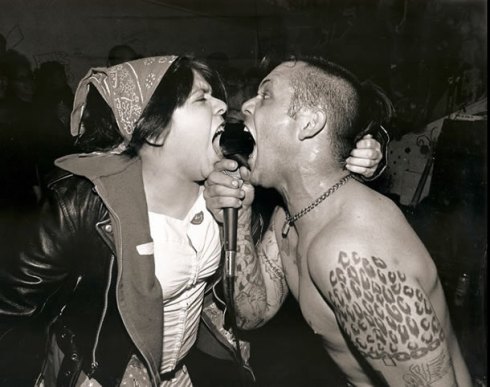
© Larry Wolfley
Last month, on a flight from Oakland to Seattle, I sat next to an energetic, punky, wide-eyed young lady. Her view of the world was full of naivete, optimism and anti-capitalism. She lived for music and she talked about the Gilman Club … a lot.
I lived in the SF Bay Area for several years but not being punk, garage, shed or synth-krunk I’d never heard of it. A week later I came across Larry Wolfley‘s photography. As well as photographing at underground shows and East Bay clubs, Wolfley has been a makeshift “house photographer” at the Gilman Club for 12 years.
Wolfley recently did an interview with Maximum Rock and Roll. He has a PhD in English Lit from Berkeley, he taught at The University of Nebraska-Lincoln in the seventies, abandoned academia, returned to Berkeley, became a carpenter, had a son, took photos, realised he knew nothing, resolved to teach himself photography, and decided street punks on Telegraph Avenue were a good topic. The homeless punks told Wolfley he had to go to the Gilman Club if he were to understand their culture. He’s been shooting punk and music gigs since.
Wolfley is more than twice the age than the majority of the crowd. All the kids know him, his Canon and his black beanie hat.
Just wanted to give a shout out to a local hero whose recognition has been a long time coming. Visit his website.

Source: http://www.artbusiness.com/1open/021210.html
American Suburb X republished an Art Voice interview with Bruce Jackson.
Bruce Jackson is one of the greats of prison photography, up there with Danny Lyon, Deborah Luster and Alan Pogue.

Jackson: “The people who are in penitentiaries are no different than the people outside, except that they’ve done a certain thing that got them classified as the kind of person that goes to the penitentiary. But they’re in a penitentiary, and being in a penitentiary does something to people. It puts you in a position. All the things that Foucault writes about—about power and what it does and the way it’s used—are there. Prison is a place where power rules. Prison is about power; if it were not, people would walk out the gate. You see it in the way people walk and in people’s faces and the way they present themselves.”
Twenty four pages of images here.


I really like Matthieu Gafsou‘s portfolio. This is from his CHAUX-DE-FONDS series.

 Prison Photography