
You are currently browsing the category archive for the ‘Historical’ category.

Stones. Mark Kirchner
Mark Kirchner has been returning to Manzanar for over 25 years. Kirchner’s project is Manzanar Pilgrimage which focuses on the annual memorial gathering and documents former internees and their families’ stories. Mark explains in his artist statement:
This project is a work in progress. As a photographer, I felt the need to create a visual record as the Japanese American community struggled to preserve the site, its history and legacy. My primary role is that of a witness. The process of witnessing the pilgrimages over many years has given me the time to attempt a holistic photographic document. Within this body of work I hope to make visible those brief moments when the human spirit is revealed. I have discovered that some of the people I have photographed do not see themselves or their actions as historically significant and rarely worth photographing. I hope some of their modesty has been instilled in me.

Inscription: Watanabe. Sentry Post Building, 1984. Mark Kirchner

Inscription: March 30th 194(2) and Kanji. 2006. Mark Kirchner
It is somewhat fortuitous that Mark asked me not to include images of people and that I didn’t wish to include any pictures of people. Manzanar is a peculiar site and certainly not of a human scale. As the Eastern Sierras drop off sharply, the plateau of high desert to the east is a stark landscape. Beautiful, awesome, sublime – yes; livable – barely by today’s standards.
Some could argue that Manzanar should be allowed to recede into the dust and weeds of the California/Nevada borderlands – that humans should never have been interred and nor should human’s need to return. But we are funny creatures and I, for one, appreciate the impression of meaning upon a site once the site has run through its cycle of original use. The dialogue about former sites of incarceration is where one finds responsibility, complexity and community.

Inscription: Remember. Sentry Post Building, 2007. Mark Kirchner
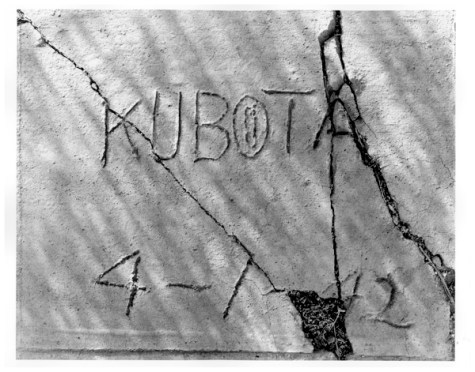
Inscription: Kubota 4-1-42. 1984. Mark Kirchner
Manzanar is a flat site with no place to hide. Everything that is visible is rooted to the ground, and all that is invisible is in the memories and oral histories of the people Mark Kirchner cares so much about. If Kirchner’s concern is preserving the stories of people interred, my concern is his images that reflect that aim. I chose these images because they speak of definites; definite people, dates and action (scribing). They are evidence of existence and time. These images are also all surface which to me summarises the barren desert site.
There is a poetic beauty that one speculates the original scrawler was aware or unaware of – that being, the paradox that the necessary human constructions at Manzanar are those to hold the visible, physical evidence. The concrete is as incongruous to the site at Manzanar as mass human occupation was between 1942 and 1945.

Inscription: Tets Ishikawa, 45, 55, 66, 83. Sentry Post Building, 1984 and 2007. Mark Kirchner
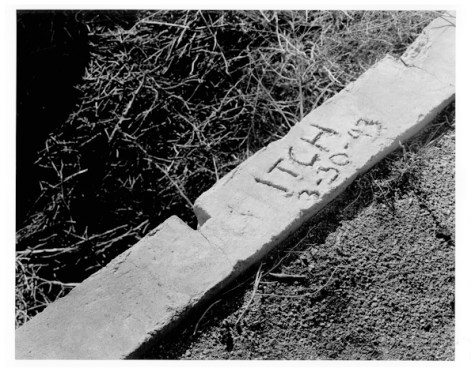
Inscription: Itch 3-30-43. 1983. Mark Kirchner
Kirchner explains further:
Since the annual pilgrimage lasts only a few hours, I knew it would take many years to make the images for the foundation of this work. As the event grew from the intimate Manzanar Pilgrimage and Potluck of the early 1980s to the pilgrimages we experience today, the task of identifying and gathering contact information has grown. After the 2007 pilgrimage I decided to try to contact the people in my photographs. Most of my free time last year was spent in research and correspondence. I have attempted to identify and contact every person photographed on this site. I still have not been 100 percent successful with this effort. I am hopeful that any person that remains unidentified will in time contact me.
If this post can help Mark Kirchner in his noble endeavour I would be thrilled. Tell your neighbours about it!
____________________________________
Mark Kirchner is an expert bookbinder and salmon flies crafter. Here is his Silver Studios website. Read Kirchner’s biography. Found via photoexchange.
Thanks to Mark Kirchner for his permission to reproduce images and the helpful background information on the project.
____________________________________
Comment from Mark Kirchner: I like that you picked up on the nature of the artifacts and their relationship to the earth. At one time there were 800 buildings on the site. Now there are 4 buildings.
Saint Valentine was executed on February 14th, 270 A.D. He was a priest in Rome who covertly married couples against Emperor Claudius II’s dictate. Claudius had banned marriage because wedded men were unwilling soldiers and he needed to sustain his warrior-class.

Wikicommons image: http://en.wikipedia.org/wiki/File:Valentineanddisciples.jpg
The mythology tells us that while in prison Valentine befriended the gaoler’s blind daughter. She brought him meals and they talked at length about imperialism, machismo and state control in the Holy Roman Empire. The night before he was “beaten with sticks and had his head cut off”, Valentine reached through the bars of his cell and touched her eye lids. She could see. It was a miracle. Later that night, Valentine penned a note to his ladyfriend and signed it “From your Valentine”. This was a first.
What next? The civic authorities mopped up the blood and the church went on a propaganda campaign. At that time it was the custom in Rome, a very ancient custom, indeed, to celebrate in the month of February the Lupercalia, feasts in honour of a heathen god. On these occasions, amidst a variety of pagan ceremonies, the names of young women were placed in a box, from which they were drawn by the men as chance directed. The pastors of the early Christian Church in Rome endeavoured to do away with the pagan element in these feasts by replacing the names of maidens with those of saints. And as the Lupercalia began about the middle of February, the pastors appear to have chosen Saint Valentine’s Day for the celebration of this new feast.
Flicking through my old bookmarks, I was pleasantly bothered by bumping into the Corrections Photography Archive (CPA). This is a great small collection of prints organised by theme and location. Unfortunately, the online form doesn’t work so I can’t learn more about CPA just yet. I now the collection is larger than that number digitized for the interwebs.
A couple of my favourite groupings are Music (for fun) and Dining Rooms (which arranges itself as a Becheresque typology of prison food halls). In the end, I decided to use the collection twofold; 1) as counseling for myself, and 2) as a guarantee for the readers.
FROM THIS POINT FORWARD,
I PLEDGE NOT TO POST IMAGES OF RECEDING CELL BLOCK TIERS.
Regardless if the tiers recede to the brightest white or darkest gray. Regardless of the cause. When given a choice between a receding cell-tier-photograph and another, I will take the other. Let us exhaust this inevitable angle of all incarceration-based-photojournalism. Let us gloss over those photographs and move to the other images, which will be the ones to make the story anyway.
PURGE!

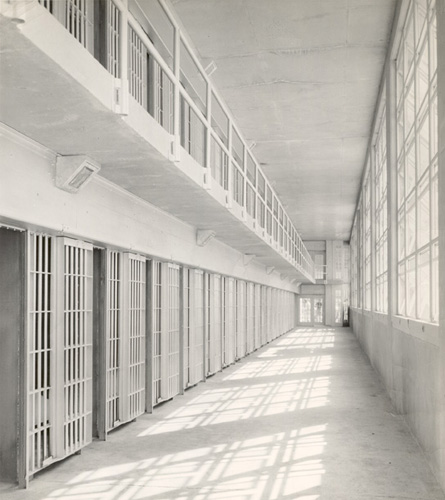

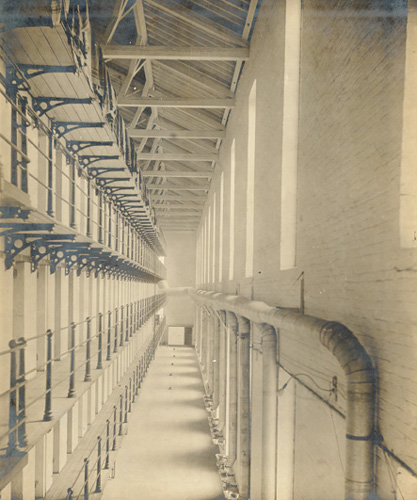

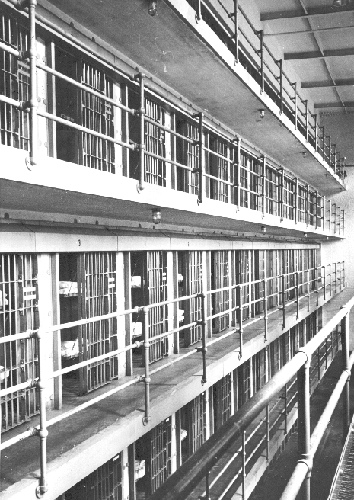

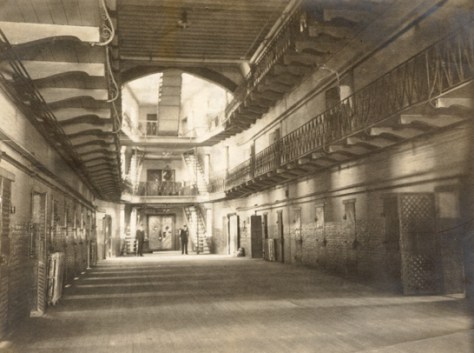

Official Blurb: The American Prison Society Photographic Archive records collection was acquired by the Eastern Kentucky University Archives in 1984 through the auspices of Dr. Bruce Wolford of Eastern’s College of Law Enforcement. Dr. Wolford received the photographs in 1979 from William Bain, instructor at the Kentucky Bureau of Training. In the 1960s Mr. Bain, a former staff member of the American Correctional Association, conceived the idea of a pictorial history of the American prison. With the aid of David A. Kimberling, a prison inmate and photographer, Bain had photographs copied from the American Correctional Association archives plus ones he received from various federal and state correctional facilities throughout the United States. In addition to the copies, which comprise the negative part of the collection, he acquired many original black and white photographic prints. Finally in 1978 through the work of Anthony P. Travisono, executive director of the American Correctional Association, Bain’s dream, The American Prison: from the Beginning. A Pictorial History, was published.
The photographic collection is rich in its depiction of early twentieth century prison life and conditions. The collection covers numerous subjects such as prison living conditions, recreational activities, industries, hospital care, corporal punishment, work gangs on the farm and quarries, vocational activities, weapons confiscated, prison architecture, and the death house. A few of the images are of prison officials, primarily in the federal penitentiary system.
Images from Top to Bottom. All images courtesy of Corrections Photographic Archive
1. One of the cell corriders in the old penitentiary for males on Welfare Island. Note the distance of the cells from the outside walls and windows and the consequent limitations of light and ventilation, especially needed on account of the absence of toilets in the cells, 1924.
2. Isolation unit at Huntsville, Texas, 1953. Photo by Frank Dobbs.
3. Eastern State Penitentiary in Philadelphia, Pennsylvania. Section of E.D.C.C.
4. Heating pipes in cell house at Indiana State Prison.
5. “A” block (North extension “outside cells”) 352 cells now used by Reception Center. Folger Adams Locking, December 5, 1946.
6. West cell block, Central Prison, Raleigh, North Carolina.
7. New Hampshire State Prison, portion of cell block.
8. No Information available.
9. Central aisle, Work House, Blackwell’s Island, New York.
I came across this image on a ‘free media web hosting site’ where I lazily put in the term “Prison” to the search. I am unwilling to name the site as I do not wish you to suffer the same banner ads and unedited content.
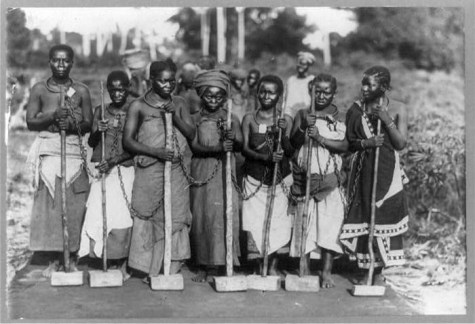
Women prisoners working on road, Tanzania. circa 1901. Source: Unknown
The search returned the usual images of pets in crates (1st-person caption optional), macro-shots of rusting locks and/or bars, stock images of barb wire, and photos from Eastern State Penitentiary (which does many photography workshops). There were three images that were worth a second glance – the other two being images WWII prisoners of war.
Despite having no means to confirm its authenticity or the accuracy of the caption, I thought the image worthy of a quick reflection. The image is contrary to the usual representation of incarcerated peoples – the era; the gender of the subjects; the continent; the anonymity of the photographer. De facto, this becomes a visual source in its most naive understanding; all we have to go on are the women depicted. The photograph wriggles away from all the contextual information one needs to assess its political purpose.
The responses of the women to the camera (pride, defiance, awkwardness, subjection – and even laughter from a lady in the background) compel me to presume nothing of this picture. I question the authority to which they are subject, I question the legitimacy of the charge by which they are held prisoner, I certainly can’t reconcile hard labour with a mode of justice for grown women. This is a depiction of slavery more than it is of criminal justice.
If the date in the caption is accurate, Tanzania (then Tanganyika) was under German rule. “Tanzania as it exists today consists of the union of what was once Tanganyika and the islands of Zanzibar. Formerly a German colony from the 1880s through 1919, the post-World War I accords and the League of Nations charter designated the area a British Mandate (except for a small area in the northwest, which was ceded to Belgium and later became Rwanda and Burundi). British rule came to an end and Tanganyika became officially independent in 1961.”
I rarely harp on about “the power of photography” because it is a subjective assessment, but I will vouch for that personal reaction to imagery that can stop you in your tracks and get you thinking.
lax |laks| adjective
1 not sufficiently strict or severe : lax security arrangements at the airport | he’d been a bit lax about discipline in school lately.
2 careless : why do software developers do little more than parrot their equally lax competitors?
It is perhaps easy to forget there once was an era when the prison in society was less useful. By 1905 when this picture was taken, there were only two prisons in California (San Quentin and Folsom) and it would remain that way for another 30 years. Much of the detention and incarceration was done through an smattering of local jails and jail houses for work crews.

Alum Rock Jail. Alice Iola Hare, ca. 1905. On the back of the photograph is written, "Much of the original road into Alum Rock Park was built by County Jail prisoners who were housed - and guarded - in these shacks. The roofed structures and the open one (stockade?) behind them stood for many years after the road building job was completed."
This image of Alum Rock Jail, Santa Clara County was taken originally by Alice Iola Hare, was then part of the Arbuckle Collection and eventually went digital as part of Silicon Valley History online.
The description is right; this is a shack more than jail. The fabric of the structure did not discipline the inmates at Alum Rock, it was the guard’s rifles and the open countryside that asserted control. The physical make-up of this carceral structure is a world away from the SuperMax US society now relies upon. And for that reason, and for the indulgence of punnery, I want to refer to this example of historical jails as a “SuperLax” Prison.
What would people at the beginning of the 20th century have made of 16ft razor wire, heat sensing detection equipment, opticons and magnetic locks? I suppose the one piece of equipment they may have shared with their contemporary guards would be dogs, but they probably didn’t call them “K9 units” back then. I doubt they’d developed rubber bullets in 1905 either…
A good friend sent me a link to a Telegraph gallery featuring images from the early 20th century. Almost 2 years ago, BBC4 aired its five-part series Edwardians in Colour. It gave the full treatment to an era distant for most but still within the memory and grasp of older generations.
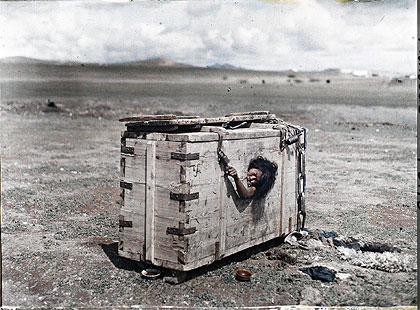
Stéphane Passet. Mongolian prisoner in a box, July 1913. Image courtesy of BBC. © Musée Albert Kahn
When I see mainstream historicisation as this, I can’t help suspect (just a little) that it is done in order to define the times, facts and lessons of the era. Like all endeavours, it is a play of power (however unintentional). At face, Edwardians in Colour is a noble pedagogical effort and one trusts the BBC to handle the history responsibly. I am no post modernist – I don’t balk at all historical narratives – but I do shrink a little when the writing of history is clearly seen in documentary projects. I wonder if the construction of history in one place means the burying of history somepleace else. Is it the subtlest or the most dogmatic narratives that bed themselves into history? What happens when those with eye-witness testimony pass? Who determines the ‘facts’ of the past?
The Lumiere Brothers marketed the autochrome only a year before French banker and philanthropist, Albert Kahn began his own collection of history colour photography in 1908. Kahn called it the “Archive of the Planet.” The fact that these photographs are brought to us in colour brings us no closer to the times, but I would say they do bring us closer to an appreciation of time. It is a sad appreciation of time, just as the dwindling number of WW1 veterans at war memorials each Armistice Day are a poignant reminder of our dislocation from previous ages. History: How do you take yours? With distant awe or with confident conclusion?
Needless to say, the image above is foreign to us. Without struggle, I would add cultural remoteness to historical remoteness and utterly compound its ‘otherness’.
You can view the original image here, and a youtube video with incongruous funky music here.
Google announced today that it has come to an arrangement with TimeInc to host the LIFE Archive. The archive is one of the largest collections in the world comprised of over 10 million images. This is an incredible new resource for photophiles worldwide. Twenty percent of the images went live today.

Carl Mydans. American flag draped over balcony of building as American and Filipino civilians cheer their release from the Japanese prison camp at Santo Tomas University folllowing Allied liberation of the city. Manila, Luzon, Philippines. February 05, 1945
A very preliminary search using the keyword “Prison” returned twelve pages of 200 images. I was struck by the strength of the handful of images from the Santo Tomas Prison Liberation Series (Manila, Philippines). The Carl Mydans photographs were captured in the days following the camp’s liberation by allied forces. It was one of four camps liberated in the space of a month in January/February 1945.
Rest assured, I will return to this archive in time to source material and discuss more widely the politics of power partially described by the photographic collection. “Mexico Prison“, with over 150 images, certainly looks like interesting material.

Carl Mydans. Freed American and Filipino prisoners outside main entrance of Santo Tomas University which was used as a Japanese prison camp before Allied liberation forces entered the city. Manila, Luzon, Philippines. February 05, 1945
I would like to make clear that this is a hastily put together post and its main function is to draw attention to this fantastic whale-sized new archive – I might go as far to say our archive – I might even go as far to say its bigger than a whale. I do not condone personal whale ownership.
I would also like to clarify that while the LIFE Archive refers to the Santo Tomas Complex as a prison, it was in fact an internment camp – not that naming conventions matter to those who were subject to its walls and discipline. Still, we must always bear in mind the different types of sites of incarceration; what they purported to do; what, in truth, they did; from what context they arose and operated; and how they fit into our general understanding of humans detaining other humans.

Carl Mydans. Emaciated father feeding Army rations to his son after he and his family were freed from a Japanese prison camp following the Allied liberation of the city. Manila, Luzon, Philippines. February 05, 1945
Personally, I encountered a strange coincidence over this matter. Internment camps are low on my list of primary interest. I am not an expert on internment camps. But, only yesterday I received a fantastic email from a Berkeley art history undergraduate who is focusing on the work of Ansel Adams, Toyo Miyatake and Patrick Nagatani at Manzanar War Relocation Center, California. From the internet monolith that is Google to the academic interests of aspiring students, the histories, memories and powerful images of Second World War internment push themselves to the fore of thought.

Carl Mydans. Two emaciated American civilians, Lee Rogers (L) & John C. Todd, sit outside gym which had been used as a Japanese prison camp following their release by Allied forces liberating the city. Manila, Luzon, Philippines, February 05, 1945
It is conventional wisdom that World War II had two sides. Unfortunately, the military definitions of ‘ally’ and ‘enemy’ spilled into civic life with catastrophic consequences. The US internment of Japanese nationals and Japanese Americans has since been proved to be based not on national security but state-sanctioned discrimination. As testimonies and images attest, where stories are concerned, there are more than two sides.
Click here for the LIFE Archive on Google. Here is an obituary for Carl Mydans, the photographer at Santo Tomas. Try here and here for first-hand account of detention and to find audio and visual resources about Santo Tomas Internment Camp.
On a recent search of the Harry Ransom Center photographic archive at the University of Texas, Austin (an incredible collection) I came across this image by Arnold Genthe.
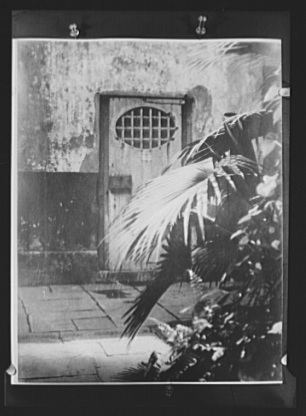
Arnold Genthe, Slave Prison (Calabozo), New Orleans, circa 1920-1926
Genthe is a widely respected practitioner of early photography, and (besides some notable exceptions) made it all the way out west before many others. Historians thank Genthe for having enough curiosity in the Chinese immigrants of San Francisco to photograph their community before the 1906 earthquake and resultant fire razed large swathes of the city. His are the only images of Chinatown from that time period.
Genthe’s Slave Prison, (Calabozo), New Orleans is, in all honesty, not an image that interests me very much. Without the caption I would not have known that this negative depicted a site of incarceration. It is reminiscent of Fox Talbot’s The Open Door; both images are mundane, both photographers pointed their lens at doors. One inconsequential but observable difference is that Genthe’s door is closed – which is, at least, consistent with the subject.
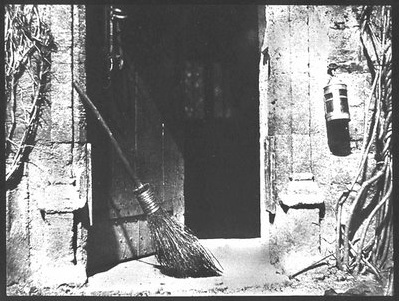
William Henry Fox Talbot, The Open Door, 1844
The Library of Congress record states that Genthe photographed the Calabozo between 1920 and 1926, and yet, in a reliable source I uncovered during a brief internet foray, it is stated the Calabozo was demolished in 1837. There are two likely explanations. One, Genthe was photographing another city jail and wrongly identified it as the Calabozo; or, two, Genthe set his camera up in the courtyard of the building that stood on the former site of the Calabozo (in which case the courtyard may have been original). There is uncertainty here that needs to be cleared up, but I don’t intend, here, to pursue the correct subject-hence-caption for Genthe’s sleepy image.
Despite the image’s astonishing banality, I was intrigued by the flawed description and I sensed an opportunity to sate my thirst for amateurish detective work. Furthermore, the fact remains it is an image of a prison; I was compelled to give it a second glance. I reasoned that a slave prison in a city that had operated under three different flags throughout the late 18th and early 19th century would have some intriguing history. The first questions that sprang to mind were: Do any other images of this same building exist? Do images of modern New Orleans’ prisons or jails exist that could provide interesting juxtaposition? I read and viewed whichever resources presented themselves readily.
Of the many passages that hooked me was this description from Louisiana: A Guide to the State (1947). It describes the conditions of the Calabozo.
An investigation in 1818 of the old Spanish Calabozo in New Orleans found the convicts “not provided for as humanity would dictate since many were destitute of clothing and others were almost destroyed by vermin.” Debtors were confined with the blackest of criminals. Entrance and exit fees as well as board and lodging payments were required of the prisoners. In 1861 a debtor was free after 90 days imprisonment, provided his keep for the interim had been paid.
Obviously, in the early 19th century matters of care while in detention & exit privileges were more easily negotiated by those with ready cash. A crude inequality that no longer remains, right? Possibly not. As I read this historical passage, I was also mousing over a slew of stories from modern newspapers that reported contemporary incidents of neglectful custodianship of men by state authorities.
The abandonment of prisoners in New Orlean’s jails during Hurricane Katrina is in no way more shocking than the early 19th century account. Within my web browser two centuries dissolved. Neglect, as the lowest common denominator, collapsed time. Men penning other men as animals showed itself ugly and unfortunate. The shortcomings of the system, the inflexibility of the system and the neglect within the system were revealed in New Orleans following Katrina in August 2005 as existed in 1818.
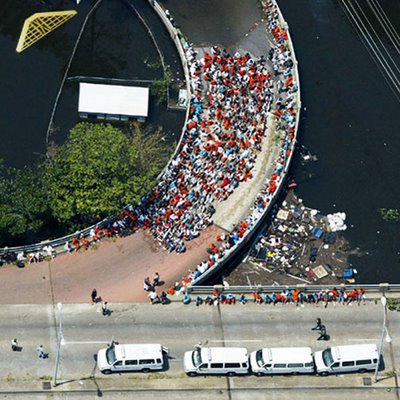
O.P.P. Inmates guarded on New Orleans overpass © AP
The BBC This World documentary Prisoners of Katrina details the week of fear, panic, riots and evacuation at Orleans Parish Prison. When Sheriff Gusman’s initial plan to retain the prisoners at O.P.P. through the duration of the storm proved to be a disastrous decision, a tactical team from Angola Prison bailed Gusman out. Over 7,000 inmates were herded out (via an engulfed freeway overpass) and relocated to 42 facilities over a period of four dehydrated, sun-scorched, unsanitary days. Accounts conflict as to whether any inmates died, but eye witness testimonies have reported floating corpses in the halls of O.P.P. during evacuation.
Still today, the Louisiana justice system has not recovered. It is in total disarray. Prior to Katrina O.P.P. held a variety of inmates including lifers, violent offenders, short stay non-violent offenders and (the most unfortunate group) those awaiting trial for offenses yet unproven. These inmates are now indistinguishable from one another because their case histories were lost in the hurricane. They are all just “in the system”.
It is contended that half of the evacuated prisoners have never been to trial. Hundreds of inmates were arrested for minor offenses, traffic fines, jay-walking and sleeping on the sidewalk. Hundreds of the prisoners do not know why they were arrested, and the system can’t tell them either. But neither can the system cannot exonerate them. Unconvicted men are now warehoused while the system tries to decide what the charge is for each inmate. Public defenders are leaving their positions in droves after seeing their caseloads increase by six, seven, even eight hundred percent.

Michael Democker, An inmate sleeps in his cell in the 10th floor psychiatric section of Orleans Parish Prison, 2008
Judge Calvin Johnson states that Katrina “blew the system apart” and they now cannot cope with the backlog of over 6,000 cases. To make matters worse still, the basement which stored the majority of files and forensic evidence was flooded destroying any hopes to rule on individual cases in a timely manner.
Three years on this is still a system in crisis. O.P.P. has been repopulated and inmates suffer doubly – firstly as victims of a system in deadlock and secondly as victims to the decrepitude of the O.P.P after the ravages of flood and riot. Unsurprisingly, those that suffer most are the poor minorities. Efforts to glean facts for a fuller story by interviewing outgoing inmates continue.
In Spring of 2008, the Times Picayune reported once more on the desperate need to overhaul the newly populated Orleans Parish Prison. When a hundred year storm converges with poor catastrophe-contingency-planning, it is those that have no means and no voice who are left to suffer longest. In the scramble to get cases heard, those without resources are shunted to the bottom of the pile. Not only are the poor and the minority populations suffering, but also the mentally ill. The stretched system has until recently only had lock up as a resort to deal with inmates with mental health care needs. The majority of the men in O.P.P. are poor and black and many of them are in the O.P.P for minor unproven offenses.
Where does all this lead? How does this relate to photography? The image above from O.P.P left a pit in my stomach. The pit lingered, long. I could not fathom why. Later, I remembered an image I had viewed the previous year. The two photographs had the same components; the orange jumpsuit, the seemingly unaware subject in the orange jumpsuit, the subject positioned as a motif of solitude, and (most oppressively) the downward angle of view as seen through the cell door window.
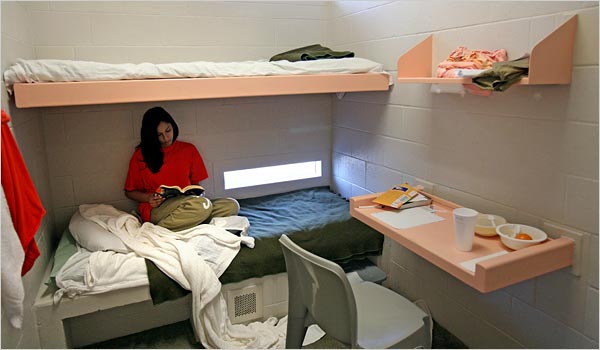
Monica Almeida, Nicole Brockett is serving her sentence for drunken driving in a pay-to-stay cell at the jail in Santa Ana, 2007
But look closer and one identifies small comforts – linen, spare linen, spare prison-threads, reading and writing material, food being saved for later. Nicole Brockett had committed a proven traffic offence. She was fortunate to be tried in Orange County and so have the option of incarceration with frills. Santa Ana Jail at $82 a day is not the most luxurious of the Californian “Pay-as-you-Stay” lock-ups. At Fullerton you can take your cell phone. Montebello and Seal Beach Jails allow iPods.
The New York Times did a great job of illustrating the cushty cells as elite privilege.
For offenders whose crimes are usually relatively minor (carjackers should not bother) and whose bank accounts remain lofty, a dozen or so city jails across the state offer pay-to-stay upgrades. Theirs are a clean, quiet, if not exactly recherché alternative to the standard county jails, where the walls are bars, the fellow inmates are hardened and privileges are few. Many of the self-pay jails operate like secret velvet-roped nightclubs of the corrections world.
The realities of these dozen or so city jails are a far cry from those at O.P.P. How is it the US criminal system fosters such inequality? How have tenets of consumerism and favouritism crept into state systems intended to administer lawful punishment? What clearer message do these two contrasting stories offer than to point out that there is no equality in our current justice system. Those that pay, just as 200 years ago, receive preferential treatment. In a country where race and class are indivisible, those not in a position to pay for cell-upgrades are more likely to be people of colour. How low have our standards dropped to allow bare-faced state authority to operate penal systems with buy-in/opt out clauses on comfort and cell-mates? How many more social institutions do we want to hand over to the amorality of supply/demand economics?
I was going to suggest that things haven’t changed in 200 years, but they have in fact gotten worse. When trangressors of the early 19th century were locked up they received the same treatment regardless of class or race. Now segregation can occur at the will (and wallet) of the inmate. The inmate can buy the comfort of their own cell and avoid the dangerous inconveniences of “hardened inmates”. By “hardened inmates” the New York Times is by definition referencing the typical inmate of the California penal system, which is to say a minority male or female, which is in the parlence of 1818, “the blackest of criminals”. It would seem discrimination between the races has always existed … the difference being that now the penal systems afford privileged prisoners the opportunity to act upon those discriminations.

 Prison Photography
