
You are currently browsing the category archive for the ‘Institutional’ category.


I am late on this one, but I thought it so important that it worth a quick post.
Last month, Amy Stein posted Bedlam Exposed. Amy put up some disturbing images by Charlie Lord. He was one of several conscientious objectors who worked at Philadelphia State Hospital, Byberry, PA in lieu of military service.
Listen to Charlie Lord talk about his experience at the Philadelphia State Hospital.
Prison Photography has long determined that there is little difference between prisons and asylums. Asylums have been referred to as sanitariums and as hospitals, but it is necessary to take a quick leap past the label and view the level of care (and security) as well as the agency of those committed.
In photographic evidences we can look to the work of Jenn Ackerman (a prison functioning as a mental health unit) and Eugene Richards (a mental health unit functioning as a prison). These thoughts are just to sow the seeds and the [in]distinctions between prisons and mental health facilities will be something I’ll return to over the coming year.
Ackerman’s Trapped:
http://www.burnmagazine.org/essays/2009/05/jenn-ackerman-trapped-epf-finalist/
http://indepth.jennackerman.com/trapped/feature.html
http://bop.nppa.org/2009/still_photography/winners/?cat=NTP&place=1st
https://prisonphotography.wordpress.com/2009/07/10/jenn-ackerman-trapped-mental-illness-in-americas-prisons/
Richards’ Procession of Them:
http://motherjones.com/environment/2009/03/out-mind-out-sight
http://motherjones.com/photoessays/2009/03/out-mind
http://www.soros.org/initiatives/photography/events/procession_20060201
Every so often commentaries converge as such that I’m compelled to connect the smallish number of dots. I have done it once before here.
So, recently:
SUSAN MEISELAS SPEAKS ON DOCUMENTARY PHOTOGRAPHY’S ROLE

In ‘Expanding the Circle’, Meiselas talks frankly about the approaches and collaborations necessary to reach a wider audience,
“With whom can I partner – if that seems appropriate – for the work to have an additional life. [It] could be a life of advocacy or a life tied to an issue in a particular way, whether it is targetted at policy makers or to a public. You have to keep documenting at the same time asking those questions. All the while one must continue to document and seek opportunities to create possibilities for engagement.”
Meiselas is a curator for the Moving Walls project. The exhibition features work by former Open Society fellows and prison photographers Joseph Rodriguez, Steve Liss and Andrew Lichtenstein.
It is fair to say that the Open Society’s Documentary Photography Project has a propensity for prison photography projects. The 17th round of Moving Walls fellows has just been announced, and of the seven recipients, two document the lives of the incarcerated.
Lori Waselchuk for her work at Angola’s prison hospice and Ara Oshagan for his coverage of juvenile detention in California.

© Lori Waselchuk
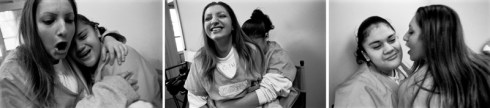
© Ara Oshagan
One last note on cages. Meiselas’ selection includes images from Eugene Richard’s Procession of Them produced as a book in 2008, see spreads here and listen to Richards speak on the project as part of Columbia University’s “Photography as Advocacy?” series (2006).
One task of prison photographers is to emote the isolation and hardness of incarceration. It is a difficult task. Richards, while not looking at prisons per se is a master of conveying the barbarity of the cage and the helplessness of the caged. And besides, in today’s discourses that prefer not to distinguish institutional forms, the mental health asylums of Richard’s work are prisons.
Macoleta, Steinmetz, prison weapon & prison tool typologies
James Pomerantz highlighted the work of Antonio Vega Macotela who began investigating the concept of time as that controlled by outside forces and ended up clocking over 500 hours in the Santa Martha Acatitla Jail, Mexico. Read the essay, it’s an eye-opener!

© Antonio Vega Macotela
This reminded me of Marc Steinmetz‘s work from Germany from a few years ago, which I mentioned last year.
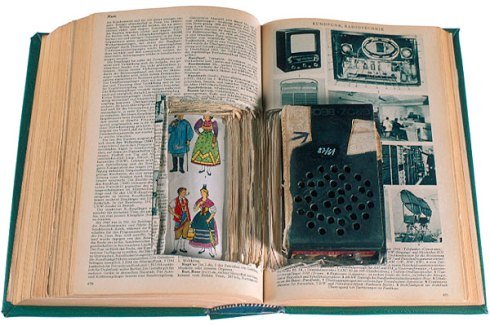
© Marc Steinmetz
PRISONER DATABASES AND MOST-WANTED GALLERIES
iheartphotograph highlighted the institutional mugshots presented online by the Florida Department of Corrections.

This is the first example I am aware of that a state DoC has provided a publicly accessible online search of full profiles and photographs of housed inmates.
No details are excluded; vital stats, aliases, crime, date of crime, body marks, date of release.
I suppose this is the voyeuristic bridge between DOC internal databases and the ever-refreshing scrolling “news” galleries of persons recently booked. The adoption of police mugshots as “news” also came out of Florida, so there is obviously research to be done there into Florida’s culture and visual rhetoric of criminal justice.
In both these cases, the public is being drawn in – by a limited amount of information – to the mechanics of regional sheriffdom.
Most wanted lists, such as that in California that just got a flashy website overhaul, carry some logic in that they inform a public about a potential menace at large. I expect there’d be a public outcry if this service was removed. Accepting that logic, though, it is curious as to why criminal justice agencies would provide mugshots of booked and detained persons.
All told, the availability of state prisoners’ photo IDs makes sense if you consider such databases as deliberate tactic. The databases become other arms in the apparatus of the panopticon; the visage of the prisoner is policed online by the gaze of unlimited number of people, as readily as it is policed by the prison guards’ gaze within the walls.
While mugshots have commonly been released at intervals to the media, particularly of infamous prisoners, never before has a photo-database of society’s transgressors been so accessible and searchable by the public.
We have become nodes in a network of observation and discipline.
The net has widened, and this previously exclusive net is now consolidating with the internet …

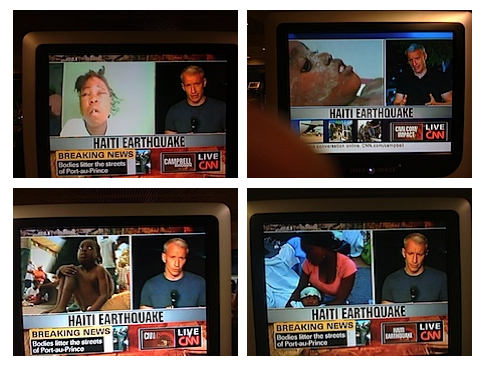
It one thing having foolish and clumsy media commentary of flash-in-the-pan (US) regional stories. It is another when CNN and Anderson Cooper use that same approach covering a humanitarian disaster.
As folk interested in media we should speak out when we see offensive framing and “reporting”.
Anderson Cooper’s bravado is only slightly more insulting than other major networks, but if we picket Cooper and his CNN editors maybe we’ll make a dent large enough that other major networks will also take note.
Michael Shaw just emailed this to concerned social media types. I am behind his sentiment:
I’m writing because I’ve just done a post at BAGnewsNotes that I think is extremely important.
It’s an appeal to readers to contact CNN, or tweet them (@andersoncooper @CNN – PLEASE STOP visually exploiting the Haitians! http://bit.ly/8R1DGc) about the way Anderson Cooper/CNN is visually exploiting the Haitians.
What Cooper has been doing is a complete affront, and it’s time we pushed back in a more systematic way. Haiti is going through a completely sub-human experience as it is, and the humanitarian effort, and dignity for its people, should absolutely extend to the media sphere.
Thanks so much for putting your eyes on this, and being part of the response.
Here’s hoping.

Last month, I gave a tip of the hat to Melinda Hawtin’s graduate work. Thereafter, Melinda’s graduate advisor Amanda Crawley Jackson dropped me a line to tell me about the exhibition L’IMPOSSIBLE PHOTOGRAPHIE, Prisons Parisiennes (1851-2010) at the Musee Carnavalet in Paris early next year. (Details via Google translate)
I have already enlisted a reporter in the field to visit and review the exhibition for Prison Photography, so there’s something to look forward to in the new year.

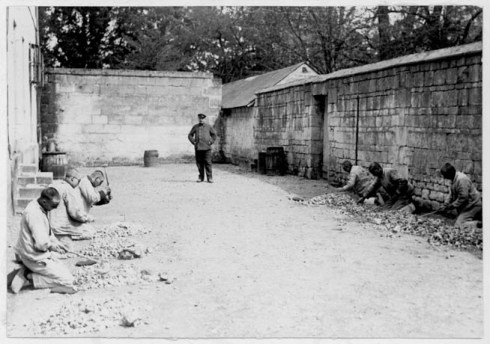
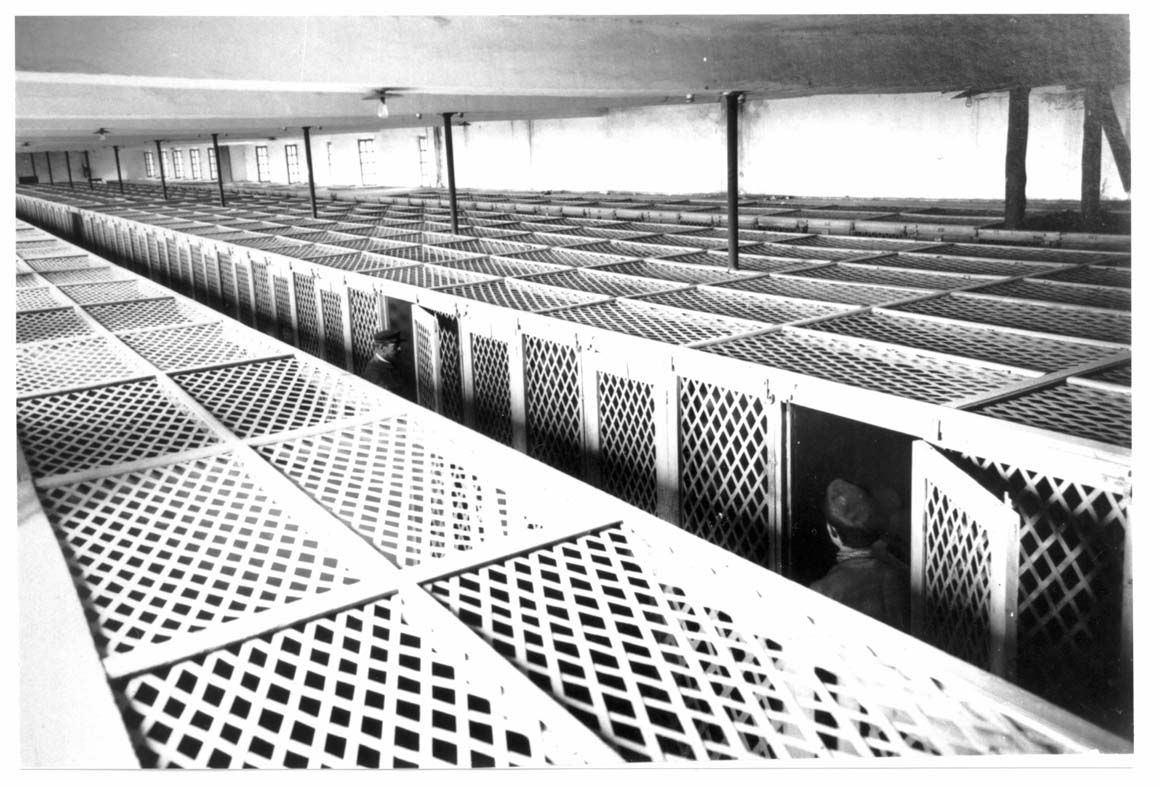
Amanda also pointed out the collection of over 2,500 photographs by Henri Manuel archived at the National Museum of Prisons, France.
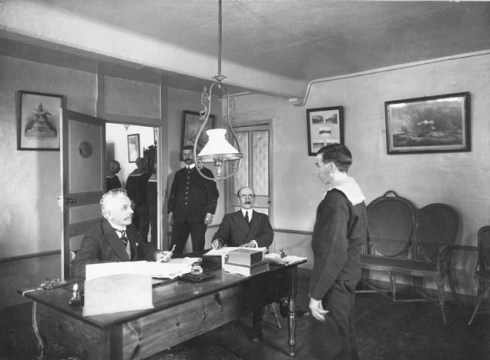
Between 1929 and 1931, the Henri Manuel studio documented prisons and juvenile institutions for the Ministry of Justice.
Manuel’s photographic survey is characterised by its scope, its exhaustiveness and its will to show that prison is not merely a place of detention and punishment but education and work also.
The survey resulted in craftsman-made albums for each prison, and several photographs were published in the press or distributed as postcards.
However, no records exist so exact reasons for the contract such as who ordered the work (and for what purpose) remain unknown. (Source)

Some of Manuel’s photographs blow my mind.




Brixton Prison governor Paul McDowell: 'We don't let them have too much fun.' Photograph: Martin Argles
THE FACTS
The UK’s most well-known prison radio station is the Sony Award winning Electric Radio Brixton. It has come in for high praise.
The US’s boasts KLSP which broadcasts within Louisiana State Penitentiary, the prison commonly known as Angola. Andy Levin of 100Eyes photographed this New York Times coverage.
THE MISSIONS
In both cases, the radio stations serve to provide inmates with valuable, marketable skills AND to disseminate prison specific communications.
Electric Radio Brixton is the model for fifteen other prison radio stations up and down the UK. The Prison Radio Association is currently working with over 40 prisons and hopes eventually to build a national network for the benefit of all British prisoners. It is a community action.
Unlike Brixton’s radio initiative, the scope and model of KLSP is not intended to go national. KLSP was established in 1986 as a “means of communicating with everyone in the prison at once. Angola is the country’s largest correctional facility, with 5,108 inmates, so the need to disseminate information rapidly is critical.” The KLSP station at Angola is the only FCC-licensed radio station in the US facilitated by prisoners.
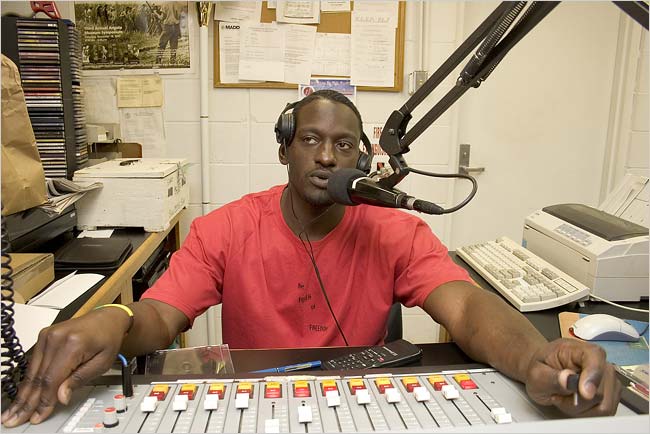
Sirvoris Sutton is a D.J. known on air as Shaq at KLSP-FM, the Louisiana State Penitentiary station where gospel wins out over gangsta rap. © Andy Levin/Contact Press Images, for The New York Times.
As with any enterprise at Angola, the radio station is implicated in Burls Cain’s philosophy of religious and moral rehabilitation. Warden Cain encourages all religious and spiritual practices, but inevitably most of Angola’s religious alliances and support are Christian:
KLSP is licensed as a religious/educational station, and, through Cain’s efforts, has formed a close alliance with Christian radio. Until recently, the station was using hand-me-down equipment courtesy of Jimmy Swaggart; last year, His Radio – Swaggart’s Greenville, S.C.-based network of stations – ‘held an on-air fundraiser for the prison, broadcast live from Angola. They quickly surpassed their $80,000 goal, raising over $120,000 within hours.
Cain used the money to update the station’s flagging equipment and train inmate DJs in using the new electronic system. In the months following their initial partnership, Cain deepened his relationship with Christian radio stations. KLSP now carries programs from His Radio and the Moody Ministry Broadcasting Network (MBN) for part of the day.
With regard the station and its remit, Brixton Prison Governor, Paul McDowell does not have the same influence as Cain. For one, the radio is operated by an independent charity, and two, the prison culture in Britain is not dictated by the personal cult/philosophies of the warden as in the US.
McDowell sees the radio station as a good way to develop critical and positive thought.
McDowell’s main work is to keep infamous inmates away from the airwaves and avoid unnecessary (sensationalised) criticism of the project;
I am a prison governor and half of my life is spent managing the politics of prisoners. One of the things I am not going to do is put Ian Huntley on a radio station to deliver a programme every week. That is opening us up [to attack] and if we get criticised for that then we might end up losing the whole thing.
I’d be dismayed if people in the UK could not see Electric Radio Brixton as a wellrun and sophisticated engagement of prisoners’ minds. I have personal reservations about the Christian focus at KLSP, but this focus has been the norm throughout Angola for 15 years.
Both of these enterprises deserve praise. Next, the content broadcast on their airwaves requires scrutiny.

Christmas tree at the District Jail, Washington, D.C. and some of the prisoners (circa 1909-1932). National Photo Company Collection, Library of Congress. # LOT 12342-9

 Prison Photography