
You are currently browsing the category archive for the ‘Institutional’ category.

Inmate Jeff Curbow, 40, says he improved a watering system for the moss after others built a special hut for it at Cedar Creek Corrections Center in Littlerock, Thurston County. Credit: Ken Lambert / The Seattle Times.
Prison Photography always looks to visual sources that represent incarcerated peoples from a different perspective. Some of the best opportunities to do this is with images of prisoners employing their time in job placements, self-growth programmes and/or restorative justice & community education projects.
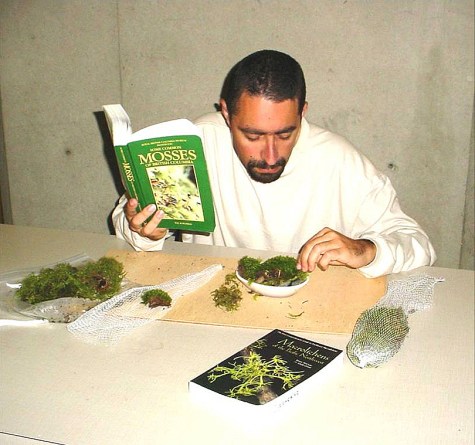
A Cedar Creek inmate and researcher in the Prison Moss Project studies mosses. Credit: Nalini Nadkarni of Evergreen State College
The Prison Moss Project, part of the Washington Department of Corrections‘ sustainability efforts uses prisoners time for the benefit of multiple causes. The project studies the growth of different mosses, cultivates the fastest growing species and sells them commercially as an alternative to mosses stripped from America’s temperate rain forests. Harvested mosses constitute a $265 million/year business. 90% of mosses come from Pacific Northwest forests. The majority of mosses are used for short lived floral-arrangement. Moss can take between 20 to 40 years to regrow even a small patch of a few square feet.
The beauty of this model based on simple scientific observation and applied methods is that it is replicable the world over. And, the business that results makes sense too.
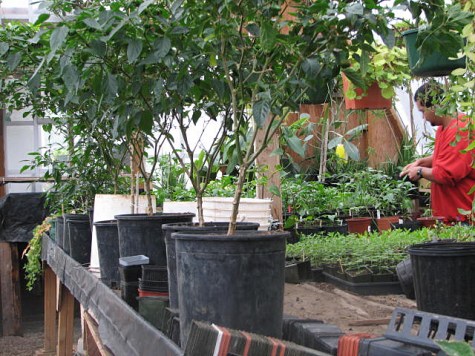
A Cedar Creek inmate and researcher in the Moss-in-Prisons project tends the garden. Credit: Nalini Nadkarni
So, the benefits? First and foremost, the inmates at Cedar Creek, a minimum security facility in the rural southwest of Washington enjoy daily active learning. Prison staff have described the facility as one without idle time among its inmate population. Engaging the bodies and minds of frequently docile populations is the first step in combating recidivism.
Concurrently, tax-payers (economically-efficient prisons), tourists (untouched old growth forests) and global citizens (robust ecological legacies) all benefit too. Finally, all this pales in comparison to the rewards for the Pacific Northwest old growth forests, which in future will not suffer unsustainable tree-stripping and moss harvesting.

A Cedar Creek inmate and researcher in the Prison Moss Project in the purpose built greenhouses. Credit: Nalini Nadkarni
How did all this start? Two convergent forces came together. The first was a general move by the Washington Department of Corrections to improve its carbon footprint, sustainability and opportunities for its inmates. This involved composting, recycling, organic farming, beekeeping at selected facilities. This green awakening fell into step with Nalini Nadkarni‘s need for extended and immediate research into moss varietal growth patterns.
Nadkarni has been called the “Queen of the Forest Canopies”. I am not one for personality worship, but let’s just say her work is socially – as well as environmentally – responsible, she knows how to work media channels, her message is imperative and the Evergreen State College in Olympia is very lucky to have her on faculty. She co-founded the Research Ambassador Program at Evergreen, which seeks to combine academic and non-academic practitioners to widen the reach of environmental dialogue and deliver relevant forms of communication to different groups; from inner city youth, to business CEOs.
It’s all about respectful communication, and it’s all for the benefit of our environmental futures.

Daniel Travatte, 36, suits up to check on the Italian honey bees he cares for at the Cedar Creek Corrections Center in rural southwest, Wash. on Friday, Oct. 17, 2008. The bees are part of a program to help the prison be more environmentally green. Credit: John Froschauer/AP
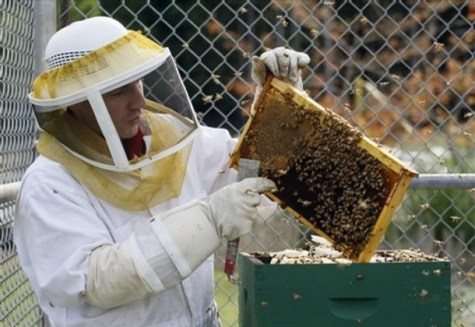
Inmate, Daniel Travatte, tends the Italian honey bees he cares for at the Cedar Creek Corrections Center in rural southwest, WA. Credit: John Froschauer/AP
The media coverage of this programme has often focused on the story of a young inmate who, since release, secured a biochemistry PhD full ride scholarship at the University of Nevada, Reno. He was imprisoned after accidentally killing his friend with his sports rifle in his student apartment. Four years later, he has continued the exceptional academic track he seemed destined to follow. It is a testament to the Washington Department of Corrections and Nalini Nadkarni (his mentor during time served) that his life has been delayed rather than destroyed.
But, he surely is an atypical case and it is a case that obscures the facts about the sustainable projects in operation at Cedar Creek. Not every inmate is a PhD candidate, but every inmate is a willing recipient of education – especially environmental education which, in many cases, is totally novel. Environmental education carries an almost redemptive message in that your actions can directly benefit everyone in modest but crucial ways. Actions based upon this new learning can be very therapeutic. Responsibility for oneself and other human beings is not separate from responsibility for our shared environment.

Inmates Robert Day (left) and Brian Deboer (right) check on plants in one of the organic gardens at the Cedar Creek Corrections Center in rural southwest, Washington, on Friday. The minimum-security prison has adopted many environmental and cost saving practices. Credit: John Froschauer/AP
I have discussed sustainability efforts in California’s prison system before. In closing I’d like to repeat the sentiments of Cedar Creek superintendents who, in attempts to convince the public of the utility of this program, talk of the direct reduction in operating costs at the facility. If commentators such as myself want to espouse the rehabilitative value also then so be it. Doubters now have firm fiscal, quantitative evidence – in addition to qualitative inmate testimonies – to shape their support for sustainability programmes in prisons. WDC senior staff are adamant Cedar Creek is the correctional model to follow in the 21st century.

Inmate Robert Knowles pitches plant stalks into a compost pile Oct. 17 at the Cedar Creek Corrections Center in rural southwest Washington. The minimum-security prison has adopted many environmental and cost-saving practices. Credit: John Froschauer/AP
There are many resources out there on the Prison Moss Project and Nalini Nadkarni‘s ongoing evangelism. I personally would recommend in this order … Nalini Nadkarni’s recent TED presentation about the opportunities for academic & non-academic communities to unite for greater good; this extended video from KCTS (9 minutes); this interview with Nadkarni; a recent Mother Jones summary of her projects and two media reports (1), (2).
I don’t want to get into the habit of posting on cases of police corruption, police brutality, or correctional officer misconduct.
I don’t want to do this for three reasons:
1. It distracts me, and you the reader, from digesting content directly related to photography and its praxis.
2. Many other regional, national and international newsrooms will cover these stories – as a matter of course – more thoroughly than I.
And 3. Despite their shared “peace officer” status, cops and screws are cut from a different cloth. It would be wrong of me to carelessly blur the activities of one disciplinary group with another. Police and correctional officers share minimal operational relation to one another.
So, I don’t wish to obfuscate the reader/viewer. However, the video below leaves no confusion in anyone’s mind.
The spokesperson in the video relayed the official words of an authority under investigation, but one feels even he could barely stomach the truth here. Where some videos are subject to interpretation – and consequently endless courtroom debate – there can be no doubt here. The officer lost his head and unleashed upon this young girl. He’s a thug, just like a guy fist fighting on the street is a thug.
As some of you may know, I have recently transplanted to Seattle. Occasionally, one witnesses acts of rote police procedure in place of common sense, but by and large, the cops on the streets here (as in my former home of San Francisco) are a friendly bunch on bikes and skates.
I am saddened such a horrendous beating should take place in my new hometown … which is why I have made an exception to my rule here.
Unfortunately, this brutal lashing occurred in the same month that Seattle police chief Gil Kerlikowske was selected by Obama to be America’s next Drug Czar. Seattleites have voiced varied opinions regarding this appointment, but secretly they are all really chuffed. It is a proud moment for Seattle residents, not least, because Kerlikowske – even as a police chief – shares some majority views of the citizenry. Kerlikowske adopted a common sense approach to urban policing by making marijuana infractions the lowest priority of his force in order to redirect resources to more serious matters … matters of violence. The Stranger, Seattle’s favourite free rag offers four wildly different but well-informed opinions on Kerlikowske’s appointment.
_______________________________________
Seattle lost an age-old institution recently. The Seattle Post Intelligencer, like the Rocky Mountain News and San Francisco Chronicle has had its day. I am not sad because I believe newspapers have unending rights or high position in urban comunities because I don’t – I am excited by new media and its different forms of creation and distribution. I am upset because it was the liberal leaning paper in this two paper town. That leaves the Seattle Times, which is very mediocre. If you are intent on getting good journalism in print pick up the San Jose Mercury Times. Crap city, great newspaper!

An interior view of the dining facility at the newly opened Baghdad Central Prison in Abu Ghraib on February 21, 2009 in Baghdad, Iraq. Wathiq Khuzaie for Getty Images Europe.
Yesterday, my good friend Debra Baida sent me through the link to the New York Times Abu Ghraib – Baghdad Bureau Blog. This came at the same moment I was preparing a post to discuss the first images to come out of the renamed, refurbished and relaunched Baghdad Central Prison.
By far the best, and possibly the only, extended photo essay of Abu Ghraib Baghdad Central Prison is by Wathiq Khuzaie of Getty Images Europe. There is also this brief video from the BBC.
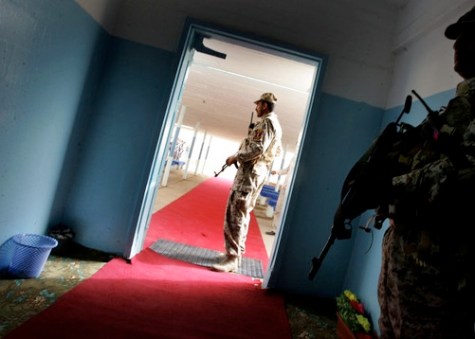
Iraqi security personnel stand guard at the newly opened Baghdad Central Prison in Abu Ghraib on February 21, 2009 in Baghdad, Iraq. The Iraqi Ministry of Justice has renovated and reopened the previously named "Abu Ghraib" prison and renamed the site to Baghdad Central Prison. Wathiq Khuzaie/Getty Images Europe
New Era, New Penology
The BBC noted, “Along with the change of name, the Iraqi justice ministry is trying to change both image and reality, billing it as a model prison, open to random inspection by the Red Cross and other humanitarian organisations.”
This transparency is a refreshing change to the policy of Abu Ghraib’s former operators. The work is not yet complete though and the upgrade is ongoing. The BBC describes, “[The prison] will eventually be the city’s main jail, holding about 12,000 inmates. Initially, only one of its four sections will be used. There are already about 300 prisoners there to test it out and, once the prison has been officially inaugurated, that figure will rise to 3,500.”
So, not only do Iraqi authorities want to repurpose the institution, they want to make it the penal institution of “The New Iraq”. This is an ambitious policy riddled with dangers; the site is loaded with memory and controversy. As the New York Times notes, “the promise of a new era can also be a time for remembrance.”
I highly recommend one goes onto read accounts from Iraqis, correspondents and photographers who lived and recorded Abu Ghraib’s recent history, particularly photographer Tyler Hicks’ account of Saddam’s prison amnesty in October 2002 that turned from celebration to human catastrophe.

Wathiq Khuzaie/Getty Images Europe

An interior view of one of the cells at the newly opened Baghdad Central Prison in Abu Ghraib on February 21, 2009 in Baghdad, Iraq. Wathiq Khuzaie/Getty Images Europe
Two things struck me about the photographic series of the new prison. Firstly, the number of flags, insignia and national colours across walls, above fences and emblazoned on uniforms. The Iraqi authorities have stamped their identity all over this project. It is the presentation necessary to supersede Abu Ghraib’s reputation.
Secondly, the pastel palette of many of the interior shots – namely the ubiquitous lilac. I want to know who has the decision-making power at Baghdad Central Prison! However, I suspect lilac paint was cheap and readily available; so it wasn’t so much a decision – more a fact created by circumstance.
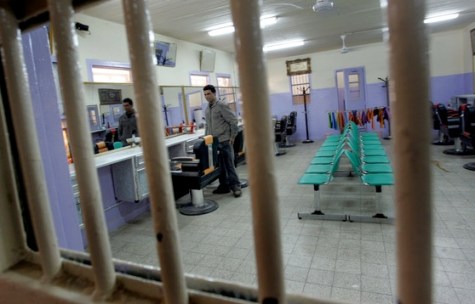
Interior view of the barbers shop at the newly opened Baghdad Central Prison in Abu Ghraib on February 21, 2009. Wathiq Khuzaie/Getty Images Europe.
Following that logic, one could presume lilac and purple fabric & thread is also at a surplus in Baghdad…

Interior view of sewing machines at the newly opened Baghdad Central Prison in Abu Ghraib on February 21, 2009. Wathiq Khuzaie/Getty Images Europe.
I don’t want to sound facetious, I was just shocked by the light purple, which according to colour theory is supposed to evoke emotional memory and nostalgia. Darker purples are supposed to represented, nobility, royalty and stability. From those evocations one is instilled with wisdom, independence, dignity and creativity.
If Baghdad Central Prison is to spur such emotional response in its inmate population it will succeed where many, many prisons have failed.
Basically, I am hopeful that the new prison can operate justly and succeed with the rehabilitation it emphasised this week. And despite all the lilac, soft-furnishings and current open media access – in reality it remains a prison with doors, locks and guards.
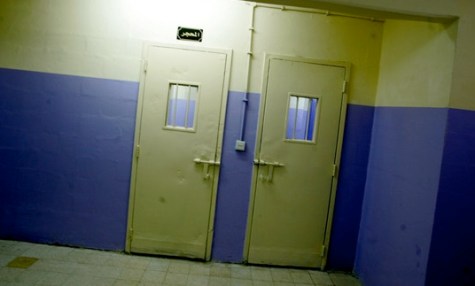
Interior view of cell doors at the newly opened Baghdad Central Prison in Abu Ghraib on February 21, 2009 in Baghdad, Iraq. The Iraqi Ministry of Justice has renovated and reopened the previously named "Abu Ghraib" prison and renamed the site to Baghdad Central Prison. According to the Iraqi Ministry of Justice about 400 prisoners were transferred to the prison which can hold up to 3000 inmates. The prison was established in 1970 and it became synonymous with abuse under the U.S. occupation. Wathiq Khuzaie/Getty Images Europe.
Robert Walsh contacted me recently to alert me his 2007 project at Delta College, Stockton, with instructor Kirstyn Russell. I asked Mr Walsh to explain the context of the series.
The story is not complicated. I have been a moderately serious photographer since the late 60s, when I got my first real job, working in the camera department of a large discount store. I have kept at it, off and on, for 40 years.
I got a job with the Department of Corrections in 1980 and worked at Deuel Vocational Institution (DVI) for 24 years, retiring as a Lieutenant 4 years ago.
A couple of years after I retired I approached the Warden, who was about to retire himself, and asked for access to shoot a photo essay of the prison.
I promised that I would go to great lengths to ensure that there were no recognizable images of inmates (legal issues) or staff (personal/professional issues) and would give the Department veto authority over any photo with any possible security issues. It worked out, and they had no issues.
I shot about 200 frames of 35mm, 120 and large format B&W negative, and ended up with a collection of 20 prints which I put in the book Images of the Gladiator School, along with a few pages of text. The text is still evolving.
The photos were shot over two days in the fall of 2007. I was trying to convey the visual impact of the institution without showing any people, both for obvious legal reasons and as a technical/artistic “challenge” for lack of a better way of putting it.
Robert Walsh
Mr Walsh sent me through the series’ twenty images, from which I selected six.
Of the remaining fourteen, two of Mr Walsh’s photographs were of receding cell tiers, so they couldn’t be included by virtue of a pledge. Two more were of receding corridors, so I extended the pledge. Three other prints that stood out were exterior shots of the yards at DVI. They depicted similar spaces to those of elementary schools – I plan to return to these in a later post.
I choose a single photograph for its own reason and five others for shared reasons.
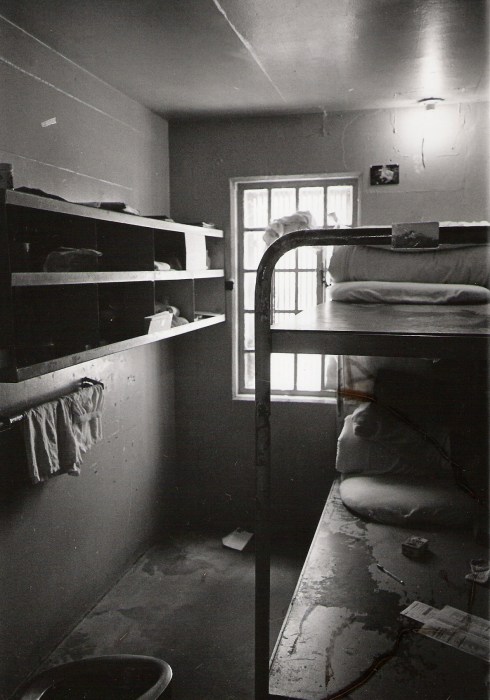
The image of the cell (above) is musty, scuffed and miserable as cell really get. Debris that lurks on the cold surfaces.
Mr Walsh actually provided two prints of the cell image; the other being less textured, darker and crisper. The other image also didn’t exhibit the same surface damage. The reproduction (above) was preferred because of its subtle mood of disintegration.
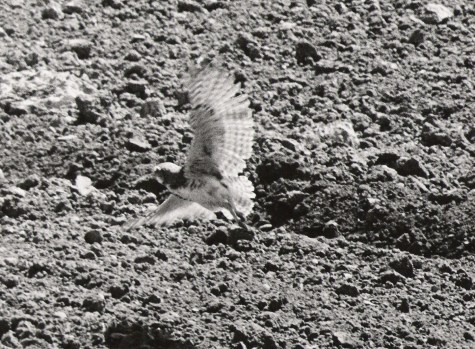
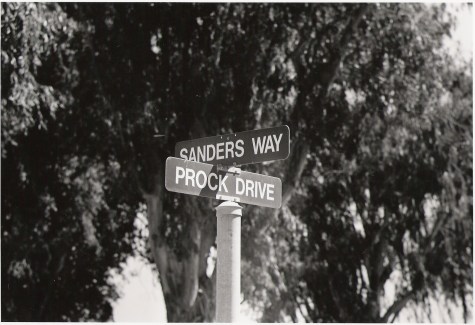
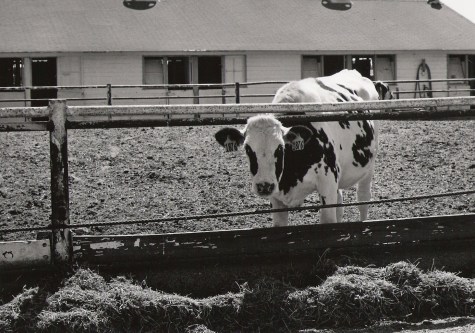
The remaining five were chosen because they express something of the action of the photographer. Away from the static buildings and fences, Mr Walsh has gone searching for anomalies amid the rigid penitentiary structures. The portrait of the cow is suitably awkward, the disturbed furrows of the field from which the owl flies are repeated in the pock-holes of the target range, repeated in the bullet-holes of the target-paper.
Robert Walsh

Robert Walsh
Palm trees. This is the West or Southwest, this is the land of middle distance road signs. This could be the work of John Divola‘s Correctional Officer Alter-Ego.
Robert Walsh
Robert Walsh

Robert Walsh
Mr Walsh challenged himself to “convey the visual impact of the institution” doing so with “no recognizable images of inmates or staff”. Bar two images, his compositions omit the activities of human life. Somehow, these five images specifically, give me the sense of human life recently fled or snuffed out entirely.
Whether Mr Walsh intended it, I find some of these images a little unnerving. The series is entitled Images of the Gladiator School based on DVI’s violent reputation between the 60s and early 80s. The project could as easily be called Ghosts of the Gladiator School.
Thanks to Robert Walsh for his time, words and images.

Modified captions on Colin Powell’s grainy images.
According to Joseph Pine we all crave – and will buy – authenticity these days.
According to Errol Morris we are more inclined to find authenticity in grainy low resolution images.
ERROL MORRIS: But, as we become more and more sophisticated about images — about how images are processed — haven’t we become more sophisticated about detecting fraud? Photoshop manipulations are relatively easy to detect. They fool the eye, but they don’t necessarily fool the expert.
HANY FARID: The answer is: yes and no. It depends on the image source. So, if we have the raw files[8], if we have the original footage from someone’s digital camera, you can’t fool us anymore. We have enough technology today where, given the camera, the original images that came off the camera, we can tell if you’ve manipulated them. If, however, you are talking about an image that has been cropped and reduced and compressed and posted on the web, then we might be able to do it, but there’s no guarantee. The task is decidedly harder because a lot of information has been thrown away. You’ve compressed the image; you’ve resized it. This is why all the Loch Ness monster and ghost images are always so tiny and grainy, because then you can’t see the signs of tampering. With low-res images it’s much harder to detect a fake. Definitely, when we have a high-res original image, we are much better at it.
[People often trust low-res images because they look more real. But of course they are not more real, just easier to fake. We look at picture of Nessie (the Loch Ness Monster). It’s grainy, fuzzy. It’s hard to make anything out. You never see a 10-megapixel photograph of Big Foot or the Abominable Snowman or the Loch Ness Monster. One explanation is: these monsters don’t exist. But if they did exist — so the thinking goes — they are probably unwilling to sit still for portraiture. The grainy images are proof of how elusive Nessie can be. This belief extends to documentary filmmaking, as well. If it’s badly shot, it’s more authentic. – E.M.]
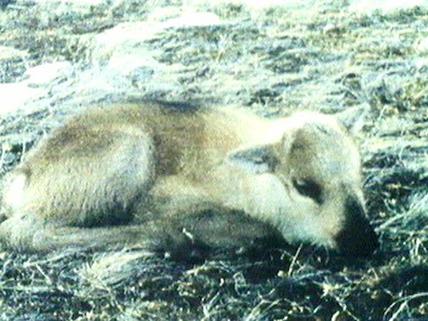
Grainy image of Caribou. From the Film Board of Canada, who gave Boards of Canada a name.

Grainy image of moon surface

Grainy image of Pentagon
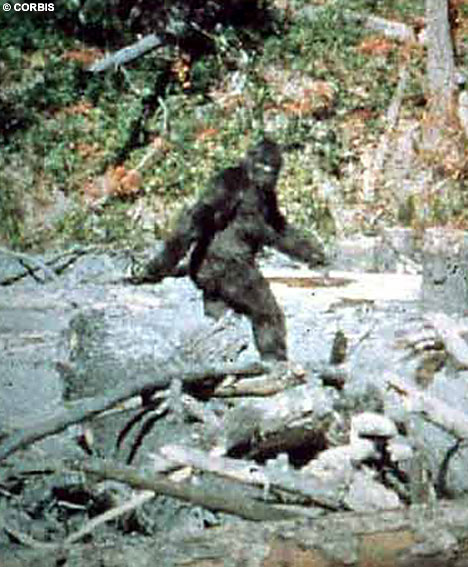
Grainy image of man in a flamboyant hirsute
TYWKIWDBI is garish and off putting to anyone who judges sites on appearance alone. Fortunately for it, and us, it is also one of the best aggregators of online content. It is a one man operation to compete with Digg!

Roy Brown
I picked up this story and had to relay it. While Christian Milton, former AIG executive, got 4 years for his involvement in $500million fraud, Roy Brown was sentenced to 15 years in Louisiana for stealing $100 from a bank. Brown only took $100 dollars from thousands the cashier handed him and subsequently surrendered himself the next day, ashamed of his actions stating “My mother didn’t raise me that way.”
I don’t know how tied the judges hands were by Louisiana law, but I would resign in disgust if I was a cog in such an abusive system. Fucking disgrace.

Christian Milton
Searching for images didn’t come up with much (admittedly, it didn’t spend too long) but it occurred to me that the mugshot is the aesthetic of the poor and the street “trialshot” is the aesthetic of the rich. I understand they are captured at different moments in the judicial process, but the qualities and circumstances of the Mugshot vs Trialshot make interesting comparison.
MUGSHOT: Regimented, Artificial light, Institutional, Accompanied by booking information, Less likely recipient of bail, Controlled & private space, Everyday clothes.
TRIALSHOT: Unrestricted, Natural light, Public, Accompanied by caption and news article, Certain recipient of bail, Public space, Selected wardrobe.
These comparisons go some length to describe the influence money and status can have in the legal process and how the procedures accommodate those with money and resources to work with/within the system vs. those who are simply subject to its machinations. Just to drive the point home, when charges were first brought against Milton in February 2008, the probation office recommended a 14 to 17 year sentence. An absolute disgrace. A mockery.

Screenshot of fate. The rise and fall of individuals.

 Prison Photography