
You are currently browsing the category archive for the ‘Non-Prison’ category.
Until three weeks ago, Aaron Bady was a blogger with limited reach. His post Julian Assange and the Computer Conspiracy; “To destroy this invisible government” written from his Mac laptop in Berkeley (Bady’s a final year PhD student in African Literature) sent his stats skyward and altered the way journalists were thinking about Wikileaks … even if they still shied away from the type of analysis Bady eschewed.
Alex Madrigal (another remarkable writer of insight and entertainment) explains in The Unknown Blogger Who Changed WikiLeaks Coverage, The Atlantic, how Bady’s work was spread, read, answered and commended by bloggers and mainstream journalists alike.
Julian Assange and the Computer Conspiracy; “To destroy this invisible government” is as simple as it is opinion-shaping. In the spirit of Wikileaks, Bady relies on two primary sources by the same author and of the same year – Assange’s State and Terrorist Conspiracies (2006) and Conspiracy as Governance (2006) (both available in this single PDF).
Bady breaks Assange’s writing – which should feasibly be interpreted as an underpinning to Wikileaks’ philosophy – into pieces, making it digestible; making it illuminating:
[Assange] decides that the most effective way to attack this kind of organization would be to make “leaks” a fundamental part of the conspiracy’s information environment. Which is why the point is not that particular leaks are specifically effective. Wikileaks does not leak something like the “Collateral Murder” video as a way of putting an end to that particular military tactic; that would be to target a specific leg of the hydra even as it grows two more. Instead, the idea is that increasing the porousness of the conspiracy’s information system will impede its functioning, that the conspiracy will turn against itself in self-defense, clamping down on its own information flows in ways that will then impede its own cognitive function. You destroy the conspiracy, in [Assange’s] words, by making it so paranoid of itself that it can no longer conspire:
The more secretive or unjust an organization is, the more leaks induce fear and paranoia in its leadership and planning coterie. This must result in minimization of efficient internal communications mechanisms (an increase in cognitive “secrecy tax”) and consequent system-wide cognitive decline resulting in decreased ability to hold onto power as the environment demands adaption. Hence in a world where leaking is easy, secretive or unjust systems are nonlinearly hit relative to open, just systems. Since unjust systems, by their nature induce opponents, and in many places barely have the upper hand, mass leaking leaves them exquisitely vulnerable to those who seek to replace them with more open forms of governance.
The leak, in other words, is only the catalyst for the desired counter-overreaction; Wikileaks wants to provoke the conspiracy into turning off its own brain in response to the threat. As it tries to plug its own holes and find the leakers, [Assange] reasons, its component elements will de-synchronize from and turn against each other, de-link from the central processing network, and come undone. Even if all the elements of the conspiracy still exist, in this sense, depriving themselves of a vigorous flow of information to connect them all together as a conspiracy prevents them from acting as a conspiracy.
Theorised and defined as conspiracy, Wikileaks’ challenge to – and Bady’s distillation of – the structure of secret diplomatic communications compliments David Campbell’s analysis of a networked world. It also precedes my comment to Campbell; that the praxis of government, corporate and public relations will change drastically in the wake of Cablegate and Wikileaks. In response, Campbell agrees that this maybe inevitable.
Hopefully the implications of Wikileaks will be a transparent future for the betterment of all; the dismemberment of closed and closeted power that operates unchallenged for decades as American diplomacy has.
AARON BADY
On a personal level, Bady’s quality of writing is invigorating, and in the larger context it shows how far thoughtful (blog) writing can reach. I need to be careful here as Bady has strong criticisms of ego, journalism and the limitations of thoughtful writers to apply themselves solely to material – as does Assange – but I just want to say that Bady’s piece is not a flash in the pan.
Bady’s writing is of the highest order. I’ve heard many criticisms about Facebook, and many of them very good, but no position has maginified the acute problem of Zuckerberg’s philosophy as Bady’s The Soul of Mark Zuckerberg: What DuBois can tell us about Facebook.
Since the publication of his breakthrough piece, Bady has followed up with tenacious balance and muck-raking in equal measure. As an example, did you know US companies in Afghanistan are pimps for paedophiles? Bady:
As Boing Boing boils it down, we now know that Dyncorp, “a company, headquartered in DC with Texas offices, helped pimp out little boys as sex slaves to stoned cops in Afghanistan.” Not actualy that surprising. What we didn‘t know, though, was that Afghanistan’s Minister of Interior was told to hush things up by President Karzai and that he then requested the American assistant ambassador put pressure on journalists to keep quiet about it, because it could “endanger lives.”
Follow Aaron’s blog and on Twitter: @zunguzungu
Bryan Formhals has delivered some festive cheer for Raw File and I. Picked as one of his Top 15 Photography Websites of 2010.
We’ve still a long way to go in terms of consistent output, but Formhals is on the money about working with quality editors. Keith Axline has been a rock.
Formhals:
“Raw File exploded onto my radar when they brought in Pete Brook as a writer. It’s a perfect example of how a mainstream magazine can tap into the talent of someone who knows their way around the blogosphere. The posts aren’t as frequent as I would prefer, but they’re always carefully selected and well written. You can tell Pete is working with good editors who are helping him refine his message. As much as I believe in independent blogs, there’s no getting around the fact that great editing elevates content. I’ll address this in a future post, but I think you’ll see more mainstream publications tapping into the blogosphere to find talented bloggers to run their photography blogs.”
Bryan confesses the “link-bait” title to his piece, but his selection is in fact very thoughtful and though out. Each pick is a departure point for discussion on a specific emerging, dying or morphing aspect of photo talk, sharing and criticism on the web. A melange of choices. Check it out.

In the interests of disclosure, I listed Formhals in Raw File’s Favourite Photobloggers article.
Lots of lists of photobooks cropping up for different reasons.
PHONAR
To close out the remarkable efforts of Jonathan Worth’s experimental open-sourced, web-based, free Photography and Narrative (#PHONAR) course offered through Coventry University, the #PHONAR course closed with a bevvy of recommended readings.
The following photographers, writers, teachers and journalists made picks:
Alec Soth; Andy Adams; Cory Doctorow; Daniel Meadows; David Campbell; Edmund Clark; Fred Ritchin; Geoff Dyer; Gilles Peress; Grant Scott; Harry Hardie; Jeff Brouws; Joel Meyerowitz; John Edwin Mason; Jonathan Shaw; Jonathan Worth; Ken Schles; Larissa Leclair; Ludwig Haskins; Matt Johnston; Michael Hallett; Miki Johnson; Mikko Takkunen; Nathalie Belayche; Peter Dench; Pete Brook; Sean O’Hagan; Simon Roberts; Stephen Mayes; Steve Pyke; Todd Hido
As a contributor, I picked out three titles. Predictably, each dealt with photography in sites of incarceration:

Too Much Time – Jane Evelyn Atwood


Chris Verene‘s Family was a later addition.

It was a privilege to be asked to guest lecture on this pioneering educational model. Thanks to Jonathan, Matt Johnston @mjohnstonmedia (Chief Engineer) and students for their encouragement and engagement.
WAYNE FORD
The #PHONAR list was spurred by Wayne Ford’s Photobooks and Narrative list.
JOHN EDWIN MASON
Following the #PHONAR list, contributor John Edwin Mason extended his selections. Mason’s Photobooks and Narrative: My (Slightly Flawed) Phonar List has an African and African American emphasis.
ALEC SOTH
Tonight, Soth put forward his Top 10+ Photobooks of 2010. As ever, Soth is thorough, thoughtful and generous in response.
JEFF LADD
Jeff at 5B4 has picked out his 15 choices for Best Books of 2010. The comments section is lively and I don’t think being to conceptual (as Jeff is accused of) is a problem, even if it were a fair allegation.
SEAN O’HAGAN
Sean at the Guardian has selected 2010’s best photography books that you should put in someones stocking.
NIALL MCDIARMID
Niall has put together his Photobooks and Magazines of the Year.
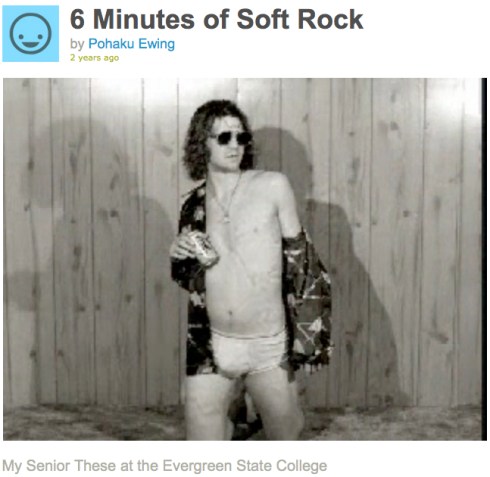

Daniel Ellsberg, left, at a news conference in 1973 in Los Angeles. In 1971, Mr. Ellsberg passed to a reporter for The New York Times a copy of a secret report casting doubt on the war in Vietnam. Associated Press
Based upon Cablegate commentary and mutterings thus far, it is reasonable to describe an opponents’ “Hierarchy of Targets”.
At the top of the pyramid is Julian Assange, second is the suspect (possibly Bradley Manning?), then come the collective of highly-skilled professionals working for Wikileaks, next are the supporters of Wikileaks (journalists, liberals, conspiracy nuts, libertarians, hackivists, net-neutrality fans, free-speech advocates, Bush-haters, China-haters, Gaddafi haters … lots of haters, you get the point). And finally – as I said, based upon commentary – toward the bottom of the pile would be Wikileaks’ major media partners, The New York Times, The Guardian, Der Spiegel and Le Monde.*
The leading newspapers of these four major powers should be and are beyond reproach. The absence of criticism toward these newspapers is telling.
Given the impossibility of controlling this outflux of data, the US Government is relying on tactics of distraction – and retribution – to elevate Assange and then take him down.
The US Government is probably well aware of the information yet to be leaked. Remember, while the cables number 251,287, of which 15,652 are “Top Secret”, only 1,344 have been published thus far.
NEWSPAPERS THEN, THE INTERNET NOW
The Nixon Whitehouse tried to smear the reputation of Daniel Ellsberg, the man who leaked the Pentagon Papers. Nixon’s painting him as a loose-nut, breaking into his psychotherapists surgery and stealing private health files to later sling shit. The thing is, before Nixon got to that he was trying to take down the media too. First he got an injunction on The New York Times. Next Ellsberg went to The Washington Post so they were next to be silenced. Through remarkable networks Ellsberg got copies of the Pentagon Papers out to 17 papers and the deluge was impossible to control.
For the Pentagon Papers leak, Ellsberg photocopied 7,000 papers himself, then photocopied those again. He delivered boxes of files by hand. 1971 was a pre-computer age; it’s easy to forget.
It is also easy to forget that Nixon administration shut down the New York Times’ publication of the Pentagon Papers for four whole days. Ellsberg’s leak brought about The New York Times vs. The United States of America, and ever since the separation between government and free press has been constitutional protected (if not always used to advantage by partisan “news” networks.)
Because of that court case – as much as the unlimited distribution possibilities of the internet – Assange and Wikileaks didn’t have to worry about any government closing down the four newspapers it had chosen as allies and partners.
As newspapers had gone before, so internet server companies followed; Assange predicted both the pressure from the government and the capitulation from Amazon and other server companies.
AREN’T WIKILEAKS AND NEWS ONE AND THE SAME?
Given that Wikileaks is only releasing individual cables after a partner has researched, redacted and discussed editorial ethics and responsibility, and given that in that light there is no difference in substance of Wikileaks’ publishing and that of its partners, why is Wikileaks singled out?
Assange claims to be a journalist. Given his blatant care (partnering with thousands of professional journalists) thus far in protecting the safety and identity of people mentioned in the cables, it seems like a fair claim.
I agree with the point of view that the Afghan or Iraq War Logs were not the equivalent to the Pentagon Papers; they told us only what we knew. We knew war was violent, we knew nasty alliances existed, we knew civilians were slaughtered, we knew no-one was in control as they claimed, we knew Iraqi’s carried out sectarian killings on one another and we could guess the allied forces turned a blind eye. Alternatively, in the way that the U.S. Embassy Cables are challenging a super power with legitimate accusations of Imperialism against it, the Embassy Cables leak could be an equivalent.
Interestingly, Ellsberg is in no doubt. If he was leaking the Pentagon Papers today, he’d be using the internet.
*Somewhere in the hierarchy of targets, there’s an argument to include Wikileaks’ methods and technologies (encryption, mirror sites, Wikileaks’ documents-cache poised for release should things not go Assange’s way). However, to keep it neat, I prefer the hierarchy of targets be made of people, not tactics.
There’s so much to be read and said about the unraveling stories and analysis of the Wikileaked Embassy Cables. The coverage by the Guardian, the New York Times’ Lede Blog and Kevin Poulsen and friends at Wired.com have been my main sources.
I cannot recommend highly enough David Campbell’s analysis – Wikileaks: From the personal to the Political.
Here’s some important snippets:
Wikileaks does publish the cables with the redactions made by media partners. (The Guardian explains how it does this here). So at the time of writing, Wikileaks has released only 1,203 of the 251,287 cables contained in the leak. This makes the coverage of the cables a prime example of networked journalism from which all partners, including the public, win.
…
In 2009, Wikileaks and Julian Assange won the prestigious Amnesty International New Media Award for exposing hundreds of alleged murders by the Kenyan police, an act which led to a United Nations investigation.
…
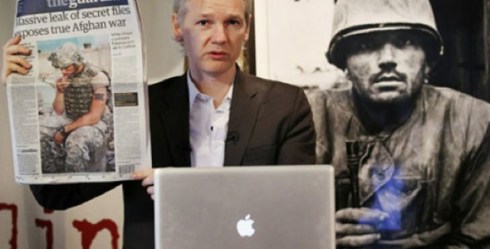
Assange is holding up a copy of The Guardian displaying a front-page story on the earlier release of the Afghan war logs. He is standing with his laptop. In the background is Don McCullin’s famous 1968 photograph of a shell-shocked marine from Hue in Vietnam. Signifying, first, the relationship between Wikileaks and its media partners, second, the role of the Internet, and third, the historical memory of the Vietnam War that hangs over current American military operations…
And just two more things from me.
1. If Julian Assange and his employees were Chinese they’d be lauded in the US as heroic dissidents and champions of free speech.
2. When was the last time rape was the headline story across the globe for a 48 hour period? Rarely? Never? Ever? Unfortunately, in this instance, I think the topic of rape will merely serve as a prop in the distraction techniques of mass media as existing powers attempt to divert the issue – from the global cultural sea change upon us – to the witch-hunt of America’s newest most-wanted. Dialogue about women’s rights, societal violence, machismo and misogyny is vitally important, but again it is diluted, set aside. The discussions that are occurring are, for the most part, not the right ones.
“Go to beauty spot to commune with nature, into the lovely park land and then when your dog shits, place it in a plastic bag and hang it from a tree like some f#*king hellish totem.”
– Mark Page
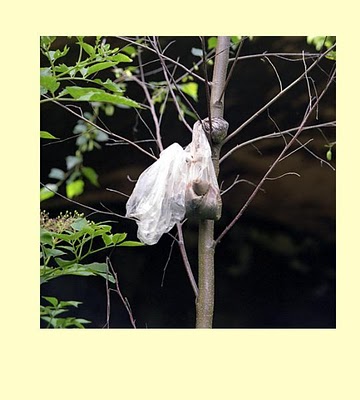
© John Darwell
Is photography better off dead than being a steaming pile of … ?
Photographer John Darwell has created a modern typology of a particular problem. Get yourself over to Manchester Photography for the full story.
HOW TO PAY A COMPLIMENT?
I have heard a lot of mutterings recently about how the photoblogosphere is in danger of becoming an orgy of self-on-proxy-self marketing; a web of palful happy-endings. Cliques for clicks.
It is against that septic skeptic view of the photoblogosphere, that Mark Page‘s Manchester Photography stands out. Let’s be honest, he’s in a bit of an outpost in Manchester (the one in the UK, not the one in New Hampshire) and I think that’s why his posts catch the eye. He’s on top of stuff no one else has got their eyes on.
A LOVE-IN, A POST-IT NOTE FOR MARK
Been really enjoying your posts recently. You’ve been on a roll. You’re still a cocky Jeremy Hunt, but I wouldn’t have it any other way. If Manchester Photography lost its colorful prose, it’d be the worst type of blog-lobotomy. A ‘blogotomy’?
Keep up the stellar work. I’ll see you, Leeming and anyone else who invites themselves for a lager-shandy down the Nag’s Head in 2011.
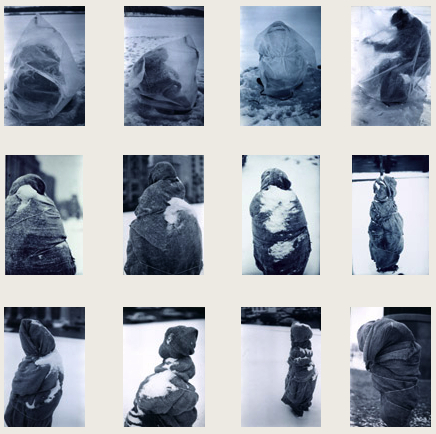
Olga Chernysheva‘s series Anabiosis looks at the “nearly indistinguishable shapes of a solitary Muscovite fisherman and plants wrapped up and protected from the freezing cold near Red Square.”
The word Anabiosis means ‘a state of suspended animation.’
Really like them.

 Prison Photography