
You are currently browsing the category archive for the ‘Opinion’ category.
I’ve been thinking about Portland recently and the potential importance of the Grid Project. I’ve been instructed to go to Christopher Rauschenberg to give my ideas the shakedown. This is because he’s largely responsible (although it is a collective effort), but also as one person mentioned over the weekend, “everything photography in Portland goes through Chris.” He is a founding member of Blue Sky Gallery, the regarded Portland photographer’s art collective.
Before I get to the Grid Project, I thought you’d get a kick out of Christopher’s answers lifted straight from this interview:
Do you feel you grew up in your dad’s shadow? He casts a big one.
Not at all. Both my parents were so full of joy and curiosity about life. They taught me how to look at the world. It was always, ‘Look at this piece of trash on the sidewalk. Isn’t it beautiful.’ I won the parent sweepstakes. The difference between me and George Bush is, we were both born on third base, but he thinks he hit a triple. I know I was born on third base, actually, a couple of feet from home plate.
You won the parent sweepstakes, but your dad was an alcoholic.
I’m not a big fan of alcohol. It’s more entertaining to be at full strength than be self-handicapped. Alcohol is a powerful dragon to slay. I’m sorry he couldn’t make that happen. People have flaws. He was a good deal as a dad.
The art world is quite hieratical, but he didn’t seem to be.
At museum openings, he was more interested in talking to museum guards than the director. He said he knew what the director was going to say but not the guards.
Were you impressed with his friends when you were growing up?
I wish I’d been more impressed. I remember one time I stopped by his place after school and he asked me to stay for dinner. Cartier-Bresson was coming. I said I couldn’t. I had homework.

RAUSCHENBERG, Robert. Brace (1962). Oil and silkscreen ink on canvas, 60 x 60 in. (152.4 x 152.4 cm) Collection of Robert and Jane Meyerhoff

WTO Protests, Seattle, November 1999. © Dean Wong. Wong is featured in Susan Noyes Platt’s Art and Politics Now
Susan Noyes Platt is perhaps not the best person to quote on issues of online (media) activism, as her primary interest is politically engaged artforms, direct action and the perfected combination of both. However, I feel her reservations about blogging may be fairly representative of many people.
I just attended the opening of Noyes Platt’s curated show, Cultural Activism in a Time of Crisis at Seattle Central Community College. The art was electrifying and, based on the first chapter, so is her book Art and Politics Now.*
Already Art and Politics Now has touched upon Alfredo Jaar, Trevor Paglen, Walid Ra’ad and the WTO protests in Seattle. Details enlivening to read and ideas that are bliss to connect with.
Noyes Platt:
“Cyberspace is not a joyous collection of people who come together in the street.”
A truism if I ever heard one, but she goes on:
“That physical event, collective street action, is an aesthetic act, the embodying of the act of resistance. The body of a political march is a creative body. It is a seething, joyful, and celebratory act of collective communal resistance. Cyberspace is an individual experience limited to a demographic and economic elite that creates invaluable networks, even as it atomizes them. Blogging for example, provides collective information, but it also can simply keep people at home, well informed, but hovering over a screen, alone.”
I quote this because for all the importance, thought [1, 2, and 3] and energy I put into blogging, it ain’t worth zip if I’m not connecting and being with people who are acting in the physical world to stake their political claim.
There are good arguments against the hegemony of the biggest social networks and yet some studies have shown internet users are more socially engaged. What to think? Firstly, Facebook’s degree of evil is yet to be determined. Secondly, correlation is not causation and perhaps it’s just that active people are bouncing through both cyber and real spaces? Ultimately, responsibility for use of blogs and other social media rests upon individuals’ personal (life) balance: screentime vs. playtime.
My basic message remains … HIT THE STREETS!
* It took a blog post by Jim Johnson for the tip off on Susan’s amazing academic activism right here in my own city of Seattle.

© David Shrigley
__________________________________________________________
AUTHOR’S NOTE: THIS POST FOLLOWS A COUPLE OF OTHERS ON (PHOTO)BLOGGING, HERE AND HERE.
__________________________________________________________
The 2011 Orwell Prize, the British awards for political writing, has just announced its longlists. The awards are into their 18th year, yet blogging was only recognised as a form of political writing in 2009. Here’s the blog longlist.
Upon the news, Charlie Beckett at POLIS chose to reflect on the health of blogging.
On one hand Beckett says that some good bloggers have bowed out (presumably not replaced instantly by new bloggers, quality-wise) but on the other acknowledges the slew of very good, very relevant and very free blogged opinion and commentary. He also applauds former mainstream media (MSM) journalists using the blog format as one tool in their kit. Overall, he thinks blogging is still in transition and “much of it below par.”
While I agree with most of Beckett’s points, I don’t agree with his conclusion. I think he is bored by the increased specialisation of blogs:
Everyone’s at it. The market’s gone way down the long tail with very specialist blogs … where people are addressing a very niche audience (though I wouldn’t be surprised if some of those narrow subject niches are rather capacious in terms of readers).
When Beckett refers to the market, I take it he is talking of activity and development of ideas, not solely about money exchange.
If Beckett is right about blog proliferation (I think he is) then we can conclude two things. Firstly, that readerships are getting cosier with their blogs of choice and selecting from an overall wider choice. Secondly, bloggers are splintering into niche next to niche to good effect; one’s subject matter does not dilute the others, but complements it.
The upshot? Bloggers and blog-readers have increased in relevance to one another.
Beckett sees this preponderance from the other side too. The mind-share (of readers) has been, and continues to be, a premium commodity for writers. For eyes-on-screens, bloggers are not only competing against MSM but against each other too.
Original content will secure those eyes.
TOO MUCH OPINION?
Beckett weighs the reporting of new facts against the “surplus supply” of opinion.
There is a so much professional and personal comment around on MSM (Comment Is Free) as well as independent forums like Mumsnet or Facebook that opinion is now so cheap (free) that it’s has lost its value in the market place of public debate. New ideas and new facts suddenly have more currency than views.
Readers don’t mind if content – containing new ideas and new facts – is written by a journalist or blogger, professional or amateur, as long as it is proven reliable and informed.
So now it seems the expectation of a blog is to be not only specialised (niche) but also to carry exclusive material (unique). That is a tall order, yet the long and engorged tail may suggest it is already being done.
Certainly, blogs need to do more than merely point.
Finally, Beckett says that here in America, we might still be hung up on a difference between bloggers and journalists. I wasn’t aware.
In the States I am amazed that there is a still a debate about bloggers v journalists. In the UK we appear to have moved on from that rather sterile argument, although our blogosphere does not have the power of the American versions.
Beckett calls the argument sterile because it is clear that if blog content is bogus, people won’t read. Conversely, if content is good and the copy is lyrical then readership follows, no matter who you are. (This logic may apply more to the act of reading more than, say, watching cable news where nonsense seems to dominate.)
“UNICHE”
You heard it here first folks. Uniche, meaning the required combination of niche subject matter and unique content, might be the tricky combination required by bloggers to survive remain relevant in the future. It’s not merely good enough to have your own area, you have to deal with its issues with fresh information and shower it over readers in timely, tasty morsels.
Whadd’ya reckon? Uniche? Does the wordplay work?
Uniche. Also the feminine plural of unico:
Adjective: unico m. (f. unica, m plural unici, f plural uniche)
1. only, sole, one, single
2. unique, unparalleled, unequalled
ONE MORE THING: BEN’S PRISON BLOG
Incidentally, one of the longlisted blogs for the 2011 Orwell Blog Prize is Ben’s Prison Blog. “The only blog by a serving British prisoner,” as claimed by author Ben Gunn, looks “stupidity and ignorance in the eye whilst attempting to inject some neurons into the criminological debate.”
I wrote about Gunn’s position as a pioneer incarcerated blogger a couple of years ago when one of his letters containing content deemed by the prison governor as “interesting enough to be published on the internet” was intercepted and not delivered. (More here)
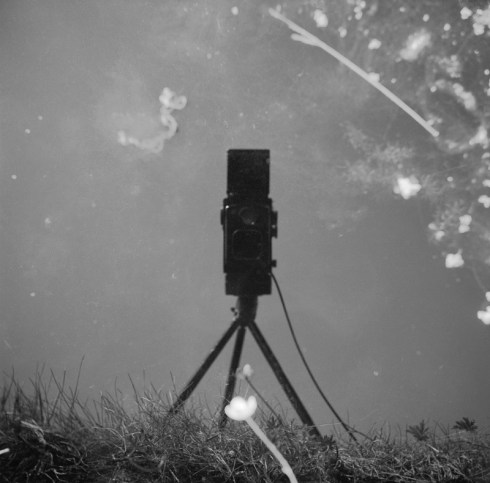
Self Portrait of the Artist as a Weeping Narcissus (free after Olaf Nicolai) © Norman Beierle, 2010.
A vicious ostrich, wedding mania in India, Nagatani’s Chromatherapy, scanner-hacked “pittance-cameras” and the scoop on the hottest new starlet of war photography; it’s fair to say that Norman and Hester are presently on top form.
Their generous sharing of finds along “the wondrous lanes and stray paths in the territory that comes with photography” often leave me gazumped and thinking afresh. Everyone knows I love Mrs. Deane, so it was great to read their take on what (photo) blogs do and where they might go if we choose to decide.
I hope you (and they) will tolerate such a large quote. It’s solid gold.
Blog posts are left as markers for the flock, to indicate where interesting fodder my be cached, where new projects can start, where questions can be engendered or where the ground becomes unstable. Each blog post can be viewed as a flag on the map, a point of interest for the visual tourist, for the data miner, for the visual entrepreneur, for the honey seeker. It can offer valuable information, or it can be a dead end, a tromp de l’oeil. At least it is an invitation to spend your time, however brief, with the text, the links, the visuals.
Aren’t we in a sense like hookers along the digital highway, pointing our fingers down in a come hither motion? I take it that in blog-land, regular visitors do their rounds, like we used to do our rounds on the flea markets, the used book fairs, the yard sales, the photographic equipment fairs in run down community centers. Now most of that now takes place on the eBays, Craigslists and Etsys of this world, and these companies profit from it, as do all parties, but the companies most of all by providing the commodity, the platform, the pipeline. Similar highways start to evolve for the photo world, does that mean we can soon expect the first blog equivalent of the chain stores?
More thoughts start to surface, do we want our blogosphere to become a market place? Do we commercialize or not, or maybe just a little bit? Or where will we find the means to support our idealistic and wilfully naive notion of a free exchange between equals? Of course, when given the choice, I prefer the vita contemplativa, but I am forced to survive in the vita activa, where there is no such thing as free love, and where everything either has a price or is considered worthless. If I would want to change that, I should be willing to fight for that, but am I, are we? (Photo) Blogging is seen by many as a fun thing that we do in our free time, not as a serious activity, or even as what it is also, a political act.
Not to promote arrogance, but maybe the hard core content blogger ought to be more self conscious about the role he/she could play. Sometimes — and curiously enough many of these sometimes occur when I visit places like Al Jazeera — , I feel as if we simply have been pussy footing for too long. What are we waiting for? Let’s go and make things happen!
I was recently asked to propose a blogging workshop for photography students. It pushed me to think why blogs should be written and why they should be read.
Blogging tools have developed concurrently with the social media platforms that have permitted our shared glut of imagery. Writers in general have provided context to images for a long time, but I reason bloggers are a new front line in the expanded process.
Here are my thoughts.
VISUAL OVERLOAD
The flow of images through our daily lives increases at exponential speeds. Social media, photo-sharing sites with essentially unlimited storage and mobile hardware have created this sprawling (and it could be said, suffocating) visual superstructure.
At 60 billion photos, Facebook has a larger photo collection than any other site on the web. By comparison, Photobucket hosts 8 billion, Picasa 7 billion and Flickr 5 billion. Facebook’s photo data as an infographic.
VIEWING PHOTOGRAPHY IN A POLITICALLY MINDFUL MANNER
What to make of this slew of imagery is something both Fred Ritchin and Joerg Colberg have addressed in the evergreen debate about ‘What’s Next? (for photography)’ now being pressed by FOAM Magazine.
Colberg asks us to think about the meaning of our own digital archives and impress upon them a meaning, perhaps even a strategy. Ritchin urges us to think about making sense of the world through all the images available to us. Both are concerned with us being actors in the real world, and knowing that the photograph plays a part in social/political action and decision.
Ritchin:
Colberg:
Beyond our status as subjects within – and/or impulsive producers and passive consumers of – imagery, we are also to a very modest extent curators and distributors. In these last two roles, we can add most meaning and most weight. And it can be done through thoughtful and engaged blogging.
I have gone on record as saying the best bloggers writing about photography are those who can be relied upon to filter content meaningfully.
A good blog has a clearly stated goal and delivers accordingly. That’s how I judge success. Some blogs may cast a wide net, others focus on a niche, but in either case a consistent voice will secure the interest of readers. One hundred committed readers are more valuable than hundreds of thousands of browsers and “stumble-upons.” People need to be told why they should look at a picture just as much as they should be told in a lede why they should read a story past the first paragraph.
THE IMPORTANCE OF TEXT
The iconic photograph – that is to say the stand alone image which communicates and resonates – is a rare and, for most photographers, an unattainable thing.
Understood within this context, writing about photography can be of paramount importance. And it can be an act of conscience.
Fine art photographers may argue explanatory text demeans a photograph; Robert Adams insisted that auxiliary captioning proved the image had failed in describing all it need to. But Adams’ is an out-dated philosophy. In current times, when photographs have diminished reliability, they require justification for looking.
During their role as World Press Photo jurors, Broomberg and Chanarin considered a photo of drawing of a battle plan from Darfur sketched into the sand on the floor of a hut, and noted:
Blog posts can be considered extended captions, highlighting the meaning and purpose of photographs. As such, bloggers’ choices on their subject matter are significant. And political.

“I was have always paid attention to how artists worked in the world, especially with the form known as the Artist Talk where the artist is invited to present his/her works. This form remains intriguing to me. It always seems to involve the following elements: A podium or table; A slide or video projector; Table with glass or bottle of water; A (most of time) inadequate introduction followed by a lecture which is inevitably interrupted by some technical problem that may or may not be resolved; End of lecture; Enthusiastic, polite, or no applause; Someone announces that the artist is willing to answer questions from the audience; Moment of silence; Artists fear and wishes that no questions are forthcoming; Audiences fears and wishes that no questions are forthcoming; Some daring soul inevitably raises his/her hand to ask a good or bad question; artists give good or bad answers; Someone mentions that time has run out; Audience leave while a few people approach the artist to ask him/her more questions; Everyone is escorted out; Artists is invited for a drink or dinner where a polite conversation takes place; Email coordinates are exchanged; Artist is dropped off at a mediocre hotel with an equally mediocre and expensive internet connection.” (Source)
Walid Ra’ad is the recipient of the 2011 Hasselblad Award and founder of the Atlas Group.
I knew something was going on when my blog stats spiked over the weekend. Prison Photography interviews with those who photographed Fabienne Cherisma’s body in Haiti were drawing readers … and they came from Sweden.
PAUL HANSEN’S SPoY WIN
At the Swedish Picture of the Year Awards, photojournalist Paul Hansen was recognised as International News Photographer and won the International News Image for his image of Fabienne (below).
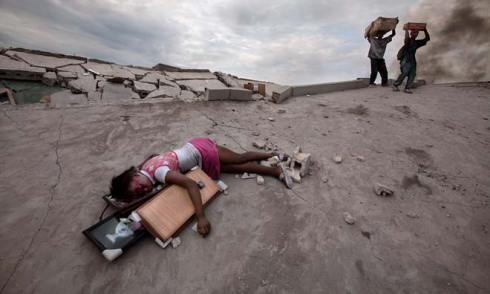
Fifteen year-old Fabienne Cherisma was shot dead by police at approximately 4pm, January 19th, 2010. Photo: Paul Hansen
In March 2010, Hansen answered some of my questions about the circumstances of Fabienne’s death, “For me, Fabienne’s death and her story is a poignant reminder of the need for a society to have basic security – with or without a disaster.”
Paul Hansen was one of eight journalists I quizzed about that fateful day in an inquiry that revealed that 14 photographers were present immediately after Fabienne’s death.
At the time, I noted how the Swedish media and public discussed the ethics of the image and that, by comparison, similar debates were absent elsewhere.
The debate has continued following Hansen’s award, focusing on Nathan Weber’s image (below) that was first published along with my interview with Weber.
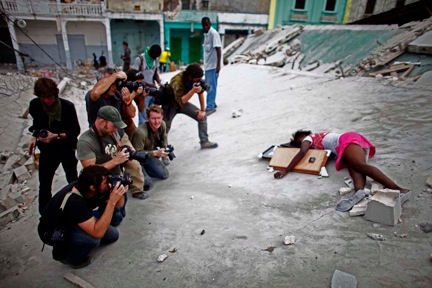
Photo: Nathan Weber
Weber’s image has unsettled many it seems. Judging by garbled Google translations here, here, and here it seems there are a few issues:
– General surprise that Weber’s image – and the revelations it brings – was not widely known before the SPoY award.
– Rhetorical questions about whether – given the scores of photographs made – Hansen’s image was “the best.”
– The expected accusations of exploitation and vulture behaviour by photographers.
– Fruitless thoughts on “truth” within this particular image.
Before they awarded Hansen, I wonder if SPoY were aware that so many photographers were present? Would it have altered the final decision? The image of Fabienne limp on the collapsed roof (whoever made a version) is the summary of innocent death, a society’s desperation and the man-made tragedies that compound natural disasters. It’s is a striking vision.
The circulation of Weber’s image has fueled skepticism toward photojournalism.
The problem with these types of brouhaha is that never are they able to measure if or what effect images – in this case Hansen’s – have. Did Hansen’s image secure a dollar amount of donations for the Haitian relief effort? Did it mobilise professionals and resources that would have otherwise not have moved?
If we are to talk about the “power of photography” then shouldn’t we expect and/or propose criteria for measuring and defining that “power”?
MICHAEL WINIARSKI, REPORTER AND HANSEN’S PARTNER
It should also be noted that Michael Winairski won the the award for News Storyteller from Dagens Nyheter, the national news outlet he and Hansen work for. When I contacted Winiarski last year about coverage of Fabienne’s death, I was particularly impressed with his transparency and commitment to the story. He and Hansen followed up two months after the killing and met with Fabienne’s family.
On receipt of the award, Winiarksi said, “”I’m glad we did not let go of Haiti. I and the photographer Paul Hansen have been back twice. And Paul is down there now with another reporter, Ole Roth Borg.”
ACCOLADES AFTER RECORDING DEATH
Paul Hansen is not the first photographer to be awarded for coverage of Fabienne’s death.
James Oatway won an Award of Excellence at POYi in the Impact 2010 – Multimedia category for Everything is Broken. Fabienne’s corpse open the piece and appears again in images 25 to 33. Olivier Laban-Mattei won the Grand Prix Paris Match 2010 for his coverage of Haiti, including the aftermath of Fabienne’s death. Fredric Sautereau was nominated for Visa d’Or News at Perpignan for his coverage of Haiti, which include seven images about Fabienne’s death.
There may be others.
I was recently interviewed by Zarina Holmes at Sojournposse about my project here at Prison Photography. Zarina’s questions were refreshing as I have a tendency to get stuck in my own thinking and politics sometimes.

The interview itself is a little long (my fault) but results from an effort to fairly explain the nuance of images from sites of incarceration.
One of the things I continually grapple with is who benefits from prison photography projects? Is it the prisoners, the audience or the prison authorities? There is no definitive answer. In the interview, however, I did make this statement:
“People are tempted to believe that creating an image from within a prison – a rare/privileged viewpoint – is in and of itself a subversive act. In fact, what I often discover is that photography in prisons and other sites of incarceration is not challenging the organisational structure of the institution but rather working within its protocols. Thus, many prisons neutralise “the power of photography” or the camera’s ability to operate as a tool for social change.”
I have not articulated this thought so bluntly before. I think it applies to a lot of photographers working in restricted institutions or milieus.
Think about it – the most famous prison images of the 21st century are those of Abu Ghraib. Those images had a global reach and brought about change yet they were amateur shots leaked against the interests of the US military (the prison authority). Photographers are never going to just walk in the front gate unannounced. Nor are they going to be welcomed by prison administrations to document the pain and abuses within.
What does that make prison photographs then?

 Prison Photography