
You are currently browsing the category archive for the ‘Opinion’ category.

Left: According to photographer D.K. Langford, this is the Texas vehicle inspection sticker designed from his photograph. Right: This photograph is exhibit A in Langford’s suit vs. the Department of Public Safety and the Texas Department of Criminal Justice. (Source)
At last. I’ve been waiting for one of these legal disputes to have a prison angle! From the My San Antonio News:
“A photographer is suing the state over roughly 4.5 million vehicle inspection stickers that appear to incorporate, without his authorization, an image of a saddle-toting cowboy he created in 1984. Plaintiff David K. Langford wants the court to block the Department of Public Safety from further use or issuance of the stickers, the design of which he says is based on his copyrighted photo, Days End 2.”
“The stickers were produced by state prison inmates under a Texas Department of Criminal Justice (TDCJ) contract with the DPS. […] The suit says Langford’s photo was illegally appropriated by an inmate who scanned it from a copy of Texas Parks and Wildlife Magazine in 1998.” [My bolding.]
Langford, the photographer, seems quite tenacious here. He argues simply that the State of Texas should be more careful about how it sources its images.
I want to avoid the lazy joke about a prisoner “stealing”. It’s just a shame that when prisoners working for the Texas Correctional Industries which is, for some, a form of modern slave labor (I withhold comment), the products of their work are at the centre of a substantial lawsuit.
This story was brought to my attention by Bob, who says, “I guess Texas is always full of unintended ironies.”
The TDCJ refused to comment, and of course there’s no response from the prisoner. I would want to hear from the prison-artist who originally ripped Langford’s image. He ended up producing a nice piece of graphic design!
With 4.5 million stickers in circulation, the prisoner has quite the visible profile. There’s more of a story here. Texas journalists! Get on it.

Golf Five Zero watchtower. Crossmaglen, South Armagh, Northern Ireland, UK. © Jonathan Olley.
Last month, I had a jolly nice chat with a jolly nice chap about what all this means at Prison Photography. Where’s this open journal taking me?
I said if I took this whole thing to the academy, it could be as simple as a historic survey: The Uses of Photography to Represent, Control and Surveil Prison, Prisoners and Publics in the United States (1945 – 2010).
I was encouraged to ditch the historical view and engage the modern. Ask myself, why should anyone care about prisons? Only a small minority care now and that status quo has remained for many reasons tied up in the antagonisms of capitalism. Would a historical survey change minds and attitudes or just lay out on paper the distinctions most people have already made between themselves and those in prison?
Perhaps people would care more if the abuse of human rights that exists within the criminal justice system of America were shown to impinge on everyone, not only on those caught in its cogs?*
What if we consider the methods and philosophies of management used by prisons and identify where they overlap with management of citizens in the “free” society. Think corporate parks, protest policing, anti-photography laws, stop and search, street surveillance, wire taps, CCTV.
My contention has always been that there was no moral division or severance of social contract over and through prison walls. For me it’s never been us & them; it is us & others among us put in a particular institution we call prison.
But, now I am seeing also, there is an ever decreasing division of tactics either side of prison walls. Strategies of management and technologies of discipline perfected in prisons have crept into daily routine.
What has this emphasis on containment and of monitoring – at the expense of education and social justice – done to our society and to our expectations of society?
SURVEILLANCE/CCTV IN PHOTOGRAPHY
And now for the tie in with photography…
Thinking about surveillance, obviously we have the big show at Tate from this Summer, Exposed: Voyeurism, Surveillance & the Camera with its devoted section to CCTV. (Jonathan Olley‘s work from Northern Ireland is the standout.)
But I always think back to Tom Wichelow‘s series Whitehawk CCTV (1999), possibly because he insists it is not a criticism of CCTV just a look at the politicisation of the human subject viewed through its lens.
Most remarkable in the series is the trio of images of the tragic site of a murder. They reveal to us that looking and bearing witness can be an act of respect as much as that of curiosity as much as an act of control. We are all compelled to look, but some observers are recording the feed and have a disciplinary apparatus to back it up.

Untitled (CCTV footage). Young family visits murder site. Brighton 1999. © Tom Wichelow

Untitled. Friends of murdered boy visit the site. Brighton 1999. © Tom Wichelow

Untitled. Resident reveals murder site outside her bungalow window. Brighton 1999. © Tom Wichelow
– – –
*There’s a simple argument that we all suffer because our tax dollars support a broken system that makes us no safer.
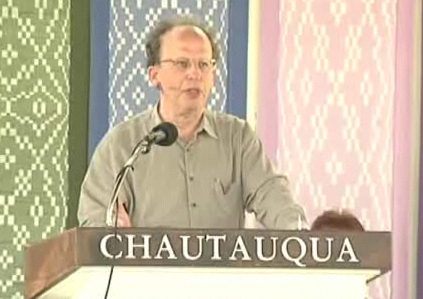
Fred Ritchin’s talk from the Chautauqua Institution is a must watch. It is over an hour, but if you don’t make it through you might just prove his point!
He lays out how digital universe allows us to reorder content as and when we please (a contact sheet has an order; digital files can be swapped about, deleted). He posits that along with the demise of analogue technologies, analogue thinking has disappeared. Today, to read is not to follow a book front to back, to listen to music is not to listen to an album. We take in bits, bytes, single tracks and isolated comments.
Ritchin isn’t moaning, he just wants us to see our current universe for what it is and respond accordingly. Ritchin wants us to use digital [photo] technologies not make models thinner, the pyramids closer or to run algorithms removing unwanted objects from caches of images; he wants us to use digital tools for positive ends. Instead of changing the past and present, why not the future envisioned? Ritchin wants us to present, to image and imagine futures so striking they might alter our behaviours – Earth without animals … or people. If we see the horrifying aftermath of climate change or war maybe we won’t go down that path? Think activist/photo-manipulation hybridism.
Ritchin questions Flickr. Rightly so. The mere upload of imagery is inadequate. After a trip to New Orleans’ Ninth Ward, Ritchin searched Flickr for imagery of “New Orleans”. The first 400 images were of young people partying on their stoops.
Our obsessive production and distribution of images (usually through socially networking) devalues meaning in, and of, photography. In photography we can increasingly find ourselves, but can we find each other? See each other? In a meaningful way?
Photography, as in life, is becoming less about them and us and more about me and I. This is a point Ritchin makes in his recent blog post too:
“I have written elsewhere about the assertion by Paul Stookey (of the singing group Peter, Paul and Mary), about the progression of values in the United States as seen through the popularity of certain magazines. During a 1980s concert he recounted how once the popular magazine in the United States was called Life (about life), then it was People (not about life, but just about people), then it was Us (not even about all people, but just about us), then it was Self (not even about us), and now – to add on to what he had said – it becomes the Daily Me of Nicholas Negroponte, where one’s dentist appointment or Facebook status supersedes the report of the declaration of a new war or healthcare initiative on the “front page” of one’s nearly ubiquitous screen.”
Of course, there is no obligation to use photography always in a means to connect with others.
There is however, an obligation to be honest. As it stands, the predominantly shallow use of image is far less of an insult as that of people obsessed with the past, with the idea of “the power of photography” and with the continued lip service to a dead idea and a false reality.
I know the drill, Got cells to burn,
I’m dressed to kill, A mortal coil,
And time is still, On secret soil.
Yeah pay the bills, Cells to burn, Mouths to fill
On Boeing jets, In the sunset make glowing threats.
Yes shall we take a spin again in business,
This time is fixed lets sweeten our facilities,
It took all the man in me.
Lyrics from Massive Attack’s Atlas Air
The animated video for Massive Attack’s Atlas Air, directed by Edouard Salier is a tour de force.
Rampaging and amorphous, what can only be described as a Donnie Darkoesque were-bunny, rips it way through and across blackened territories of prismatic violence. Against and allied, it runs with commercial jets into explosions. Apparently, this is a second appearance for the satanic leporid; it previously romped around Massive Attack’s last video Splitting the Atom.
The randomness of it all, sometimes seen through a gun-sight, recalls the Wikileaks Apache Attack video. But other things are going on too – burning oil fields (the first Gulf War); shattering buildings (9/11); Prestwick airport gets a mention (not the most well known airport but it was the site of a botched car-bomb attack in 2007).
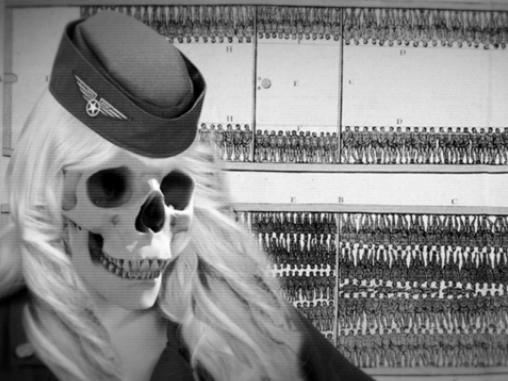
Ultimately, this is a video about extrajudicial rendition flights, the absence of law and the suspension of human rights. The screen grab above – which flashes by so quickly you’ll be forgiven for missing it – deals quite clearly with the involuntary movement of humans, only in this case that of slavery.
Just as the 9/11 plotters usurped commercial airliners for their ideology, the US military adopted commercial jets for its murky logistics. Salier doesn’t miss the opportunity to point out the hypocrisy in the visuals. 737’s get a mention in Atlas Air‘s lyrics.
Salier shows us the negation of order and, perversely, the power-distorted dominance and slick allure of disorder.
By strangling any reason out the compressed annihilation, the Atlas Air video is, for me, one of the finest visualisations of REAL terror. Massive Attack and Salier are not describing anything that relates to the rhetorical usage of the word ‘terror’ pushed on us by war-mongering politicians; they are dealing with pure destructive force as and when it is sent out against an equal force.
This is not a narrative of us against them or of us against them and their allies, or even us and our allies against them and their allies, it is about how fucked it all is … and about the terrifying, beyond-human-scale to which violence escalates. By relying on images of man made cities and theatres of war, Salier reminds us that these crushing vortexes are of our own creation and our own instigation.
I’ve admired Massive Attack’s intelligent use of video before.
*GWOT = Global War on Terror
This morning I bemoaned America’s use of the criminal justice system to manage and punish unfairly the poorest people in America – a population Michelle Alexander describes as those from “ghetto neighbourhoods” and mostly African American.
Well, it seems Britain’s criminal justice is even more punitive to Black people – within its criminal justice system and particularly in its prisons.
From yesterdays Guardian:
“The proportion of black people in prison in England and Wales is higher than in the United States, a landmark report released today by the Equality and Human Rights Commission reveals.
The commission’s first triennial report into the subject, How Fair is Britain, shows that the proportion of people of African-Caribbean and African descent incarcerated here is almost seven times greater to their share of the population. In the United States, the proportion of black prisoners to population is about four times greater.”

Some items banned by the Oregon Department of Corrections are understandable, ie, “Weapons or Explosives” and “Escape Device”.
The mail-rooms at all Oregon prisons are instructed to refuse sexually explicit material. Fair enough, you might think (maybe not?) but it is the definitions they provide that make me chuckle. I quote, “Personal Photographs (i.e. individual print or copy or photograph extracted from another source) in which the subject is nude … or exposes any portion of the female breast below the top of the areola.”
Also banned, “Polaroid type photographs with a chemical substance on the back of the photograph.”
Recently, I published an article on Wired.com about the opulent interiors of private jets. The owners of these jets remain anonymous as photographer Nick Gleis must protect client confidentiality.
For Gleis’ most recent and high profile showing, The Brighton Photography Biennial (BPB) described Gleis’ photographs as aircraft of African dictators. Gleis refutes outright the suggestion. “There are NO African Dictators that own any aircraft I have ever photographed. My clients are hard working people that have been fortunate enough to acquire wealth,” said Gleis via email.
Gleis and BPB need to get on the same page.
THE WEAKNESS OF THE VIEWER, MYSELF
In my mind, the term ‘Dictator’ (applied to any continent) brings up notions of human rights abuse and blood money, and of constructed and contested narratives. There are many contested narratives about African government in the fourth quarter of the 20th century.
My naive understanding of a continent’s countless ruling structures would be ridiculous enough, if I didn’t then try to guess if any of my limited-knowledge-based narratives were to be applied to the lavish interiors of aeroplanes.
I will not apply such narratives to Gleis’ then, but others likely will – especially as long as BPB and other institutions make use of questionable captioning.
MANIPULATING THE IMAGE, MESSAGE
The unavoidable information-gap in Gleis’ imagery is its Achilles heel. My basic point is that that if we as Westerners are suspicious of wealth, we are really suspicious of wealth originating in a developing country.
My argument here is not about Gleis’ imagery, nor about the specifics of any imagery. My argument is about the innate bias of viewers and about how “the Other” is consumed and constructed based upon such biases in the context of image.

EL HADJ MAMADOU KABIR USMAN, Emir of Katsina, Nigeria © Daniel Laine
Think back to Daniel Laine’s African Kings series. It is old work now (completed between 1988/91) but I am still impressed by the access Laine secured – based, I presume, on respect between photographer and subject ruler. But, due to exotic costumes Laine’s work is open to misinterpretation and misappropriation. In the light of BPB’s description, Gleis’ work too is being peddled as something it is not.
Often when I look at photography, I feel as though I am loading an image with my own baggage, criticism, emotion desires to see what I want to see in and about the world.
I am increasingly certain that images are boons to our own narratives and as more and more images fall into our laps and onto our laptops, I worry we are able to create the world we want and avoid the one we don’t.
Ambiguity in images is sustenance for the egos of men and women (but mostly men). Can we escape ourselves enough to view images unbiased?
We might never see Africa, unless, of course, we get on a plane and go there.

HALIDOU SALI, Lamido of Bibemi, Cameroun © Daniel Laine

AGBOLI-AGBO DEDJLANI, King of Abomey, Benin © Daniel Laine

ABUBAKAR SIDIQ, Sultan of Sokoto, Nigeria © Daniel Laine
DANIEL LAINE
Daniel Laine is a former storekeeper, professor, and hotel concierge turned photographer. Between 1988 and 1991 he made twelve trips to the African continent tracking down and photographing figures of royalty, and leaders of kingdoms. During this time he managed to photograph 70 monarchs and descendants of the great African dynasties. The book, African Kings: Portraits of a Disappearing Era was published in 2000 by Ten Speed Press. Laine lives in France.
Okay, okay, I know DAH is a good photographer and a greater promoter of work.
Seriously, what he does for youngsters in the industry is incredible and he was doing it a long time before the internets allowed him to share his support and passion via burn.
So, I’ll probably take a lot of heat for what I am about to say … like that time I was invited around to a friends house and ended up pissing on the kids’ Christmas presents.
It’s just that, this seems like quite an essay for a time of emergency.
“This calls for immediate action!”

 Prison Photography