
You are currently browsing the category archive for the ‘Opinion’ category.
If you ever needed a reason to question America’s prison system, the Daily Kos gives you dozens …
… and then some.

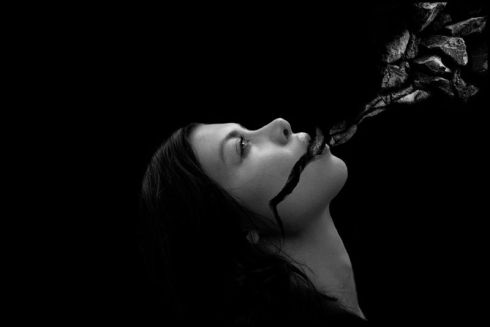
© Zoriah Miller. Model Laura Peterson's negative sandwiched with an image of devastation in Lebanon after the 34-Day Summer War.
CHANGING DIRECTION
Zoriah Miller has put aside his photojournalist work to pursue photocollage full time.
Zoriah’s statement declared photojournalism “rigid and stagnant … obsessed with rules, hiding behind “ethics” in order to produce nothing but formulaic, generic press photography.”
“What if you could create works of art that would not only stun people visually, but also educate people about a subject that they may otherwise ignore or find too depressing to pay attention to?” asks Zoriah.
Zoriah explains that he has been “shooting models and celebrities to work on creating composite images of beauty, sex and fame mixed with conflict, crisis and disasters.”
Zoriah and all models and celebrities involved in the project donated their time and the proceeds from the project will benefit refugees of conflict.
HOW TO POSITION THE WORK?
Judging by the example offered above the composite results will be incongruous mixtures of elements. Seemingly, Zoriah has traded his prior claims toward humanitarianism for the language of Dada.
Zoriah’s position is conflicted. The way in which he suggests putting images together is antagonistic, which is fine if you’re willing to argue away meaning as many agitators do, but Zoriah is trying to bring about attention to the issues surrounding the images of death which he then obscures with images of sex appeal. Do you see his problem?
Anyone want to have a stab at throwing these two images together on photoshop?*
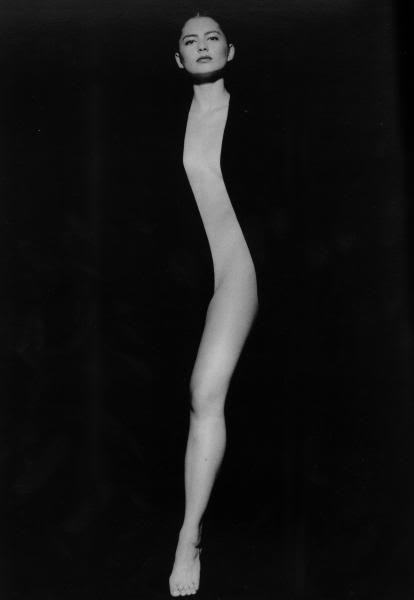
© Tono Stano, 'Sense'

© Yannis Behrakis/Reuters. A Palestinian worker repairs a bullet-ridden wall damaged during the three-week offensive Israel launched last December, at a factory in the northern Gaza Strip November 2, 2009.
If one experiments often enough fusing images together visually intriguing results will ensue. However, visual interest is cheap these days so it alone is not enough to prove an image ethical (I use that word knowingly) and/or effective.
I can see what Zoriah plans. It just doesn’t make a lot of sense.
QUICK THOUGHTS
1. Following the Haitian workshops debacle and in the face of unforgiving and acerbic name-calling, I think Zoriah argued his early corner quite well. To unleash this bizarre move is either total stupidity or unrelenting self-confidence. Either way, I would have liked to have heard and seen more works and reaction from Haiti and from his students before this.
2. Whether or not photojournalism is in a pickle – as Zoriah insists – the questionable cocktail of “sex and fame mixed with conflict, crisis and disasters” is, in my opinion, not the answer.
3. Likely, Zoriah’s future claims of being a journalist will be met only with derision.
4. Zoriah’s efforts at a thanaphilic fashion photography are not without precedent. Zoolander’s poor-taste DERELICTE fashion collection, a homeless aesthetic wrapped in the glitz and lights of the catwalk was great satire. So good it inspired Vivienne Westwood and the late Alexander McQueen. Etnies also had a good go at bad taste with its Hobo Ad campaign. I suppose Vice readers have been getting off on photographs of blood stained victims for years now?…
5. The greatest problem with this issue is that is inflates the importance of photography as an agent of change. No matter how much we recognise a need to raise attention about global issues, photography is not the sole answer, nor is photojournalism. The mode of photography Zoriah suggests is an unholy marriage. Who is the audience for this hybrid approach? What does he expect audience reactions to be? It would seem to me that consumers of images are turned on and off by visual cues. It is very easy to hook them with slick tried-and-tested commercial cliches. It is one thing grabbing a viewers attention for a second or two, it is another mutating that into a long and complex engagement with the real issues.
6. As offensive as this manouver may be to some folk, it isn’t the first time (and won’t be the last) a photographer oversteps logic and accepted practice with great hopes to change the cultural landscape.
7. I suspect there’s a reason why the worlds of fashion and photojournalism are distinctly separate. I can also think of many other more subtle ways in which art and marketing has been used as part of photojournalist careerism.
8. Given the consumer climate in America it is not unlikely that Zoriah will succeed in raising substantial funds. Ultimately, it will become an issue of the project’s branding and delivery.
9. If all else fails, it’s a good start for an Onion feature, right?
What do you make of all this? The “Leave a comment” button is at the top of the post.
*NB. Zoriah is using Negative Sandwiching
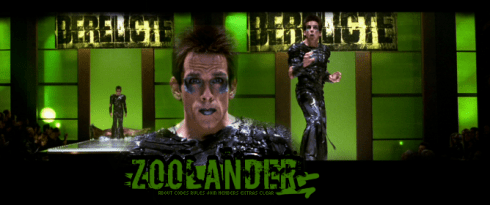
Derek Zoolander launches the DERELICTE collection. Image source: http://www.uninvitedgrace.com/zoolander/
© 1989 A.G. Reinhold, 14 Fresh Pond Place, Cambridge, MA 02138. K2PNK "May be freely distributed with attribution."
Recently, I’ve been floored by the quality of writing and fresh analysis springing forth from the biospheroblog:
PRISONS
Sara Mayeux, a relative newbie over at the Prison Law Blog has been busy her first two months. Lots of serious stuff but it was Sara’s reminder that Lil Wayne goes to Rikers in two weeks that held my attention.
“Lil Wayne was supposed to head to Rikers earlier this month, but got his sentencing postponed to accommodate an oral surgery appointment; his new court date is March 2. I’m always curious about what, if any, effect celebrity prison stints such as this will have upon the national dialogue about mass incarceration.”
I think the circus surrounding Lil Wayne’s stint will further obscure the facts of a broken system. If it gets millions of Americans talking, I suspect it’ll be the wrong talk.
Everybody should have Grits For Breakfast in their RSS reader.
Radley Balko on the significance of a milestone exoneration for the Innocence Project:
“These 250 DNA exonerations aren’t proof that the system is working. They’re a wake-up call that it isn’t. Instead of falling back on groups like the Innocence Project to serve as unofficial checks against wrongful convictions, lawmakers, judges, and law enforcement officials should be looking at why there’s so much work for these organizations in the first place.”
PHOTOGRAPHY
The Spinning Head, pulls no punches, especially when talking about photography in Haiti. Rafiqui’s long-form posts are worth their weight in word-count.
I don’t know where Peter Marshall gets the energy to photograph seemingly every protest in the Greater London area, post the images and then offer an editorial for each event! Over at >Re:PHOTO
I found Simon Sticker‘s writing first via A Developing Story swiftly followed by his photography and Ugandan workshops WITH OUR OWN EYES via his site Flow Media
The Visual Student, courtesy of the NPPA, doesn’t waste anyone’s time. The site has filled a much-needed niche offering students advice and most importantly encouragement from other students/recent grads. None of it is patronising and the interviews and showcases are quality. For proof see: Scott Brauer, Dominic Nahr, Kathryn Cook and Alex Welsh. They also announce important stuff like the recent NPPF $16,500 worth of scholarships.
Of course, we are all intrigued by the Hulin’s new aggregation-toy The Photography Post.
JOURNALISM
Charlie Beckett has been coaxing us back to the hard questions about the nature of photojournalism and media coverage. Necessarily, he’s looking at Haiti (Part one & part two).
Louisiana has the highest rates of incarceration of minors of any state in the country. Louisiana has the highest incarceration rate per capita of any state in the country.
It has now become the first state to sue its own death row inmates:
via Solitary Watch.
The absurdity of this gesture is fitting for a policy that only ensures time and resources are wasted on arguing the merits for and against killing people for symbolic purposes.
Get beyond the obvious – that is that the state shouldn’t be involved in de-existing people – it seems the main conclusion to be drawn is that hundreds if not thousands of jobs rely on the self-indulged death-industry toying with the fate of death-rowers for decades.
It seems to me that victims, victims’ families and those sentenced become a secondary concern; an infrastructure of legal jousting imposes itself, acquires its own logic and fights it out because that what the cogs demand. The results are laughably tragic deadlocks and bizarre gestures such as that of suing convicted individuals who are virtually powerless anyway.
My solution would not be to limit the legal avenues of appeal following conviction, it would be to abolish the death penalty as a sentencing option.
Just as the state should not be involved in killing people, it should not be involved in the retaliatory-posturing concerning the killing of people.
_________________________________________________
Previously on Prison Photography: There is a lot of inequalities within Louisiana’s criminal [in]justice system, that I have touched upon here, here and here. There’s also chinks of light in an unforgiving system such as radio and football programs at Angola.
PART FOUR IN A SERIES OF POSTS DISCUSSING PHOTOGRAPHERS’ ACTIONS AND RESPONSES TO THE KILLING OF FABIENNE CHERISMA IN PORT-AU-PRINCE, HAITI ON THE 19TH JANUARY 2010.
On the 3rd February, Adjustment Layer posted an account by photographer Edward Linsmier. It is the fullest eye-witness account by a photographer of events surrounding Fabienne’s death that I have read.
The account doesn’t name the girl as Fabienne. Her name has been available from different sources for some time.
Also worth noting, Linsmier talks of Nathan Weber, another photographer present. I was not aware Weber was at the scene.

Fabienne Cherisma lies dead after being shot in the head by police. January 19th, 2010. © Edward Linsmier
LINSMIER’S ACCOUNT
Read the full account on Adjustment Layer.
Linsmier opens with the excess necessary to hook the reader, “We heard gunshots and knew we needed to be closer. We processed the thought for a split second and we took off running with our fixer not far behind.” and, “Emboldened by the electricity of the chaos, we advanced further and saw people laying on the ground with police yelling and waving guns in the air and shouting commands.”
Linsmier goes on, “We retreated several steps and waited behind a truck for several seconds until the police were distracted. I saw another photographer up the road and decided that we needed to make a move closer to him so we could make some pictures.”
(One presumes this other photographer is Weber?)
“We followed … onto a downed roof top that led to the exposed insides of several shops filled with the scavenging and excited crowd. We were making pictures.”
“The fixer motioned for me to come because the police had caught a man and had him down on the ground. I, in turn, motioned for my friend and fellow photographer, Nathan Weber, who was still on the slanting concrete rooftop to follow me to the commotion down the road. I yelled his name and he looked at me with a blank stare. Nathan is someone who is on point in a situation such as this. He communicates quickly, clearly and with authority when needed. He is no stranger to photographing in similar situations but something of this magnitude was new to both of us. I knew he heard me and figured he would be right behind me as I headed down to the commotion.”
Linsmier returns to see Fabienne’s body, “[I] climbed back up on the roof to see Nathan in almost the exact same spot where I last saw him, except he was looking at a girl who was lying face down on the slanting concrete roof. As best as I can recall, Nathan spoke in short sentences, “I saw her fall. I thought she tripped and knocked herself out. She’s dead. Fuck. She got shot. I was right here.”
“The decision to continue making photographs was instinctual. More photographers showed up and we were all making pictures, composing the dead girl in the foreground as the looters continued to walk past her, almost over her, carrying whatever they could. Several men stopped to turn her over, seemingly to identify the body. They gently took her arms and almost had to twist her just a little to face her upward. They looked at her with little emotion and left.”
This record of events is interesting because it doesn’t report the bypassers going through Fabienne’s pockets as the Guardian did here.
“She had been shot in the head. From what I could tell, the bullet entered her cheek and exited from the back of her head. The blood had been pooling in some picture frames she was carrying when she fell. After the men moved her, the blood began to run down the slanting concrete roof towards us. We all were still making pictures. To anybody else, it must have looked sick, a crowd of photographers vying for the best position to tell the story of the death of a girl.”
“Just about the time that I figured the pictures were over and we should leave, a frantic man and several others emerged from the crowd. It was the family of the girl. The father hoisted her onto his shoulders and began the journey of bringing his daughter home. The photographers followed. Ordinarily, this would be a scene that hardly anyone could bare to photograph. They were experiencing probably some of the most painful moments of their lives but they knew why we were there. Not once did anyone give a mean look; not once did I hear anyone question why all the photographers were following this family’s grief so intently and so closely. It was part of the story.”
THOUGHTS
The underlining above is mine. It highlights the photographers’ conscious activities. I make no judgments here. Linsmier is aware of the sensitivity of the situation. Like, Mullady, yesterday, Linsmier’s candour should be appreciated.
Photographs are deceiving. I should know that by now. When I began my inquiry into Fabienne’s death, I assumed there was a scarcity of images. I presumed only Grarup and Garcia Rawlins had witnessed and recorded the incident.
It is clear, now, that there was more photography and activity. On the scene, at various points, were six photographers – Jan Grarup, Olivier Laban-Mattei, Edward Linsmier, Michael Mullady, Carlos Garcia Rawlins and Nathan Weber.
I’d like to state that I have no agenda here, I am simply interested in constructing the scene in a wider context. Photographers don’t work in a vacuum and we must demand to turn their images inside out to understand the context in which the images were created.
Mining the conditions of production is a position I have held consistently throughout my writing on Prison Photography. I am a great admirer of Errol Morris’ writings that demystify photography; it is in that spirit I am pursuing this inquiry.
Thanks to Melissa Lyttle for the note on Edward’s interview.
– – –
ALSO IN THE ‘PHOTOGRAPHING FABIENNE’ SERIES
Part One: Fabienne Cherisma (Initial inquiries, Jan Grarup, Olivier Laban Mattei)
Part Two: More on Fabienne Cherisma (Carlos Garcia Rawlins)
Part Three: Furthermore on Fabienne Cherisma (Michael Mullady)
Part Five: Interview with Edward Linsmier
Part Six: Interview with Jan Grarup
Part Seven: Interview with Paul Hansen
Part Eight: Interview with Michael Winiarski
Part Nine: Interview with Nathan Weber
Part Ten: Interview with James Oatway
Part Eleven: Interview with Nick Kozak
Part Twelve: Two Months On (Winiarski/Hansen)
Reporter Rory Carroll Clarifies Some Details
Part Fourteen: Interview with Alon Skuy
Part Fifteen: Conclusions
PART TWO IN A SERIES OF POSTS DISCUSSING PHOTOGRAPHERS’ ACTIONS AND RESPONSES TO THE KILLING OF FABIENNE CHERISMA IN PORT-AU-PRINCE, HAITI ON THE 19TH JANUARY 2010.
Following up on last months post about Fabienne Cherisma’s murder, it is apt to note Natasha Elkington’s Reuters Photographers blog post.
Amidst a very serious opinion piece about the hardships of childhood in Haiti and Kenya, Elkington includes a comment from the photographer of the renowned image of Fabienne Cherisma.
I spoke to the Reuters photographer in Haiti, Carlos Garcia Rawlins, who took the pictures of Fabianne to find out who shot her and why. He had no answers. By the time he got there she was already dead. She could have been shot by the police or armed security guards hired to protect property, he said. Witnesses said they didn’t know if she was targeted or hit by a stray bullet when police fired into the air to disperse a hungry mob.
What Rawlins did say is that people around her continued looting and would only stop for a moment to look at her body. “I couldn’t believe the indifference of the people around her,” he said.
Which is a different response to that of Jan Grarup.
– – –
ALSO IN THE ‘PHOTOGRAPHING FABIENNE’ SERIES
Part One: Fabienne Cherisma (Initial inquiries, Jan Grarup, Olivier Laban Mattei)
Part Three: Furthermore on Fabienne Cherisma (Michael Mullady)
Part Four: Yet more on Fabienne Cherisma (Linsmier, Nathan Weber)
Part Five: Interview with Edward Linsmier
Part Six: Interview with Jan Grarup
Part Seven: Interview with Paul Hansen
Part Eight: Interview with Michael Winiarski
Part Nine: Interview with Nathan Weber
Part Ten: Interview with James Oatway
Part Eleven: Interview with Nick Kozak
Part Twelve: Two Months On (Winiarski/Hansen)
Reporter Rory Carroll Clarifies Some Details
Part Fourteen: Interview with Alon Skuy
Part Fifteen: Conclusions
While much recent debate has been about if bloggers, indie-writers and stopgap-journos can find ways to make money, Brian Ulrich asks if many of us actually deserve to:
“It’s become fairly commonplace for one to put together a website or blog. Ask several questions of an artist by email, spellcheck and publish them.”
and
“An interview is not a questionnaire and all too many of these interviews are distilled down to a manufactured series of questions where it may even be obvious that the person asking the questions hasn’t even looked to see if those questions were answered somewhere else before. ‘What got you interested in photography?’, ‘tell me some of the inspiration behind your current project _____’, etc…. I hasten to say it but we would not stand for that sort of journalism in the printed press why should we stand for it online?”
and
“I feel we have a responsibility as publishers and broadcasters of media today. If we’re going to do it, let’s make it right, give us something we can learn from.”
[Bolding mine.]
In November, I penned a piece for Change.org about the Texas Department of Criminal Justice’s ban on two books that advocated for prison reform.

This week, friend Matt Kelley brought to my attention that Texas is now banning John Grisham novels. Kelley describes the sophisticated approach of the TDCJ:
The system is fairly arbitrary – prison mailroom staff look for offensive images and make the decision on the spot. Prisoners can appeal to state officials, but it’s tough to argue on behalf of a book you can’t see.
C’mon! Really? Add your name to over 500 petitioners.

 Prison Photography