
You are currently browsing the category archive for the ‘Opinion’ category.

The Rev. Dr. Martin Luther King, Jr., jailed in Birmingham, Alabama for protesting injustice.
Because I just read this, I wince a little as I repost thoughts via the indubitable Jim, but time is of a premium today. Please excuse me.
Martin vs. Barack
Why is it some American’s “mythologize and sanitize” MLK – a man that called for a national guaranteed income – but as quickly abase and demonize Obama who, by the way, is a pithy moderate by comparison?
In other words, why is the socialist agenda of one leader ignored and – worse still – why is a socialist agenda fabricated and super-imposed on another?
Oh, and also, actual functioning democratic socialism (even in its sputtering form under New Labour) is a pretty good ticket.

Matt and Scott at Dvafoto have made some important observations on the behaviour of the press in Haiti.
Dvafoto just got a redesign too, bringing all their commentaries of the past up to the surface again. Well worth swimming about in the visual archive for a while.
–
UPDATED: SARAH SHOURD WAS RELEASED FROM EVIN PRISON ON 14TH SEPTEMBER, 2010. SHANE BAUER WAS RELEASED ON SEPTEMBER 21ST, 2011
–
Shane Bauer, Sarah Shourd and Joshua Fattal are imprisoned in Tehran’s notorious Evin prison. They are not spies; they are principled activists, valued journalists and now political pawns.
I’d like to summarise their situation and then focus on Bauer’s ongoing work in Sudan.
HIKING, CROSSING, LANGUISHING
Earlier this week I met Shon Meckfessel, one-time Cake band-member, occasional anarchist, and long-time writer for literary, political periodicals.
Shon has been known most recently as the fourth member of the hiking party on the Iraqi Kurdistan/Iran border. Shon is not in Tehran’s notorious Evin prison because he – due to illness – delayed the start of his hike by 24 hours.
The day after his three friends Shane Bauer, Sarah Shourd and Joshua Fattal had set out, Shon got on a bus headed to the same trail-head with the intention of catching up. While on the bus, he received a call from Shane telling him that the three of them had just been detained by Iranian border patrol. That was on the 31st July, 2009.
Most US mainstream media coverage has been neutral presentation of the known facts, sometimes peppered with confusion and incredulity. It has focused on the absurdity of the situation instead of the integrity of the writing, teaching and activism of the three members of the party.
Outside of the media, there has been organised support. There has also been the minority view – the predictably offensive right-wing nut-jobs.
To answer briefly the questions of how and why a party of Americans were hiking near the Iranian border, Iraqi Kurdistan has been peaceful for nearly twenty years since the close of the first Gulf war.
Shane, Sarah and Joshua were all seasoned travellers and they had been advised that the mountains and waterfalls of Ahmad Awah in the North East were well worth a visit. Shon and his friends travelled to As Sulaymaniyah together. When they took the two hour bus ride from the city they thought it headed northwest, not eastward. No locals they spoke to mentioned the proximity of the Iranian border.

Shon, Shane, Sarah and Joshua stayed in As Sulaymaniyah (bottom left) for a night. The bus ride they thought went north west in fact headed east to Ahmad Awah (top right).
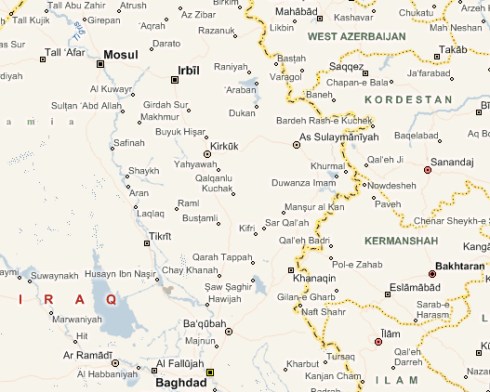
As Sulaymaniyah and Ahmad Awah are in Kurdistan, North Eastern Iraq. The areas marked Kordestan and Kermanshah are in Iran.

Iraq and Iran border and territories.
For a long time – aside of an early factual statement (August 6th) – Shon stayed out of the media spotlight and let the Department of State run its diplomatic channels. However, his friends remain imprisoned. Recently, media coverage of the story has declined (Diane Sawyer’s direct questions to a prevaricating Ahmadinejad the exception). On November 2nd, Shon wrote an open letter to Iranian President Ahmadinejad:
I had hoped that the misunderstanding would be resolved quickly. Three months have now passed, and I cannot imagine what more the Iranian authorities might have to learn about my friends or what they were doing in the area. … Mr. President, by continuing to deprive Shane, Sarah, and Josh of their liberty, Iran is working against some of the very causes it supports. Each of these three has a long and public record of contesting injustice in the world and addressing some of the inequities between rich and poor which you have spoken about through their humanitarian work in their own country and overseas.
Shon goes on to describe their various work and causes. Read the letter in full. Also on November 2nd, Shon appeared on Democracy Now! to reassert his position that the Iranian authorities can have no illusions as to their characters.
On November 9th, the three were charged with espionage.
Of the three, Shane Bauer has written and published the most. Most recently his article, Sheikh Down (Mother Jones) described how the ‘Pentagon bought stability in Iraq by funneling billions of taxpayer dollars to the country’s next generation of strongmen’.
Shon notes, “As a fluent speaker of Arabic, Shane has focused on injustices in the Arab world, in Iraq and Palestine in particular. The Christian Science Monitor published Shane’s January 7th interview with Musa Abu Marzook, the only English-language interview with a Hamas leader during Israel’s attack on Gaza.”
SHANE BAUER’S DARFUR PHOTOGRAPHY
I could have as easily featured the publicly available works of Josh or Sarah; each of the three illustrate their non-spy credentials through their past writings and journalism. That said, neither Josh or Sarah are involved in photojournalism or multimedia journalism as Shane is.
As Shane’s AP editor said in the clip atop this post, there are not many twenty somethings in Darfur freelancing and living with Sudanese rebels.
I have picked out five images from Shane’s Darfur series, but he also has produced two multimedia pieces One Day with the S.L.A. and Darfur: Rebellion from the Margins. In both stills and video he is trying to offer a context for the rebels bearing arms. The equation is simple: without a fight they would have “been run into the desert, where there is no water and left to die”.
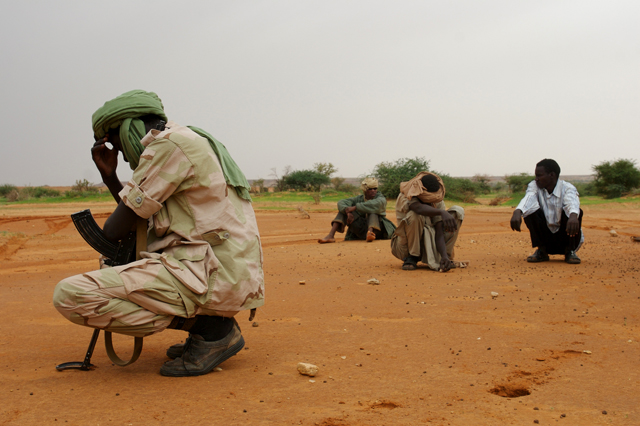
Rebels from the SLA-Unity faction sit stranded in the countryside. North Darfur, 2007. © Shane Bauer
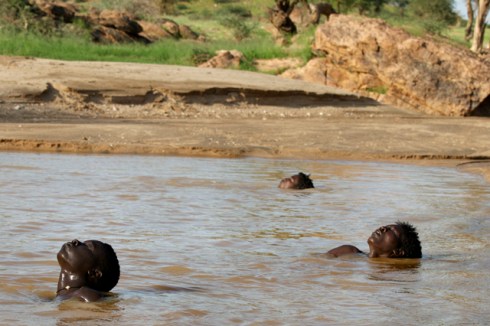
In the heat of the summer, SLA rebels swim near their base after a long night of rain. Deisa, North Darfur, Sudan, 2007. © Shane Bauer

A UN helicopter takes off after delivering medical supplies to a small clinic that was looted by the Janjaweed. Many Darfuris are demanding a UN peacekeeping force to replace the beleagured African Union mission, but for now the UN is limited short stopovers to deliver small boxes of supplies to villagers. Bir Maza, 2007. © Shane Bauer

Village elders meet in North Darfur. Many civilians remain in the countryside, either because they cannot afford to travel to a refugee camp or because they refuse to leave their homes, 2007. © Shane Bauer
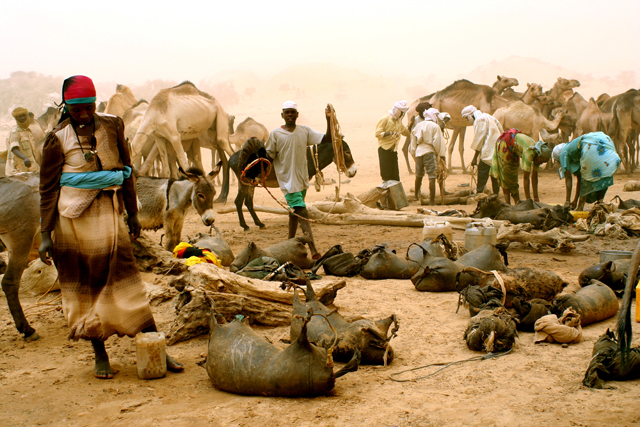
Women collect water in goatskins at a well in Farawia, North Darfur. With no water facilities and many wells poisoned or destroyed by the Sudanese government and its janjaweed militias, people have to travel long distances to find water. 2006. © Shane Bauer
The stills and video are a privileged view of existence for the Sudanese Liberation Army and the civilians they protect, but it is also a view that has dated. Shane continues to work on a feature length film about these same civilians, the S.L.A. and their continued struggle. Time ticks on.
Given that Shane is an accomplished photographer, I was a little surprised that his cause hasn’t been forwarded much in photographic circles, or more specifically the photoblogosphere. Jack Kurtz picked up on the story and posted it to Lightstalkers but it got no takers. Shane is a member.
Tewfic liked Shane’s Darfur multimedia but missed the story of his and his friends capture … as many of us did.
And, of course, we only anticipate Shane’s release in the context of all three’s release.
HELP HERE, HELP THERE
Perhaps, especially when the photographic community are mobilising to help in Haiti, we should also be aware of ongoing problems elsewhere?
The family have set up the Free The Hikers website, and also Facebook and a Twitter. We can start there with our actions.
BIOGRAPHIES
Shane Bauer received 1st place for independent audio slideshow features in the 2008 NPPA’s Best of Photojournalism contest. In 2007, he was a national finalist for photojournalism in the Harry Chapin Media Awards as well as a national finalist for feature photography for the Society of Professional Journalists’ 2007 Mark of Excellence Awards. He also received the Lyon Prize in photography that year. (Source)
Sarah Shourd, 31, is an English teacher in Damascus and is learning Arabic. She previously taught as part of the Iraqi Student Project, a program which gives Iraqi students living in Damascus the skills to continue their education in US schools. Sarah has written articles on travel and social issues reflecting her time in Syria, Ethiopia, Yemen and Mexico (Escape From Iraq: A Muslim Family Finds Solace in Ramadan, Brave Eyes, Laughing Hearts: My First Encounter with Yemen, Families Shout Their Love Across Minefields in Golan Heights). She attended UC Berkeley in the San Francisco Bay Area, where she lived after graduating until moving to Damascus with Shane. (Source)
Joshua Fattal began undergraduate work at UC Santa Barbara and graduated from UC Berkeley (2004). For three years after college he was invested in the Aprovecho Research Center, a sustainable living project in Oregon. In 2009, Josh was on a years travel partly independently and partly as a teaching assistant for the International Honours Program ‘Health and Community’ semester. (Source)

The BBC reported today that Italy was to open its first prison to serve specifically transgender prison population. In terms of its policy and service, such a move is welcome and progressive.
The US, however, doesn’t have specific institutions for its transgendered inmates, instead it employs the following policy:
This rigid policy can result in housing a woman (male-to-female trans) with a male inmate in the same cell. When this occurs, violent and/or sexual assault is common. Karen Franklin PhD posits that the prison system in the US establishes for transgendered youth a track toward future incarceration;
So Italy is leading by example? Well, yes and no. The prison at Pozzale (near Florence) was formerly a women’s prison subject to senior staff abuses, consequent court battles and ongoing bureaucracy ensuring mismanagement of resources. Recently it has housed only two inmates while other prisons in the area were overcrowded. The transgender prison is the socially-responsible solution; a new start for an institution with a corrupt past.
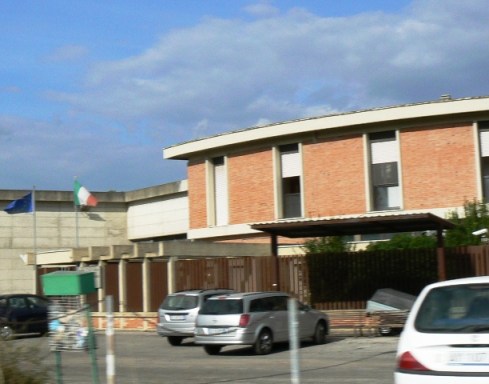
There is a total dearth of photographs of this institution, but also of trangender prisoners in the media today. I hadn’t paid it any thought until I was pressed to search for images for this post. I hope and expect that photojournalists will document activities at the prison once the new inmates arrive. It is a worthy story; there is a need. I suspect the Italian authorities would want to put a positive media spin on the story, and also on the trangender realities that are unfortunately still uncomfortable and/or controversial for some members of the public.
Further reading

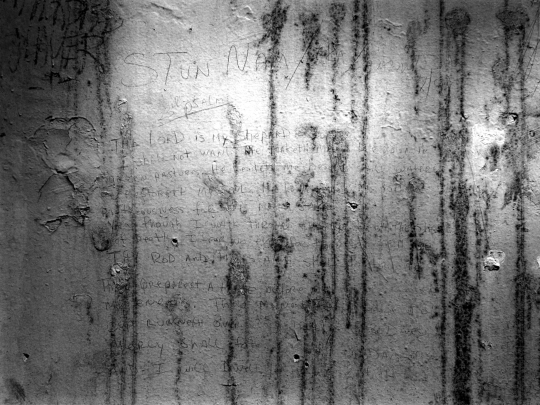
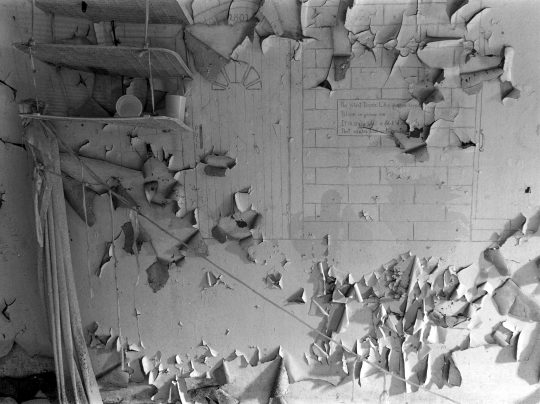
In 2005, Powerhouse Books published Thomas Roma‘s book In Prison Air: The Cells of Holmesburg Prison.
Arguably, the introduction by John Szarkowski is more interesting – or at least more complex – than Roma’s images. Szarkowski tackles head on the common question that looms over photographic studies of prisons:
“Roma’s book is in fact an odd and possibly perverse work, designed for who knows what audience. There are probably a few aging sociologists, still completing their works on what prisoners write on their walls, to whom the book might be useful (although it might be faulted on the basis of a lack of systematic rigor), and there might be another small but dedicated segment of our population that is interested in thinking about what life in prison might be like – not in terms of dramatic narrative, as with Cagney, Bogart, Robinson, etc., but rather (I am tempted to say) in terms of the aesthetics of incarceration.”
“But that is only a quick, superficial and comfortably middle-class response; and on second thought it is surely wrong.”
“Perhaps it might be more useful to ask why a photographer of high talent and conspicuous achievement might decide to make a book of photographs looking into empty prison cells. This is the same photographer who gave us the great, free-spirited dogs of Brooklyn, and the great open pastures of Sicily; and it is not unreasonable to ask why a photographer dedicated (or half-dedicated) to the cause of freedom should make this extended, serious, hermetic effort to produce a book of photographs concerning the very essence of subjugation.”
Szarkwoski then meanders through speculations about the photographs as a warning – even preparation – for forthcoming and unknown (possibly increasing) uses of incarceration:
“We might therefore, to be on the safe side, consider whether their evidence might help us prepare us for our possible future.”
To hammer the point home, Szarkowski lists common human preoccupations:
“According to their wall drawings and other graffiti, it would seem that the principled interests of Roma’s inmates were God, sex, time and to a lesser degree, art, the last being perhaps merely a method of dealing with the first three. These issues have been historically important to men in and out of prison.”
Szarkowski flourishes the introduction with reference to Conrad and Kafka and ends on an unfinished train of thought about medical experimentation on humans. Relevant, but not finished.
All in all, it is a bizarre essay. Szarkowski seems to grapple with the fact he has no connection to the content nor anchor with which to investigate and make sense of Roma’s work. But maybe that is the point he’s [un]intentionally making about photographs of prisons and of places one’s never been?

Related to crime and tangentially to prisons, Colin Pantall has been examining the cult, mythologies and obfuscations at the point where visual media and female criminals cross. He does so over four posts.
Pantall summarises: In Media and Crime, Yvonne Jewkes identifies seven standard narratives to describe women who commit serious crimes:
• Sexuality and sexual deviance
• (Absence of) physical attractiveness
• Bad wives
• Bad mothers
• Mythical monsters
• Mad cows
• Evil manipulators
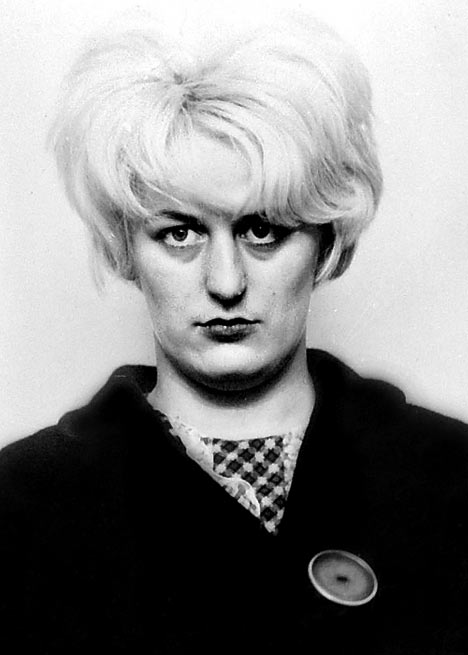
He takes on the common consumption of Myra Hindley’s mugshot:
“The world brought bored indifference to her mentor, the sadistic, fascistic Ian Brady. He was just another bad bloke.”
“It is a police photograph taken in maximum light in a dungeon. That stark, sinister expression could also be one of fright, the antithesis of the transgressive transcendence conceived by Brady.”
Pantall compares: the national disgust at a smirking bully with the forgiveness of the victims parents.
Finally, Pantall confesses he has no idea if Amanda Knox is guilty or not.

In his ‘Trial by Photography’ post he points out that she’s already been judged for not behaving – or looking – innocent in front of the cameras.
He closes, astutely noting, “A virtual reconstruction of the murder of Meredith Kercher was shown in court, with the screen fading to red at the end. Which puts everything about the trial into question.”
Now we know what the six jurors and two judges think. Did the visual aides used by the prosecution disproportionally affect Knox’s guilty verdict?
Serco is a UK based multinational company, with many fingers in many pies. The Guardian has called them “The biggest company you’ve never heard of.”
Serco sees profit in many things, including the private prison of the UK and Australia. Are you caught in the web?
The wikipedia profile supplies many valuable news sources for further learning.

The greatest priority for sentencing reform must be to dismantle the Three Strikes Law.
Three Strikes has not made society safer, it has only handed down overly-punitively long sentences.
Familial support during incarceration is the largest deciding factor in helping released prisoners to stay clean. It is therefore great to see Families to Amend California’s Three Strikes, a grassroots activist group focusing the voices of disenfranchised family members against unjust sentencing policy … and doing it well. Check out the videos and the resources page.

 Prison Photography