
You are currently browsing the category archive for the ‘Opinion’ category.
Flicking through my old bookmarks, I was pleasantly bothered by bumping into the Corrections Photography Archive (CPA). This is a great small collection of prints organised by theme and location. Unfortunately, the online form doesn’t work so I can’t learn more about CPA just yet. I now the collection is larger than that number digitized for the interwebs.
A couple of my favourite groupings are Music (for fun) and Dining Rooms (which arranges itself as a Becheresque typology of prison food halls). In the end, I decided to use the collection twofold; 1) as counseling for myself, and 2) as a guarantee for the readers.
FROM THIS POINT FORWARD,
I PLEDGE NOT TO POST IMAGES OF RECEDING CELL BLOCK TIERS.
Regardless if the tiers recede to the brightest white or darkest gray. Regardless of the cause. When given a choice between a receding cell-tier-photograph and another, I will take the other. Let us exhaust this inevitable angle of all incarceration-based-photojournalism. Let us gloss over those photographs and move to the other images, which will be the ones to make the story anyway.
PURGE!

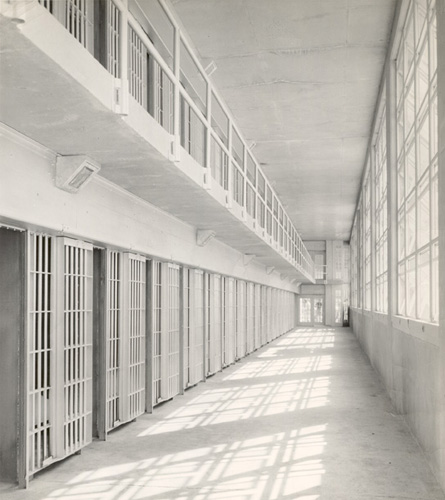

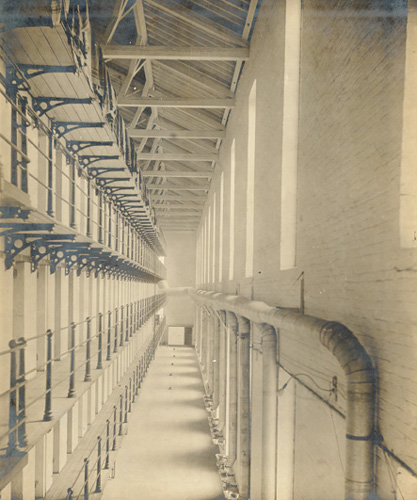

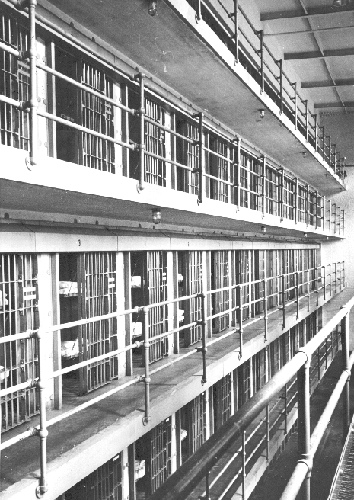

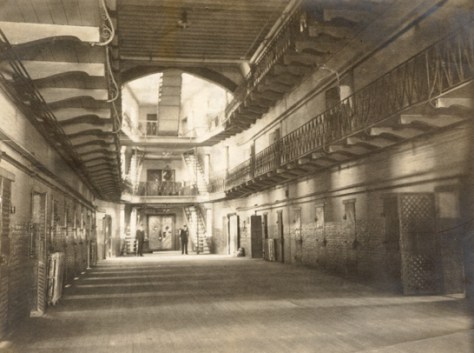

Official Blurb: The American Prison Society Photographic Archive records collection was acquired by the Eastern Kentucky University Archives in 1984 through the auspices of Dr. Bruce Wolford of Eastern’s College of Law Enforcement. Dr. Wolford received the photographs in 1979 from William Bain, instructor at the Kentucky Bureau of Training. In the 1960s Mr. Bain, a former staff member of the American Correctional Association, conceived the idea of a pictorial history of the American prison. With the aid of David A. Kimberling, a prison inmate and photographer, Bain had photographs copied from the American Correctional Association archives plus ones he received from various federal and state correctional facilities throughout the United States. In addition to the copies, which comprise the negative part of the collection, he acquired many original black and white photographic prints. Finally in 1978 through the work of Anthony P. Travisono, executive director of the American Correctional Association, Bain’s dream, The American Prison: from the Beginning. A Pictorial History, was published.
The photographic collection is rich in its depiction of early twentieth century prison life and conditions. The collection covers numerous subjects such as prison living conditions, recreational activities, industries, hospital care, corporal punishment, work gangs on the farm and quarries, vocational activities, weapons confiscated, prison architecture, and the death house. A few of the images are of prison officials, primarily in the federal penitentiary system.
Images from Top to Bottom. All images courtesy of Corrections Photographic Archive
1. One of the cell corriders in the old penitentiary for males on Welfare Island. Note the distance of the cells from the outside walls and windows and the consequent limitations of light and ventilation, especially needed on account of the absence of toilets in the cells, 1924.
2. Isolation unit at Huntsville, Texas, 1953. Photo by Frank Dobbs.
3. Eastern State Penitentiary in Philadelphia, Pennsylvania. Section of E.D.C.C.
4. Heating pipes in cell house at Indiana State Prison.
5. “A” block (North extension “outside cells”) 352 cells now used by Reception Center. Folger Adams Locking, December 5, 1946.
6. West cell block, Central Prison, Raleigh, North Carolina.
7. New Hampshire State Prison, portion of cell block.
8. No Information available.
9. Central aisle, Work House, Blackwell’s Island, New York.
…. was today’s New York Times’ rueful statement of fact.
Writers note: These immigrants are undocumented and unsentenced. They are not criminals. This is not prison. This situation is of acute interest to Prison Photography blog because Maricopa County Sheriff’s office is deliberately trying to blur the distinction between these two very different populations.
I recently commented on Sheriff Joe Arpaio’s scurrilous publicity stunt and parading of immigrants in Maricopa County, Arizona. Not only does Arpaio don his ensnared with the stripes of historical chain gangs, he actually puts them to work as such.
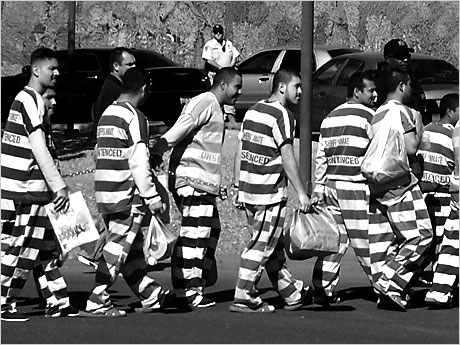
Carlos Garcia for the New York Times
Arpaio’s continued antics are firmly in the national spotlight. The New York Times has a long and varied history of comment. His mob-rule is increasingly divisive because a) we now hope for a just application of the law under an Obama administration and b) Janet Napolitano, former Governor of Arizona, and new Secretary of Homeland Security has yet to prove whether she can run the department without trampling human rights AND in so doing put pay to Arpaio’s abuses. The New York Times notes:
The burden of action is particularly high on Ms. Napolitano, who as Arizona’s governor handled Sheriff Arpaio with a gingerly caution that looked to some of his critics and victims as calculated and timid.
Ms. Napolitano, who is known as a serious and moderate voice on immigration, recently directed her agency to review its enforcement efforts, including looking at ways to expand the 287(g) program. Sheriff Arpaio is a powerful argument for doing just the opposite.
Now that she has left Arizona politics behind, Ms. Napolitano is free to prove this is not Arpaio’s America, where the mob rules and immigrants are subject to ritual humiliation. The country should expect no less.
All eyes are rightfully on this situation. It cuts right to the heart of the ideals America professes to uphold. Watch closely.
TYWKIWDBI is garish and off putting to anyone who judges sites on appearance alone. Fortunately for it, and us, it is also one of the best aggregators of online content. It is a one man operation to compete with Digg!

Roy Brown
I picked up this story and had to relay it. While Christian Milton, former AIG executive, got 4 years for his involvement in $500million fraud, Roy Brown was sentenced to 15 years in Louisiana for stealing $100 from a bank. Brown only took $100 dollars from thousands the cashier handed him and subsequently surrendered himself the next day, ashamed of his actions stating “My mother didn’t raise me that way.”
I don’t know how tied the judges hands were by Louisiana law, but I would resign in disgust if I was a cog in such an abusive system. Fucking disgrace.

Christian Milton
Searching for images didn’t come up with much (admittedly, it didn’t spend too long) but it occurred to me that the mugshot is the aesthetic of the poor and the street “trialshot” is the aesthetic of the rich. I understand they are captured at different moments in the judicial process, but the qualities and circumstances of the Mugshot vs Trialshot make interesting comparison.
MUGSHOT: Regimented, Artificial light, Institutional, Accompanied by booking information, Less likely recipient of bail, Controlled & private space, Everyday clothes.
TRIALSHOT: Unrestricted, Natural light, Public, Accompanied by caption and news article, Certain recipient of bail, Public space, Selected wardrobe.
These comparisons go some length to describe the influence money and status can have in the legal process and how the procedures accommodate those with money and resources to work with/within the system vs. those who are simply subject to its machinations. Just to drive the point home, when charges were first brought against Milton in February 2008, the probation office recommended a 14 to 17 year sentence. An absolute disgrace. A mockery.

Screenshot of fate. The rise and fall of individuals.
Update: Prison Photography collated a Directory of Photographic & Visual Resources for Guantanamo in May 2009.
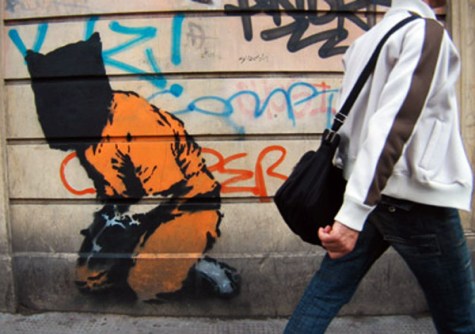
Guantanamo Prisoner, Political Graffiti. Banksy
Anyone who says the recent media tour of Guantanamo isn’t a public relations exercise by the lame duck has not had their eyes open. Global media were given a tour of camps 4, 5 and 6 at Gitmo and all the footage was screened and vetted before release.
Video: Here is the Guardian’s three minute offering. With any hope Obama will put this illegal operation out of action in 2009.
Artistic legacy of Guantanamo

Guantanamo Protesters outside the US Embassy, London
Meanwhile, we can think of the potency that the orange jump-suit has gained. It’s another icon of the Bush presidency. With regard it’s establishment and its bare-faced operations, Guantanamo was far outside of the public’s imagination. Our culture stomached the guilt and under the Bush administration it was never likely Guantanamo prison would be brought back into line with international law. Activist and non-activist art protested Guantanamo by subverting the camp’s own visual vocabulary.

UHC Collective. "This is Camp X-Ray". Art Installation, Manchester, 2003. Guards with replica guns were on duty 24 hrs and followed a regime copied from media reports.
Back on my home turf in Manchester, UHC, a notoriously bold and inventive art collective, scaled up a version of Camp X-Ray on an unused lot in Withington. It was complete with guard towers, fake guns and orders and activity that replicated the media’s reports of Guantanamo, Cuba. See other UHC Projects here, and read the BBC report here.

Road to Guantanamo (2006). A Michael Winterbottom Film, Spanish Release
And while we are not focusing entirely on photography, slightly off topic with video, I cannot recommend Road to Guantanamo highly enough. The film tells the ridiculous story of three young British-Pakistanis who were in the wrong place at the wrong time (southern Afghanistan, November 2003), and ended up in Guantanamo for 2 years. Your jaw will not leave the floor.
This blog is 10 weeks old. At that same age an infant is lifting its head and neck without help, blowing bubbles, smiling and cooing. I reckon this blog is straining its neck, blowing hot air, cooing to no-one, but certainly smiling to itself. So, things look good. I’d like to propose a vague rhythm for my posts. Now, read carefully for I shall say this only once.
Every week or so you’ll see long, well-researched and edited pieces about critical prison issues. Between these “anchor” posts, to keep the juggernaut powering on the information-super-motorway, I’ll post items a little more flimsy. They’ll definitely be prison and photography related, and usually with great visuals and little text. This is a warning to all you early readers to decipher the serious stuff from the really serious stuff.
So, without further ado let me bring to you a quite incredible image. In browsing the United Nations’ official photography galleries I came across this curious image tagged as “Prison”
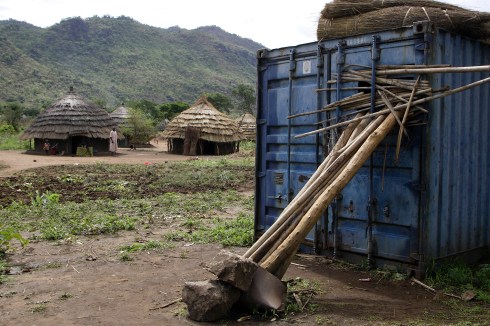
The container serves as a detention facility. Human rights and protection officers made an inspection of the capabilities of the local police and prison service. UNMOs from Torit were engaged in a long range patrol to Chukudum along with various civilian sections of UNMIS in order to assess the security and social conditions of the area.
Sudan, at last count, with 12,000 prison inmates had the lowest prison population of any North African country. In fact, Sudan is doing very well at not locking its population away. It is joint fifth, with Angola, of all the African nations for the lowest prison population (36 per 100,000 people). Sudan is surpassed by Mali (34), Nigeria (33), Gambia (32), and Burkina Faso (at a mere 23 inmates per 100,000 people)! Source.
These figures should absolutely be compared to US figures where 1,000 of every 100,000 American adults are behind bars. 1 in every hundred US adults is under the jurisdiction of federal or state corrections! It’s madness, it’s broken and it’s costing a fortune. (I warned my politics might creep through every so often).
Torit and Chukudum are in the very southeast of Sudan, close to the borders of Uganda and Kenya. This site is over a thousand miles from the Darfur region. It’s even further to the border and refugee camps of Chad. I have no comment on Darfur here. I only wanted to point out that as we grasp and grapple to understand the people in the world around us and we conjure makeshift plans and patchwork solutions, sometimes they involve small personal sacrifices and sometimes they involve locking other human beings in shipping containers.
As of August 2002, Sudan had 125 sites of incarceration – 4 federal prisons, 26 local government prisons, 46 provincial prisons, 45 open and semi-open prisons and 4 reformatory centres for juveniles. I wonder what the nomenclature is for this box? The picture was taken in April, 2007 by Tim McKulka, who has also done some photography covering the Angola Prison Rodeo in Louisiana, an event of which I have opinions. Indeed, I have a piece up my sleeve on my hard drive, awaiting…
Two weeks ago I attended a talk by Van Jones, the founder of the Ella Baker Center. He advocates for social equality and the rights & opportunities of incarcerated youth. Recently, if he didn’t have enough on his plate, he has added saving the environment to his roster of causes. Jones’ energy is contagious and he quickly convinces you that there indeed is “one solution to our two major problems”.

Jarnail Basraa lines up solar cells for a solar energy panel at Evergreen Solar's headquarters in Marlborough, Massachusetts. After decades on the fringe, solar power is closing in on America's mainstream as surging fossil fuel prices and mounting concern over climate change spur states, businesses and homeowners into a quickening embrace with alternative energy. (REUTERS)
Hold on! What? Two problems? Aren’t there more problems than that? Yes, and so Jones, like President Elect Obama, argues that all these can be traced back to economics and environment. Furthermore, Jones argues for a single root solution to these two issues that solves the many related problems. Jones envisages a government-supported, corporate-boosted, people-activated Green Economy that shifts investment from “a 20th century pollution-based & consumption-oriented economy” to “a 21st century clean, solution-oriented economy”. The magic being that the jobless urban poor with the worst cases of asthma, cancers and pollutant-based health problems are the ones to take full advantage of this new platform. Jones asks, “Do we really want to further entrench ourselves in “eco-apartheid” in which the affluent retreat to the hills and the remainder suffer the smog?”
Jones admitted he is not the most likely of authors for a book of this type, but following quick inspection, it (and he) makes sense. Jones seeks routes out of poverty for the urban poor and the formerly incarcerated. His native California is more desperate for solutions than most states.

Solar panels soak up some rays near the Ironwood State Prison in Blythe, Calif. Last week, the state unveiled a 1.18 megawatt solar-power plant at the prison that provides enough electricity to power a quarter of the facility
Jones is thinking big. The creation of jobs, personal prosperity and regional economic growth would need to be unprecedented if it were to mop up the wasted lives and wasted dollars of the California Youth Authority & the CDCR let alone the gross deficit of California’s halting economy (For your interest I read that over 20% of California households owe more on money toward their mortgage than their house is actually worth).
It seemed that I had, accidentally, skirted the same issues Jones works with. How do you give enough previously disenfranchised people enough work and pride to reverse social histories of crime and transgression? If the state intervenes, prematurely or not, where friends and family cannot succeed, it absolutely must begin when the offender is committed to an institution. And yet, as I noted in my previous post only 5,400 inmates are involved in PIA work. (This figure doesn’t factor for the number of inmates in retraining programs, which fluctuates. I’ll get back to you) The fact remains, the CDCR is overcrowded and not investing in rehabilitation adequately. All education and vocational training is fully subscribed.

Ironwood Solar Field
The unremarkable photograph (above) of the first CDCR solar field at Ironwood State Prison, which I wrongly attributed to Wasco, and used as for closing cynical footnote about watercolour painting is perhaps worth revisiting.
The fields are in the middle of nowhere, because most newly constructed prisons are in the middle of nowhere. I wonder if there could be a conspiracy of persuasion to bring SunEdison or any of their partners and competitors to these remote locations with an inactive but very willing pool of men, set up factories and operations and train inmates during their sentences?
I would like to ask Van Jones if he considers the current CDCR and/or the developing green economy infrastructure flexible enough to execute a long term retraining programme within California’s prison system. How plausible is it that the new green economy can benefit the imprisoned population of America? I believe Jones when he says we can reach out to the urban poor and provide training schemes. I believe Jones when he expects government support to launch thousands, even millions, of jobs and through doing so gives rise to a multitude of career paths that emerge, shape and change along with the renewable energy industry.

Ironwood Solar Field (REUTERS)
That said, I am skeptical that this herculean social project could dovetail easily with the federal and state prison systems of America. People are suspicious of corporations involved in state corrections; people may be shocked to inaction when learning of the massive investment and rarified leadership required for a large scale prison works programme; people know that historically the prison is hard to access; people may suspect no return on its tax dollars.
Logistically, anything is possible. But culturally many things are proscribed. The political will to enact a sweeping reform of prison training based upon a new-green-economy-doctrine may wither quickly when confronted with public opinion and economic depression. I fear prisoners will get ignored for another generation and pushed oncemore to the bottom of the priority list.
Two weeks ago, I was lolling in bed with the local NPR station airing in the background. It was one of those times when the free sway between sleep and wake buoyed the iterations feeding the subconscious. The words from the waves were deep and clear and the meanings my own to navigate without the filters of plain-sailing reality. The whole reverie was quite comforting. Rick Steves was at the mic and his words about ‘otherness’ charted the same course my thoughts had – many times previous.
Rick Steves is a travel journalist who is keen to see (American) tourists embrace an less-disneyfied, more-connected type of travel. He was answering a listener’s question about border towns, but instead of responding with specific tales from specific towns Steves was much more interested in excavating the structure of thought that defines the appreciation of border towns. What parameters of thought do we rely on when thinking about borders? Why do border towns gain notoriety? Why do border towns evoke fear, love, misery and hope? Why do borders bring people escape, opportunity, exploitation, largess and threat?
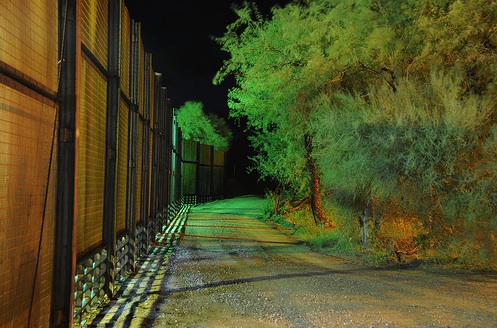
Photographer: Glyph Hunter, US Mexico Border
Before I quote Steves’ answer, I want to put his response into the context of my somnolent appreciation. Borders delineate two forms of existence; the difference sometimes extreme, and sometimes barely recognizable. Nevertheless, borders are defined by the imposition of different rules on either side. Borders have many manifestations and, unfortunately, walls have become a recent embodiment of bi-national relations.
Prisons also have central to their function the imposition of one set of rules on one side of the wall in order to maintain the prevailing rules on the other. A border delineates the exterior reaches of a territory, whereas the prison exists within the interior. The prison, historically, is less porous than a border and is more heavily policed – although in the case of the US border the distinctions are becoming less evident.

Photographer: Eros Hoagland
In short, I believe prisons (and other sites of incarceration) should be thought as systems of state/corporate authority, based on the lowest common economic denominators, based on the concealment of activity and the creation of an excluded class whose definitions are open to manipulation. In the most tragic interpretation of Edward Said’s theory, I contend that on the other side of prison walls, just as on the other side of border walls, “The Other” exists.
And so, Rick Steves:
I am standing on top of the rock of Gibraltar. I read that this is the only place on the planet where you can see two continents and see two seas come together. There are tiderips. It is a confused sea, but there is food there. And all the seagulls go to the tiderips and the salmon are underneath, and the swarms of little herring, and so on … and it is a fascinating thing when two bodies of water come together. It makes danger for your boat, but there is food there and that is where the fish come and that is where people go for sustenance and that where the action is. And I am standing on the rock overlooking the tiderips. And there’s the ocean going freighters and the local people worried about the maritime environment. There are the stresses between Christianity and Islam which is just over [the water] in Africa, and that morning I was stood in a church, which was built on the ruins of a mosque, which was built on the ruins of a church, which itself was built on the ruins of a pre-Christian holy site! And if you can go to the places where cultures come together that’s where you have tension and you can have opportunity.
Translation – expect, witness and embrace difference in novel ways. Choose between tension and opportunity.
We have tension now [in America]. If we have unsophisticated political leadership, and dumbed down media and an electorate that doesn’t expect its neighbors to be nuanced and complex and more thoughtful in how they approach these challenges right now then the places where these cultures come together will be a big, expensive headache. And if we have smarter leadership and we engage the world, then the places where the cultures come together will be a plus. When we have cultures coming together in a constructive way it becomes a blessing instead of a curse. If it’s “my way or the highway” and if it’s just shock and awe then it’s not going to work.

Photographer: Eros Hoagland
Steves wasn’t talking about methods of incarceration, but his structuralist description that clearly defined ecological, socio-cultural, tectonic and psychological tensions of borders reflected society’s same unconscious antagonism that I have observed in popular thought. At best the American public is apathetic; at worst, it breeds searing hatred of those on the other side of the walls.
In the case of prisons, the American public has been duped by dumbed down media – Cops, News bulletins disproportionately reporting crime, movies that exploit false stereotypes of prisons and prisoners. In the case of prisons, the American public has been scared by the shock and awe tactics of politicians – “Tough on Crime” rhetoric. In the case of prisons, the American public has been fooled by an unsophisticated civic leadership that panders to the public’s desire to not think any further than “throwing criminals” in prison – massive prison expansion, state budgets dominated by corrections spending. Prisons have become a big expensive headache.

Photographer: Jon Lowenstein
We need to stop ignoring the harsh facts about prisons and we need to bring them closer to our society, in which they sit. We need to reevaluate the failed prison expansion experiment of the past 30 years and we need to look upon the problem as an opportunity for sensible decision-making. We need to stop our fear and anger from dictating our reason and we need to analyse the system and not judge those subject to it.
The prison is a focus of hard emotions for those who reside, work and visit. It is a tumultuous place with fierce tensions. Those of us on the side of the wall with more resources and opportunity should think about how we can affect existence on the other side. We shouldn’t be fooled by the physical barrier dividing us because history has only ever shown that walls are temporary and humanity lasting. We should not allow the concrete walls to harden a psychological barrier to the communities on the other side. We should not find excuses – we should find opportunities.
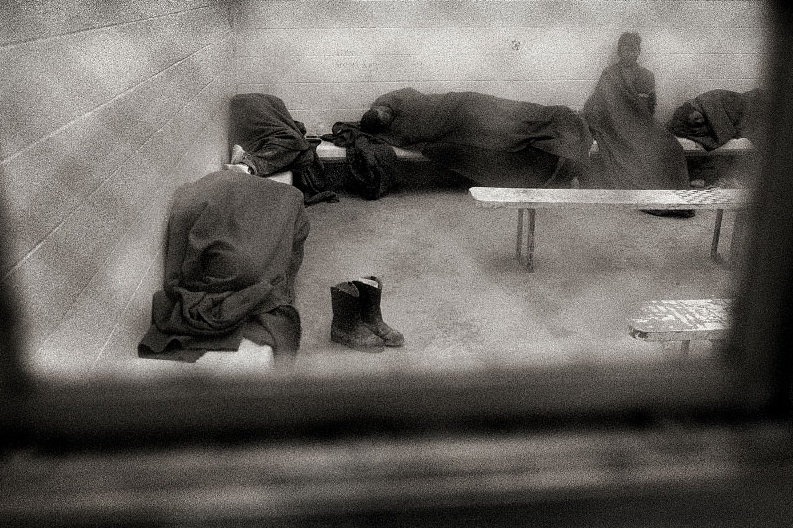
Photographer: Jon Lowenstein
And with this said, it is apparent why photography as a medium appeals so personally to me. Of all media, photography seems one of the most responsible. Photography has a history of social responsibility. Photography, some would argue, takes a bit more effort than TV. If photography is to be allied to the moving image, I prefer it allied to cinema and film. I hope to support this theory over many more posts.
Image notes:
Eros Hoagland has recently done some excellent work in newly constructed prisons of Southern California that I shall return to soon.
Jon Lowenstein is extending his portfolio rapidly. He rightly won plaudits for his documentary work in South Chicago schools back in 2005. He continues his commitment to Chicago.
Glyph Hunter, by his own admission, got lucky and caught a great exposure.
Wild thanks to Brendan over at Anxiety Neurosis for publishing on the world wide web my recent heartfelt plea to close friends. My words are now world wide … and webby. Seriously, I’d encourage you to read his analysis as he said, with some degree of wit and intelligence, what I had relied on the New York Times Opinion Page to say for me.

David Alan Harvey, Title Unknown, from Living Proof 1 series
I’d advise that you don’t read on after Brendan’s discussion of the propositions regarding criminal justice, as the tone changes to one of outrage and profanity. Do, however, consider Brendan’s intriguing solution to our failed social experiment and financial black hole we know as the prison-industrial-complex.
My daydreams might seem a little strange to you. I envision a system of work-camps spread throughout California. Low-level offenders (obviously non-violent) would be siphoned away from the concrete and steel onto various prison farms. They would become, possibly for the first time, acquainted with the world of plants, dirt, sky. They would be required to till the soil, sow the seed, reap the harvest and above all else participate in a cycle of life greater than their own. The crops (organic, obviously) would be distributed throughout state agencies providing food for the convicts, prisons, schools and state hospitals. Imagine school-children eating something that hadn’t be processed and purchased from a profit-driven third party with no regard for the kids’ health or well-being. At night the inmates of my farms would take various classes both academic and trade-oriented. They could see therapists, take workshops or paint the distant mountains in watercolor. Whatever they need to show them something outside of the life they’ve known. They would have free range of the property in question, requiring a couple fences and a small staff of guards. Where are they going to run to?
Knowing Brendan as I do, he hides here a vulnerable idealism that we would all like to embrace but the bottom-line mentality of modern life has disappointed us too often. We keep our arms folded. Brendan’s main points are uncontestable though – remove non-violent offenders from prisons; engage them in more than wall-staring for 23 hours a day; provide meaningful, even plentiful, opportunities for rehabilitation, education and therapy. Unfortunately, all this costs money and when CDCR struggles to cover the cost of inhumane lock-up the chance of seeing an individual-oriented rehabilitation is less than zero.
Work-camps do exist in California and they specialise in training for fire-abatement. This is a far cry from Brendan’s organic farming initiative, but probably skills in bio-diverse agriculture are as handy as skills in fire suppression. As we continue to burn fossil fuels and globally-warm our summers, growing local crops and putting pay to the 3,000 mile caesar salad, will be as relevant as beating annual forest fires.
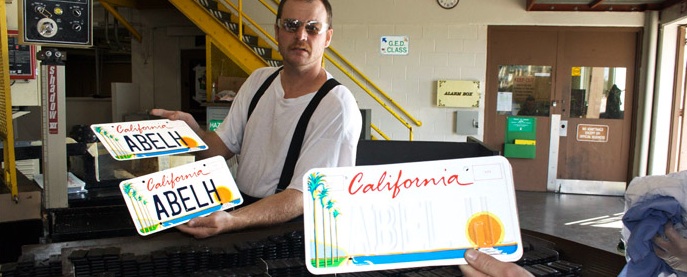
Photographer Unknown
But if we are talking about productive inmates it is worth noting that the CDCR runs the Prison Industry Authority paying inmates anywhere between 30 cents and 95 cents before deductions. This is a body that provides state departments with furniture, uniforms and California drivers with their license plates. Many have described this system as “Modern Day Slave Labor”. If it seems that way, it’s because it is.
CDCR runs the PIA because the state profits from it. Engaging the inmate in daily activity is essential, but we should try to move away from repetitive factory production, or at the very least break it up with other outlets of energy (and ideally even creativity). What other administered programs could occupy inmates’ time? We must consider here programs that do not turn an immediate product or profit – but secure long term savings for society as the inmate is provided with skills and self esteem. The PIA uses 5,900 CDCR inmates. What do the remaining 312,511 men, women and children under CDCR jurisdiction do?
These are general questions (and admittedly subjective gripes) for which there are no correct answers. Nevertheless, with so many systemic problems we should only focus on the problems we can affect and the most timely problems of the CDCR. Californians’ priorities now must be to prevent the motion to change the criminal-justice system into a “victim-vengeance system” (Prop. 9) and the motion to broaden the state’s definition of crime, subjecting thousands more citizens to the abuses of a failed system (Prop. 6).
In the meantime, we can all focus on the watercolour opportunities available to inmates at Wasco State Prison.

Wasco State Prison's new solar field
Note on Images: David Alan Harvey’s image here is included purely for aesthetic reasons. The author confesses no background knowledge of the image, only an intrigue in the juxtaposition between uniform-pressed youth and caricatured-inmates subjected to the humility of stripes and trucker hats. Even if these young men grew up and/or went to the same schools together, there is no relationship between them now. All this is neatly summarised by the wielding of the gun. The guard pays attention to the camera almost unaware of his responsibilities over his shoulder. The rifle makes the guard’s close personal observation of inmates unnecessary; the guard has a back-up. With the use of weaponry, any misdemeanour can be remedied/snuffed out within an instant.
I do not know David Alan Harvey’s views on the prison industrial complex. If I ever acquire that knowledge I will be sure to share it. As well as his website he also has a solid blog.
Disclaimer: This post, while making use of photographic imagery is a non-objective commentary. It has more to do with the author’s politic than an academic look at the photographic medium.

 Prison Photography