
You are currently browsing the category archive for the ‘Opinion’ category.

Danny Lyon, Guns Are Passed to the Picket Tower, Ferguson Unit, Midway, Texas, 1968
During a brief speech made upon receiving the Missouri Honor Medal in Journalism, documentary photographer Danny Lyon made an astonishing call for insurgency in America:
“There, I said it, ” he added.
Lyon evokes the blood spilt as matter of course to forward the campaigns of the American revolution, the civil rights movement, and the anti-Vietnam protests.
I cannot argue with his politics but I am not ready to make a call for “blood on the streets.” Maybe, I am not brave enough; maybe I am still hopeful that meaningful change can occur in America through non-violent means. I just know if a right-winger made similar calls, I’d be repelled.
I bring this up because Lyon and I are scheduled for an interview in December and his comments must be revisited and tested.
For the benefit of the media, Lyon penned an 11-point “laundry list” of issues he wishes to see addressed – jail terms for the bankers responsible for the economic crash; rights for immigrant workers; jobs to enrich the environment. Items 9 and 10 caught my eye:
9) Abolition of the American prison system as it stands.
10) Immediate reviews and interviews inside state or federal prisons by public committees and parole boards with any inmates that have been inside prison for twenty calender years.
Prisons have grown as a result of social division, greed and flawed abstract notions of justice – seemingly, the same damaging forces in *free* society to which Lyon responds.

Blimey! It’s actually happening. Prison Photography on the Road is fully funded … and then some.
I’ve got the cash, the collaborators and the car. All I need are places to lay my head.
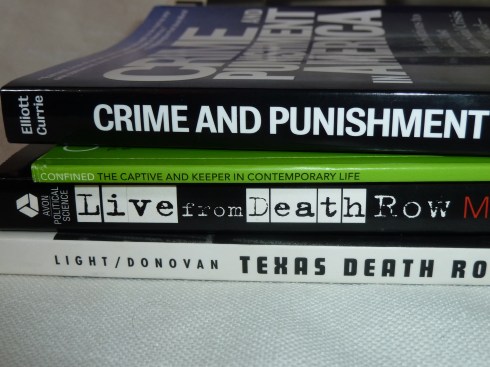
To make the prospect of opening your place to an itinerant more appealing I’m offering four books to sweeten the deal:
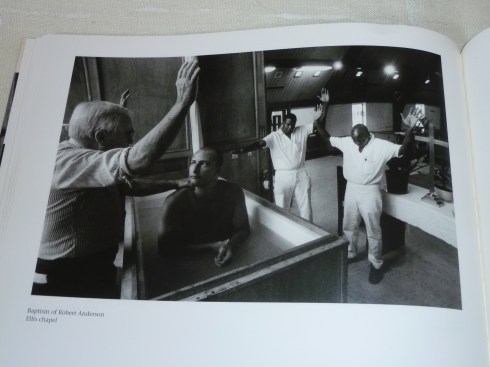
Texas Death Row by Ken Light and Suzanne Donovan – one of the most remarkable photobooks of prison subject matter given Light’s unprecedented access.
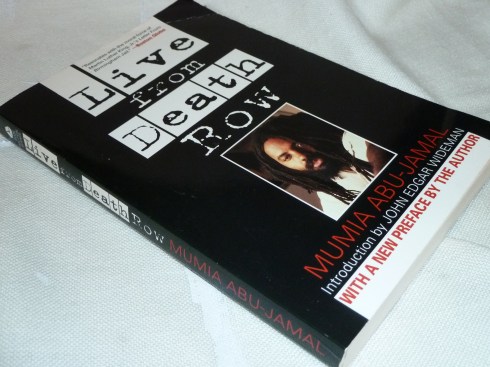
Live from Death Row, by Mumia Abu Jamal – commentary on the physical and psychological hardship of death row and on the U.S. prison systems by America’s most famous incarcerated activist. A landmark work.
Crime and Punishment in America, by Elliott Currie – one of the earliest analyses of the growing U.S. prison system written for the lay person. “Currie concludes that America can combat the problem of violent crime if it wants to. The question is, are affluent Americans willing to make the effort, or will they continue to set up their own ermine-lined ghettos, while pouring tax-money into prisons rather than schools,” says Timothy Mason.
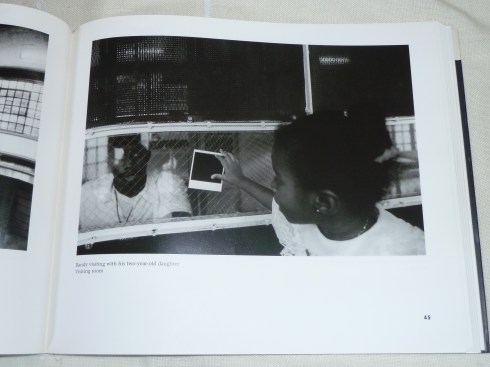
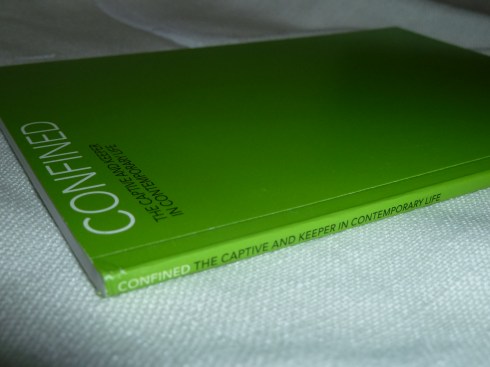
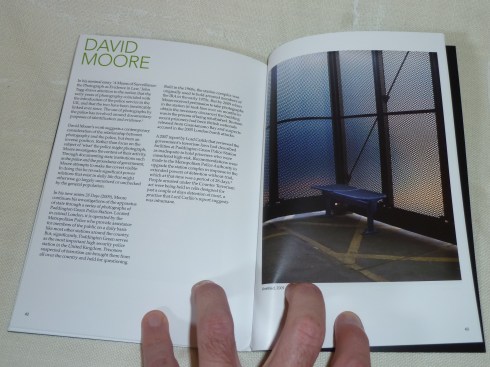
Confined exhibition catalogue including the work of photographers Juergen Chill, Edmund Clark, John Darwell, Dornith Doherty, Ben Graville, David Maisel and David Moore. And with a foreword by yours truly.
LEGALESE
All you have to do to be entered into the draw for these four books is to send an email with your name and home city to me at prisonphotography [at] gmail [dot] com. Please include ‘PPOTR Book Giveaway’ in the subject line.
The PPOTR book giveaway is open to anyone in the world.
For those of you who enter and live in the U.S., know that by doing so there’s a chance I’ll be taking up temporary residence on your sofa.
The winner will be announced a week from today, on the 4th October.
PICTURES!







Families of youth incarcerated at the Walnut Grove Youth Correctional Facility in Mississippi listen to testimony at a hearing about alleged inmate abuse. © Phoebe Ferguson/NPR
A couple of months ago colleagues and I discussed Inside San Quentin, Inmates Go To College, a story about the San Quentin Prison University Project, aired on NPR. Our discussion wasn’t about the content of the story as we’re all very familiar with that excellent education program. (I do encourage you to listen to the piece).
Rather we noted the sharp increase in the number of stories about prisons on NPR over the last 12 months.
I wanted to point it out for my own peace of mind. In several interviews recently I have bemoaned the lack of meaningful national media coverage of prisons and sentencing issues. I don’t want to mislead anyone and suggest that good analysis is entirely absent because that isn’t true. It’s just that NPR is doing the heavy lifting at the moment.
Stories in the past year have included: female entrepreneurs in an Oregon prison; Laura Sullivan’s two-parter on private prisons and immigration in Arizona (one and two); Buddhist meditation in an Alabama prison; youth incarceration in Mississippi, in two parts (one and two); and the sanctuary of prison libraries.
The difficulty of re-entry was at issue in the segment For Many Ex-Offenders, Poverty Follows Prison.
Not to mention Laura Sullivan‘s heroic journalism – in three parts – on the inequities of the bail bond system (one, two and three.)
This American Life has had at least two stories about the criminal justice system. One on a corrupt juvenile court in Walnut Grove in Mississippi and the other about a father/son adoption story behind prison walls.
There’s also the series Prison Diaries from a while ago.
Glad I got that off my chest.

Photographers attempt to capture a picture of Julian Assange, believed to be in this prison van, leaving Westminster Magistrates Court on December 7, 2010 in London, England. (Photo by Peter Macdiarmid/Getty Images)
Today I came across this image by Peter MacDiarmid. It converges a few threads I’ve noted before.
I don’t know how many times Assange went to court along the public streets of London but it’s worth looking at another of McDiarmid’s images, this time of Assange in the interior of a custody van.
SERCO, the company providing the custody van is as global as Wikileaks itself and specialises in lock-ups and government services.
The Wikileaks saga has gone relatively quiet recently. Bradley Manning’s circumstances are no longer top of the hour. The Bradley Manning Support Network describes his conditions of detention:
Although Bradley has not yet been tried, he has been held in solitary confinement since May 2010. He has been denied meaningful exercise, social interaction, sunlight, and has occasionally been kept completely naked. These conditions are unique to Bradley and are illegal even under US military law as they amount to extreme pre-trial punishment.
Contrary to this account are reports that Manning is no longer in total lockdown. In April, he was transferred to a medium security facility in Fort Leavenworth.
If we are to compare experiences, remember, Assange in the scenario above was also under pre-trial detention.
Solitary confinement or not, Bradley Manning – regularly the subject of bullying -is not in the best shape to cope with incarceration. In 2007, early in Manning’s army career, doctors reported he was “mentally unstable” and recommended he be “discharged immediately”. The recommendation was rejected and due to a shortage of computer intelligence analysts, Manning was recycled back into service and pushed through the system.
Currently, Manning is heavily medicated with anti-depressants.
The U.S. military has made no comment on Manning’s psychological condition other than to say it is being investigated. He faces court marshal in December 2011. Manning faces 52 years if he is found guilty. That’s a long time for someone who, according to this credible 18-minute presentation, is a shell already.
The theatre surrounding Assange’s charges, detention, court dates and bail are in stark contrast to the near invisibility of Manning’s transfers and detention. With Assange remaining bold, vocal and in the public eye, Manning’s invisibility is even more conspicuousness. By numerous definitions, it seems Bradley Manning is already fading away.
It’s fair to say that building, finding and maintaining momentum for a Kickstarter project keeps you busy (the case for any crowdfunding effort I’d guess).
In promoting Prison Photography on the Road, I’ve been lucky this week to tap a couple of networks previously beyond me.
KICKSTARTER BLOG
Cassie Marketos and I did an email interview for the Kickstarter blog: Creator Q&A: Pete Brook and Prison Photography.
This seems to be the most popular quote: “We live in a visual world. Every image is political. Sometimes we should not be thinking about the images we see, but instead thinking about the images we do NOT see.”
THOUGHTS ON PHOTOGRAPHY
Paul Giguere and I did a phone interview for the Thoughts on Photography podcast (available on iTunes).

For any of you in Seattle this Thursday, September 8th, I’ll be speaking at the “Photo Slam” event in the PIONEER PASSAGES alley between 1st Avenue S & Occidental Ave S and Yesler Way & S Washington St.
I’ll be talking about a handful of prison photographers, my motives for focusing on U.S. prisons and asking the audience to think about the images they don’t see.
Others presenters are John Keatley, Mike Kane, Alan Berner, Danny Gawlowski, Jordan Stead, Genevieve Alvarez, Joshua Trujillo and Chantal Anderson.
The event runs from 6pm to 8pm.

The goodies just keep rolling in. Shame they aren’t shifting as quick as the smaller level funding incentives. So while this print is amazing and I want it myself, I must encourage any of you with big “photography collector friends” to pay the Prison Photography on the Road Kicksarter page. They might just get a bargain!
If you want to know more about Stephen’s work and motivations see The Feedback of Exile, an interview we did a couple of years ago.
– – – – – – – – – –
Photographer: Stephen Tourlentes
Title: Comstock, NY State Prison
Year: 2009
Print: 11″x14″ B&W, Archival Pigment Print
Aritist’s Proof, Signed
Print PLUS, self-published book, postcard and mixtape = $500 – BUY NOW

A Meeting of the Harvard Corporation, which invests Harvard’s endowment, guarded by police. © Gregory Halpern
As a resident alien, much of the American revelry is lost on me. But Labour Day? That’s a national holiday dedicated to the social and economic achievements of American workers. That’s something I can celebrate.
Today then, I point you in the direction of Gregory Halpern‘s neatly edged project Harvard Works Because We Do (it has a beginning, a middle and an end) about the service workers employed by Harvard University. From portraits to playful presentation (above) to messy colour film shots of a student sit-in to a successful outcome securing over $10 million in pay and benefits for the more than 1,000 service workers on campus.
Harvard Works Because We Do is a project full of character and a clear voice. Halpern was one of the sitting students. From his portfolio:
“Between 1994 and 2001, the endowment of Harvard University tripled, making the school the wealthiest non-profit in the world, second only to the Vatican. In the same years, Harvard heavily outsourced many service jobs to lower-paying companies, thus resulting in average wage cuts of 30% for the schools’ custodians, food-workers and security guards. In response, I got involved with a student group called the Harvard Living Wage Campaign and I began this project. My goal was to publicize the situation, to share the stories of a number of service-workers I had come to know, and to raise questions about the prevailing class-structure at Harvard and on college campuses in general.”

 Prison Photography