
You are currently browsing the category archive for the ‘Photography: Non-Prison’ category.

Says Trolley Books:
The Arabic version of Alixandra Fazzina’s latest book A Million Shillings – Escape from Somalia (Trolley, 2010) was officially launched last Friday the 14th of January at the government buildings in Aden, Yemen, by António Guterres, the UN High Commissioner for Refugees.
Whilst the English version of the book keeps getting much attention and critical acclaim, both by the media and official institutions, it is hoped that the Arabic version will help it reach an even wider audience across the world, and to continue to advocate for the cause of these people who deserve a better treatment and better conditions, both at home and in the receiving countries.
The case for why this important book should be published in the language of the lands which it describes is as huge as my embarrassment that it had never, would never have, occurred to me.
My embarrassment is compounded by the fact that I rarely ever think about photobooks published outside of the English language.
FURTHER READING/VIEWING
Book review: A Million Shillings: Escape From Somalia by Alixandra Fazzina, Sean O’Hagan, the Guardian.
Gallery: A Million Shillings: Escape From Somalia, Alixandra Fazzina photographs of refugees and migrants from civil war-torn Somalia, the uprooted people who risk all to cross the Gulf of Aden in search of a better life.
Exodus, British Journal of Photography article on the work of photojournalists covering migration. Details extreme danger of Fazzina’s work in Somlalia.
Review: A Million Shillings: Escape from Somalia by Alixandra Fazzina, by Wayne Ford.
A Million Shillings also made it on to Sean O’Hagan and Colin Pantall‘s Best Books Lists for 2010.

© Alixandra Fazzina
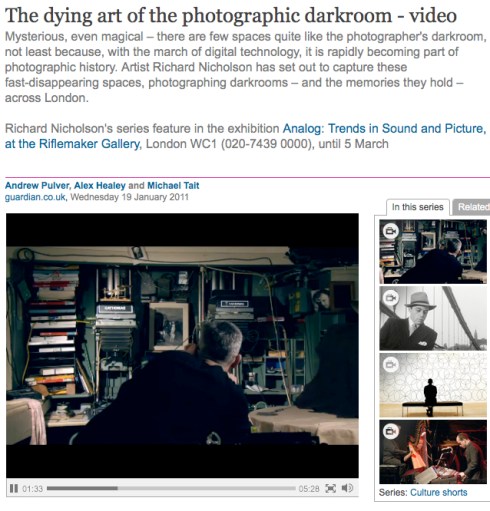
Following up on yesterdays activities, the Guardian has produced this video about Richard Nicholson‘s series Analog.
Prisoner Advocate Elaine Brown on Georgia Prison Strike: “Repression Breeds Resistance”
Elaine Brown appeared on Democracy Now! today. Amy Goodman described the strike as the biggest in American History.
Brown alleged an inmate paid $800 to a prison guard for a cell phone.
Goodman suggested the term cell-phone has realised its true meaning.
‘CELL’ PHONES
Also, for the New York Times, in Inmates in Georgia Prisons Use Contraband Phones to Coordinate Protest, Sarah Wheaton describes how ‘prison protest has entered the wireless age’ and how gang, religious and race divisions were put aside to organise the strike.
Note: The Georgia DoC say they have locked-down the prisons. Not true. The inmates locked themselves down, refusing to leave their cells.
Biggest Prison Strike in American History
Prison strikes are a rarity these days, with prison populations fragmented, disciplined, docile, estranged from society and stripped of tools for political mobilisation.
There’s a growing number of reports coming out of Georgia, where the strike is now into its fourth day. You should read the excellent Prison Law Blog for a summary of communications and developments – Georgia Prisoners Strike for Better Conditions.
As Sara points out:
“Relative to the state’s population, it has an outsize reach. In Georgia, 1 in 13 adults is either in prison, in jail, on probation, or on parole — the highest rate of correctional control in the country. (Nationwide that figure is 1 in 31.) According to the Sentencing Project, over 4% of Georgia adults and almost 10% of African-Americans cannot vote due to felony disenfranchisement laws.”
The strike is based on reasonable demands; notably, demands applicable to issues in many state prison systems:
· A LIVING WAGE FOR WORK: In violation of the 13th Amendment to the Constitution prohibiting slavery and involuntary servitude, the DOC demands prisoners work for free.
· EDUCATIONAL OPPORTUNITIES: For the great majority of prisoners, the DOC denies all opportunities for education beyond the GED, despite the benefit to both prisoners and society.
· DECENT HEALTH CARE: In violation of the 8th Amendment prohibition against cruel and unusual punishments, the DOC denies adequate medical care to prisoners, charges excessive fees for the most minimal care and is responsible for extraordinary pain and suffering.
· AN END TO CRUEL AND UNUSUAL PUNISHMENTS: In further violation of the 8th Amendment, the DOC is responsible for cruel prisoner punishments for minor infractions of rules.
· DECENT LIVING CONDITIONS: Georgia prisoners are confined in over-crowded, substandard conditions, with little heat in winter and oppressive heat in summer.
· NUTRITIONAL MEALS: Vegetables and fruit are in short supply in DOC facilities while starches and fatty foods are plentiful.
· VOCATIONAL AND SELF-IMPROVEMENT OPPORTUNITIES: The DOC has stripped its facilities of all opportunities for skills training, self-improvement and proper exercise.
· ACCESS TO FAMILIES: The DOC has disconnected thousands of prisoners from their families by imposing excessive telephone charges and innumerable barriers to visitation.
· JUST PAROLE DECISIONS: The Parole Board capriciously and regularly denies parole to the majority of prisoners despite evidence of eligibility.
In my spare time I enjoy sorting my socks in color sequence, imagining the sound of volcanoes and simulating flight with the aid of Google Earth.
On a recent “flight” out of Boeing Field, here in Seattle, I noticed a plucky peace protest right under the nose of one of Americas largest military contractors.
Behind Lockheed Martin, Boeing is the second biggest defence contractor in the nation.
Keep you eye on the top left as I zoom in …

… closer …
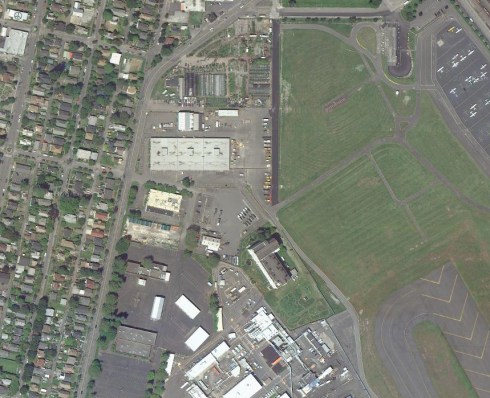
… closer ….

… hooray! Whoever you are, you peace-luvvin’, rooftop decoratin’ hippiester, I salute you.

MAKE ART, NOT BOMBS

I’m not the first to ask the question which is why it is so easy for me to answer.
Known commonly as “the Parked Domain Girl” or “the Expired Domain Girl“, her’s is the beaming face that pops up when the URL punched into your browser includes a typo. Two years ago, You Suck at Websites explained:
“Demand Media is the company responsible for pimping out this girl on empty websites set up to generate money from accidental visits. The Demand Media business model is this — scoop up generic or keyword-rich domain names and sell advertising space despite the lack of any iota of useful content. It’s not exactly spamming, but it’s just one notch above mass emailing Viagra ads.
In the comment threads, readers quickly found the original iStock image ‘Attractive Student‘, the photographer, a whole portfolio of images of her and one in which she’s really happy.
Also in the comments, the original photographer, Dustin Steller chimed in:
I am the photographer who took the photo you all are talking about. I shot the series in the Kansas City area, so it is definitely not a real college campus. Here is the link to see some more from the series – http://www.istockphoto.com/dsteller/ As a side note, it is my little sister.
Steller took the photo at Unity Village in Kansas (Flickr image of tower, Google street view)
WHOSE IS THAT FACE
Is it even her own at this point? Is it recognisable by a significant number of folk? Maybe only in America? Is this image ubiquitous (enough)? You Suck at Websites reckon she’s been viewed “more times than a Paris Hilton sex tape.” Of course, Ms Hilton is not the measure by which we gauge web-notoriety.
I’d argue the face/image is ours more than hers at this point. An unintended visual pseudonym for glitches in web-browsing.
AN ARTIST RESPONDS TO THE FACE
The website Urlesque points us in the direction of Parker Ito; an artist who grappled with the empty infamy of this image. For his project The Most Infamous Girl in the History of the Internet, Ito asked orderartwork.com, a Chinese company which makes oil paintings on-demand, to create a series of paintings based on the Steller/iStock/Demand Media image.
The results are spectacularly banal:
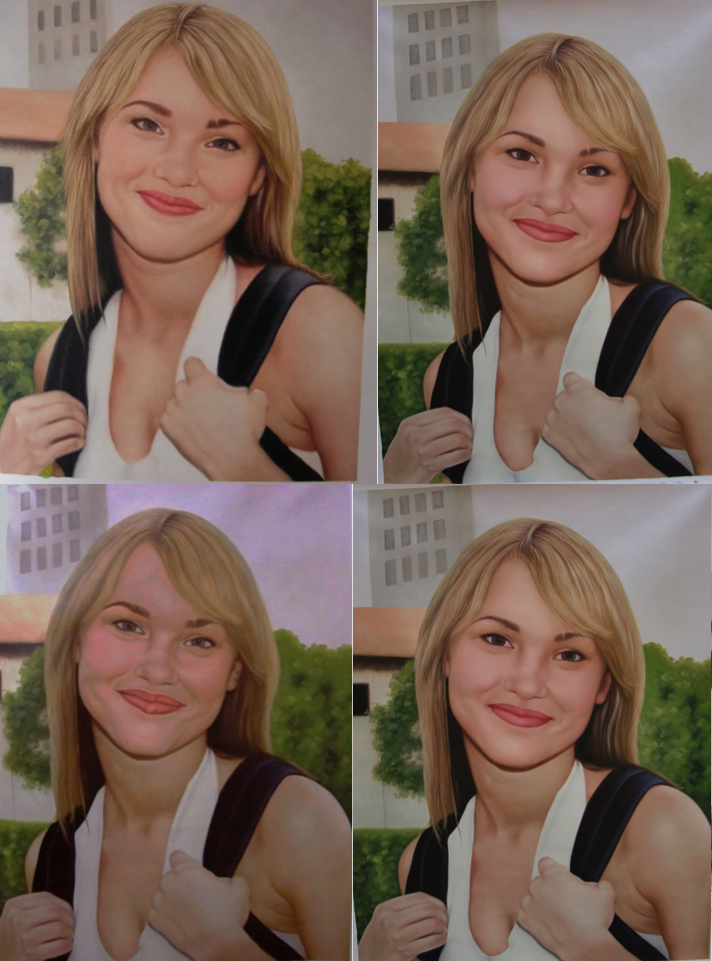
Gene McHugh at Post Internet has written about Ito’s project:
“[The Most Infamous Girl in the History of the Internet] might be considered in relation to Warhol’s Marilyn series of silkscreened paintings. Both Marilyn Monroe and “the parked domain girl” are icons of emptiness–Monroe was (in her media representation) a blank slate for sexual desire, the parked domain girl is (in her media representation) a symbol of sites without content.”
McHugh goes on to point out that Warhol was interested in “the way that ‘real life’ stars like Monroe developed a life of their own in the sphere of reproducible images. Whereas “the parked domain girl” takes on – indeed establishes – a meaning and a “reality” that didn’t exist prior to Ito’s art.
McHugh concludes that the image of “the Parked Domain Girl” is culturally-distributed enough to be defined as icon.
“Ito’s work is thus meaningful not for depicting the automated painting of a “real” icon, but for depicting the outsourced hand-painting of a “fake” icon and, in so doing, bringing Warhol’s joke full circle.”
Ito also adopted the format of Demand Media’s web-pages for his own website homepage:
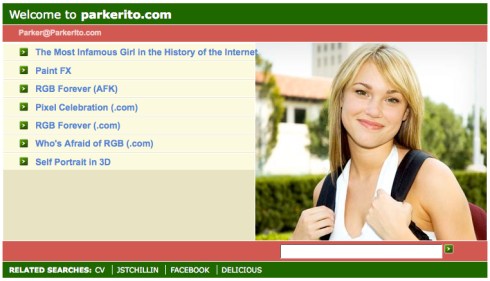
Also worth checking out
The Everywhere Girl – http://www.theeverywheregirl.com/ – … the face that launched a thousand ads!
An artist’s use of photography to stick it to the man
Asim Rafiqui brings to our attention the response of Hasan Elahi, a Bangaldeshi-born American citizen, to government suspicion and the FBI’s unwillingness to remove him from the “watch-list”.
Since 2002, Elahi has monitored his own movements on his website Trackingtranscience.net
Rafiqui:
Elahi posts his day, every single mundane aspect of it. A globe-trotting Professor of media, he posts all his activities, complete with GPS coordinates and the date/time stamps at the site, effectively monitoring his daily life. His meals, toilet breaks, airport waits and almost all the mundane acts that define 99% of what constitutes modern life. His server logs reveal that the Pentagon, and even the Executive Office of The President have clicked in while the FBI continue to monitor his activities through this site itself. Our tax payer’s money at work.
Pictured below, Elahi’s toilet breaks.

Two years ago, Elahi appeared on the Colbert Report and explained that if 300 million Americans did this, the FBI would have to employ millions of agents just to keep up with the data flood. Subversive, funny and the best type of protest … except he’s left with no privacy.
HASAN ELAHI
Hasan M. Elahi is an interdisciplinary media artist with an emphasis on technology and media and their social implications. His research interests include issues of surveillance, sousveillance, simulated time, transport systems, and borders and frontiers. Elahi is currently an Associate Professor at the University of Maryland. He previously taught at San Jose State University; Rutgers; the University of South Florida in Tampa, Florida; West Virginia University; Wanganui School of Design, in Wanganui, New Zealand; and also in Houston, Texas.
Elahi’s own site – http://elahi.umd.edu/
The Visible Man: An FBI Target Puts His Whole Life Online, Wired.com, by Clive Thompson, 05.22.07.
– – – – – – –
Found via Andrew Jackson’s Writtenbylight blog

Golf Five Zero watchtower. Crossmaglen, South Armagh, Northern Ireland, UK. © Jonathan Olley.
Last month, I had a jolly nice chat with a jolly nice chap about what all this means at Prison Photography. Where’s this open journal taking me?
I said if I took this whole thing to the academy, it could be as simple as a historic survey: The Uses of Photography to Represent, Control and Surveil Prison, Prisoners and Publics in the United States (1945 – 2010).
I was encouraged to ditch the historical view and engage the modern. Ask myself, why should anyone care about prisons? Only a small minority care now and that status quo has remained for many reasons tied up in the antagonisms of capitalism. Would a historical survey change minds and attitudes or just lay out on paper the distinctions most people have already made between themselves and those in prison?
Perhaps people would care more if the abuse of human rights that exists within the criminal justice system of America were shown to impinge on everyone, not only on those caught in its cogs?*
What if we consider the methods and philosophies of management used by prisons and identify where they overlap with management of citizens in the “free” society. Think corporate parks, protest policing, anti-photography laws, stop and search, street surveillance, wire taps, CCTV.
My contention has always been that there was no moral division or severance of social contract over and through prison walls. For me it’s never been us & them; it is us & others among us put in a particular institution we call prison.
But, now I am seeing also, there is an ever decreasing division of tactics either side of prison walls. Strategies of management and technologies of discipline perfected in prisons have crept into daily routine.
What has this emphasis on containment and of monitoring – at the expense of education and social justice – done to our society and to our expectations of society?
SURVEILLANCE/CCTV IN PHOTOGRAPHY
And now for the tie in with photography…
Thinking about surveillance, obviously we have the big show at Tate from this Summer, Exposed: Voyeurism, Surveillance & the Camera with its devoted section to CCTV. (Jonathan Olley‘s work from Northern Ireland is the standout.)
But I always think back to Tom Wichelow‘s series Whitehawk CCTV (1999), possibly because he insists it is not a criticism of CCTV just a look at the politicisation of the human subject viewed through its lens.
Most remarkable in the series is the trio of images of the tragic site of a murder. They reveal to us that looking and bearing witness can be an act of respect as much as that of curiosity as much as an act of control. We are all compelled to look, but some observers are recording the feed and have a disciplinary apparatus to back it up.

Untitled (CCTV footage). Young family visits murder site. Brighton 1999. © Tom Wichelow

Untitled. Friends of murdered boy visit the site. Brighton 1999. © Tom Wichelow

Untitled. Resident reveals murder site outside her bungalow window. Brighton 1999. © Tom Wichelow
– – –
*There’s a simple argument that we all suffer because our tax dollars support a broken system that makes us no safer.
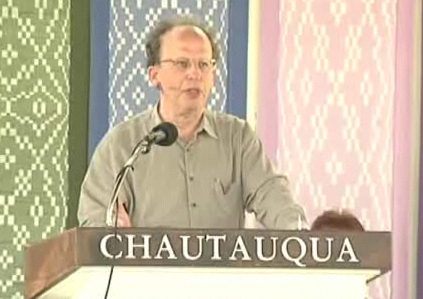
Fred Ritchin’s talk from the Chautauqua Institution is a must watch. It is over an hour, but if you don’t make it through you might just prove his point!
He lays out how digital universe allows us to reorder content as and when we please (a contact sheet has an order; digital files can be swapped about, deleted). He posits that along with the demise of analogue technologies, analogue thinking has disappeared. Today, to read is not to follow a book front to back, to listen to music is not to listen to an album. We take in bits, bytes, single tracks and isolated comments.
Ritchin isn’t moaning, he just wants us to see our current universe for what it is and respond accordingly. Ritchin wants us to use digital [photo] technologies not make models thinner, the pyramids closer or to run algorithms removing unwanted objects from caches of images; he wants us to use digital tools for positive ends. Instead of changing the past and present, why not the future envisioned? Ritchin wants us to present, to image and imagine futures so striking they might alter our behaviours – Earth without animals … or people. If we see the horrifying aftermath of climate change or war maybe we won’t go down that path? Think activist/photo-manipulation hybridism.
Ritchin questions Flickr. Rightly so. The mere upload of imagery is inadequate. After a trip to New Orleans’ Ninth Ward, Ritchin searched Flickr for imagery of “New Orleans”. The first 400 images were of young people partying on their stoops.
Our obsessive production and distribution of images (usually through socially networking) devalues meaning in, and of, photography. In photography we can increasingly find ourselves, but can we find each other? See each other? In a meaningful way?
Photography, as in life, is becoming less about them and us and more about me and I. This is a point Ritchin makes in his recent blog post too:
“I have written elsewhere about the assertion by Paul Stookey (of the singing group Peter, Paul and Mary), about the progression of values in the United States as seen through the popularity of certain magazines. During a 1980s concert he recounted how once the popular magazine in the United States was called Life (about life), then it was People (not about life, but just about people), then it was Us (not even about all people, but just about us), then it was Self (not even about us), and now – to add on to what he had said – it becomes the Daily Me of Nicholas Negroponte, where one’s dentist appointment or Facebook status supersedes the report of the declaration of a new war or healthcare initiative on the “front page” of one’s nearly ubiquitous screen.”
Of course, there is no obligation to use photography always in a means to connect with others.
There is however, an obligation to be honest. As it stands, the predominantly shallow use of image is far less of an insult as that of people obsessed with the past, with the idea of “the power of photography” and with the continued lip service to a dead idea and a false reality.

 Prison Photography