
You are currently browsing the category archive for the ‘Photography: Non-Prison’ category.
Kevin Carter committed suicide in 1994. The Manic Street Preachers made this in 1995. I saw them play it live in 1996.
Bit of a dodgy (dated) video, but sweet song. Feel the trumpet. And, then, watch them get shot down by a camera!

Gary King, Computer Technician, Disabled. “Over the last eight years, these two plates are the only family memories I have left. Only by the Grace of God have I been able to hang onto them. They’re hand painted. I believe that both of these plates were done by my dad’s mom. The one I especially wanted to hang onto was especially done for me. It was stolen when the storage unit got busted into.”
– – –
Daylight Magazine granted us sneak preview of Susan Mullally‘s upcoming book What I Keep: Photographs of the New Face of Homelessness and Poverty, by way of Elin o’Hara Slavick’s introduction.
o’Hara Slavick says:
“Susan Mullally’s unforgettable color photographs of people who gather together in their “Church under the Bridge of I-35″ make visible something we usually choose not to see. There is a young woman holding a photograph of her sweet baby girl with whom she cannot live because she does not have a place to live. There is a picture of an African-American woman holding her Junior High School diploma. This is the first time the woman has ever shown it to anyone. There is an unemployed carpenter who collects any stuffed animal that he finds so he can give them to the children he encounters during his homeless days.”
and,
“Mullally respects her subjects, many of whose lives are constantly disrupted by serious challenges such as homelessness, incarceration, drug addiction, alcoholism, mental illness and poverty. Mullally simply asks each person what he or she keeps and why it is valued and she makes a color photograph of them holding that object of subjective value.”
– – –
What I Keep: Photographs of the New Face of Homelessness and Poverty, Susan Mullally is published by Baylor University Press and due for release Summer, 2010

I plan to keep a close eye on Jason Lazarus‘ clever online plea for all those photographs that are simply ‘Too Hard To Keep’.
Lazarus pledges to collect vernacular photographs that – leaden with emotion – must be deaccessioned from personal albums. This project combines many of the cute attractions of informal photo exchange – web-based, cathartic, bittersweet, reusable, romantic in its view of photography and with a potential for serendipity.
If you’d like to be a contributor, Lazarus explains:
I have started an archive of photographs deemed “too hard to keep.” This may include photos or photo albums of:
ex’s, photos of deceased friends/family/pets, places/objects too hard to view again, etc. The reason you can’t live with the photo or photo album I do not need to know…
I am creating a repository for these images so that they may exist without being destroyed. You may dictate whether the images you submit to the archive are:
- images not to be shown again, or
- images that may be exhibited in the future with other submissions to the archive.
If needed, I can pay shipping costs to send any photos to the repository in Chicago.
Jason Lazarus
810 n Wood, 3f
Chicago, IL 60622
I am happy to answer any questions and hope this project helps you part with something in a more graceful manner.
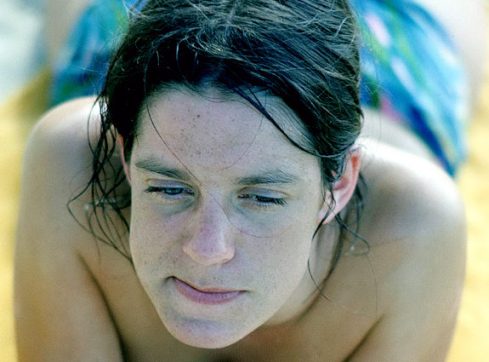
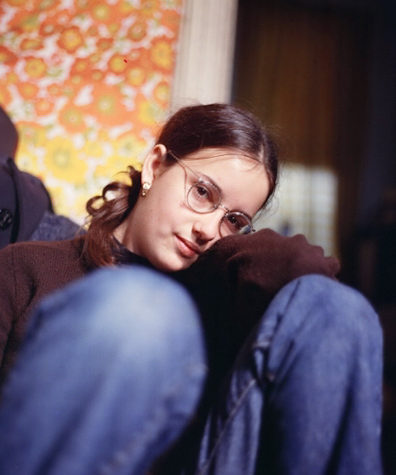
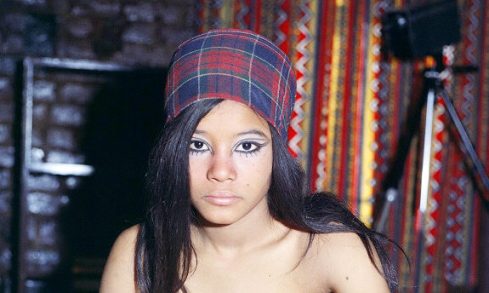
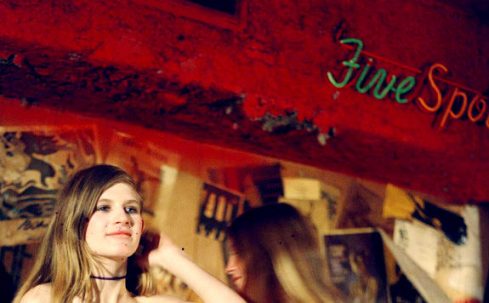
The NYPD has released 215 photographs taken by convicted serial killer Rodney Alcala in an attempt to secure identifications and restart cold case inquiries.
Alcala was recently sentenced to death for three murders in California in the late seventies. In the early seventies, Alcala lived intermittently in New York; some of the photographs found in his storage upon his arrest are thought to be from his time in New York
“They should be in every newspaper, on TV and on the Internet,” Sheila Weller, cousin of victim Ellen Hover, said before the NYPD decided to release the pictures.
RESPONSE
The collection is one of the most discomfiting things I’ve been audience to. To look at these photographs is to ready oneself the very limited likelihood of recognizing someone. It is a very grave and uneasy type of involvement with the image and the serious context by which it has come to be viewed.
Usually, personal portraits have their story shared and history mutually written, but – in viewing these previously unknown images of unknown persons – the viewer potentially writes the story’s end.
The public release has already yielded results:
The photos were kept quiet until Alcala was sentenced to death last month. “We needed an unbiased jury,” said retired Huntington Beach Detective Steve Mack.
Last month, Huntington County cops posted 137 of the less graphic pictures online. So far, 21 have been identified, often by the women themselves.
Four families of missing women say they recognized their loved ones, but police have not yet been able to confirm a link.
Most of the photos sent to the NYPD were not among those posted online. They include details that suggest they were taken in New York, sources said.



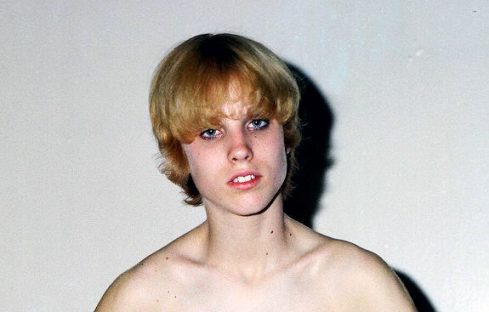
Found via Elizabeth Avedon
– – – –
NY Daily News coverage
NYPD not releasing pictures taken by sicko serial killer Rodney Alcala of possible victims (April 20th, 2010)
NYPD releases serial killer Rodney Alcala’s photos of women — seeks public’s help in ID’ing them (April 21st, 2010)
Gallery: NYPD seeks clues from photos taken by serial killer Rodney Alcala (April 21st, 2010)

© Beb C. Reynol
Last month, I met social documentary photographer Beb Reynol.
For the past five years, Reynol has concentrated his documentary work in Central and south Asia, specifically in Afghanistan and Pakistan. Reynol has been an Artist in Residence at the Photographic Center Northwest and is now on its faculty.
In 2005, Reynol trained local photojournalists in Kabul with AINA, the non-governmental organization founded by veteran photojournalist Reza Deghati. AINA aims to rebuild the Afghan’s freedom of expression through journalism.
Whenever I look at imagery from the AfPak region I am consciously looking for work that does not depict military engagement. It was for that reason I was drawn to Reynol’s series of Afghan Coalminers.
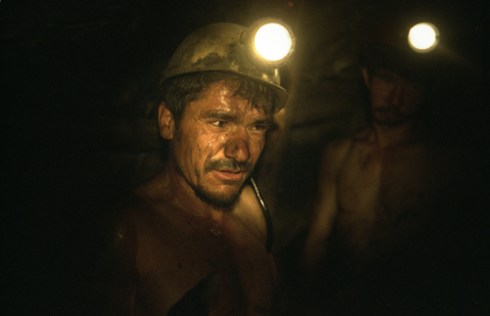
Lit only by headlamps, the miners discuss the conditions of the shaft and their approach to the coal seam. Kar-kar, Afghanistan, May 10th, 2005. © Beb C. Reynol

© Beb C. Reynol
Beb’s The Cost of Coal in Afghanistan statement:
During past decades, Afghanistan has only known a succession of conflicts: the Soviet occupation, the Afghan civil war, the rise and fall of the Taliban and today American and allied military engagement. These wars ruined economic development and eroded the vitality of the Afghan population. Coal, abundant in Afghanistan, is an essential fuel used for the production of electricity, making it a basic need.
When Russian forces occupied the country in 1979, they sent their own engineers to run the large-scale production of natural resources. I visited a mine (difficult to access due to its geographical location) 12 kilometres northeast off Pol-e-Khomli. During the Soviet occupation, more than 2000 miners extracted the black gold from the mine. Today, the 150 employed miners barely cover the vast site and the hundreds of formerly excavated galleries.
Often working at a depth of more than 360 metres, the miners extract coal with only shovels and pick-axes in hand, battery powered lamps on top of their heads, and old equipment once imported from Czechoslovakia. Intense heat, total darkness and the risk of explosion from methane gas make coal-mining very difficult and dangerous.
The limited local demand for coal makes the mining far from profitable. Lacking reliable transportation and security infrastructure, the Afghan government is unable to exploit the fossil fuel. While the present war against the Taliban wages on, the country seems to be losing grip on its most wanted resource.
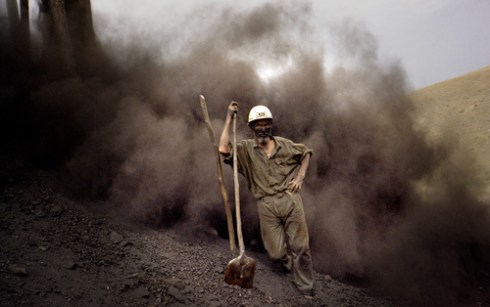
Coal mine, Kar-kar, Afghanistan, May 11th, 2005. © Beb C. Reynol
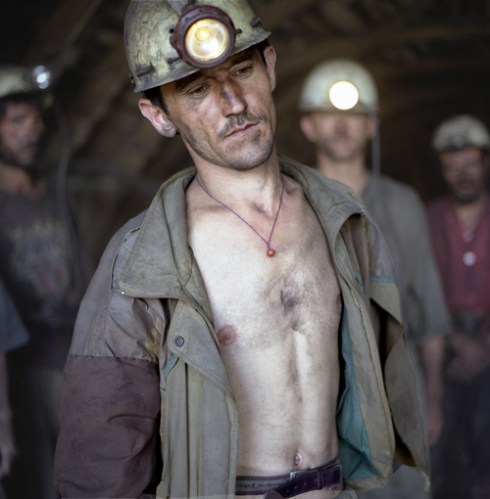
© Beb C. Reynol
I have also been thinking about Jim Johnson’s recognition of “powerful installment[s] in what should be considered a photographic tradition depicting men who work in extractive industries.”
If you are looking for a one-stop-shop for the visual politics of mining in photography then look no further than Jim’s posts labeled ‘Miner’.

PART FIFTEEN IN A SERIES OF POSTS DISCUSSING PHOTOGRAPHERS’ ACTIONS AND RESPONSES TO THE KILLING OF FABIENNE CHERISMA IN PORT-AU-PRINCE, HAITI ON THE 19TH JANUARY 2010.
The aftermath of the Haiti earthquake was zealously covered by the media and American networks particularly.
Several factors likely fed the saturation of disaster over the wires – Haiti’s geographic proximity; Haiti’s diaspora and cultural ties within the US; fresh memories of the controversial, US-backed coup and removal of Jean-Bertrand Aristide; and collective guilt over (or, alternatively, the collective amnesia of) the US’ corporate involvement in Haiti.
The US was going in full-yield again.

The lifeless body of fifteen-year-old Fabienne Cherisma lies on the roof of a fallen building in downtown Port-au-Prince while looters file down the street on January 19, 2010. The young girl was carrying three ornamental mirrors when she was hit by a random shot from Haitian police as she walked with looters on the street. Photo by Lucas Oleniuk / Toronto Star.
WHY ONE IMAGE?
The still Fabienne Cherisma surrounded by the bustle of opportunists jolted me from my image-stupor for long enough to realise it was time to voluntarily step off the media-photo-treadmill and pay attention to a single image, a single person, a single story.
It occurred to me that this was barely a risk. If the majority of the imagery had stopped informing then I really had nothing to lose by redirecting my energies and time elsewhere.
(Please, don’t misunderstand me: I appreciate the purpose for a lot of media images, and I believe that they deliver immediate messages which catalyse reaction, donations and aid. That said, emoting a response in an audience is a distinct function to that of informing an audience.)
WHY FABIENNE?
In all honesty, I may have never have seen that image and with that in mind, I may have paid particular attention to another single victim of the earthquake. Chance? Compulsion? My “small contribution”? I don’t know. I don’t want to minimise my analysis of Fabeinne Cherisma’s death in photographs, but nor do I know exactly what it is yet …
Now, after some time, two unique things about the image of the dead Fabienne Cherisma still stand out.
In other pictures bodies were either buried, dusted, pulverised or piled high with other corpses. If they lay in the streets they were circled by onlookers. Fabienne’s body was isolated. Secondly, unlike 230,000 of her compatriots, it wasn’t the violent instability of concrete in the physical environment that killed Fabienne, it was the violent fallibility of human decision making that killed her; a bullet, from a gun, in a hand.
MAN-MADE NATURAL DISASTER
It has been said that no natural disaster is simply that, but that every disaster comprises natural and man-made factors. Man-made corruption, political instability and resultant poverty led to inadequate (if any) building codes. Just as human decisions prior to the quake cost lives, so they would after the quake.
The rainy season is about to begin in Haiti and the quality of aid, community solidarity, flood and disease abatement measures will determine how many people succumb to this second wave of elemental assault.
Fabienne, to me, was one of the first victims to fall to poor human decision-making following the earthquake. Others have perished since and unfortunately, thousands more are likely to die. (I read an estimated 5,000 people may die in the predicted mudslides, but I don’t know on which this is based – the cold calculation makes me quite uncomfortable).
Fabienne’s death was not in the earthquake but in its aftermath.
VISUAL FORENSICS
The day after seeing Garcia Rawlin‘s photograph for Reuters, I found a virtually identical image by Jan Grarup, except Fabienne’s body was positioned differently. Suddenly, time and timing was brought to bear upon Fabienne’s demise. Two photographers. Soon after, I saw the work of Olivier Laban-Mattei, whose photographs followed the family down the street as they carried the body. Three photographers.
Once I had launched my inquiry, the full picture developed quickly. An interview with Michael Mullady. Four photographers. Shortly after, Edward Linsmier discussed his experiences at the same locations. He was with Nathan Weber. Six photographers.
At this point I was already in contact with Grarup and Mullady. Garcia-Rawlins and Laban-Mattei did not respond to inquiries and have not until this day (I cannot be certain they received my inquiries). Grarup’s response mentioned Paul Hansen and Jan Dago. Eight photographers.
( Jan Dago did not respond to my inquiries. His images of Fabienne are here and this slideshow references looting in its title but actually has little of visual evidence to contribute to my inquiry.)
Hansen was also accompanied by Michael Winarski, US correspondent for Dagens Nyheter. Eight photographers, one reporter.
The next photojournalist to surface was James Oatway. Ten journalists – nine photographers, one reporter. Oatway mentioned Alon Skuy, who in turn mentioned the delayed arrival of Felix Dlangamandla upon the scene. Eleven photographers.
Meanwhile, I stumbled upon Nick Kozak‘s work and upon contacting him learnt of two other Canadian photographers present – Lucas Oleniuk and Matt Levitch (Tranbleman De Te). Fourteen photographers.
Soon thereafter, a reader alerted me to Frederic Sautereau‘s portfolio containing graphic images of disorder, skirmishes, police and Fabienne’s corpse. Fifteen photographers.
CONCLUSIONS
1.) There may well have been more photographers on the scene. It wouldn’t surprise me to learn so.
2.) A couple of photographers mentioned giving others space and trying not to get in others’ shots and avoiding getting photographers in their frames. Why? If a situation is chaotic and journalists are part of that chaos, what does it matter if photographers or journalists are in the scene?

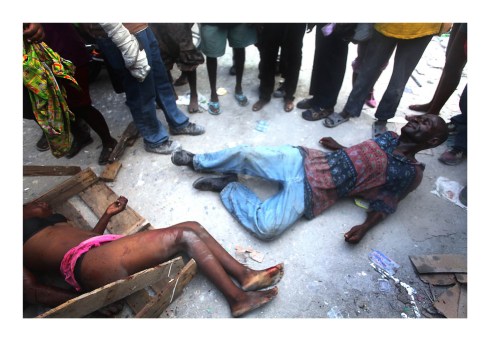
Jan Grarup photographs police beating a looter in downtown Port-au-Prince Tuesday afternoon. © Lucas Oleniuk/Toronto Star.

Tuesday, January 19th. Photo: Jan Grarup/NOOR Images
As a small step, this mutual refusal to depict fellow professionals in the field, can be understood as the first step toward a manipulated in front of a distant audience.
The erasure of fellow media from a scene is a paradox. Journalists are required to record events as they are, but if a photographer depicts them as if he or she is working in isolation – as if from a unique one-off viewpoint – then what is delivered is not an objective, neutral description but a construction.
3.) I am not criticising the photographers who have kindly given their time, thoughts and (often) emotions to this inquiry, but I am questioning the decisions at the photodesks of mass media. I usually only see images that implicate media/photographers when the story becomes about them, when they get injured or kidnapped. Photojournalists are either the directors of a scene or the embattled hero of a scene; they are never bit-part players.
4.) I am convinced, CONVINCED, that enough evidence exists in the digital files of these fifteen photographers to identify and prosecute the policeman who fired the fatal shot.

© Alon Skuy
– – –
ALSO IN THE ‘PHOTOGRAPHING FABIENNE’ SERIES
Part One: Fabienne Cherisma (Initial inquiries, Jan Grarup, Olivier Laban Mattei)
Part Two: More on Fabienne Cherisma (Carlos Garcia Rawlins)
Part Three: Furthermore on Fabienne Cherisma (Michael Mullady)
Part Four: Yet more on Fabienne Cherisma (Linsmier, Nathan Weber)
Part Five: Interview with Edward Linsmier
Part Six: Interview with Jan Grarup
Part Seven: Interview with Paul Hansen
Part Eight: Interview with Michael Winiarski
Part Nine: Interview with Nathan Weber
Part Ten: Interview with James Oatway
Part Eleven: Interview with Nick Kozak
Part Twelve: Two Months On (Winiarski/Hansen)
Reporter Rory Carroll Clarifies Some Details
Part Fourteen: Interview with Alon Skuy
Part Sixteen: Fabienne Cherisma’s Corpse Features at Perpignan (Frederic Sautereau)
Part Seventeen: Brouhaha in Sweden following Award to Paul Hansen for his Image of Fabienne Cherisma (Paul Hansen, Olivier Laban Mattei, James Oatway)
Part Eighteen: A Photo of Fabienne Cherisma by Another Photographer Wins Another Award (Lucas Oleniuk)
PART FOURTEEN IN A SERIES OF POSTS DISCUSSING PHOTOGRAPHERS’ ACTIONS AND RESPONSES TO THE KILLING OF FABIENNE CHERISMA IN PORT-AU-PRINCE, HAITI ON THE 19TH JANUARY 2010.
Alon Skuy, photographer for The Times in South Africa, was in Haiti from 17th – 22nd January.
Fabienne was shot at approximately 4pm. What had you photographed earlier that day?
General looting and destruction in the downtown area of Port-Au-Prince.
How many other photographers did you see at the scene? Do you know the photographers’ names?
Contrary to another article on this site, there were three South African Photographers on the scene: myself, Felix Dlangamandla and James Oatway.
How was the atmosphere? How did others behave?
The atmosphere was very tense and thick with emotion. It was quite a chaotic scene. Photographers were jostling for images. On the whole, I feel that the photographers behaved
respectfully on the scene.
Did you discuss the tragedy with other photographers?
Yes, briefly on the scene with the two other South African photographers, we were all aware of each others presence.
How long was it until her family and father arrived to carry away Fabienne’s corpse?
About 30 minutes.
How long did you follow the group as they carried her away?
For about three kilometers down the main road.
Where was their destination? How far away was that?
Their destination seemed to be a market where Fabienne’s mother, as well as other relatives may have been.

How does Fabienne’s death fit in with the visual narratives of Haiti’s earthquake aftermath?
An important event to cover, imperative to show the desperation due to lack of aid getting through, and the inhumane fashion in which the law enforcement behaved at times. The family were obviously really distraught.
– – –
Both images © Alon Skuy. From top, Osam Cherisma mourns the death of his daughter Fabienne; Amante Kelcy, Fabienne’s mother (in white), mourns the loss of her daughter.
– – –
ALSO IN THE ‘PHOTOGRAPHING FABIENNE’ SERIES
Part One: Fabienne Cherisma (Initial inquiries, Jan Grarup, Olivier Laban Mattei)
Part Two: More on Fabienne Cherisma (Carlos Garcia Rawlins)
Part Three: Furthermore on Fabienne Cherisma (Michael Mullady)
Part Four: Yet more on Fabienne Cherisma (Linsmier, Nathan Weber)
Part Five: Interview with Edward Linsmier
Part Six: Interview with Jan Grarup
Part Seven: Interview with Paul Hansen
Part Eight: Interview with Michael Winiarski
Part Nine: Interview with Nathan Weber
Part Ten: Interview with James Oatway
Part Eleven: Interview with Nick Kozak
Part Twelve: Two Months On (Winiarski/Hansen)
Reporter Rory Carroll Clarifies Some Details

 Prison Photography