
You are currently browsing the category archive for the ‘Photography: Non-Prison’ category.

Larry Sultan is gone. When someone is gone I try to identify a piece of wisdom that should not go with them. (Go straight to the bottom of this post for Sultan’s wisdom without my preface.)
Six years ago, my partner and I stood in front of one of his large Valley prints at SAM’s Baja to Vancouver exhibition. During the early months of our relationship, we’d picked apart topics of passive violence, misogyny and late capitalism as a matter of course. Sultan’s photograph spurred debate on, again, and in novel directions.
Sultan’s photographic series are all deliberate, different and exemplary. He identified something that needed to be done (differently) and worked his way to a solution. This was his genius.
Evidence shifted thinking not only the fine art world and the academy but also in popular culture. It preempted a widening reverence for the tangible image – a trend that dominates our post-film nostalgia for found and vernacular photography. Joerg’s recent musings about curator and editor can predate self-publishing online technologies and hark back to Sultan and Mandel ferreting about government archives.
The Valley is iconic. Although, it is interesting to hear Sultan describe a project that I thought stripped (pun intended) the porn industry to its boring facts. Not so:
“The sex industry can be such a tired, worn out subject but when it’s imported into kitchens and dining rooms of a middle class suburban home something new opens up. At least for me it did.”
Pictures from Home goes alongside Toledano’s Days with My Father for the privilege of emotional inclusion it gives the audience.
And, finally, Homeland is a beautiful reconciliation of Sultan’s new Bay Area living:
“Light’s too hard where I live, it’s hard to work in it. The character of light means a lot to me. It’s how I begin to photograph, it’s usually with the light. So it’s a bit problematic. L.A. light, that kind of foggy, smoggy, soft light—I miss that. It’s the light of my childhood. There are certain sounds, feelings of the air, and all of that which you can’t photograph but you can find the equivalent of, in light. But who knows, maybe I can find a new version of that in Northern California.”
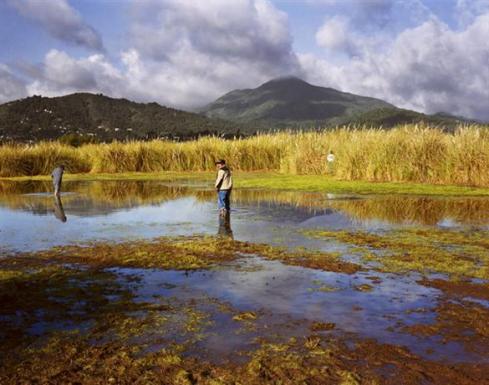
The marshes of Corte Madera and fog of Marin County provided Sultan his respite from direct San Francisco sunshine.
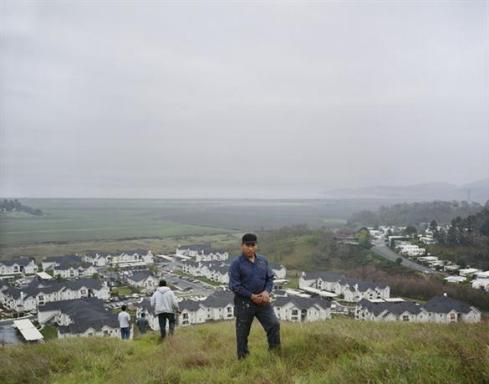
Sultan died at 63. Relatively young. Yet, the inquisitive spirit of his work means he got more than enough done before his early departure. A oeuvre by which one is humbled.
Sultan’s interview with Ben Sloat featured on American Suburb X yesterday originally appeared on Big, Red and Shiny in April, 2008.
The stand-out quote is simultaneously a lament AND a call for rigorous photographic practice:
Which accumulated representations are you battling with? What do you need to stop doing because its been done before?
Of course, everyone in the photobooks debate had their own preface and a necessary confirmation bias to bolster. Andy and Miki unleashed a monster. Great stuff.
IT’S THE EYE OF THE BURGER, IT’S THE CREAM OF THE FIGHT …
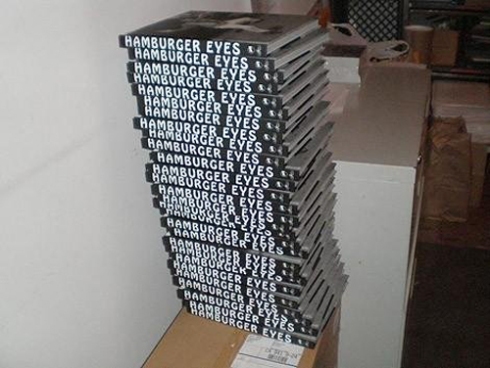
Hamburger Eyes has my mostest respect so far. HE is rightly confident in the book as a medium; HE doesn’t uphold a naive belief in the internet or technologies to deliver ALL the goods; and they make a call for real life.
Photos and photographers should “get into some shit” away from the web.
Hamburger says:
I was asked to write my thoughts on this subject as part of a forum in the form a blog, meaning FLAK PHOTO and LIVEBOOKS are writing about the subject and inviting others to join in by writing something, linking it, then they re-link it up for an ultimate future post of all of it together in one blog? I don’t know I’m confused too. Blogs eat blogs, and they never be not hungry.
Blogging is a good segway into my thoughts about the future of photo books. I’m thinking the internet is turning into a library or more like jail for your photos. Yes, libraries are way awesome and yes we are all photo nerds forever learning, but how long can you stay in there. It’s like detention for your photos. Saturday school. Your photos need to get out, go on dates, and get into some shit.
What happens next is what’s already happening now. Photogs are deleting their flickr and their blogs and crewing up with only the hardest realist ninjas. It’s hyper attack mode. Photogs are scrambling because their agency just cut them and their editors got laid off. Not to mention, “Oh, you shot this or that, someone else caught it before you on their cell phone and New York Times already spent their budget on those.”
HERE’S WHAT I SAY
I wrote a huge treatise not only on the future of books, but on the future of the image and the future of our existence based upon our surrender to the image. We will soon all be docile slaves.
I shelved the piece. I’ll need to chew on it for a while until the next photoblog debate about the future of photography/contracts/journalism/print/distribution/consumption comes along. My main points will still apply:
– E-books is an oxymoron. Hopefully, all digital text will be referred to as E-words.
– Actual books will be fewer in quantity and higher in quality.
– Open source will dominate, because ownership of any digital matter will become useless.
– Micropayments are bogus. In the future if a creator unleashes it on the web, they will hold no claim to it
– Every household will have access to rapidly improving printing technology; any available online material will be printable to spec.
– Handhelds will have instance access to every non-proprietary file on the internet.
– People will have self-facilitated projections to the sides of buildings as a legitimate alternative to books when experiencing images.
– We will become detached from one another. Those who question the mediation of technology – even moderately – will be ostracised. In this regard, book ownership will become a slightly perverse political act.
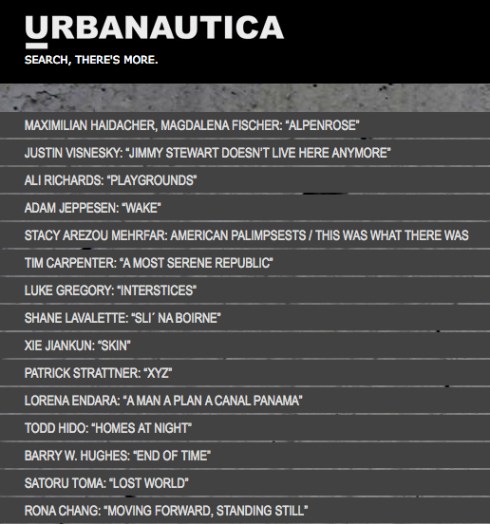
Steve Bisson and Andrea Filippin facilitate Urbanautica a research project on photography and human landscapes.
“Dealing with studies on urban and industrial sociology lead us to the idea of a website, without commercial purposes, that tries to bring back people’s looks on the “ways of doing” territories.”
“The featured projects are the result of our research, even though we receive several submissions that we are happy to evaluate from time to time. We do not take in consideration portraits, commercial, fashion or those things as we are sticked to our research.”
“By the way, we are interested in art and conceptual deviations from the main theme as probable evolutions of landscape photography.”
Found via Bryan

James Pomerantz recently posted on Movies About Photography. Not surprisingly I added Standard Operating Procedure to the fray in the comments section.
Not a movie, but every part cinematic, I implore you to watch Shooting the Past by the stellar Stephen Poliakoff. It is a three part mini series. Back when it was first released (1999) I watched it alone in my parents house for three Thursdays running … even refusing trips to the pub to watch it undisturbed. It’s a glorious, delicate piece of television; tragic, persuasive and eventually uplifting. One of those that leaves you sat still and quiet five minutes after the credits have rolled.
The premise is simple. Big, faceless American corporation sends business-like minion (Liam Cunningham) to oversee the break-up and sale of an old photography archive in a mid-sized, regional, musty museum. The museum is staffed by an eccentric archivist (Timothy Spall) and a strong, caring custodian-director (Lindsay Duncan).
The staff must – over the course of a few days – convince the administrator to turn his focus from the bottom-line value of the collection to the intangible value of stories, histories and truths within the photographic collection, thus transforming his heart and ultimately his decision on the fate of the collection.
Spall and Duncan are a delight … Cunningham less so, but an American accent is difficult to do. In defence of Cunningham, his performance a decade later in Hunger (another of my favourites) was remarkable.
So, there you are. My most heartfelt recommendation.
I earnestly urged someone to watch Shooting the Past a few years back, but the last time I was round at their place I saw it still wrapped in cellophane in the DVD cupboard. That hurt. Shooting the Past should be relished.

Some of you might know that I volunteer for Books to Prisoners. Our book donations fall into a few categories: the majority go on the stacks for future dispatch to prisoners; other books not suitable/requested in prisons go to the bargain bins (25c-$1) at Left Bank Books; and good quality titles we sell online (I think?) for the $5 or $10 we anticipate. This third scenario crops up infrequently.
All monies raised from book-sales goes toward postage … and it is postage that accounts for most of BTP expenditure.
Last night, I was sorting some old donations – the usual suspects were there (Alice Walker, Louis L’Amour, John Le Carre, James Patterson) as were the much-needed non-fiction (Spanish dictionaries, parenting books, American history titles, etc.)
I did not expect to come across an original edition fine art photography book. I put Images a la Sauvette, Photographies par Henri Cartier Bresson aside while I sorted the thrillers from the biographies from the media studies text books.
At the end of the night I picked Images a la Sauvette up again. It was obviously too large and too heavy to go on the stacks. During my induction, I remember high end monographs were mentioned specifically as candidates for sale rather than dispatch. I new this was a special book, but I didn’t realise it was Cartier-Bresson’s foundational work, fully illustrating his ‘Decisive Moment’ philosophy.
The book is beautiful. Published by Editions Verve, Paris in 1952. The cover was designed by Matisse purposefully for the book. There are 126 pages of full-sized (37 x 27.5 cm) black-and-white gravure reproductions. The cover is strong, the spine a little discoloured. The pages are in fine fettle. The pages are bound to one another tightly but as a group have come away from the spine. Still, gorgeous.
I instantly thought it might be worth more than your average book – I hoped maybe $100, perhaps even $200. That amount would pay for a fair whack of postage, right? A few hundred books, right?
After getting home, I checked out the specifics. The proceeds from the sale of this book are to pay for postage on thousands rather than hundreds of books. Depending on which source you credit, make allowances for the condition of this copy and factor in the state of the book market, it could be worth anything between $1,000 and $3,200.
Antiqbook pegs it at $1,053; AbeBooks start it at $1,260 running it up to $7,700 (for what I guess is a pristine copy); Franklin Books values it at just shy of three grand and Bauman Books pushes it a little further to $3,200. In 2007, PhotoEye auctioned a copy for $2,250.
Books to Prisoners has never sold a book of such high value before so we’re a little stumped. I guess we’ll get a local dealer to stick a valuation on it and then carefully search out buyers. We’ll likely use AbeBooks. I’ll let you know in due course. If you have any advice or interest, please drop me a line.
In the mean time, salivate over these images:


A Developing Story is a new joint venture by Johnny Bennett, Phil Maguire and Benjamin Chesterton of duckrabbit.
In an email a few months ago, Ben said to me his interest lies in “getting under the skin of NGOs” and have them realise that they can deliver their stories and campaigns in far more effective ways. A Developing Story wants the stories told in Government & NGO international development campaigns to outlast the short term objectives of said campaigns.
A Developing Story proposes that the media of these campaigns is deposited in a common silo, accessible by all (usually under a Creative Commons license) so stories – once created – can tell themselves infinitum.
Given the primacy of Creative Commons and open-source content, Matt and Scott at DVAfoto needed clarification on A Developing Story‘s impact on the photographer (which was provided). I have fewer worries as I feel this venture is aimed at transforming media sharing practices among government funded and NGO initiatives rather than another pressure on the distribution and remuneration of individuals’ works.
I would anticipate that the payments made to photographers and journalists by media campaign management will continue and that photographers will take on assignments in the knowledge that their work can be used repeatedly for non-profit purposes.
That said, A Developing Story is very open to individual contributions. This is the most relaxed approach to collaboration I’ve witnessed!
So, as Ben asked, “Can You Help?”

Past and present ruminations about what is and isn’t a photograph have been a source of frustration for me. For one, people can draw whatever lines they wish to determine the point at which manipulation tricks out a photograph and thus qualifies it as photo-illustration. And for another, as Errol Morris keeps banging on about, ALL photography is lies (and manipulation).
These debates are not about truth. Interventions – power relations, habit, photographic custom, complicity among subjects, props, political agendas (and framing), cropping, tweaking of exposure levels before and after development, digital alterations – mean that photography can never be, will never be truthful.
People forget that often it is the ingenious tricks that have spurred the largest wonder among viewing public – think Oscar Rejlander’s Two Ways of Life, Spirit Photography and – in a different sense – Ansel Adams’ Zone System.
It is therefore, with some relief that an artist like Azzarella comes along using photo-manipulation as the tactic and purpose for his work.
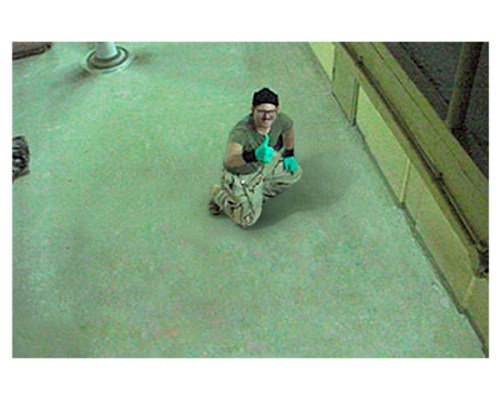

Last week, I questioned Anton Kratochvil’s Homage to Abu Ghraib, mainly because I think it makes little contribution to the discourse on the political aesthetics of Abu Ghraib. The blurry references to torture in Kratochvil’s images are in response only to a personal, conscious and willing point of view. I understand that Kratochvil’s work was an exercise in self-therapy but that shouldn’t stop me comparing it to Azzarella’s broader concerns about more general and unconscious reactions to well-circulated images.
If I w re to wr t th s sent nce wi h lette s m ss ng, you can still read it. The human brain is a wonderful instrument drawing on past experience to quickly filter out the non-possibilities. Just as the brain instantaneously deciphers gaps in text so it does with gaps in images.
With every passing hour the Spectacle suffuses itself further. It isn’t so much us reading images but images reading us. Our involuntary responses to images are predictable, predicted, precoded. The redacted action of violence in Azzarella’s pictures plays second fiddle to the original image, for it is the original image we drooled over and devoured.
The hooded detainee, dead student, wailing child or falling soldier needn’t even be present; our internal, emotional feedback spun by these images will forever be the same. We fill in the gaps and short circuit to prescribed disgust, sadness and politics, thus confirming our prevailing bias.
Azzarella’s works expose the fraud in us all … and our cheapened, robotic response to image.

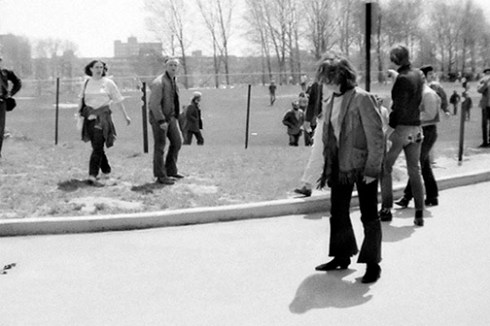
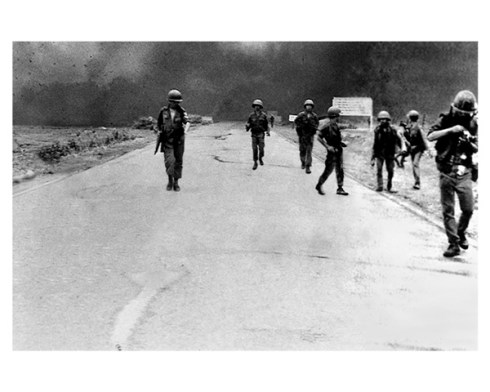
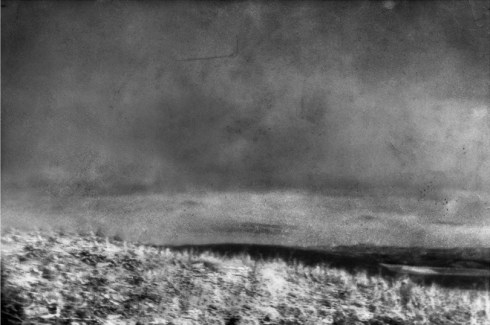
ALL IMAGES © JOSH AZZARELLA. FROM TOP TO BOTTOM: UNTITLED #13 (AHSF); UNTITLED (SSG FREDERICK); UNTITLED #24 (GREEN GLOVES); UNTITLED #35 (CAFETERIA); UNTITLED #39 (265); UNTITLED #20 TRANG BANG; UNTITLED #43 (PAR115311).

 Prison Photography