
You are currently browsing the category archive for the ‘Photography: Non-Prison’ category.
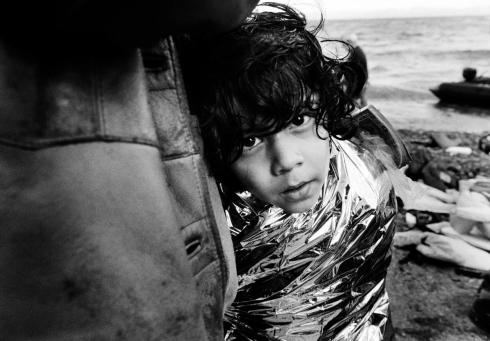
A boy from Afghanistan tries to keep warm after a cold and wet crossing from Turkey. Cases of hypothermia are on the increase as the weather deteriorates across the eastern Mediterranean.
In an image saturated world it’s difficult to define and measure the effects of photographs. We know advertising works, but those are images intended to sell us stuff. What if the purpose of a photograph is to “sell” us of a moral or political point? What if a photograph wants us to shift our emotional and practical response to far away events?
Giles Duley’s work Lesvos: Crossing To Safety made in Greece last October are intended, firstly, to bear witness and, secondly, to provoke action to help the hundreds of thousands of migrants. That’s why he didn’t simply make images and send them to the wires, but he courted the support of the United Nations so that he might extend the distribution of his images — and the refugees’ stories — far into global, humanitarian dialogue channels. (This UN-produced feature on Duley’s career and motivations is very thorough.)
Not content with only traditional distribution channels, Duley looked for alternative ways of launching his images into an unorthodox space; a Massive Attack gig.
“The scenes were overwhelming,” Duley said to the UNHCR. “In all the time I’ve worked, I’ve never seen such emotion and humanity laid so bare as I witnessed on the beaches of Lesvos. One of the first emails I sent was to the guys in Massive Attack. Seeing such events, I felt so powerless, I needed to do something. At that stage I had no idea how the collaboration would work, but I knew the band would want to act.”


Stills of Giles Duley’s photos on screen behind the stage of Massive Attack. Courtesy: Massive Attack.
A founding element of the era-defining Trip Hop genre, Massive Attack are known for taking forthright stances on political and governmental behaviours. Saturday Come Slow, their collaboration with released British Guantanamo detainees, Broomberg & Chanarin and Damon Albarn was poignant, crafted and clever, I thought.
Furthermore, as Alexis Petridis wrote for the Guardian, “Massive Attack have worked with the Stop the War coalition and visited refugee camps in Lebanon, while in 2011, Del Naja and Radiohead’s Thom Yorke threw a party for Occupy protesters who had taken over a UBS bank building in London.”
It’s not surprise Massive Attack are lending their support to Duley and shocking their euphoric crowds with thumping reality. Duley’s images loop throughout the gig, but they get their biggest showing at the close of the show, when the music ends and the band leaves the stage. For minutes — in silence — the crowd is shown a mammoth slideshow of Syrians and other migrants landing in boats, hungry, tired and terrified. A far cry from the revelry of a gig. But people stayed. This Channel 4News segment is well worth the watch:
History has taught us that photos can certainly alter the mood of entire populations. Practice has also taught us that earnest, targeted messaging can help photos land. I hope more artists can lend a hand to serve the messages of humanitarian photographers. Usually, professionals commission images to be made to meet their own messaging needs so it’s great to see artists, citizens and successful public figures provide space within their platforms to amplify photographer’s voice.
Included here are Giles Duley’s images from Lesvos, Greece, made in October 2015.

An overcrowded boat carrying Syrian refugees heads to shore. One Syrian man had fallen from the boat into cold water. He was later rescued by volunteer Spanish lifeguards. Despite the approach of winter and worsening weather, refugees are continuing to arrive on the island at a rate of more than 3,200 per day. As of mid-November, at least 64 people have drowned this year in 11 shipwrecks off Lesvos.

Boat after boat lands on the coast of Lesvos between Eftalou and Skala Sykaminia. Over 45 per cent of the 836,088 refugees and migrants who have arrived in Europe so far in 2015 have landed on this Greek island, which is separated from Turkey by a 10-kilometre channel.

An Afghan mother holds her child moments after landing on the beach near Skala Sykaminia. UNHCR and its partners work to prevent family separations and create safe areas for women and children who are particularly vulnerable.

An Afghan family of several generations disembark from an overcrowded boat. Almost 40 per cent of refugees currently arriving on Lesvos are from Afghanistan.
–
UNHCR is working around the clock with other agencies and aid groups, stockpiling and distributing winter aid items to keep vulnerable people, both in camps and urban settings, protected and warm. Donate money to the UNCHR (United Nations High Commission for Refugees) here.
• The distribution of winter survival kits including high thermal blankets, sleeping bags, winter clothes, heating stoves, and gas supplies.
• The provision of emergency shelters including family tents, refugee housing units and emergency reception facilities.
• Improvement of reception and transit centers and preparing and supporting families for winter conditions.
You can help make a difference. Donate money to the UNCHR (United Nations High Commission for Refugees) here.
–
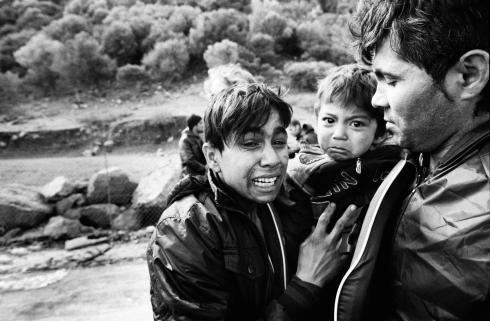
A relieved Afghan family, clearly still suffering from the trauma of a rough sea crossing at the hands of people smugglers, disembarks from a flimsy vessel onto a Lesvos beach.

An Afghan mother hugs her child and cries with relief after arriving on Lesvos.

Survivors struggle ashore after their boat has capsized. In the background a Spanish lifeguard, one of the many volunteers working on the beach, swims out to help other survivors.

A Syrian father, his two children now safely wrapped in thermal blankets, looks to the heavens in thanks after landing safely on the beach.
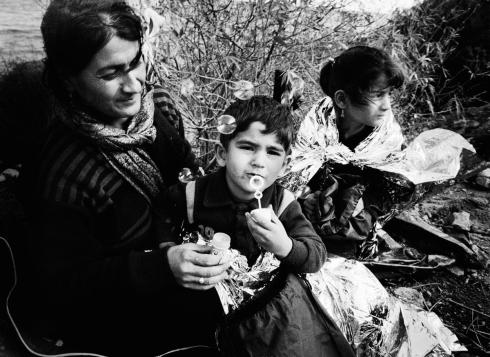
A young Afghan boy with his aunt. His mother is receiving emergency medical treatment after she collapsed upon landing. Since August UNHCR, in close cooperation with the Greek authorities and other humanitarian actors, has considerably stepped up its activities to respond to the increasing needs. This is even more imperative with the onset of winter.

Volunteers prepare to wrap a young girl in an emergency blanket to protect her from the cold wind.
–
Follow UNHCR on Instagram, Twitter and Facebook. Donate money to the UNCHR (United Nations High Commission for Refugees) here.
Read ‘War Survivor Focuses Lens on Refugees‘ about Duley’s work in Greece. Reacquaint yourself with the ‘Lesvos: Crossing to Safety‘ feature. Read a review ‘How Many Stories Can You Tell In One Second?‘ of Duley’s new book One Second of Light.
Connect with Giles Duley on Facebook, Twitter, Linked In and EW Agency.
My list of fave photobooks is the Vantage list of fave photobooks. I noted the subheader should read: How four books mailed to the author and two other books he bought in crowdfunding campaigns made the grade
THE ANOINTED ONES
Fan by Rian Dundon (Modes Vu)

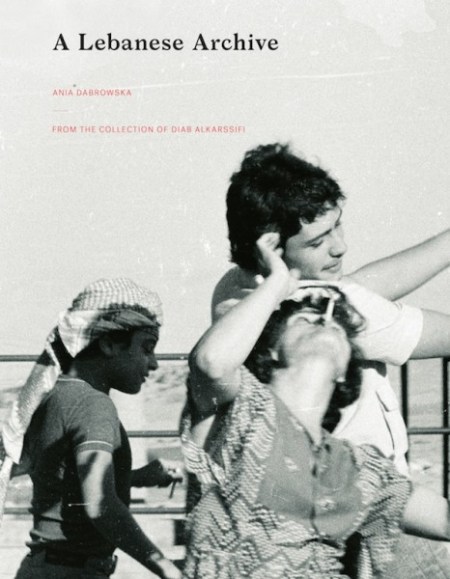
A Lebanese Archive by Ania Dabrowska (Bookworks + Arab Image Foundation)
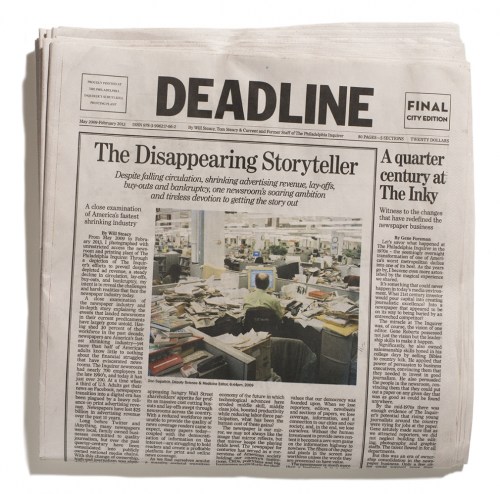
Deadline by Will Steacy (b.frank books)
In The Vale of Cashmere by Thomas Roma (Powerhouse)

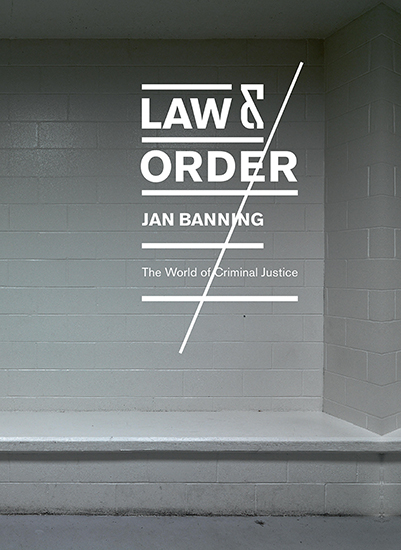
Law & Order by Jan Banning
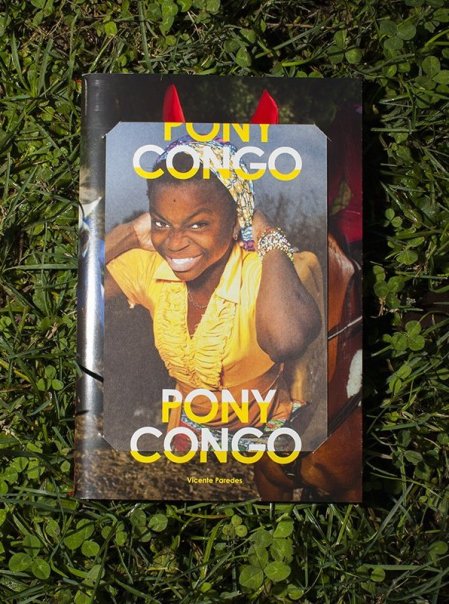
Pony Congo by Vicente Paredes (This Book Is True)
–
I’m perplexed by how exactly the photo-world goes about constructing its holiday exhortations. So much so that Joachim Schmid’s polite takedown of the Photobook-Industrial-Complex is just the best thing.
–
READ THE FULL REASON BEHIND THE LIST HERE
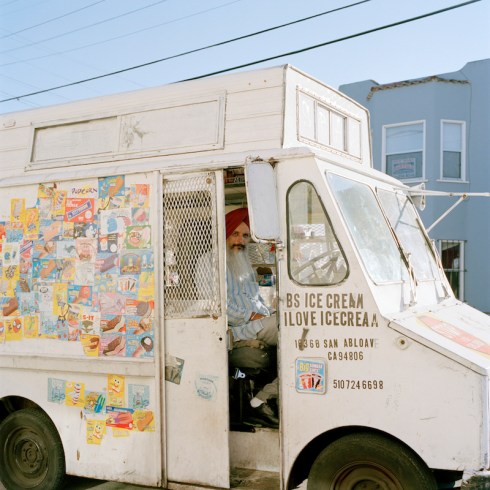
Paccarik Orue. BS Ice Cream, I Love Ice Cream, 2010. From the series ‘There is Nothing Beautiful Around Here.’
When mentioning, yesterday, that the Status Update book is now on sale, I listed the press thus far. Hours after I published that post, Michael Shaw published his own — a review of the show at Reading The Pictures. More accurately a review of the edit of images within the projects.
Shaw’s review, titled Silicon Valley in the Mirror pairs some images and makes juxtaposition between others. It’s full of the pep and the frenetic keen-eyed we’ve come to expect of RTP articles.
I think Shaw is being deliberately provocative putting Silicon Valley front and center of the title and piece; he knows Rian Dundon, Catchlight and I wanted to create a show that went beyond the “tech narratives” but Shaw, to be fair, makes good points to say that all aspects of this Bay Area region are (knowlingly or unknowingly) in response or conversation with tech monies, people, culture and economies.
On Talia Herman‘s photographs of her family and his comment that “the symptom on the flip side of the [tech] boom is narcolepsy” I reckon Shaw misinterpreted the images and our curation. If there’s a slowness in the countryside and in the last embers of counter culture, it’s still a chosen sleepier pace; a calm, not a fatigue.
I love, though, what Shaw had to say about Paccarik Orue‘s portrait of a Sikh ice-cream vendor in Richmond:
“So much for virtual reality and commodification. In Orue’s photo, a sense of place (and respectful commerce, too) comes from identity and ritual, faith and ethnicity, as well as all the old flavors of the neighborhood.”
Good stuff.

WARM OFF THE PRESS
The Status Update publication which accompanies the exhibition of the same name is now available.
If you’d like a copy email me at prisonphotography(at)gmail[dot]com. Retailing at $25.
A perfect-bound, 128-page, softcover book featuring the work by Lily Chen, Janet Delaney, Sergio De La Torre, Rian Dundon, Robert Gumpert, Pendarvis Harshaw, Talia Herman, Elizabeth Lo, Laura Morton, Paccarik Orue, Brandon Tauszik, Joseph Rodriguez, Dai Sugano and Sam Wolson.
Introduction by Raj Jayadev, coordinator for Silicon Valley De-Bug and an interview with San Francisco Public Defender Jeff Adachi.
5.5 x 8.5 inches
ISBN 978-0-692-55576-7
Edition of 1,000 (November 2015)
Designed by the genius Bonnie Briant.
Produced by Catchlight, Status Update curated by Rian Dundon and myself is an exhibition of photography and video about change, chance and inequality in the San Francisco Bay Area. It premiered at SOMArts in San Francisco in November 2015.
PRESS
Laurence Butet-Roch reflected for Time: Witness the Complex Evolution of the San Francisco Bay Area
California Sunday Magazine gave us a showing: Long Exposure: New Exhibit Captures Residents Experiencing the Boom and Bust of the Bay Area
Mark Murrmann wrote a glowing preview for Mother Jones: These Photos Show the Bay Area You’ll Never See From a Google Bus
Stanford Ethics students got to grips with the show: Adjusting our Focus: the Tech Boom through a Different Lens
Mashable threw down a gallery: Photos Capture Inequality and Change in San Francisco Bay Area
Wired offered great support with Laura Mallonee‘s feature: Capturing the Bay Area’s Diversity — and Rapid Change
Erin Baldassari for the East Bay Express reviewed the show with focus on Oakland-based artists: Beyond Black and White: Nuanced Ways of Documenting the Housing Crisis
Silicon Valley DeBug, with whom we partnered in the show posted for their committed South Bay community and following.
And finally, I was interviewed by Doug Bierend for Vice: ‘Status Update’ Captures the Evolution of the Bay Area
GET IT NOW
The book’s going to last longer than any of the prints and beyond next years traveling exhibit. Whether it will last as long as the issues that are percolating here in the Bay Area and Silicon Valley, we’ll see.
If you’d like a copy email me at prisonphotography(at)gmail[dot]com. Retailing at $25.

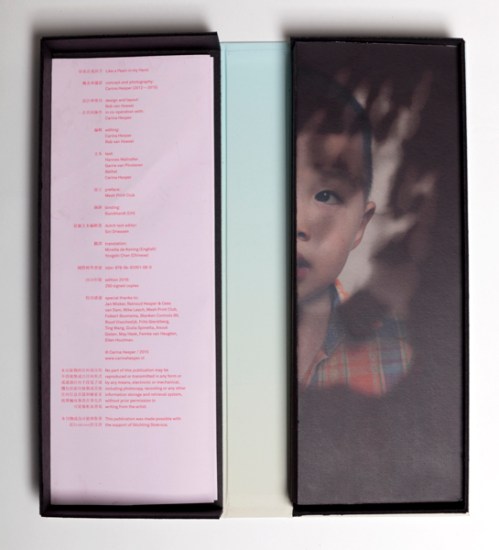
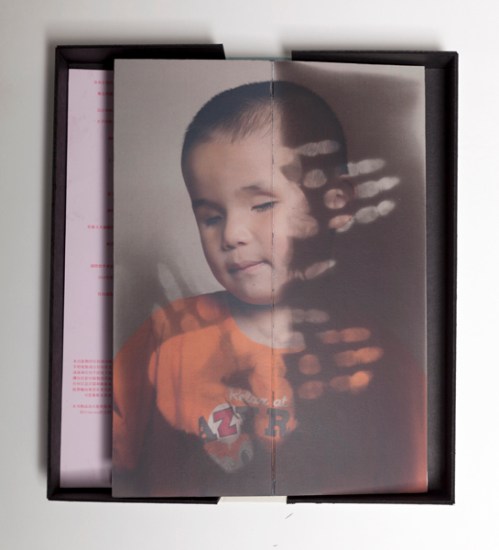
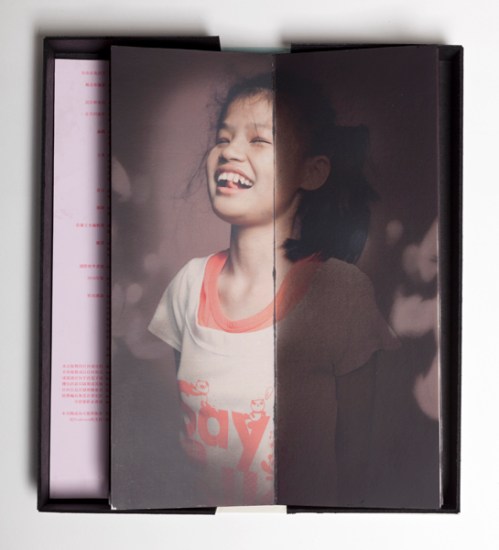
I just wrote, for Vantage a review titled The Portraits In This Book Are Only Visible When You Hold It In Your Hands of Carina Hesper’s yet-to-be-made book, Like a Pearl In My Hand.
The book is printed with thermochromatic ink (yes, the same stuff used to make 90s Generra Hypercolour Tshirts) and so it changes from pitch black in a resting state to emerging portraits of blind Chinese orphans the next.
I’ve never seen anything like it. Of course, the book hasn’t made full production yet, so I’ve not held on in my hands, but the dummy and the vids look impressive.
The degrees to which Like a Pearl In My Hand plays with metaphor and reconfigures our use of sight and touch further distinguishes Hesper’s book.
Disability is a hidden problem. Blindness prevents sight. By literal description or by strategic manipulation, everyone is in the dark. But when sight is denied, other senses compensate. Hesper plays with this truth.
Hesper is currently raising Kickstarter funds to get the project into book form (it’s already shown at numerous festivals as single prints on the wall.)
Read my review in full and see more pictures: The Portraits In This Book Are Only Visible When You Hold It In Your Hands.



I’m being facetious of course. Playful, yes. And earnest, oh yes.
Love the Hurford Center for Arts and Humanities (HCAH). Over at HCAH, they’ve got Matthew Callinan the hardest working man in the Greater Philadelphia area and the fellow who gave me my big break.
Callinan, the campus exhibitions coordinator at Haverford College, builds four shows every year, from the ground up. He’s interested not in the big names per se but the emerging ideas of curators, artists and collectives who’ll connect Haverford students to the world as it is now.
And there’s a good amount there for photo-lovers, too. For example, the recent The Past is a Foreign Country a solo show for François-Xavier Gbré and Possible Cities, curated by Ruti Talmor including the work of photographers Sammy Baloji, Pieter Hugo, Salem Mekuria, Sabelo Mlangeni, Guy Tillim and IngridMwangiRobertHutter.
Check out the archive. There’s Zoe Strauss and Hank Willis Thomas, too.
Oh, and how could I miss the current show?!?! The Wall In Our Heads is a themed show about the Berlin Wall, curated by the legendary Paul M Farber who has written extensively on the TV show, The Wire. Do not miss Farber’s paper The Last Rites of D’Angelo Barksdale: The Life and Afterlife of Photography In The Wire.
How better to follow this hotbed of innovation than through the Instah?

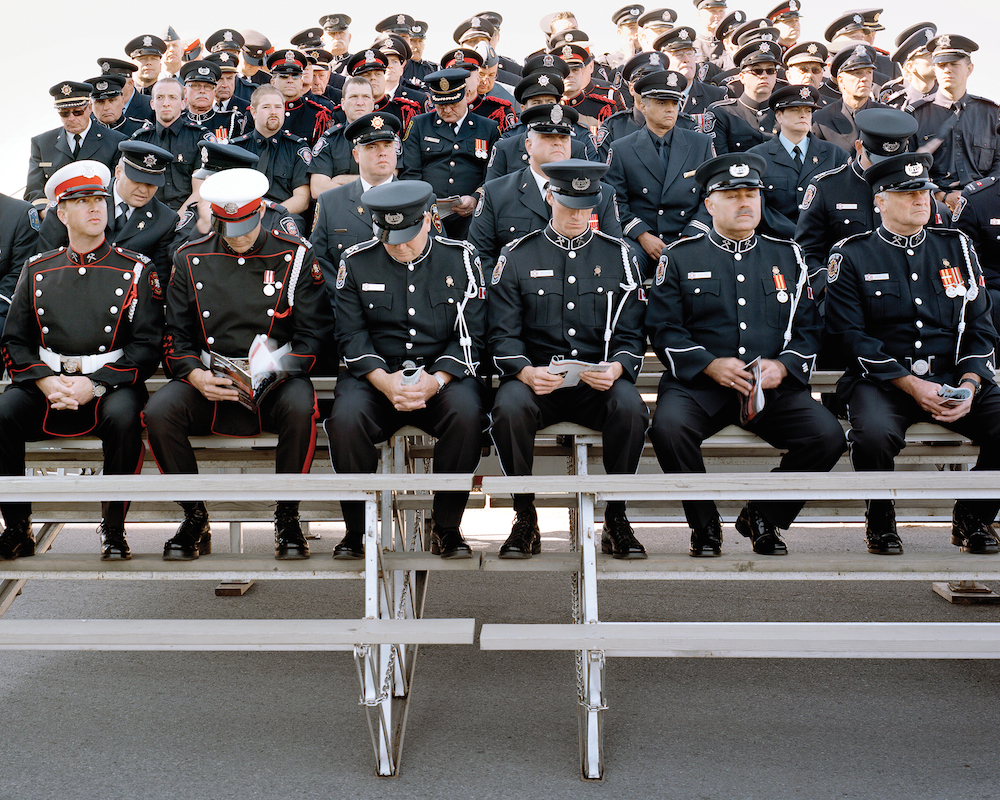
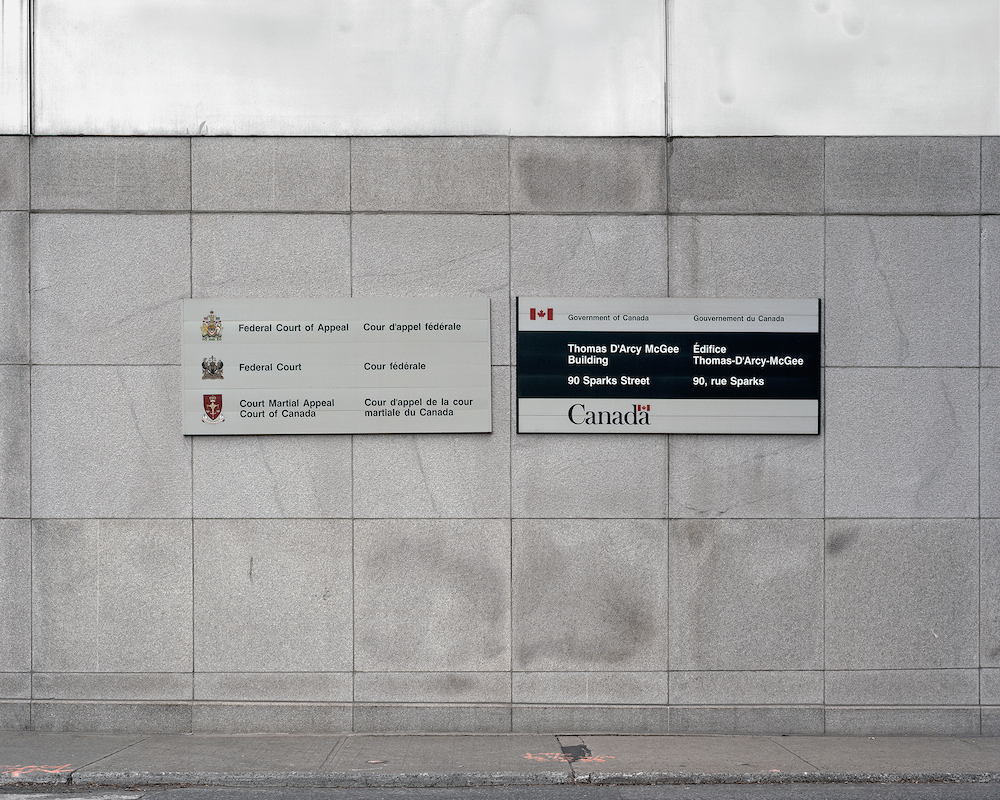
Photographer Tony Fouhse photographed his hometown of Ottawa. Then he made a newspaper of his images and gave all 2,000 of them away for free. The project is called Official Ottawa.
I dig Fouhse’s images of politics, power, pomp and circumstance in Canada’s capital. The concept was great, the execution fine and the distribution in cafes and at truck-stops brings a smile to my face.
FREE FOTOGRAFY WILL SET YOU FREE!
I interviewed Tony about the project for Vantage in a piece titled Control and Containment in the Canadian Capital.
About Ottawa, Fouhse says:
“There is a kind of pervasive fear that percolates through the city. Not a fear of getting mugged or anything, rather, a fear of saying or doing the wrong thing. Workers here seem to know which side of their bread is buttered and who is buttering it; they certainly wouldn’t want to put their pensions at risk. An atmosphere like that dampers a lot of healthy thinking and questioning and certainly precludes action.”
–
Read Control and Containment in the Canadian Capital.






Geekfest,a gathering of a motley bunch of photographers young and old begins tonight in Oakland.
Above is an early flier. Below is the full line-up. I’m speaking in the final spot on Sunday afternoon. I still have no idea what I’ll do or speak about. Really. I think the organisers think I’m joking but, nope, totally undecided.


 Prison Photography