
You are currently browsing the category archive for the ‘Photography’ category.

Michael Shaw has been conscientiously restructuring BagNewsNotes over the past six months or so. Here’s how he describes the rebranded Bag:
• An almost hypnotizing archive featuring hundreds of ways to sort through our over 3000 image posts.
• A dedicated photojournalism section, BagNewsOriginals, steered by long-time BNN contributor, Alan Chin with a powerful lineup showcasing BAG’s distinguished contributor, Nina Berman, fresh off her Whitney Biennial success; World Press and Pulitzer Prize winner Tony Suau on the economy; and much, much more.
• A Salon section managed by the talented photographer and multimedia producer, Sandra Roa, formerly of the NYT Lens Blog, mixing audio slideshows and live chats, all focusing on key images of the day. We kick off on Wednesday with an audio slide show featuring Ashley Gilbertson’s look at the bedroom shrines of fallen US soldiers.
• Our mainstay news image analysis by BAG publisher Michael Shaw, with new contributors, including: acclaimed photojournalist Chris Hondros conducting exclusive interviews; leading visual academics Bob Hariman and John Lucaites deconstructing visual culture; and former White House photographer, Stephen Ferry, on media’s pictorial stereotyping of the third world.
_______________________________
The Bag is all about demystifying (political) imagery and helping people along with visual literacy. Yes, audiences are more savvy, more sophisticated, but there is still a distance to go.
The Bag is the most persistent contributor to this ongoing analysis. The importance of the Bag’s ever critical eye cannot be underestimated in a world that sinks deeper into the swell of images every day.
The new look by designer Naz Hamid of Weightshift is super navigable and I think it is funny (humorous) that the Bag has made use of the same font used by the New York Times’ arts and media blogs.

The font choice is a cheeky nod to the subtle echoes of form and type that run through our daily visual experiences! It’s as if the Bag is testing its own hypothesis from within the permanent elements of its own visual architecture. That, and it doesn’t hurt to have subliminal associations with the Grey Lady!
_______________________________
MY CONTRIBUTION?
Last year, Shaw contacted me and at the same time as describing Bag’s sweeping changes asked me if I’d come on-board as a contributor.
Writings on US prisons here on Prison Photography will be cross-posted to the Bag in order to bring images and issues of America’s prison industrial complex to a wider audience.
I’ve a got a couple of posts coming up this week so stay alert for those and for all that the Bag offers consequently.
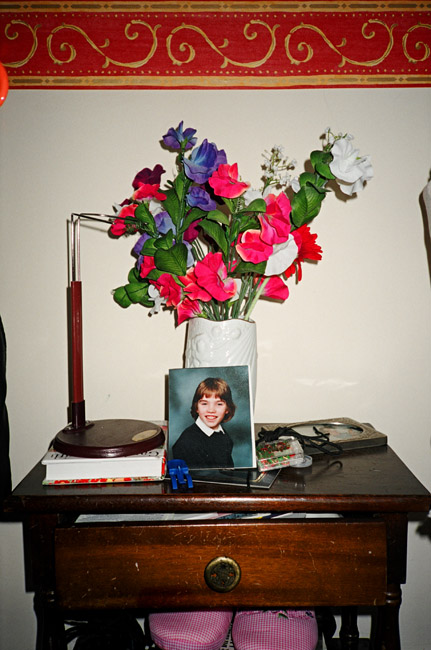
Anna Fox
Tomorrow, the 17th March, the Deutsche Borse Prize is announced.
Two artists up for this year’s prize can fill us with humour and optimism, two others serve the cold reality of human’s strategic antagonism and ability to destroy. It depends on which worldview you prefer.
THE COLOUR OF FOX AND LEONARD
Anna Fox’s bright works are full of love and wonder but they aren’t winners … not yet. Fox has too many ongoing projects that it would be counter intuitive to make her the Deutsche Boss.
The appeal of Fox’s work is obvious part Richard Billingham, part Cindy Sherman, large part Martin Parr. Fox observes congested cupboards, Mothers Day flowers, plastic dolls and emphatic interior details with awe but without irony. All her work is colourful and her later photography staged (Country Girls). Fox’s work is a celebration of that British penchant for chintz and pattern that is rarely brought into focus. While it is distancing, Fox’s work is not distant. Necessarily the ugly brocade of a parents’ generation is balanced by the crayons of the kids’ generation, Fox’s work is unifying. It’s a winner but a winner in its mid-development, so not a winner for now.
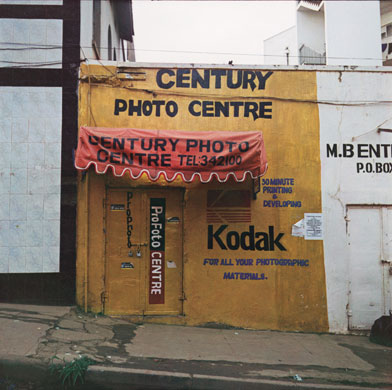
Zoe Leonard
Zoe Leonard has a keen omnicultural view that picks out the additions and modifications that humans make to their world. Surely, it is Leonard’s wandering eye which casts wonderment upon all nations that is the attraction of her work?
Like Fox, Leonard is interested in human ingenuity. Both artists are optimistic about the utility and purpose of things. For Fox and Leonard things, as curious and benign as they may be, are material objects that budded elements of creativity and graft.
Leonard’s worldly view is generous and progressive but is it a fair reflection of our world?
THE DARKNESS OF WYLIE AND RISTELHUEBER
On the other side of the equation, Wylie and Ristelhueber – with restrained palettes – throw down their documents of strife and its aftermath with dominating conscience.
The choice you must make between the two is simple. Do you go for Wylie’s final phase ‘Troubles’ of Northern Ireland or do you go for Ristelhueber’s sprawling and ongoing multinational survey of carnage?
Do you prefer your battles contained or dispersed? Can violence be enclosed, bright-burning and abated between walls, or is conflict slower – continually popping and maiming in every country and on any old road?

Donovan Wylie
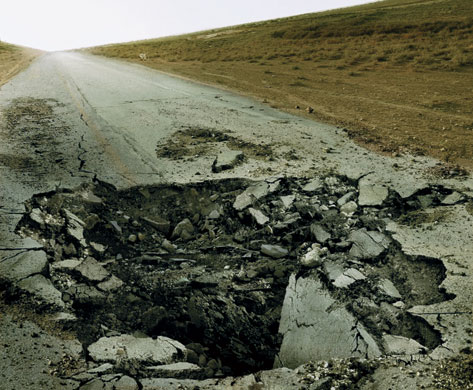
Sophie Ristelhueber
As Ristelhueber opens up space Wylie closes it down. As Wylie describes literal containment Ristelhueber prowls the unnerving territory of psychological containment. Ristelhueber’s Blowups series of craters after IED and car bomb explosions are chilling and very effective.
The ultimate difference between these two artists is that Wylie offers reprieve. Wylie recently declared his image of the Maze’s last wall to be demolished his “Best Shot”. Everyone is aware of Wylie’s Northern Irish heritage and H.M.P. Maze carries more meaning for him personally than it may for us. Wylie documented the prison’s decommission and demolition over a period of eight years. He hopes that the work be simultaneously a record of the site and a “metaphor for the peace process”.
Ristelheuber’s document of violence seemingly has no limits or borders, a notion of violence that is depressing but accurate for today’s globalised military engagement. Where do we find a peace process here? Which road or road-map do we follow here?
If Wylie’s work references the remnants of a political battle, Ristelhueber’s is record of ongoing skirmish. Ristelhueber’s photographs of blockades and bomb-craters are images not unlike those of the Northern Irish Troubles so we can identify a lineage there. However, hers are not photographs from 35 or even 15 years ago; Ristelhueber’s work shows us the violence of the 21st century.
Some might favour the distant and deadpan of Wylie’s aesthetic, but for me, for its immediacy and for its relevance, Ristelhueber should take the prize.
Dawoud Bey suggested during his address to the Society for Photographic Education 2010 Conference audience, Saturday night that ‘diversity’ had become not an ideal but a political mantra of art institutions that papered cracks and contributed nothing to long-term involvement of people of colour.
Bey argued the word ‘diversity’ has been appropriated, misused and redefined. Bey does not foresee a reclamation of the word but calls for an abandonment of the institutional practices the word has come to stand for.
Bey wants ‘inclusivity’, a firm shared understanding of the term, and relevant action instead. Bey distinguishes:
Diversity to me implies that there is still some normative paradigm at the center that we are seeking to destabilize rather than doing away with it in favor of something quite different. It suggests that institutions have an inherently white and male identity that needs to be added to. To operate out of this paradigm is, of course, a kind of tokenism by yet another name and seeks to trade on the momentary (but always empty and short lived) self-congratulatory excitement of seeing a new color in still unexpected places. It would seem to me that by now we should be approaching a point where anyone should be expected to be anywhere.
I think it’s time to turn away from “diversity” as an operative objective and turn instead towards the more meaningful and substantial goal of making institutional spaces ever more inclusive and embrace the goal of inclusivity, in which everyone’s identity is central to the whole. One way to accomplish this is to consider how in fact the institution’s identity can be meaningfully transformed and expanded conceptually by this enhanced inclusiveness in a way to deeply transforms the very nature of that institution. Inclusivity implies a desire to actually change through institutional expansion, while diversity implies to me that those being brought in have to simply fit into the normative and dominant existing paradigms and simply add “color” to it.
[My bolding]

The full lecture which Bey transcribed to his blog is essential reading as it sums up with authority the history of localised art movements, the legacy of protest among minority communities against silenced or non-represented voices (even in shows dedicated to the work of African American artists for instance!)
Bey recounts the protests against the “Harlem On My Mind” exhibition at the Metropolitan Museum of Art in 1969. Bey reminds us that Roy DeCarava carried a sign outside reading, “The White Folks Show the Real Nitty Gritty.”
Bey traces many of his own successes not to umbrella changes in culture or industries but to committed artist actions doing the leg work for themselves. He is the inheritor of community spirit so to speak.
Bey drives the point home exquisitely by pointing to one of New York’s favourite and largest art love-ins:
And then along comes the Whitney Biennial 2010 to remind us just how little some things have changed … In an exhibition that ironically uses an image of Barack Obama on the catalogue cover, we find among other things absolutely no Latino artists and a total of three black artists among fifty-five artists in the exhibition. What is your response to that? What would the response have been in 1969? I can’t imagine that this kind of situation would have been tolerated at that moment.
[My bolding]
CONCLUSION
Again, cold hard figures don’t lie, and I think Bey has shown that history doesn’t lie. We’ve got a lot to do.

Constitution Hill is a former prison that used to hold political prisoners during apartheid, including both Nelson Mandela and Mahatma Gandhi.
Now the prison, a repurposed art space, faces a new controversy. Lulu Xingwana, a South African government minister, walked away from her official speaking engagement because she considered the images of lesbians immoral and “against nation-building”.
Zanele Muholi, an award-winning activist and artist has expressed her disappointment.
As the Guardian reports:
This is an understandable position.
The Guardina summarises:
It is within this context of ongoing violence toward women, that I think Muholi’s pitched her response to Xingwana perfectly,
“There is nothing pornographic. We live in a space where rape is a common thing, so there is nothing we can hide from our children. Those pictures are based on experience and issues. Where else can we express ourselves if not in our democratic country? Children need to know about these things. A lot of people have no understanding of sexual orientation, people are suffering in silence.”

 Prison Photography