
You are currently browsing the category archive for the ‘Photojournalism’ category.

Photo: Chip Litherland
I spent all day looking at photography and this was the last thing through my RSS. Exhausted but pissed off, I have to post.
Chip Litherland (@chiplitherland) was on assignment for this story in the New York Times, and shared a few images on his blog. I simply copy & paste the comment I left with Chip here:
The red hues, the spot light (recalling war photography), the drama in general but most of all the solemnity of Jones who poses between the ultimate Hollywood myth and a shooting target – it reeks of a man who’s more obsessed with theatrics & violence than he ever will be with reality.
I expect this was one time you wanted to put down your objective journalist persona and tell him straight he’s a liar, a nutter and a danger to those fooled by his hate.
More of Chip’s images here.
Fair Warning: This will probably be the only post I do about the Islamophobia gripping the vocal minority in America. There’s no point talking about it; it’s hate and those spewing it are dangerous simpletons. My only worry is that TV will continue to bombard people with heady graphics, drastic statement and “passive wonderment” (as Jon Stewart has best described it). At this point, Fox News conjures the wildest conspiracy theories in America.

It seems like I’ve been saying a lot on prison tattoos (here and here) recently … which is true, but it’s not even an area of keen interest for me. Maybe this will be the last one, or maybe not, depending on what friends and photographers continue to produce.
I have expressed reservations about photographing prison tattoos because inevitably the images may fail to penetrate the coda that prisoners share, understand and guard.
Therefore, I applaud Bob Gumpert for providing his audience with as much understanding as he has drawn during his documentation. Accompanying American Prison Tattoos the multimedia piece published on Foto8 last week, Gumpert provides a “short and incomplete glossary of tattoo markings & terms” and a “list of slogans reflecting beliefs or attitudes.”
Of course, Bob Gumpert‘s work is about much more than just tattoos. He has been working in the San Francisco and San Bruno jails systems for 14 years and it touches upon every imaginable story of American cities, families and experience. I encourage you to check out Take A Picture, Tell A Story, his multimedia platform for his jail work; his general website; and his blog.

I think it is fair to say that the average Westerner’s understanding of the ethnic conflicts in Southern Kyrgyzstan is small to non existent. And I’d include myself in that.
I would have remained distant and uninformed if it wasn’t for Ikuru Kuwajima in Kyrgyzstan’s coverage. Kuwajima worked with Save the Children. He says, “About 2000 people were thought to be killed in the recent clashes in the southern Kyrgyzstan. A number of people, especially ethnic Uzbeks lost houses due to arsons and looting, and hundreds, or thousands, of IDPs still don’t know where to move.”
For some reason, Kuwajima’s work distinguished itself above and beyond other B&W dispatches from the caucuses/Middle-East/Far East that run the risk of getting lumped together in Westerns viewers’ minds.
I am not exactly sure why Kuwajima’s work made such an impression? It just a delicately edited collection of images.

A woman voices her opinion while a Police man looks on as hundreds of demonstrators gather outside a Toronto Police Station to protest against tactics used by the Police against anti G20 protesters over the weekend. THE CANADIAN PRESS/Chris Young
Just have to say, I enjoyed reading Chris Young‘s NPAC blog this week. He’s good with words:
A colleague of mine had advised me that kayaking helmets are the way forward for this kind of thing as they are built to come into contact with rocks. I went to a camping store and asked the guy behind the counter where they kept their rock proof helmets and was sent into the basement. There, I was met by Colin, a thin man with darting eyes. […] He looked me up and down, beckoned me towards him and asked in a hushed, conspiratorial tone “Is it for this weekend ?” I confessed it was. He quickly produced two helmets and began to give me the low down on what helmet could withstand what impact from what size rock and from what distance. I got the impression that Colin had been selling a lot of helmets recently.
The weapons cache found in the roof rack resembling a grade 2 project comprised of a crossbow, a chain saw, and a swiss army knife as well as an assortment of handyman tools. Unless this was an A-team inspired assassination kit it began to look like a hillbilly had stopped in town on the wrong day.
I’m the first to admit that I have a cynical streak […] maybe it’s from attending too many carefully choreographed PR stunts. But watching police cars haphazardly left at major intersections with easily flammable front seats whilst an unchecked mob of pimpled anarchists career towards them tugs at my senses. Was this a justification for the $1billion tab that the taxes payers have been left with for the summits?
The look on the cop’s face pretty much said it all. As he climbed onto his bike to trail a group of several hundred demonstrators as they set off march through the streets of Toronto to voice their anger at the detentions, harassment and beatings they’d experienced over the previous 48 hours. He looked like a five year old being dragged around a mall by his mum to find a new pair of gloves after he’d lost the last pair. Slightly guilty, though not completely sure why, and totally over it.
THE COAL WAR

The Coal War, a “documentary about hope, change, and one unstoppable grandmother”, is looking for funding.
Chad Stevens heads a team of familiar names.
QUESTION OF POWER

Carlan Tapp’s Question of Power project began in 2005. It delivers photographic essays and “the voices of individuals, families, and communities affected by the mining, processing, burning, and storage of waste materials created by coal for the generation of electricity in America”.
MINING ON NATIVE AMERICAN LANDS
“Carlan is a descendant of the Wicocomico Tribe, Taptico family. His strong belief and respect for the earth and all creatures is the continual theme in his work.”
Carlan’s documentation of the mining activities and environmental destruction on Navajo land is startling. I particularly advise viewing the 42 images and captions of Coal Production. Mining kicks up toxic dust, pollutes the earth and water, causes respiratory problems in the local population and causes structural weakness in homes.
As a point of comparison, watch Aaron Huey’s TEDxDU presentation. Huey’s talk about the broken treaties, chronic poverty and human rights abuses wrought upon the Lakota people of Pine Ridge in the Black Hills area of South Dakota (a place he describes as “ground zero for Native issues in the US”) was well received – largely due to the fact he passionately presented a history we rarely hear. It is likely the legal and environmental rights of the Native Americans in Tapp’s coverage are under attack by similar forces.
Especially in light of the Gulf of Mexico disaster, we must ask the same questions of coal, oil and all non-renewables with regard our own consumption habits.
Carlan blogs here. He has been on the Gulf Coast since last month. Good write up by Elizabeth Avedon.

LEFT: Henry Montgomery, who has served 23 years in prison for homicide, serves the ball during a match at San Quentin State Prison. RIGHT: Guards stand watch over inmates in San Quentin’s recreational yard, which now includes a tennis court. © Rick Loomis LA Times
TENNIS AND THE CALIFORNIA DEPARTMENT OF CORRECTIONS
Last year, whilst featuring photo essays (here & here) on the San Quentin Giants baseball team, the photographer Emiliano Granado mentioned seeing tennis matches.
San Quentin sits on a Marin County promontory; every day, in the surrounding well-heeled communities deuce and lemonade are being served, but it was a stretch even for my imagination to envision games, sets and matches playing out inside those walls.
Kurt Streeter – for the Los Angeles Times – went to San Quentin to play a match and profile Don DeNevi, San Quentin’s 72 year old recreation director. DeNevi is largely responsible for the construction of the prison’s tennis court. Read Tennis is serious sport in San Quentin Prison.
THE PHOTOGRAPHS
Rick Loomis created a photo essay Tennis Inside the Walls of San Quentin of his own; the two works of journalism are a nice compliment.

LEFT: Henry Montgomery, 43, center, laughs with other inmates during a break in play. RIGHT: Raphael Calix watches the activity on one of the blocks at San Quentin. Calix is a regular on the tennis court. © Rick Loomis/Los Angeles Times

Backstage, Miss Light, Mesitas del Colegio. © Carl Bower
Last month, at the Critical Mass Top Fifty exhibition at Photographic Center Northwest I found myself transfixed by Carl Bower‘s Backstage, Miss Light, Mesitas del Colegio.
I presumed it was shot on a nocturnal, hedonist jaunt to which photographers (Antoine D’Agata, David Alan Harvey, Kohei Yoshiyuki, Clayton Cubbitt) often turn.
Or possibly an indifferent Larry Finkesque look at glamour?
The image was noir enough that I placed it simultaneously in different eras. It echoed Erwitt but without the sentimentality.
For me, it was the stand-out print of the exhibition and I told Carl as much. With a touch of class I insisted on qualifying my flattery, “I don’t bullshit people.”
BEYOND THE SURFACE
When I got home unable to shake the threatening image nor the fool of a comment I delivered its creator I checked out Bower’s Critical Mass portfolio.
Bower’s sumptuous, dangerous image of surface and tease was – is – to my surprise part of an important look at collective escapism, denial and dreams.
I have talked about Colombian beauty pageants before, but in the context of prison contests! I hadn’t appreciated at that time of writing that the prison pageant merely reflected the appetite for swimsuits and tiaras in wider Colombian society. Carl’s artist statement is remarkable:
What is perhaps most remarkable is that Bower’s work is void of any sense of judgement. Every crowd is matched with a lonely figure. Every smile parried by a sideways glance. Every opportunity for scorn mollified by a capture of genuine emotion. This balance is admirable and may stem from Bower’s journalist background.
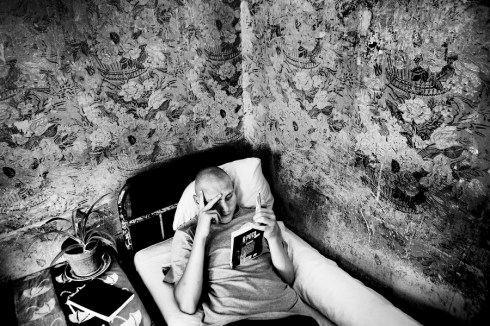
Every Wednesday the inmates have free time for a couple of hours in the afternoon, where they have to clean their dorm room, but there is also time to read a book. © Christian Als / GraziaNeri
Christian Als contacted me recently, to let me know of his project A Childhood Behind Bars.
Als visited Cesis Correctional Facility for Juveniles, Latvia’s only juvenile prison. A quick internet search indicated a paucity of information on Cesis; so this documentary project should be considered a important record of this particular institution and the lives contained within.
Cesis is situated one hundred kilometres northeast of Latvia’s capitol, Riga. It houses 140 young men between the ages of 14 and 21. As soon as the youngsters turn 21 they are transferred to adult facilities.
Als describes the young prison population as half Russian youth and half Latvian youth.
2007
The project is now three years old, so I encourage caution not to assume that all things are the same.
“A study from 2005 made by the ‘Latvian Centre for Human Rights’ evaluated the situation of juvenile prisoners in Cesis and gave recommendations how to bring the prison in line with International standards. So far nothing has been done and the prison looks like something out of Soviet Union and not EU 2007,” says Als
Latvia’s system for juvenile offenders is unique. “Four percent of Latvian prisoners are juveniles; that is a far higher rate of juvenile incarceration than other countries in the region. In comparison Sweden has only 0.2%, Denmark 0.6% and Poland 1.3%,” explains Als.
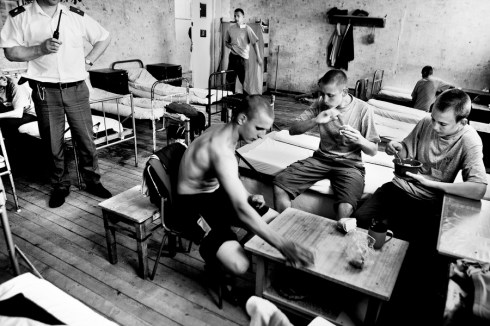
During the inmates free time some boys are eating soup and playing cards, while the warden is keeping an eye on the action. In Latvia the official standard for living space per juvenile prisoners is three square metres. In the section for sentenced prisoners, juveniles are accommodated in large dormitory type rooms for 20-22 inmates in eight units. © Christian Als / GraziaNeri

The boys are not allowed newspapers or television, because they are not to have any influence from the outside world. But the boys save pages from magazines and hang them on the wall. The most popular teenstars are Britney Spears and Christina Aguilera. © Christian Als / GraziaNeri

© Christian Als / GraziaNeri
WHEN IS A PRISON NOT A PRISON?
ALs recounts, “The management insists on calling the prison by other names like school, institution or home. The plaque outside reads: ‘Cesis Correctional Institution for Underage Children’.”
The age of criminal responsibility in Latvia is 14 years-old. Prior to the new Criminal Law of 1999, the age of criminal responsibility for most crimes was 16, and 14 only for the most serious crimes.
The new Criminal Law extended the maximum prison sentence length for juveniles from 10 to 15 years. Many of the children in Cesis Prison were convicted on charges of murder.
INSTITUTIONAL VIOLENCE
In March 2005 a juvenile prisoner was killed by hanging by two fellow prisoners. On July 28, the Vidzeme District Court sentenced both killers to eleven years imprisonment.
Months later at Cesis, in December 2005, a 16-year old boy, upon his return from a Central Prison hospital, was murdered in his cell by two other juvenile cell-mates.

The boys in Cesis Correctional Facility for Juveniles are allowed a bath once a week, every Wednesday. © Christian Als / GraziaNeri

According to Latvian law the juvenile prisoners are entitled to at least one short visit by relatives or other persons once a week for up to one hour in the presence of a prison officer, and one phone call a week, not shorter than five minutes. But the prisoners rarely get in touch with the outside world. © Christian Als / GraziaNeri

Every Wednesday the inmates have free time for a couple of hours in the afternoon, where they have to clean their dorm room, but there are also time to hang out in the court yard. © Christian Als / GraziaNeri
– – –
A Childhood Behind Bars won third place in the PoYI’s Feature Picture Story category, 2008.

 Prison Photography