
You are currently browsing the category archive for the ‘Press’ category.

Nieman Labs reports:
“Starting in February, The Atlantic will have a new section on its website: In Focus, a photography blog featuring “photo essays on the major news and trends of the day.” Editing the site will be Alan Taylor, who’s moving to the magazine from the Boston Globe, where, for the past two-and-a-half years, he edited Boston.com’s celebrated photo-essay feature, The Big Picture.”
The incredible thing about this story is the figures it detailed. The Big Picture had 8 million page views per month. That is an incredible number of eyes on an incredible number of images. Rather naively, I’d never imagined that scale of internet image distribution … and I don’t really know what it means.

Mrs. Reagan sitting on Santa Claus (Mr. T) lap after reviewing White House Chrismas Decorations with the press. 12/12/83.
Source: White House photo via Reagan Library, # C18929-22.
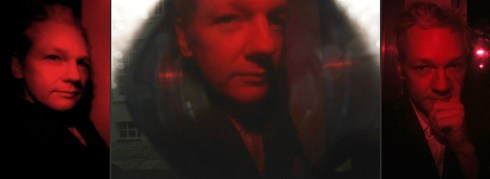
Carl Court / AFP – Getty Images; Dan Kitwood / Getty Images; Peter Macdiarmid / Getty Images
These photos of WikiLeaks founder Julian Assange arriving at Westminster Magistrates Court inside a prison van with red windows reminded me of Ben Graville’s past work, which I wrote about here.
Graville’s In & Out The Old Bailey caused some controversy drawing accusations of exploitation. Do we feel Assange is being exploited here? I don’t really think so. Assange is well aware of media praxis and photographer protocols for winning that shot. By his direct eye contact, it would seem he’s putting on a show for these photographers? Or maybe it’s just the edit?
BUT WHAT ABOUT THE RED?
You could run hog wild with reading the colour here, but I won’t. I’ll just mention, witch-hunts, the Hunt for Red October, Red Letter Day, the commies, the Reds, blood on “their” hands, whoever they are, the Scarlet Pimpernel, drive by night tactics, sex by surprise, red light districts and the red ink of Top Secret papers. All collapsing on top of this portrait of a man, still widely misrepresented.
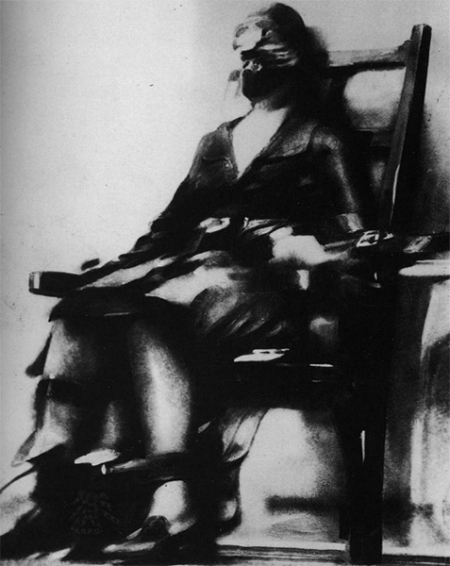
From the consistent, informative and often disturbing Iconic Photos:
“Photographers are not permitted into executions in the United States. For the notorious Ruth Snyder case, the New York Daily News was desperate to get pictures; so they hired a Chicago Tribune photographer Tom Howard – virtually unknown to the prison warders or journalists in the New York area. On that fateful day (12 January 1928), Howard, posing as a writer, arrived early in Sing Sing Prison and took up a vantage position. A miniature camera was strapped to his left ankle, the shutter release button was concealed within his jacket. As Snyder’s body shook from the jolt, Howard hoisted his pant leg and secretly snapped with a one-use camera.”
[My bolding]

Source: http://www.time.com/time/world/article/0,8599,1903971,00.html
Last week, Ahmed Khalfan Ghailani, 36, the first suspect transferred from Guantanamo military prison to stand a civilian trial was found guilty of only 1 of the 285 charges brought against him – a charge relating to involvement in the 1998 bombing of the American Embassy in Nairobi, Kenya.
PBS reports:
Prosecutors branded Ghailani a cold-blooded terrorist, but the defense portrayed him as a clueless errand boy, exploited by senior al-Qaida operatives and framed by evidence from contaminated crime scenes. Ghailani was convicted of one count of conspiracy to destroy U.S. property. He faces a minimum of 20 years and a maximum of life in prison at sentencing on Jan. 25.
Only one charge was successfully prosecuted because civil courts don’t look kindly upon the involvement of torture in extracting testimony for evidence.
From the New York Times:
Many observers attributed any weakness in the prosecution’s case to the fact that the Judge Lewis A. Kaplan of United States District Court in Manhattan, who presided over the trial, refused to allow prosecutors to introduce testimony from an important witness, who was discovered after interrogators used coercive techniques on Mr. Ghailani.
If this trial is a precedent for other trials of Gitmo detainees to follow, prosecutions are going to have a tough time of it.
The extent of torture used by American powers across the globe is picked apart in the ACLU’s ‘Torture Report’.
Experts have dissected govt. documents (released under the Freedom of Information Act) to piece together the practice of enhanced interrogation techniques; practices that have ultimately derailed the prosecution cases against hundreds of GWOT detainees.
(Found via)
The prison officials had given us a room where we could talk to the women and I could take their pictures. […] I photographed each woman in a slightly different setting. When it was Williams’ turn, I photographed her next to a calendar showing the date: May 1987.
I told the warden that I wanted to see the women in more of a typical prison setting. After much discussion, I was allowed to photograph Williams in her room, as long as I didn’t show any other prisoners or the barbed wire fences surrounding the prison.
– J.B. Forbes

May, 1987 Chillicothe, Missouri Vicky Williams was 30 years old in 1987 when she posed for a photo in the Chillicothe Correctional Center where she was serving a 50-year sentence for killing her husband. © J.B. Forbes
Here’s a nice human interest piece in the St. Louis Daily by photographer J.B. Forbes.
“I was not interested in judging Vicky Williams’ guilt or innocence,” says Forbes. “This was a woman whose life was dramatically different from mine, someone for whom time had stood still.”
Forbes:
“After a decade-long fight by lawyers who took the cause of several women convicted of murdering their husbands, the state Board of Probation and Parole granted Williams an early release. The lawyers pointed to claims of abuse, the fact that domestic violence was poorly understood years ago, and a new state law that said abuse victims could be granted early release under certain conditions. The move infuriated prosecutors and relatives of Gilbert Williams.”
“By the time Williams walked out of the prison, she had been behind bars for 32 years. She was now 55.”
Forbes was with Williams during her first few hours of freedom following early release. Quite intriguing, to me at least, are Williams’ first requests upon leaving prison:
“One of her first requests was to see the town of Chillicothe. She’d been there all this time, but she had no idea what the town was like. She wanted to see a local Catholic church because she had watched from prison as a crane installed a new steeple there. She wanted to pray there because a priest had prayed in the sanctuary for her during her appeals process.”
“And she wanted to visit the grave of one of the prison guards who had befriended her. When the guard died in 2004, Williams was not allowed to attend the funeral. I watched as she poured a vanilla Coke on the ground next to the grave. It was the guard’s favorite drink.”
[My bolding]

Tijuana — Young men sit on the 3-foot-wide floor of a holding cell in the old Tijuana jail. © Don Bartletti/Los Angeles Times
Don Bartletti provided photos for Richard Marosi’s story “Notorious Tijuana jail to be just a dark memory.”
From the LA Times: “A cacophony of shouts and clanging metal. The overpowering stench of vomit and urine. This is the Tijuana jail, nicknamed “La Ocho” because it is on Eighth Street. The lockup, known for decades to hard-partying hordes of Americans and locals, is closing.”
My guess would be anyone who suffered a night or more in this hole will be glad no-one else has to endure the same?

Michael S. WIlliamson for the Washington Post was inside Deerfield Correctional Center earlier this month and photographed the aging and sick prison population.
From The Washington Post:
“We’re left trying to be both a nursing home and a prison,” said warden Keith Davis

SOURCE: Virginia Department of Corrections, The Washington Post – Sept. 8, 2010
Since the General Assembly abolished parole in 1995, Virginia has been forced to care for more and more elderly prisoners. In 2008, 12 percent of Virginia’s prison population was age 50 or older, up from less than 5 percent in 1990.

 Prison Photography