
You are currently browsing the category archive for the ‘Press’ category.

Spread from Toppled
Toppled by Florian Göttke
Two weeks ago, Foto8’s Guy Lane reviewed Toppled by Florian Göttke. The review is what it is – a description of Göttke’s “(mainly) pictorial study of the destruction, desecration and mutation of many of Iraq’s plentiful statues of its former dictator.”
Lane’s conclusion points to the significance of Göttke’s study:
“Perhaps this might all appear somewhat peripheral, an iconographical diversion from the real business – invasion, subjugation, and expropriation – of Occupation. But from amongst Göttke’s collated written testimonies and reports, it is possible to sense something of the importance that was attached to the Coalition’s iconoclasm. For example, a BBC account of British activities in Basra concluded that ‘the statue of Saddam is in ruins. It is the key target of the whole raid.’ Meanwhile, in Baghdad a US army captain was ordered to delay destroying a statue until a Fox TV crew arrived. Most famously, the Firdous Square episode appears to have been – to a degree – choreographed for the benefit of the foreign media based in the overlooking Palestine Hotel. ‘American and British press officers were indeed actively looking for the opportunity to capture the symbolic action of toppling statues and have the media transmit these to the world,’ writes Göttke. As such, Toppled’s events and pictures correspond tellingly and damningly to the Retort group’s analysis of our ‘new age of war’.”
Would I buy the book? Probably not. The book is a concept. I understand the concept. And, the images are essentially props to the concept (illustrations of the new biographies of statues, of things).
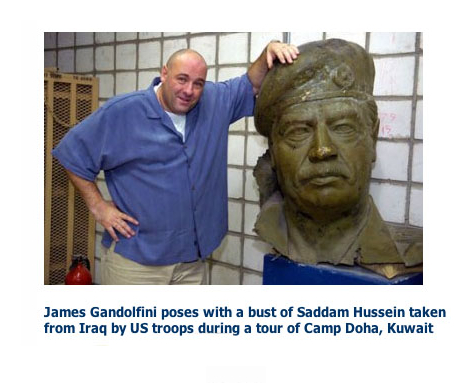
Besides, I can get my fill elsewhere. The best (most ridiculous) image – James Gandolfini meets the Butcher of Baghdad – is on the accompanying Toppled website.
SADDAM’S PERSONAL PHOTO ALBUM
Göttke’s work leaves me wondering how Saddam’s personal photo-album fits in?
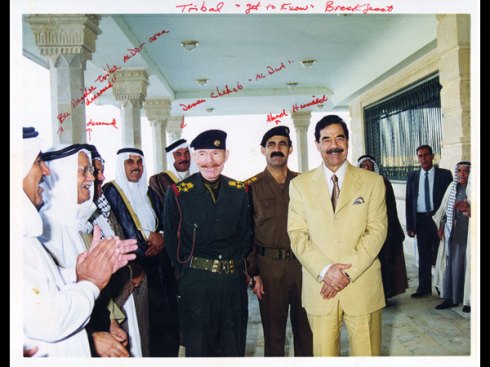
Similarly, these images were found and taken during the invasion of Iraq: “On the night of June 18, 2003, the soldiers in the 1-22 Infantry stormed a farm in Tikrit, Iraq, hoping to find a fugitive Saddam Hussein. They didn’t find their target, but they did find a consolation prize: Saddam’s family photo album […] When he returned from Iraq, Lt. Col. Steve Russell, the commander of the 1-22 Infantry, donated the album to the National Infantry Museum at Fort Benning, Ga.” (Source)
This is a reversal, no? Not the effigies of megalomania, but personal snapshots. Not public monstrosities but flimsy two-dimensional depictions. Would these have got pissed on and slapped with sandals? Would they have been torn up/burned up had Lt. Col. Steve Russell not slipped them into his luggage?
Also, to describe the collection (for media publication) as the dictator’s “personal album” is one thing, but to what extent were these Saddam’s photo-memories? Are these really the contents of an album he valued? Are we even glad that Saddam’s images still exist?
One final thought, how do we distinguish between the staging of Saddam’s images to the staging of the images in Göttke’s survey?
JAMAL PENJWENY
On a less-grander scale, Jamal Penjweny is attempting (with his Iraqi subjects) to make sense of the spectre of Saddam. The series is called Saddam is Here. It’s not great photography but I don’t think this type of playful exploration needs to be.
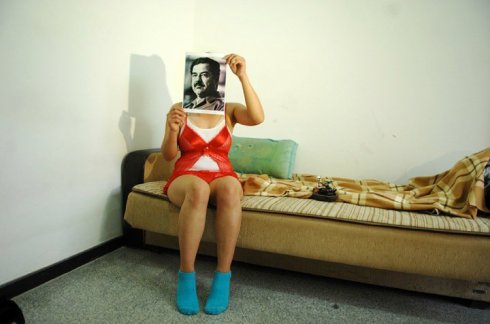
© Jamal Penjweny
Photographer Glenna Gordon provided the image (below) to accompany Liberia’s inclusion on a recent Foreign Policy (FP) listing of failed states. She was not impressed by the piece – this is what she had to say:
“A couple of weeks ago, Foreign Policy ran one of those not-all-that-informed lists they called Postcards from Hell: Images from the World’s Most Failed States. In my book, a list that includes Yemen and Somalia alongside Ivory Coast and Liberia isn’t going to tell us that much […] Thanks FP, for often providing great news and analysis, and every now and then providing crappy link bait.”


A woman voices her opinion while a Police man looks on as hundreds of demonstrators gather outside a Toronto Police Station to protest against tactics used by the Police against anti G20 protesters over the weekend. THE CANADIAN PRESS/Chris Young
Just have to say, I enjoyed reading Chris Young‘s NPAC blog this week. He’s good with words:
A colleague of mine had advised me that kayaking helmets are the way forward for this kind of thing as they are built to come into contact with rocks. I went to a camping store and asked the guy behind the counter where they kept their rock proof helmets and was sent into the basement. There, I was met by Colin, a thin man with darting eyes. […] He looked me up and down, beckoned me towards him and asked in a hushed, conspiratorial tone “Is it for this weekend ?” I confessed it was. He quickly produced two helmets and began to give me the low down on what helmet could withstand what impact from what size rock and from what distance. I got the impression that Colin had been selling a lot of helmets recently.
The weapons cache found in the roof rack resembling a grade 2 project comprised of a crossbow, a chain saw, and a swiss army knife as well as an assortment of handyman tools. Unless this was an A-team inspired assassination kit it began to look like a hillbilly had stopped in town on the wrong day.
I’m the first to admit that I have a cynical streak […] maybe it’s from attending too many carefully choreographed PR stunts. But watching police cars haphazardly left at major intersections with easily flammable front seats whilst an unchecked mob of pimpled anarchists career towards them tugs at my senses. Was this a justification for the $1billion tab that the taxes payers have been left with for the summits?
The look on the cop’s face pretty much said it all. As he climbed onto his bike to trail a group of several hundred demonstrators as they set off march through the streets of Toronto to voice their anger at the detentions, harassment and beatings they’d experienced over the previous 48 hours. He looked like a five year old being dragged around a mall by his mum to find a new pair of gloves after he’d lost the last pair. Slightly guilty, though not completely sure why, and totally over it.

Kenneth Clarke, the combative old school Tory, who is Justice Minister in Cameron/Clegg’s new UK coalition government has outlined his plans for major prison reform in his first major speech since taking office.
(Before preceding any further, I should say that beyond all the UK news outlets you should always consult John Hirst‘s opinion at Jail House Lawyer blog as regards the politics of prisons and the perceptions of prisoners & crime in the UK. He’s a bit irreverent but he’ll deliver the silenced opinion.)
RADICAL, EH?
From the BBC: Justice Secretary plans ‘radical’ prison policy change
Of course, anything is radical compared to then justice minister, Michael Howard taking a head-up-his-own-ass approach and declaring in 1993 that “Prison’s work”. Let’s see if Clarke and the Tories can undo 17 years of disastrous policy, which it is fair to say Labour made their own during their time in government (1997-2010)
PHOTOGRAPHY
I’ve looked at photographic projects in the UK before, particularly at the work of Edmund Clark, Casey Orr, the iconic photography of Ged Murray and Don McPhee at Strangeways and even young offenders using Facebook from behind bars.
WRITING
For the best account of prisons during the past disastrous 20 years, read Sir David Ramsbotham’s Prisongate. Ramsbotham was the independently-appointed Chief Inspectorate of UK prisons (1995-2000). His findings were shocking and surprised many who were deep in the British culture of corrections. (Ramsbotham offers his opinion in the BBC piece linked to here.)
Alfie Brooks (not his real name) is the focus of Amelia Gentleman‘s recent Guardian article. Photographer Tom Wichelow spent 12 months with Alfie documenting his life:
During those 12 months, Alfie was sentenced to eleven days in prison (for stealing 400 balloons). It was his first stay in prison. Alfie intends it to be his only stay in prison. He was bored.

A coffee table at his flat, on which are instructions on how to use the curfew tag he has to wear. © Tom Wichelow
To the journalist, Alfie is simultaneously endearing and frustrating; he delivers pearls of wisdom and then childish logic. More startlingly, sometimes the two are the same – and we, the reader, need to rethink our perceptions and expectations of a younger generation without the same future-oriented behaviours we value and reward.
Alfie is affable and greeted warmly by folk about his hometown. He isn’t violent and has never stolen from an individual, only shops. It is a code he justifies. He has also smoked marijuana for as long as he can’t remember:
AMELIA GENTLEMAN
For me, Gentleman’s piece is not a ground-breaking piece of journalism, but it is unique. It takes the time to look at a young life that could be the norm for more young lives than we’d like to admit. It really spells out for us the drifting uncertainties of life for youth who’ve opted out of formal education, but are still bright, articulate, playful and “clear with ambition”. Gentleman has a fondness and hope for Alfie which is appropriate and understandable.
TOM WICHELOW
Gentleman’s piece is well supplemented by Tom Wichelow’s photo essay, A Year in the Life of Alfie Brooks. His year long study of Alfie is a nice counterpoint to other work in his portfolio, notably his work on CCTV in the Whitehawk housing estate, Brighton, You’ll Never be 16 Again and 2000 portraits.
The Fault Lines programme on English Al-Jazeera looks at America’s aging prison population. Reporter Josh Rushing gets exclusive access across the US, but the most astounding footage is from the Geriatric Unit of the Joseph Harp Correction Center, Lexington, Oklahoma.
Fault Lines also visits the Mabel Bassett Correction Center, Oklahoma’s largest women’s prison.
NOTES
* At the time of filming, Oklahoma’s prison system was operating at 75% staffing, referred to by administration as “warehouse mode”; housing but not rehabilitating prisoners.
* Check out Sherman Parker’s situation beginning at 9.38. Sherman is 100 years old. He is cared for by Seth Anderson, another inmate convicted for kidnap and drug and weapon possession. Anderson speaks frankly about the hospice care at the Dick Conner Correctional Center, Oklahoma.
* Prisoners over 55 years account for the fastest growing class of inmates in America.
* Only three out of every 100 inmates over 55 years return to prison after release, compared to the national average of over 60%.
* Fishkill Correctional Facility, 70 miles north of New York is the nations first purpose-built unit for the cognitively impaired. The average age is 63 and many prisoners suffer from Alzheimer’s and other conditions of dementia.

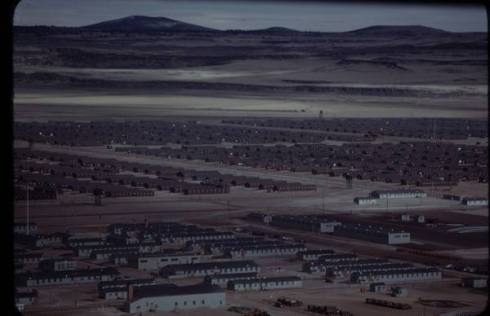
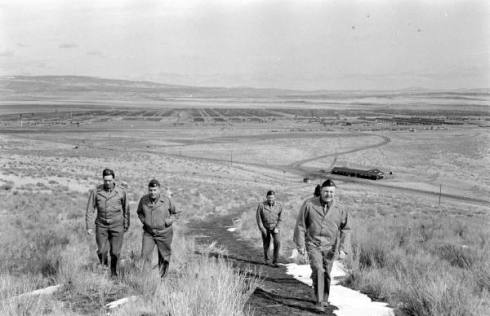
A couple of weeks ago I posted four Library of Congress photographs (attributed to Russell Lee) of Tule Lake internment camp .
In follow up, I encourage you to check out the 200+ images of Tule Lake by Carl Mydans on the Google/LIFE archive. Mydans took these for a LIFE Magazine feature in 1944. [More down the page]


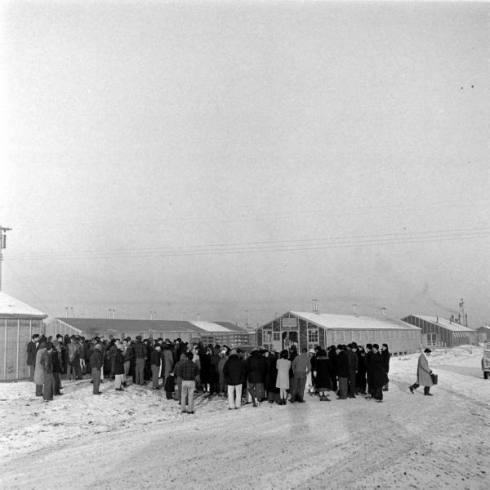
I am especially drawn to the photographs in which Mydans’ presence cannot be ignored – a blinding flash,or fixed stare. Are some of Mydans prints are attempts to be poetic? The scenarios for other prints seem invasive. [More, scroll down]


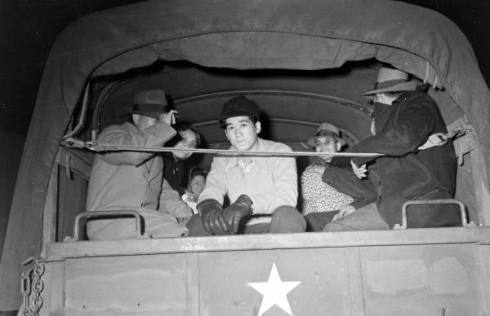


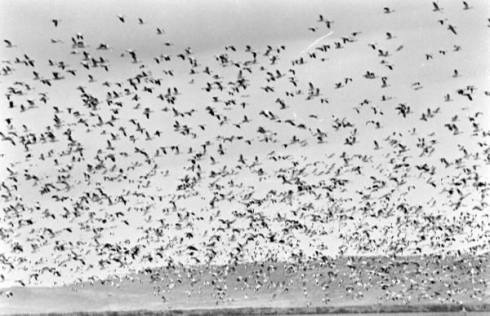


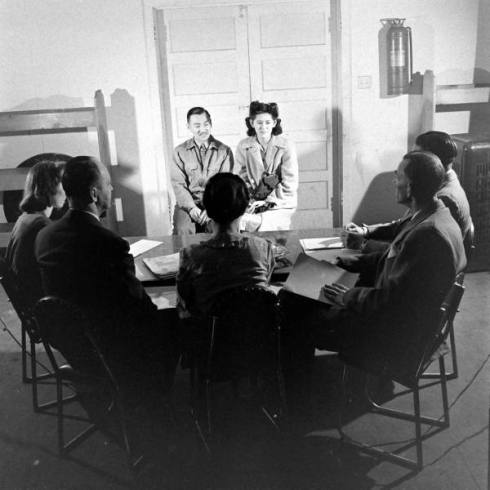
Mydans’ success was his portraits; his reportage of the interactions between internees and authorities appear to be staged. Maybe pictures were staged, or maybe authorities just fidgeted in front of the camera?



– – – – –
For more about Japanese-American Internment during WWII, refer to the Densho archive of video-recorded oral testimony paired with images and documents of the time. It is the most thorough archive I know of.
– – – – –
Found via International Center for Photography, FANS IN A FLASHBULB blog:
http://fansinaflashbulb.wordpress.com/2010/05/29/tule-lake-internment-camp/
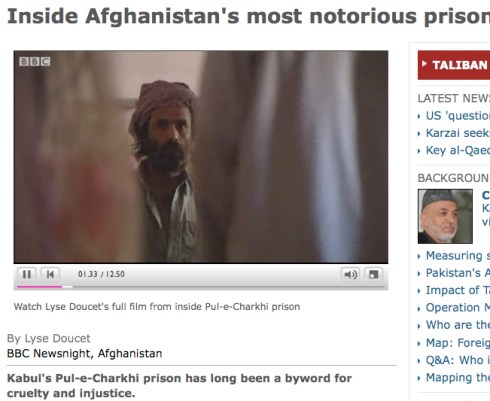
“Here” is Pul-e-Charki.
The long and contested history of this complex has eluded my ability to summarise. Lyse Doucet‘s 13 minute report for BBC Newsnight does an excellent job.

 Prison Photography