
You are currently browsing the category archive for the ‘Prison Non-Photography’ category.
Two million voters disenfranchised in key swing states. Something to think on this week and next.
 via Prison Policy Initiative


Photo: Roger May. (Source)
You’d think after 26 months in an Iranian prison, Shane Bauer would not be interested in seeing the inside of another cell. Think again. As I’ve noted before, Bauer is a journalist with human rights at the core of his stories.
Since his return to the U.S. he has been increasingly involved in describing the real problem we have with our approach to corrections. From Bauer’s Mother Jones feature piece:
I’ve been corresponding with at least 20 inmates in SHUs around California as part of an investigation into why and how people end up here. While at Pelican Bay, I’m not allowed to see or speak to any of them. Since 1996, California law has given prison authorities full control of which inmates journalists can interview. The only one I’m permitted to speak to is the same person the New York Times was allowed to interview months before. He is getting out of the SHU because he informed on other prisoners. In fact, this SHU pod—the only one I am allowed to see—is populated entirely by prison informants. I ask repeatedly why I’m not allowed to visit another pod or speak to other SHU inmates. Eventually, Acosta snaps: “You’re just not.”
Bauer excavates the policy and the logic, if you can call it that, used by the CDCR in their categorisation of prisoners and how those policies lands individuals in solitary. Pelican Bay State Prison, the oldest state-built Supermax, is Kafkaesque in its imprisonment of prisoners classified as gang affiliated. Bauer describes the *evidence* used by the CDCR in its case tying Dietrich Pennington to gang activity.
In Pennington’s file, the “direct link” is his possession of an article published in the San Francisco Bay View, an African American newspaper with a circulation of around 15,000. The paper is approved for distribution in California prisons, and Pennington’s right to receive it is protected under state law. In the op-ed style article he had in his cell, titled “Guards confiscate ‘revolutionary’ materials at Pelican Bay,” a validated member of the Black Guerilla Family prison gang complains about the seizure of literature and pictures from his cell and accuses the prison of pursuing “racist policy.” In Pennington’s validation documents, the gang investigator contends that, by naming the confiscated materials, the author “communicates to associates of the BGF…as to which material needs to be studied.” No one alleges that Pennington ever attempted to contact the author. It is enough that he possessed the article.
Getting out is a Catch-22 that is best described by Bauer than I.
For the longest time, there was a media blackout in California prisons and very few journalists got in to the SHU. I have heard from a few reporters and photographers this year who have visited Pelican Bay’s SHU but on a very tightly controlled media tour. Ultimately, Bauer wants to decode what purposes are served by solitary confinement. The CDCR argues it keeps prison violence down, but …
Prison violence fluctuates for myriad reasons, among them overcrowding, gang politics, and prison conditions. It’s impossible to say for certain what role SHUs play; what is clear is that in states that have reduced solitary confinement — Colorado, Maine, and Mississippi — violence has not increased. […] Since Mississippi State Penitentiary at Parchman released 75 percent of inmates from solitary in the mid-2000s, violence has dropped 50 percent. CDCR officials claim California is different because the gang problem is worse here, though they don’t have data to confirm this.
Bauer goes on to compare the correspondences he received as a prisoner with the letters he receives from Californian prisoners during his investigation. He describes the extreme psychological stress of solitary confinement and possibility of less labyrinthine regulation of SHUs with forthcoming CDCR policy changes (which may or may not transpire.)
He also offers readers to chance to contact the prisoners in the article.
Recommended read.
– – – – – – – – – – – – – – – – – – – – – – – — – – – – – – –
UPDATED: Oct 23rd, 2012
See Shane Bauer’s two-part conversation with Amy Goodman on Democracy Now – one and two – and his support for California Hunger Strikers alongside Sarah Shourd and Josh Fattal in Oakland, Oct, 2011.

Source: NYCLU
Recently, Nina Berman and I talked about Stop & Frisk in New York and the difficulties for photographers to depict the issue. Of course, there is the possibility of citizens documenting Stop & Frisk.
Stop & Frisk is a matrix of interactions (1,800 stops per day) that go on between between NYPD and members of the public … and in almost every case without audio or visual documentation.
Stopped-and-Frisked: ‘For Being a F**king Mutt’ by Erin Schneider and Ross Tuttle for the Nation is one of the best presentations of this controversial recent issue I’ve come across.
Schneider and Tuttle’s video centres around the story of a Harlem teenager named Alvin who secretly recorded NYPD officers during a stop.
In the course of the two-minute recording, the officers give no legally valid reason for the stop, use racially charged language and threaten Alvin with violence. Early in the stop, one of the officers asks, “You want me to smack you?” When Alvin asks why he is being threatened with arrest, the other officer responds, “For being a fucking mutt.” Later in the stop, while holding Alvin’s arm behind his back, the first officer says, “Dude, I’m gonna break your fuckin’ arm, then I’m gonna punch you in the fuckin’ face.”
[…]
Alvin’s treatment at the hands of the officers may be disturbing but it is not uncommon. According to their own stop-and-frisk data, the NYPD stops more than 1,800 New Yorkers a day. A New York Times analysis recently determined that more than 20 percent of those stops involve the use of force. And these are only the numbers that the Department records. Anecdotal evidence suggests both figures are much higher.
The multimedia piece is 13 minutes and worth every moment. Illuminating, shocking and important.
And on the topic of sousveillance, the NYCLU recently released the Stop & Frisk Watch App which allows bystanders to fully document stop-and-frisk encounters and alert community members when a street stop is in progress.
– – – – – – – – – – – – – – – – – – – – – – – – – – – – – – – – – – – – – – – –
SEE ALSO
Stop and Frisk: NYC and UK Kids Respond with Cellphone Photography, Artist with Projections
When Police Harassment Comes Knocking
– – – – – – – – – – – – – – – – – – – – – – – – – – – – – – – – – – – – – – – –
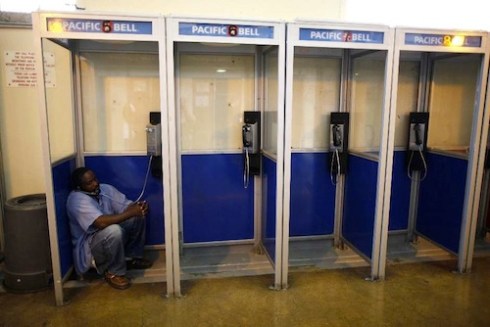
An inmate talks on the phone at San Quentin State Prison, California, June 8, 2012. © REUTERS/Lucy Nicholson
Everybody knows prisoners are routinely ripped off by the phone provider/dept. of corrections contracts across the States. Yet, it’s not something I’ve dealt with in depth here at Prison Photography (except for a brief bout of disgust toward a foolish Gaga music vid.)
Why does the cost of telephone contact matter?
Research has routinely showed that the maintenance of family ties during incarceration is the biggest factor in helping former prisoners break the cycle of recidivism and imprisonment.
“Currently, the high rates charged in most states can force the families of incarcerated people to choose between keeping in touch with a relative behind bars and putting food on the table,” says Peter Wagner, executive director of the Prison Policy Initiative.
The Prison Policy Initiative, recently published The Price To Call Home: State-Sanctioned Monopolization In The Prison Phone Industry, an extensive report on the exorbitant telephone charges levied upon prisoners. The details are shocking. Non-competitive – and arguably corrupt – agreements exist between private phone companies and the state prison systems with whom they contract.
“Prison phone companies are awarded monopolies through bidding processes in which they submit proposals to the state prison systems; in all but eight states, these contracts include promises to pay “commissions” – in effect, kickbacks – to states, in either the form of a percentage of revenue, a fixed upfront payment, or a combination of the two,” writes Drew Kukorwoski, the PPI report author.
The vast differences in phone rates is evidence enough of a piecemeal and unregulated approach. PPI details:
“In many states, someone behind bars must pay about $15 for a fifteen minute phone call. […] Rates vary widely between states — even between states that use the same prison phone company. A fifteen minute long-distance phone call from Global Tel*Link costs $2.36 in Massachusetts, but that same call costs more than $17 in Georgia. This large difference in rates originates in large part from the wide range — anywhere from 15% to 60% — in the size of kickbacks that prison phone companies pay to state governments.”
One day after the release of the PPI report, Costly Phone Calls for Inmates, a New York Times editorial noted that New York state prohibited the practice of kick backs and that the Federal prison system uses a computerised and affordable phone system. Such examples lead me to think that there is no excuse for the flagrant extortion of millions of prisoners and their families.
So, which are the companies behind this ignored corner of the prison industrial complex? What does this monopoly look like? Kukorowski for PPI:
“Over the past few years, three corporations have emerged to dominate the market. 90% of incarcerated persons live in states with prison phone service that is exclusively controlled by Global Tel*Link, Securus Technologies, or CenturyLink. The largest of these corporations, Global Tel*Link, currently has contracts for 27 state correctional departments after its acquisition of four smaller prison phone companies between 2009 and 2011. Global Tel*Link-controlled states contain approximately 57% of the total state population of incarcerated people in the United States. Government regulation was designed to control this kind of corporate domination over a captive market.”
The report was cited in a letter from Congress members Reps. Waxman and Rush to the FCC.
“Affordable phone calls home are a proven way to reduce the high social and economic costs of incarceration and recidivism. Inmates’ families have been waiting for relief for almost a decade. It’s time for the FCC to take action,” said Rep. Waxman.
Last week, the Prison Policy Initiative mobilized the corporate accountability organization Sum Of Us to organize their members to sign a petition to the FCC.
“Tens of thousands of their members have already signed the petition, and we’ll be delivering the petitions to the FCC soon,” says Wagner
WHAT TO DO?
Take action with Sum Of Us.
Take action with Thousand Kites.
Read more at the Prison Policy Initiative.

Source: Take Part

The Prison Library Project will be having a mail art exhibition in October 2012 and invites inmates, families and those who look to improve the lives of those incarcerated to participate:
The Prison Library Project receives hundreds of letters every week from inmates across the country. These letters requesting books and dictionaries, are often beautifully illustrated. In the spirit of these talented prison artists the Postmarked show was created, using the envelope as a canvas to create and share mail art.
The art of letter writing and the use of “snail mail” is on the decline, a casualty of the electronic age. But who among us does not smile when we received a letter in our mailbox? Who doesn’t thrill to find art instead of junk mail and bills? The Postmarked show is a chance for all of us to reconnect with the magic of “snail mail” while helping a population whose voice, if heard at all, is limited to the humble envelope, letter and pen.
Interested participants may decorate, illustrate or create art on an envelope and mail it in for the Postmarked mail art exhibition and fundraiser. Send submissions to:
Postmarked 2012
Prison Library Project
112 Harvard #303
Claremont CA 91711
Entries must be postmarked by September 30, 2012.

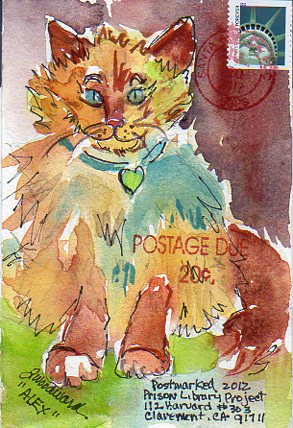
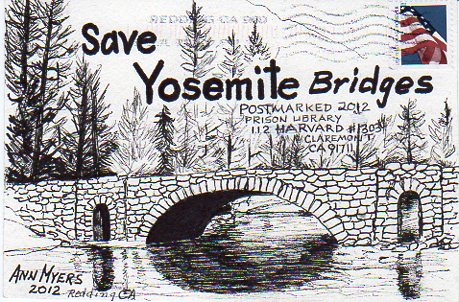

Only the side with the official USPS Postmark/barcode will be displayed. Mail art may be painted, stamped, collaged, printed, decorated or constructed. It may be any shape and size that will go through the mail and receive an official postmark.
“Mail may get worn or torn through the mail, but the handling process is an important part of the theme,” says organiser, Rachel McDonnell
Mail will be opened only by the person who purchases the art envelope.
Exhibition: October 5 – November 2 at the Claremont Forum Bookshop & Gallery. Opening Reception: Friday, October 5 Final Bid Party: Friday, November 2, 6:30 – 8:00pm
For more information, see PLP’s Postmarked blog or contact Rachel McDonnell at rachel@claremontforum.org

The Prison Library Project is a prison book and literacy program which sends thousands of books, study aids, educational and spiritual resources to inmates nationwide.
Measured by any metric, Michelle Alexander’s The New Jim Crow: Mass Incarceration in the Age of Color Blindness is a scathing and utterly contemporary critique of American laws.
Now, a crowdfunding effort wants to bring the bestseller to the airwaves.
Alexander has argued that the confluence of many new sentencing laws in recent decades has created an inescapable web of penalty, deprivation and economic traps against the poorest Americans. As we know a disproportionate number of poor Americans are black and brown. A pervasive racial bias in law, particularly Drug War legislation has hit minority groups and resulted in stark, debilitating and unjust institutional racism.
NPR set up its interview with Alexander as follows:
“Alexander argues many of the gains of the civil rights movement have been undermined by the mass incarceration of black Americans in the war on drugs. She says that although Jim Crow laws are now off the books, millions of blacks arrested for minor crimes remain marginalised and disenfranchised, trapped by a criminal justice system that has forever branded them as felons and denied them basic rights and opportunities that would allow them to become productive, law-abiding citizens.”
More here, here, here and here.
In a March OpEd for the New York Times, Alexander highlighted the story of her friend Susan Burton, a criminal justice activist and formerly incarcerated African American woman, who has suggested that defendants demand trials in order to clog up the courts system.
She’s incendiary … and she’s closer to the truth than most commentators dare to believe.
A NEW MEDIUM
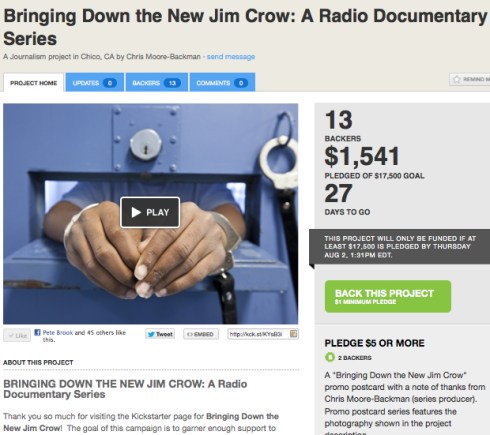
Wanting to propel the message and capitalise on the unusually wide appeal of a book on criminal justice, radio documentarian Chris Moore-Backman wants to produce five radio documentaries, and to publish and promote a CD box set of the series along with a companion discussion guide.
Moore-Backman plans the following five hour long episodes for the series Bringing Down the New Jim Crow:
(1) Frat Row vs. Skid Row: The Racial/Socio-Economic Disproportionality of Drug Law Enforcement;
(2) Living with the New Jim Crow: Conversations with Loved Ones of Incarcerated Men and Women of Color;
(3) The War On Drugs: Human Rights Nightmare on Both Sides of the Border;
(4) Still At It: Veterans of the African-American Freedom Movement on the New Jim Crow;
(5) White Allyship in the Era of Mass Incarceration
KICKSTARTER
If this is something you’d like to help get off the ground and hear the product, please consider donating.
– – – –
Chris Moore-Backman is a radio documentarian, nonviolence educator/trainer, musician and father. He is based in Chico, California.
Michelle Alexander is a highly acclaimed civil rights lawyer, advocate, and legal scholar. As an associate professor of law at Stanford Law School, she directed the Civil Rights Clinic and pursued a research agenda focused on the intersection of race and criminal justice.
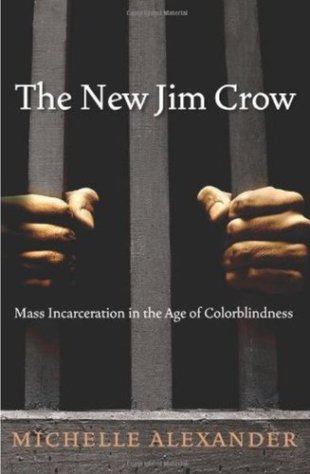
In 2005, Alexander won a Soros Justice Fellowship that supported the writing of The New Jim Crow and accepted a joint appointment at the Kirwan Institute for the Study of Race and Ethnicity and the Moritz College of Law at The Ohio State University. Prior to joining academia, Alexander engaged in civil rights litigation in both the private and nonprofit sector, ultimately serving as the director of the Racial Justice Project for the ACLU of Northern California, where she helped lead a national campaign against racial profiling. Currently she devotes her time to freelance writing, public speaking, consulting, and caring for her three young children.
Alexander is a graduate of Stanford Law School and Vanderbilt University. She has clerked for Justice Harry A. Blackmun on the U.S. Supreme Court and for Chief Judge Abner Mikva on the D.C. Circuit of the U.S. Court of Appeals, and has appeared as a commentator on CNN and MSNBC, among other media outlets. The New Jim Crow is her first book.
For more information, visit www.thenewjimcrow.com

“Jackson and Christian have pulled back the proverbial curtain so that all can see the American Way of Death.”
– Mumia Abu-Jamal
In the 1979, Bruce Jackson and Diane Christian, a husband-and-wife documentary and research team conducted one of the largest (photographic) surveys of prison life. Jackson and Christian used photography, film and interview to understand and illustrate life on cell block J in Ellis Unit – the Death Row of the Texas Department of Corrections.
Their new book In This Timeless Time (University of North Carolina Press) offers an unflinching commentary on the judicial system and the fates of the men they met on the Row. You can see a gallery of 20 photographs from In This Timeless Time here, and an edit of 74 on Jackson’s own website here.
In This Timeless Time includes a copy of Death Row (1979) a film made by Jackson and Christian (trailer below). In This Timeless Time is also available as an e-book.
To coincide with the release Jackson and Christian have done a couple of interviews.
The first Listen, Read: Bruce Jackson and Diane Christian on Their New Book, “In This Timeless Time,” and Jackson on Curating “Full Color Depression” is with the Center for Documentary Studies (also abridged and in the online version of Document, Spring 2012 CDS Quarterly Newsletter.)
A second, very comprehensive interview Bruce Jackson and Diane Christian discuss Death Row in America is on the website of publisher University of North Carolina Press.
THE BOOK
In This Timeless Time includes 113 duotone photos, all accompanied by explanatory text, sometimes of considerable length. The book is divided into three significant sections.
First is a survey of their work:
“Instead of just showing those men as they were then and printing in another section their words about their condition then, this book tells what happened to each of them: who was executed, who got commuted, who was paroled and who, after more than two decades on the Row, was found to be innocent,” say Jackson and Christian.
Second is a look at capital punishment across the United States since Gregg v. Georgia (1976) in which the Supreme Court ruled states could resume executions.
Third, Jackson and Christian talk about their own role as practitioners, academics and documentary makers.
“Usually with books like this, you just get a book about the subject with nothing about the intelligence that produced it, or the politics that produced it, or the work that produced it. We thought that should be part of it, too,” says Jackson.
I think this is incredibly significant inclusion. I approach photo-criticism with the assumption power is implicated in its manufacture; I want to turn the lens 180 degrees – so to speak – and investigate how those images came into existence. Jackson and Christian want to talk about relationships, want to talk about their privileged access and reinforce the issue of subjectivity. They made a body of work no one else could and others would make a body of work they could not.
This third introspective, “meta-documentary” section of the book distinguishes it from other books of prison photographs. I’ve yet to get my hands on a copy, but expect a book review in late 2012.
BIOGRAPHIES
Bruce Jackson, a writer and documentary filmmaker and photographer, is James Agee Professor of American Culture and SUNY Distinguished Professor of English at the State University of New York at Buffalo.
Diane Christian, a poet, scholar of religious literature, and documentarian, is SUNY Distinguished Teaching Professor of English at the State University of New York at Buffalo

Nigel Poor (left) and Doug Dertinger (right).
The intersection of photography and prisons doesn’t always manifest as a photographer pointing his or her lens at incarcerated people.
Photography – or more specifically the discussion of it and associated issues – can enter relationships, education, exchange. Both the practice and theory of photography can be taught and learned within prisons.
Last September, Nigel Poor, Associate Professor of Photography at California State University, Sacramento contacted me to tell me about her volunteer role teaching the History of Photography at San Quentin State Prison. I was blown away. Never before had I come across a photo history class taught behind bars. Immediately, I made arrangements to meet Nigel and her co-teacher and fellow CSUS professor Doug Dertinger.
As faculty, Poor and Dertinger adapted their existing CSUS syllabus, covering photography from 1970 to the present. However, the California Department of Corrections understandably wanted veto power over slides presented during the course.
Depictions of drugs, violence, sex, children, nudity are problematic for prison administrations … “Which is about 95% of photography,” points out Poor.
Poor and Dertinger were helped out by the experience of Jody Lewen, director of the Prison University Project at San Quentin. Lewen is insistent that PUP teachers do not self-censor, but respectfully present their preferred teaching material and allow the burden – and justification – for any censorship to fall upon the prison administration.
The interaction, therefore, was unorthodox but successful: Poor presented her entire 12 week course to Scott Kernan, Under Secretary to the CDCr (now retired) and to Mike Martel, the then Warden at San Quentin … in two hours!
Of the entire course, only four images were deemed unsuitable, a surprising but pleasing result that Poor describes as “a triumph.”
With Poor focusing on portraits and Dertinger focusing on land use and media, they quickly schooled their students in line, formal composition and leapt from there into sophisticated readings of images.
“I told them the photograph is like a crime scene,” says Poor, “and it is ours from which to draw evidence.”
Poor and Dertinger talk about what a life-affirming experience teaching inside proved to be; about how the men in San Quentin were the “most present students” they’ve ever taught; how invigorating it is to have a passion that isn’t only about oneself; and about the responsibility to educate people in free society about the potential of incarcerated people, a “veiled population.”
“They were ready to travel,” says Dertinger of the students’ willingness to unleash their own emotions and imagination upon photographs read.
Interestingly, the idea that the photograph was not – is not – a reflection of truth was disconcerting for the many of the students. Obviously, the reliability, or not, of narrative and testimony may have had a more profound effect on the reality of their lives as compared to others not subject to the criminal justice system. If you can’t use the language of truth and reality when discussing photography (popularly considered to be objective), then can you use those concepts when discussing your own life?
We end the conversation on a high note: One of the students wrote a comparative analysis of Richard Misrach’s Drive-In Theatre, Las Vegas and one of Hiroshi Sugimoto’s Theatres. He wrote a 9-page essay during a four-week solitary confinement stint. He concluded Misrach’s work is about space; Sugimoto’s about time.
So impressed were Poor and Dertinger they got the essay into Misrach’s hands … and he read the essay to an audience of 2,500 at the November Pop-Up Magazine Event in San Francisco.
LISTEN TO OUR CONVERSATION AT THE PRISON PHOTOGRAPHY PODBEAN PAGE


 Prison Photography