
You are currently browsing the category archive for the ‘Prison Non-Photography’ category.

… you should check out a fine exhibition of prison art.
As some of you may know, I teach an art studio class once a week at a nearby prison. Last year, I asked a local gallery if they’d be interested in partnering for a show. The time has come. Here’s the skinny:
NON-SUFFICIENT FUNDS
Fundraiser for University Beyond Bars
Opening Reception: Thursday, April 28, 5-9pm.
Vermillion Gallery, 1508, 11th Ave (between Pine & Pike), Seattle
Featuring Artists from Monroe Prison with Special works by Buddy Bunting and Paul Rucker. (show runs through May 14.) Special Video Presentation of When You Learn, You Don’t Return, by Gilda Sheppard at 7:30pm.
Non-Sufficient Funds brings together the work of twelve prison-artists from the University Beyond Bars program at Washington State Reformatory, Monroe, WA, with works by established artists Buddy Bunting and Paul Rucker.
This exhibition of more than 50 acrylic paintings, graphite drawings and one video installation address abstract, figurative, allegorical and spiritual concerns. Non-Sufficient Funds is the culmination of over a year’s worth of weekly studio sessions within the prison and the brainchild of Pete Brook, a dedicated volunteer and board member of the University Beyond Bars.
In addition to the artwork by the inmates at Monroe, Paul Rucker will be showing his video, ‘Proliferation’, which documents the growth of the US Prison system over the past 200 years in an animated mapping of the US Prison system set to original music. Also, Buddy Bunting is presenting a 13 foot color painting of the stark facade of a prison at ground level.
The title of the show, Non-Sufficient Funds, has a few meanings: First, it refers to the stretched resources of volunteer-based rehabilitation programs within prisons across America, which is what this particular exhibit is advocating for. Research indicates that inmates who maintain contact with the outside world and who engage in educational and vocational programs experience a much lower rate of recidivism.
Second, it is a commentary on the financial burden the Prison-industrial Complex places on US society. Due to harsher sentencing laws and the war on drugs, the prison population has quadrupled since 1980. Now, in times of economic crisis, serious questions are being asked about the amount of tax dollars spent on prisons.
Finally, it refers to the scenario when a prisoner receives a letter or package has insufficient postage, and no funds available in their prison account fund to cover the difference. “Non-sufficient funds” is stamped upon the return correspondence. Many of us are unaware firsthand of the rigid structure the penal system requires. Mail sent to inmates in violation of policies can lead to punishment. Prison libraries and other media are also highly censored for various reasons. Non-sufficient funds hopes to shed some light on the way art and education in institutions benefits society as a whole and we hope it encourages a dialogue and additional advocacy.
In the local press
Keegan Hamilton of Seattle Weekly penned Insider Art and also ran a photo gallery with the article.
“I hold this slow and daily tampering with the mysteries of the brain to be immeasurably worse than any torture of the body”
– Charles Dickens, American Notes, (Harper & Brothers, 1842) p. 39
If we are to understand how and why prisons function in modern America, it is helpful to know their history. As many of you will be aware there was a time in Western societies when prisons were not the primary form of punishment; instead jails were used for short sentences for disturbing the peace, debt, being poor and as a means to hold people before trial.
Likewise, prisons have not always used solitary confinement. Solitary today is used to punish (sometimes minor) infractions within a prison or to isolate inmates during an investigation/following an incident. Its use differs institution to institution.
Needless to say, on any given day in America 20,000 people are held in solitary despite scientific proof it damages the psyche and regresses basic functioning.
With that in mind, the origins of the practice are pause for thought. In the above video, Sean Kelley, Program Director at Eastern State Penitentiary outlines the history of the famed prison in Philadelphia, and its evolution of the practice of solitary confinement.
PRODUCTION
‘The Invention of Solitary‘ was produced by Muralla Media Works headed up by Chris Bravo and Lindsey Schneider.
Bravo and Schneider are involved in several projects and as such I’d describe them both as media activists. They’ve produced advocacy video for incarcerated women and for the mentally ill in prisons. They were also videographers at the ‘Fighting Prisons’ panels at the 2010 US Social Forum.
Their largest current project is CONTROL, a feature-length documentary that tells the story of youth whose lives have been caught in the web of the criminal justice system. View the trailer.
With audio-visuals as their material, it is interesting that they also muse – through the SILENCE OPENS DOORS webzine on the history and philosophy of silence & noise.
Which brings us full circle – read the SILENCE OPENS DOORS blog post about The Invention of Solitary.

Philadelphia County Prison, Debtors’ Wing, Reed St. & Passyunk Ave., PHILADELPHIA, Philadelphia County, PA.
This from Welcome to Debtors’ Prison, 2011 Edition, Wall Street Journal.
Some lawmakers, judges and regulators are trying to rein in the U.S. debt-collection industry’s use of arrest warrants to recoup money owed by borrowers who are behind on credit-card payments, auto loans and other bills.
More than a third of all U.S. states allow borrowers who can’t or won’t pay to be jailed. Judges have signed off on more than 5,000 such warrants since the start of 2010 in nine counties with a total population of 13.6 million people, according to a tally by The Wall Street Journal of filings in those counties. Nationwide figures aren’t known because many courts don’t keep track of warrants by alleged offense. In interviews, 20 judges across the nation said the number of borrowers threatened with arrest in their courtrooms has surged since the financial crisis began.
In September 2009, Jeffrey Stearns, a concrete-company owner from Indiana felt the full force of the present law. From On the Rise of Debtor’s Prison: ‘The Scariest Thing That Ever Happened to Me’ (WSJ)
[Stearns] answered a knock at the door from a Hancock County, Ind., deputy sheriff. The deputy was holding a warrant to arrest Stearns for not paying $4,024.88 owed to a unit of American International Group Inc. (AIG) on a loan for his pickup truck.
The irony here, as pointed out by a Demand Progress petition, is that AIG recieved a $122.8 billion bailout – about $4,000 for every American.
More from the WSJ:
After being handcuffed in front of his four children, Stearns, 29 years old, spent two nights in jail, where he said he was strip-searched and sprayed for lice. Court records show he was released after agreeing to pay $1,500 to the loan company. “I didn’t even know I was being sued,” he said, though he doesn’t dispute owing the money.
Sign a petition to your lawmakers against the greed and manipulation
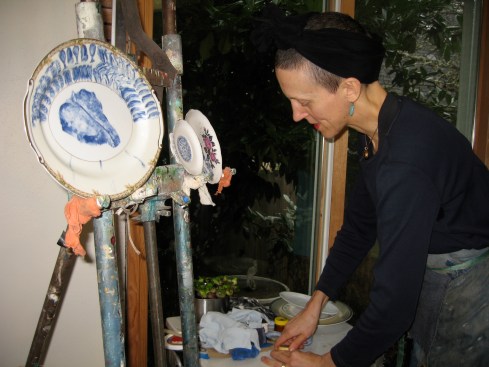
Julie Green in her studio. Photo Credit: Pete Brook
I recently visited Julie Green at her studio in Corvalis, Oregon. For the past twelve years, between her responsibilities as Professor of Art at Oregon State University, Green has been painting plates. Each plate quietly marks the life of a man or woman executed in the US and each depicts their final meal request.
Green’s The Last Supper has steadily grown down the years. There are now approximately 450 plates in the series and, when exhibited, they come together in a ghostly feast of absent eaters. I imagine a toast to the fury and retribution of US society.
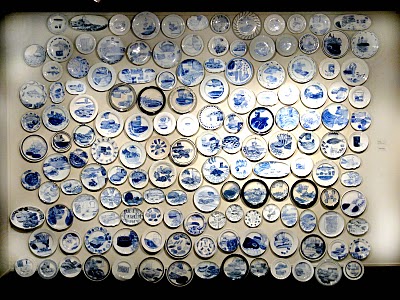
The Last Supper exhibited at Oregon State University (OSU). Photo credit: Doug Russell
Green acquires all her plates from thrift stores and bargain barns. Her preference is plain white plates, but she’ll tolerate flashes of navy or gold. The plates showing the last meals of female prisoners are occasionally a little more elaborate and may include floral decorations.
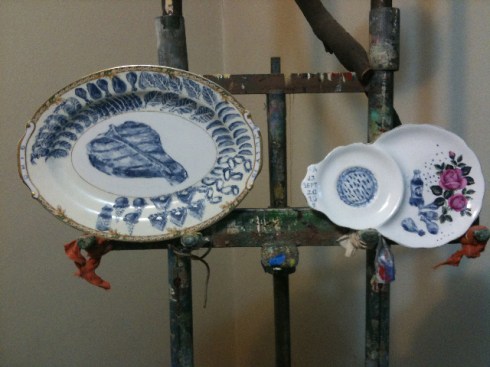
Two plates partially complete, for The Last Supper series, Julie Green’s studio, Corvalis, Oregon. Photo Credit: Julie Green
In some instances, last meals were refused and a statement was offered instead. Although, Green withholds the identity of the inmates, cursory internet sleuthing can pair meals with murdered prisoners. Writes Kelly Klaasmeyer for Houston Press:
Odell Barnes, Jr. [was] a Texas death row inmate. Barnes’s case caught international attention and caused Pope John Paul II to urge then governor, and presidential candidate, George W. Bush to show “compassion.” Barnes was executed, and Green has painted his last request on a gold-rimmed oval plate: “Justice, equality, peace.”
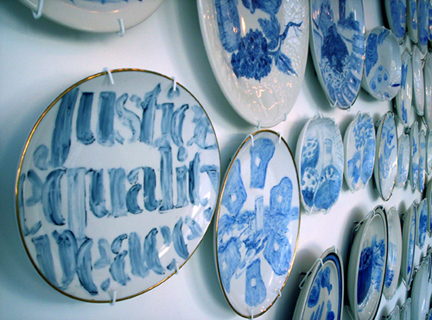
The Last Supper exhibited with Odell Barnes Jr.’s ‘Justice Equality Peace’ plate in the foreground. Photo credit: Aswin Subanthore

Mineral paint and Julie’s hand. Photo credit: Pete Brook
Green uses mineral paint, sometimes called porcelain paint. “I often add cobalt blue pigment to the mineral paint. Sometimes Nassau blue,” says Green. The paint slides across the reused plates and the effect is one of translucent foodstuffs. To fix the paint, Technical advisor Toni Acock kiln-fires each plate at 1,400 degrees Fahrenheit.

Kiln firing plates, January 2011. Photo credit: Deborah Gangwer
Finding out the last meal requests from across the States is not complicated work. As a matter of process, the last meal is usually included in media coverage. Until 2003, the Texas Department of Criminal Justice published its own online record of last meal requests. Green will also write to state authorities; the information is public record and always forthcoming. The fact that the details of last meals secured as part of procedure, and as part of the service of information to the wider public, is both significant and perplexing to Green. Why our fascination?
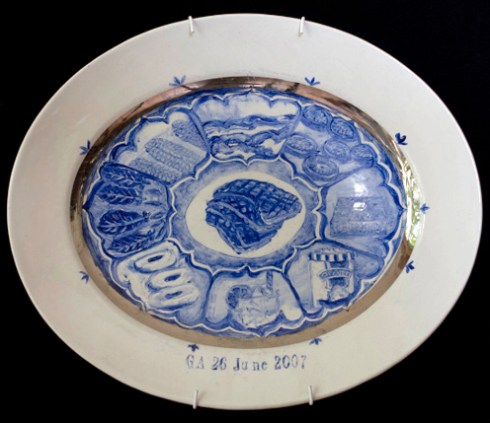
The Last Supper: Georgia 26th June 2007. Four fried pork chops, collard greens with boiled okra and “boiling meat”, fried corn, fried fatback, fried green tomatoes, cornbread, lemonade, one pint of strawberry ice cream and three glazed donuts. Mineral paint fired on to porcelain, 9″ x 15″
In keeping with her other projects, The Last Supper is an act of meditation. (Green was diligently painting shells on sheets with fabric paint before, during and after the Gulf oil spill of 2010.) Through the act of painting, Green takes on a critical awareness that – unfortunately – many of us choose to ignore. The Last Supper is both a remarkable dedication to mindful art practice and, for Green, an unsettling focus on violence.
“I think about food, choice, and whether inmates are able to eat the food they order,” says Green. “Specific food requests, often-local specialties, provide clues on region, race, and economic level.”
I don’t think Julie would mind me calling her a foodie (she made some hearty organic soup and bread for us to share), and so to her it is logical that the connection between the body, health and living intertwine with circumstance of education, socialisation and (potential) institutionalisation.
Aware of “the heinous crimes committed, the victims, the individuals executed, the large number of minorities on death row, and the margin for error in judicial process” Green is undoubtedly invested in the politics of prisons and anti-death penalty. And yet her response as an artist is apt, personal and all the more powerful for it. If she is angry, it is quiet anger.
Many photographers have chosen last meals as their subject. Possibly the best known is Celia Shapiro. Critic Fred Ritchin has referred frequently to Shapiro’s work saying that its power lies in the food choices of men and women clearly of lower economic status, but Green corrected this view; often a choice is not ‘choice’. Prisoners in most states have a budget of $20. “Inmates in some states are limited to food available in the prison kitchen,” says Green “There is a great deal of red meat but few lobsters, no sushi, and no Godiva chocolate.” The chocolate is usually Hershey’s.

Julie Green’s self-made reference book of food images. Photo credit: Julie Green

Plate from The Last Supper series waiting to be fired. Firing seals and dries the mineral paint. Photo credit: Pete Brook
The Last Supper plates were first displayed at University of Liverpool Art Museum, UK in 2000.
Later they have been on show at the University of California at Santa Cruz; Copia American Center of Food, Wine and the Arts, Napa, CA; Oregon State University, Corvalis; The Wing Luke Asian Museum, Seattle; The Hunter Museum of American Art, Tennessee; Living Arts, Oklahoma; Fort Collins MOCA, Colorado; The Spencer Museum of Art, University of Kansas; The Mulvane University Museum of Art, Kansas; Reed College, Portland, OR; and DiverseWorks, Texas.
Awaiting their next outing, the plates are numbered, ordered and locked in Green’s basement. I found some irony in that.
And when is The Last Supper project complete? “I’ll stop painting plates when the US ceases with the death penalty,” says Green.
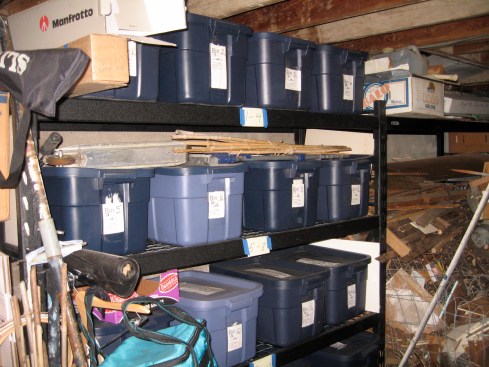
Between exhibitions, Green stores the plates in her basement. These sixteen tubs contain approximately half of the collection. Photo credit: Pete Brook
In 2003, Green was interviewed about The Last Supper on the NPR program The Splendid Table.
In 2008, The Last Supper was shown as part of the San Francisco State University show Criminal along with artists such as William Pope. L and Deborah Luster. Green’s work was included in the follow up book PRISON/CULTURE, (Ed. Bliss, Sharon E., Kevin B. Chen, Steve Dickison, Mark Dean Johnson & Rebeka Rodriguez) and published by City Lights. In 2010, I reviewed PRISON/CULTURE as “simultaneously a consolidation of achievement, a fortification of resources and celebration of resistance. PRISON/CULTURE may be a book with a Californian focus, but it has national and international relevance. Succinct, well researched, egalitarian and lively. For me, PRISON/CULTURE is the best collection of works by any US prison reform art community up until this point in history.”
FURTHER READING: FOOD AND DEATH
Cabinet Magazine: Debt, Guilt, and Hungry Ghosts: A Foucauldian Perspective on Bigert’s and Bergström’s Last Supper
Famous Last Meals blog
Dead Man Eating blog
Food in the Arts: The da Vinci Mode: Last Suppers, Old & New
THE DEATH PENALTY ON PRISON PHOTOGRAPHY
Media and the Aftermath of an Execution: Poring Over the Apparatus of Death
Louisiana Sues Its Own Death Row Prisoners
Photographer Scott Langley talks about the Death Penalty
STATISTICS
On her website, Green provides the following statistics.
As of May 2009, there had been 1165 U.S. state-sanctioned executions since 1976:
438 Texas
103 Virginia
90 Oklahoma
67 Missouri
67 Florida
43 North Carolina
45 Georgia
42 South Carolina
42 Alabama
27 Louisiana
27 Arkansas
28 Ohio
23 Arizona
19 Indiana
14 Delaware
13 California
12 Nevada
12 Illinois
10 Mississippi
6 Utah
5 Maryland
4 Washington
3 Montana
3 Nebraska
3 Pennsylvania
3 Kentucky
2 Oregon
5 Tennessee
1 Connecticut
1 Colorado
1 Idaho
1 Wyoming
1 South Dakota
0 New Hampshire
0 Kansas
3 U.S Federal Government
States without the death penalty: Alaska, Hawaii, Iowa, Maine, Massachusetts, Michigan, Minnesota, New Jersey, New Mexico, New York, North Dakota, Rhode Island, Vermont, West Virginia, Wisconsin, and Washington D.C.
I have a lot of reasons for opposing America’s prison industrial complex, but zealously guarding infirm, hospitalised prisoners (and the wasted money) seems like one we reason should all understand.
This, from the Los Angeles Times:
A degenerative nerve disease has left 57-year-old California inmate Edward Ortiz semi-paralyzed in a private Bay Area hospital for the last year. The breathing tube in his throat tethers him to a ventilator at one end of the bed; steel bracelets shackle his ankles to safety rails at the other.
Still, California taxpayers are shelling out roughly $800,000 a year to prevent his escape. The guards watching Ortiz one day last week said department policy requires one corrections officer at the foot of his bed around the clock and another guard at the door. A sergeant also has to be there, to supervise.

Nutraloaf, a product from the cafeteria of the Chittenden Regional Correctional Facility, sits atop an inmate’s bunk bed at the facility in South Burlington, Vt., March 21, 2008. (AP Photo/Andy Duback)
Last August, with Is Prison Food Unconstitutional? was the first time (on the blog) that I had considered the nutritional health of US prisoners.
Despite the catchy headline bait, the number of organic food programs within prisons serving their canteens is still limited. The reality is that prisoners eat poor quality food.
Earlier this month, CBS reported that “the USDA recalled more than 200,000 pounds of ground beef products sent to prisons in Oregon and California after inspectors found that some were discolored and smelled funky.” The packed-on dates were between July and November 2010. This beef went only to prisons, not to retailers.
Bryan Finoki, usually residing at Subtopia, has launched a call for Prison Food Critics.
“It seems as though the connections between the two [prisons and food] can be seen across a fascinating spectrum of cultural, moral, and economic landscapes, sharing fascinating intersections with histories of pop food magnates, innovative smuggler networks, Auschwitz-era recipe books, the politics of prison labor, and race-infused hunger strikes, just to start! […] Prisons don’t just deserve their own inmate food writers – they absolutely need them!”
Finoki meanders through prison food law, the cultural history of Nutraloaf and even theorises food as warfare, “Food is a very primal weapon, and its disguise under the cloak of non-lethality would surely not escape our astute prison food writer. In fact, no one has studied the long-term effects of prison food or the Nutraloaf.”
I am just left to wonder if writing is enough? Isn’t the juicy, dripping, all-colour image part-and-parcel of foodie blogs, recipe mags and eatery advertisements?
Shouldn’t the articles Finoki calls for be accompanied by dressed food photography?
WANTED! Prison Food Photographers!
SUSTAINABILITY PREVIOUSLY ON PRISON PHOTOGRAPHY
Science in Prison, Change Within Ourselves
Benjamin Drummond, Sara Joy Steele, Nature and Washington State Prisons
It was with great sadness I heard about Pete Postlethwaite‘s death. He’s a Lancashire lad like myself. He and my dad attended the same teacher training college in London during the sixties. Postlethwaite’s performance in In the Name of the Father knocked me off my seat, making a huge impression on my teenage mind; on what justice was and what injustice could be masked to be.
And, until today, I did not know he was ever an advocate for prison reform.
R.I.P. Pete.
Above clip found at the Prison Reform Trust’s Youtube channel.
The Prison Reform Trust (UK) has also just launched a new website – http://www.prisonreformtrust.org.uk/. As a side note, the new website includes the work of Edmund Clark.
_________________________________________________
This time last year Laura Sullivan for NPR reported on the US broken Bail Bond System. I celebrated her work and later, upon it’s resurfacing called Sullivan “An American Hero”
NPR contacted me recently to let me know Sullivan’s series won an Excellence in Broadcast Journalism Award.
Bravo!
From NPR:
NPR News is being honored with a 2010 Alfred I. duPont-Columbia University Silver Baton Award for excellence in broadcast journalism for a three-part investigative series revealing deep and costly flaws in the U.S. justice system’s bail bond process, it was announced today. Reported by NPR Correspondent Laura Sullivan and edited by Senior National Editor Steven Drummond, “Bonding for Profit” exposed deep inequities in the treatment of rich and poor defendants, how the bail industry is vested in maintaining those inequities and the surprising cost to taxpayers. The series aired on the NPR newsmagazines All Things Considered and Morning Edition, and is available online at npr.org: www.npr.org/series/122954677/behind-the-bail-bond-system
After months-long research into the perpetual and expensive overcrowding problem in U.S. prisons, Sullivan discovered that the bond system may be a major factor in keeping jails stuffed. “Bonding for Profit” focused on the dilemma of more than a half million petty, nonviolent offenders stuck in jail for months due to the simple reason of not being able to make bail – which is sometimes as little as $50 – at a $9 billion a year cost to taxpayers. In three reports, Sullivan revealed how stark options often force inmates to take prosecutor deals in exchange for early release, and how the bondsman lobby fights pretrial release programs proven to save millions of dollars.
The “Bonding For Profit” series produced emotional feedback from listeners, and has been cited by The Justice Department, the American Bar Association and lawmakers in Virginia, North Carolina and Florida in initiatives to examine current bail practices. The Awards Jury also praised Sullivan’s writing, saying it “crackles with insight and storytelling based on hard facts.”
The duPont-Columbia Awards will be presented at a ceremony on January 20 at Columbia University in New York. Accepting the awards on behalf of the organization are Laura Sullivan and Steve Drummond. Information about all of the winners announced this year is available at: www.dupont.org
The Alfred I. duPont-Columbia University Awards honoring overall excellence in broadcast journalism were established in 1942 by Jessie Ball duPont in memory of her late husband. Administered since 1968 by Columbia University’s Graduate School of Journalism, the awards are considered the broadcast equivalent of the Pulitzer Prize, which the Journalism School also administers.

 Prison Photography