
You are currently browsing the category archive for the ‘Prison Non-Photography’ category.

Pre-cast Concrete Prison Cell. Computer Rendering by Matt Scott
I was interested to read A Typical Day for PFC Bradley Manning, a blog post by David E. Coombs, the lawyer for Wikileaks’ leaker suspect Bradley Manning.
Manning has been in Quantico Confinement Facility, a maximum security military prison since July of this year. Manning is under Prevention of Injury (POI) watch. Whether Manning is a danger to himself or not we cannot know, but we can consider the strict regime such status brings in terms of scrutiny and the control the prison authority has over his waking (and sleeping) body.
Excerpts:
At 5:00 a.m. he is woken up (on weekends, he is allowed to sleep until 7:00 a.m.). Under the rules for the confinement facility, he is not allowed to sleep at anytime between 5:00 a.m. and 8:00 p.m. If he attempts to sleep during those hours, he will be made to sit up or stand by the guards.
The guards are required to check on PFC Manning every five minutes by asking him if he is okay. PFC Manning is required to respond in some affirmative manner. At night, if the guards cannot see PFC Manning clearly, because he has a blanket over his head or is curled up towards the wall, they will wake him in order to ensure he is okay.
He is prevented from exercising in his cell. If he attempts to do push-ups, sit-ups, or any other form of exercise he will be forced to stop.
He does receive one hour of “exercise” outside of his cell daily. He is taken to an empty room and only allowed to walk. PFC Manning normally just walks figure eights in the room for the entire hour. If he indicates that he no long feels like walking, he is immediately returned to his cell.
When PFC Manning goes to sleep, he is required to strip down to his boxer shorts and surrender his clothing to the guards. His clothing is returned to him the next morning.
The body disciplined, no?
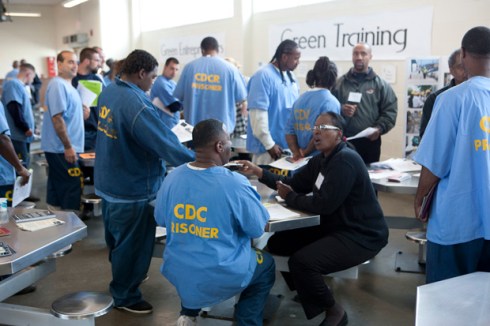
Green jobs fair at San Quentin State Prison. Courtesy of Kirk Crippens.
KALW Informant, a great quality news-site on criminal justice in the San Francisco Bay Area is asking the tough questions – The state could release 40,000 inmates soon. Where will they work? (Rina Palta, November 19, 2010) Palta has answers for readers too. The green economy.
I talked about the common sense behind green jobs for paroled and released prisoners in December 2008. Van Jones (yup, the guy hounded out of the Obama administration by the right-wing media crying Commie) posited before the nation’s economy tanked that social justice and environmental justice had common solutions. He was and remains right.
Palta highlights the mutual benefit for the tens of thousands of released prisoners and the State of California in a progressive, state-sponsored jobs programs and the expansion of the renewable energy industry. San Quentin Prison held a ‘Green Jobs Fair’ in August 2010.
Unfortunately, getting support for govt. stimulus is, these days, difficult politically; taxpayers may balk at the idea of putting taxpayer dollars toward work for felons.
However, unexpected or unpalatable for some CA residents, it would be wise to support former prisoners. It’ll save communities and save future DoC costs. California may be about to release 40,000 inmates based on a 2009 federal judicial ruling (the State of California has taken the case to the Supreme Court for appeal). That’s a lot of working age men with gaps in their skills and working histories. Train them.

Source: http://www.time.com/time/world/article/0,8599,1903971,00.html
Last week, Ahmed Khalfan Ghailani, 36, the first suspect transferred from Guantanamo military prison to stand a civilian trial was found guilty of only 1 of the 285 charges brought against him – a charge relating to involvement in the 1998 bombing of the American Embassy in Nairobi, Kenya.
PBS reports:
Prosecutors branded Ghailani a cold-blooded terrorist, but the defense portrayed him as a clueless errand boy, exploited by senior al-Qaida operatives and framed by evidence from contaminated crime scenes. Ghailani was convicted of one count of conspiracy to destroy U.S. property. He faces a minimum of 20 years and a maximum of life in prison at sentencing on Jan. 25.
Only one charge was successfully prosecuted because civil courts don’t look kindly upon the involvement of torture in extracting testimony for evidence.
From the New York Times:
Many observers attributed any weakness in the prosecution’s case to the fact that the Judge Lewis A. Kaplan of United States District Court in Manhattan, who presided over the trial, refused to allow prosecutors to introduce testimony from an important witness, who was discovered after interrogators used coercive techniques on Mr. Ghailani.
If this trial is a precedent for other trials of Gitmo detainees to follow, prosecutions are going to have a tough time of it.
The extent of torture used by American powers across the globe is picked apart in the ACLU’s ‘Torture Report’.
Experts have dissected govt. documents (released under the Freedom of Information Act) to piece together the practice of enhanced interrogation techniques; practices that have ultimately derailed the prosecution cases against hundreds of GWOT detainees.
(Found via)

Left: According to photographer D.K. Langford, this is the Texas vehicle inspection sticker designed from his photograph. Right: This photograph is exhibit A in Langford’s suit vs. the Department of Public Safety and the Texas Department of Criminal Justice. (Source)
At last. I’ve been waiting for one of these legal disputes to have a prison angle! From the My San Antonio News:
“A photographer is suing the state over roughly 4.5 million vehicle inspection stickers that appear to incorporate, without his authorization, an image of a saddle-toting cowboy he created in 1984. Plaintiff David K. Langford wants the court to block the Department of Public Safety from further use or issuance of the stickers, the design of which he says is based on his copyrighted photo, Days End 2.”
“The stickers were produced by state prison inmates under a Texas Department of Criminal Justice (TDCJ) contract with the DPS. […] The suit says Langford’s photo was illegally appropriated by an inmate who scanned it from a copy of Texas Parks and Wildlife Magazine in 1998.” [My bolding.]
Langford, the photographer, seems quite tenacious here. He argues simply that the State of Texas should be more careful about how it sources its images.
I want to avoid the lazy joke about a prisoner “stealing”. It’s just a shame that when prisoners working for the Texas Correctional Industries which is, for some, a form of modern slave labor (I withhold comment), the products of their work are at the centre of a substantial lawsuit.
This story was brought to my attention by Bob, who says, “I guess Texas is always full of unintended ironies.”
The TDCJ refused to comment, and of course there’s no response from the prisoner. I would want to hear from the prison-artist who originally ripped Langford’s image. He ended up producing a nice piece of graphic design!
With 4.5 million stickers in circulation, the prisoner has quite the visible profile. There’s more of a story here. Texas journalists! Get on it.
“Prison companies had a plan — a new business model to lock up illegal immigrants. And the plan became Arizona’s immigration law.”

Remember AZ SB1070? Laura Sullivan shows us the greedy plotting behind it.
In the first of two reports, Sullivan exposes the murky connections between Arizona’s legislators and the private prison companies, and how they manufactured a legal landscape to profit form locking up immigrants.
Basically, there is a secretive group called the American Legislative Exchange Council. Insiders call it ALEC. It is “a membership organization of state legislators and powerful corporations and associations, such as the tobacco company Reynolds American Inc., ExxonMobil and the National Rifle Association. Another member is the billion-dollar Corrections Corporation of America — the largest private prison company in the country.”
In December 2009, ALEC convened in Washington D.C. and in cahoots with Arizona state Sen. Russell Pearce, wrote a piece of model legislation that four months later was adopted almost unmodified as an Arizona SB1070.
“As soon as Pearce’s bill hit the Arizona statehouse floor in January, there were signs of ALEC’s influence. Thirty-six co-sponsors jumped on, a number almost unheard of in the capitol. According to records obtained by NPR, two-thirds of them either went to that December meeting or are ALEC members.”
“That same week, the Corrections Corporation of America hired a powerful new lobbyist to work the capitol. […] At the state Capitol, campaign donations started to appear.”
“Thirty of the 36 co-sponsors received donations over the next six months, from prison lobbyists or prison companies — Corrections Corporation of America, Management and Training Corporation and The Geo Group.”
An absolute scandal.
LAURA SULLIVAN
I have celebrated Sullivan’s reporting before.
Her three-parter on the inequalities and injustices of the bail system is heroic:
Part One: Bail Burden Keeps U.S. Jails Stuffed With Inmates
Part Two: Inmates Who Can’t Make Bail Face Stark Options
Part Three: Bondsman Lobby Targets Pretrial Release Programs
NPR
Reporting such as Sullivan’s is, in simple terms, essential. Which brings the illogic and limelight-obsessions of these idiots’ calling for the defunding of NPR into sharp focus.

“It’s More Expensive to Do Nothing explores the dark and often disregarded world of criminal justice, the revolving door of institutionalization, the complexities of remediation, and the programs that have worked to help nonviolent ex-offenders succeed as self-sufficient members of society.”
“The math is staggeringly simple: It will cost $75,000 year if a nonviolent offender returns to prison, whereas $5,000 a year will help that individual lead a productive life outside.”
This morning I bemoaned America’s use of the criminal justice system to manage and punish unfairly the poorest people in America – a population Michelle Alexander describes as those from “ghetto neighbourhoods” and mostly African American.
Well, it seems Britain’s criminal justice is even more punitive to Black people – within its criminal justice system and particularly in its prisons.
From yesterdays Guardian:
“The proportion of black people in prison in England and Wales is higher than in the United States, a landmark report released today by the Equality and Human Rights Commission reveals.
The commission’s first triennial report into the subject, How Fair is Britain, shows that the proportion of people of African-Caribbean and African descent incarcerated here is almost seven times greater to their share of the population. In the United States, the proportion of black prisoners to population is about four times greater.”

The title of Michelle Alexander‘s book The New Jim Crow: Mass Incarceration in the Age of Colorblindness may seem incendiary to some, but when you get to know the facts about the disenfranchisement of felons there can be no doubt that minorities and African Americans in particular suffer most inside and following prison.
2010 has been a break through year for Alexander and she has described with clarity the injustice of the justice system.
I am late to post about her important writing, but I’ve enjoyed her commentary throughout this past year. I even had the privilege of sitting in on her first ever presentation about the book within a prison. Unsurprisingly, the men were very familiar with her arguments.
Listen to her explanation of Reagan’s legal and media blitz in efforts to construct the war on drugs in the early eighties.

 Prison Photography