
You are currently browsing the category archive for the ‘Prison Non-Photography’ category.
Andy Kershaw‘s view is a welcome counter to the presumptions of an unknown scenario I and others had considered:
“Most journalists were reporting breathlessly that Port-au-Prince’s main prison had collapsed. Good story. But not for the reasons we were told. The inexperience – and indeed arrogance – of every single reporter who drew our attention to the jail, missed the real significance of its destruction.
It was not that “violent criminals”, “murderers”, “gang bosses” “notorious killers” or “drug dealers” had “simply walked out the front gates”. (And just how did these escapees miraculously avoid being crushed to death in their cells?) Even if true, that was a minor detail to the people of Port-au-Prince, who had more urgent concerns.
The true significance of the prison’s implosion was that it represented for ordinary Haitians, like the wreckage of the presidential palace and the city’s former central army barracks, exquisite revenge upon the prime symbols of decades of state cruelty and oppression.
And many of the prison’s inmates were surely not the dangerous stereotypes of these lurid reports. Haiti’s jails were, notoriously, full of petty thieves and other unfortunates who shouldn’t have been in there anyway. I once had to go into that Penitentiaire Nationale, where I saw hundreds of men kept in cages, without room to lie down, shuffling around literally ankle deep in their own shit, to get out of there the son of a Haitian friend who’d been arrested so that the local police could extort money from his father for the release of his boy.”
via Colin
Currently, truth is also a large casualty in Haiti.
Kershaw’s version is as politically self-serving as most accounts coming out of Haiti, in the confusion following the earthquake citizens, aid-workers and journos are making fast assertions based on their own observations. We should expect that most of these assertions will need modifying in time.
Nevertheless, Kershaw’s is the only commentary that has countered the immediate furor and conjecture surrounding the vacated national prison.
Indeed, Kerhsaw makes it clear that the obfuscations of fact are the direct result of the typical blend of fear and uninformed judgement; judgement applied to prison populations of every nation.
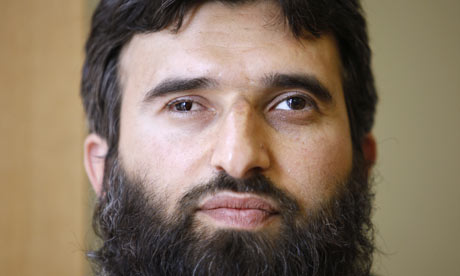
Omar Deghayes: 'I gave them a really hard time.' © Stefan Wermuth/Reuters
Excerpt: ‘How I fought to survive Guantanamo‘ (Guardian, UK)
I don’t want to give the impression I dislike Obama. I think he has toiled strenuously against many idiots this past twelve months. I think he’s carried a nation-sized curse of rhetoric and is subject to a Bush-beaten electorate hoping for more than neglect and dis-empowerment. However, I am disappointed he hasn’t yet been able to close Guantanamo, especially as it seemed like one of his easier-to-achieve promises.
Friend, Steve Silberman, pointed out Ezra Klein‘s WaPo article about where Obama has gone wrong this past year. Obama tried to get stuff done in a congenial manner but it was just not sexy enough for the American public. He never even tried to sell it;
Conclusion: No pleasing everyone. Politics is a b*st*rd of a career.

Brixton Prison governor Paul McDowell: 'We don't let them have too much fun.' Photograph: Martin Argles
THE FACTS
The UK’s most well-known prison radio station is the Sony Award winning Electric Radio Brixton. It has come in for high praise.
The US’s boasts KLSP which broadcasts within Louisiana State Penitentiary, the prison commonly known as Angola. Andy Levin of 100Eyes photographed this New York Times coverage.
THE MISSIONS
In both cases, the radio stations serve to provide inmates with valuable, marketable skills AND to disseminate prison specific communications.
Electric Radio Brixton is the model for fifteen other prison radio stations up and down the UK. The Prison Radio Association is currently working with over 40 prisons and hopes eventually to build a national network for the benefit of all British prisoners. It is a community action.
Unlike Brixton’s radio initiative, the scope and model of KLSP is not intended to go national. KLSP was established in 1986 as a “means of communicating with everyone in the prison at once. Angola is the country’s largest correctional facility, with 5,108 inmates, so the need to disseminate information rapidly is critical.” The KLSP station at Angola is the only FCC-licensed radio station in the US facilitated by prisoners.
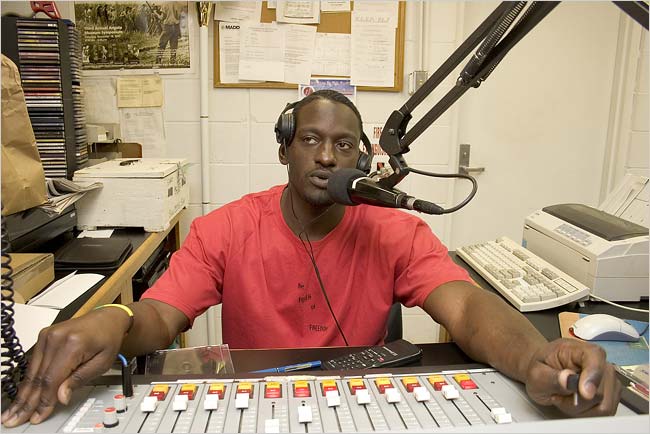
Sirvoris Sutton is a D.J. known on air as Shaq at KLSP-FM, the Louisiana State Penitentiary station where gospel wins out over gangsta rap. © Andy Levin/Contact Press Images, for The New York Times.
As with any enterprise at Angola, the radio station is implicated in Burls Cain’s philosophy of religious and moral rehabilitation. Warden Cain encourages all religious and spiritual practices, but inevitably most of Angola’s religious alliances and support are Christian:
KLSP is licensed as a religious/educational station, and, through Cain’s efforts, has formed a close alliance with Christian radio. Until recently, the station was using hand-me-down equipment courtesy of Jimmy Swaggart; last year, His Radio – Swaggart’s Greenville, S.C.-based network of stations – ‘held an on-air fundraiser for the prison, broadcast live from Angola. They quickly surpassed their $80,000 goal, raising over $120,000 within hours.
Cain used the money to update the station’s flagging equipment and train inmate DJs in using the new electronic system. In the months following their initial partnership, Cain deepened his relationship with Christian radio stations. KLSP now carries programs from His Radio and the Moody Ministry Broadcasting Network (MBN) for part of the day.
With regard the station and its remit, Brixton Prison Governor, Paul McDowell does not have the same influence as Cain. For one, the radio is operated by an independent charity, and two, the prison culture in Britain is not dictated by the personal cult/philosophies of the warden as in the US.
McDowell sees the radio station as a good way to develop critical and positive thought.
McDowell’s main work is to keep infamous inmates away from the airwaves and avoid unnecessary (sensationalised) criticism of the project;
I am a prison governor and half of my life is spent managing the politics of prisoners. One of the things I am not going to do is put Ian Huntley on a radio station to deliver a programme every week. That is opening us up [to attack] and if we get criticised for that then we might end up losing the whole thing.
I’d be dismayed if people in the UK could not see Electric Radio Brixton as a wellrun and sophisticated engagement of prisoners’ minds. I have personal reservations about the Christian focus at KLSP, but this focus has been the norm throughout Angola for 15 years.
Both of these enterprises deserve praise. Next, the content broadcast on their airwaves requires scrutiny.
Serco is a UK based multinational company, with many fingers in many pies. The Guardian has called them “The biggest company you’ve never heard of.”
Serco sees profit in many things, including the private prison of the UK and Australia. Are you caught in the web?
The wikipedia profile supplies many valuable news sources for further learning.

The greatest priority for sentencing reform must be to dismantle the Three Strikes Law.
Three Strikes has not made society safer, it has only handed down overly-punitively long sentences.
Familial support during incarceration is the largest deciding factor in helping released prisoners to stay clean. It is therefore great to see Families to Amend California’s Three Strikes, a grassroots activist group focusing the voices of disenfranchised family members against unjust sentencing policy … and doing it well. Check out the videos and the resources page.
I’ve shared this before on Photography Prison, but it’s been ringing in my brain all night.
Your midweek menace:
“
No, not this type.
The type that is a) the Anglican Church’s leading expert on St. Nicholas of Myra; b) accompanied by a distinguished Anglican cleric; c) dressed as St. Nicholas rather than Santa Claus; d) understands that St. Nicholas is the patron saint of children and of the imprisoned, and; e) decided to show some Christmas cheer down the local immigration detention centre!
But when the Anglican church’s leading expert on Father Christmas, dressed as St Nicholas himself, arrived at the Yarl’s Wood immigration removal centre in Bedfordshire, things took a turn straight out of Dickens.
Let me be clear, I don’t like private prisons. The need for profit to satisfy shareholders allows for cost cutting that can deprive a system (and its inmates) much-needed resources and possibly rehabilitative opportunities.
This is a general opposition but I currently see nothing to suggest the mandate of private prisons is anything more than that to securely hold its wards.
Andrew Leigh, an Australian economist is suggesting a third way which conjoins market incentives with successful reentry practices. He wants to see prisons with the lowest recidivism rates among its released inmates to reap financial award.
This comes from an article “Shock, An Economist Has a Good Idea!” While I’d temper such enthusiasm, I would like to see the idea investigated a little more. It could lead to private prisons committed to aggressive Research and Development in practices that lower recidivism.
My only worry would be that they’d compete for a finite amount of money and merely create a static ecosystem of excelling, well-funded prisons vs. forsaken, poor-funded prisons.

 Prison Photography