
You are currently browsing the category archive for the ‘Prison Non-Photography’ category.
While not related to the work of a single photographer or project, the lines of argument proffered by Subtopia are so resonant that Prison Photograph Blog feels the diversion justified. Through summary of the four chosen articles, we can gaze upon the complexity and omnipotence of incarceration in our frantic, contested global society. Subtopia’s images will knock you on your arse!
The analysis of Bryan Finoki at Subtopia consistently join the dots between geopolitics & biopolitics; movement & paralysis; spatial theory and spatial reality. Unsurprisingly, for a writer in the 21st century, his interest in the production of structures & networks, often leads him to theories of militarised space.
I am in awe of Subtopia’s output. From lengthy and comprehensive issue-based summaries; to purposed surveys; from fine image-editing; to diverse links and sources in each post. Finoki serves up rigorous analysis, or entertainment, but usually both.

© 2009 Subtopia/Brian Finoki
Over the past couple of years Finoki has submitted a few pieces on “The Prison”. Subtopia’s preoccupation with power and spatial production means carceral sites/archipelagos are referenced frequently. Finoki has been keen to unravel the mysteries of the Global War on Terror (GWOT), its structures and its legacies – this always means dealing with detention, rendition, and construction (that can be visible, but more often invisible.)
Article One – Fantasy Prison is a meditation on potential prison architectures spurred by the 2007 Creative Prison project a collaboration between architect Will Alsop prisoners at HMP Gartree to redesign corrective and rehabilitative space. Two things struck me about the suggestions made by prisoners. 1) They were most afraid of attack from other inmates, and therefore an option to lock themselves IN was a shared high priority, and 2) They wanted to include a designated photo-room within the visitors center to allow for photography and variant backgrounds. I have posted before about manifestly curious prison-polaroid aesthetic. This article also threw up the crucial social responsibilities of architects & designers in a time of prison expansion, most notably the Prison Design Boycott launched in 2004 by the group Architects/Designers/Planners for Social Responsibility (ADPSR).
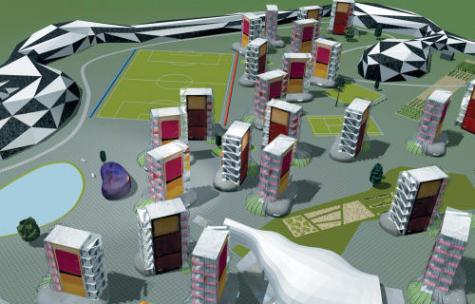
A rendering of Will Alsop’s new corrections landscape, developed in collaboration with prisoners, resembles a cross between Communist-era housing blocs and a series of South Beach condos. Courtesy Alsop Architects
I have been a fan of Alsop’s work since his 2005 hypothetical SuperCity project which would subsume my hometown in the North.
Article Two – Floating Prisons is a historical survey of sea-faring, carceral solutions by warring and colonising nations. Finoki maps the use of prison ships from 18th & 19th century economic necessity to transport human cargo to contemporary manoeuvrings in avoidance of international law. He makes reference to the convenience use of islands as sites of detention, the use of ships as temporary housing in leiu of land locked sites, and the dubious experiments in swapping refugees held in off-shore camps. The summary was to say that new legal definitions and controls are creeping in giving one the sense, “refugees and migrants are just an excess of biomass to be herded around on prison islands or in prison vessels, traded like geo-economic commodities, removed and disposed of like capitalist human waste, reinforcing the state of exception that goes on re-organizing the architectural spheres of global migration.” Phenomenal.

The Vernon C. Bain is a prison barge operated by the City of New York, housing 800 prisoners in a medium and maximum security facility. Built in 1992 at a cost of $ 161 Million means it would have been cheaper to send the inmates to Harvard instead. (Source)
Article Three – “Block D” enters the Pantheon of GWOT Space is a meditation on the totality of restricted space across the globe – in multiple nations – in order to sustain military operations. The point of the survey (which includes previously known sites such as Guantanamo, Baghdad’s ‘Green Zone’, Bagram Theater Internment Facility, US homeland immigrant detention facilities, and Taxi networks for rendition) is to add another site to the list: “Block D” in Pul-e-Charki Prison just east of Kabul, Afghanistan.
With persistent references to journalists’ work for the BBC, New York Times and Washington Post, Finoki summarises, ” ‘Block D’ or ‘Block 4’ as it is also apparently known: a newly built detention facility [is] quickly becoming understood as the Asian corollary of Guantánamo Bay. No matter, it is another utterly disturbing black hole in the universe of legally suspect and secret space.” Finoki doesn’t focus on the conditions of detention but rather America’s self-created legal imbroglio.
Nearly a year after writing, this analysis seems prophetic now, as the American public is slowly coming to realise that Obama’s closure of Gitmo doesn’t necessarily magic away the human rights issues … only shifts them somewhere slightly more obscured. As with Gitmo, one expects Block D to focus the new rounds of jousting between the same ideological stakeholders.
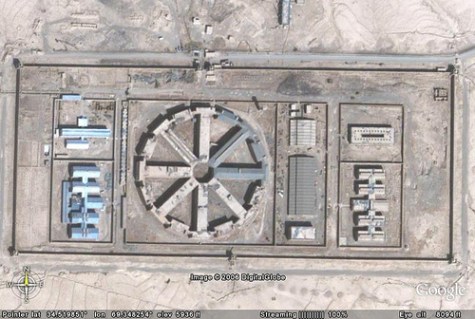
Pul-e-Charkhi prison, Kabul, Afghanistan. Construction began in the 1970s by order of then-president Mohammed Daoud Khan and was completed during the Soviet invasion (1979-89). The prison was notorious for torture and abuses under the control of Afghanistan's communist government following the invasion by the Soviet Union. (Source)
Article Four – The Spatial Instrumentality of Torture is a stomach-pounding dose of reality in the form of an interview with Tom Hilde, Research Professor in the School of Public Policy at the University of Maryland. I will not offer a synopsis, just encourage you to read through it. The interview is illustrated in part by Prison Photography‘s favourite Richard Ross.
Hilde ends with the sobering words, “The secrecy of much of the US torture program, its physical spaces, and its extent has certainly kept public debate rather subdued. But I think the dualistic moral framework has been even more corrosive of a public understanding of torture in general and the consequences of American torture in particular. When a majority of Americans say that torture is acceptable for some purposes, I think they have the fantasy of the ticking timebomb, and likely racism in many cases, in the backs of their minds.”

Camp X-Ray, Guantánamo, Cuba. The facility has not been used since early 2002, and recent heavy rains at Guantánamo Bay have brought about overgrowth. Credit: Kathleen T. Rhem
I don’t want to get into the habit of posting on cases of police corruption, police brutality, or correctional officer misconduct.
I don’t want to do this for three reasons:
1. It distracts me, and you the reader, from digesting content directly related to photography and its praxis.
2. Many other regional, national and international newsrooms will cover these stories – as a matter of course – more thoroughly than I.
And 3. Despite their shared “peace officer” status, cops and screws are cut from a different cloth. It would be wrong of me to carelessly blur the activities of one disciplinary group with another. Police and correctional officers share minimal operational relation to one another.
So, I don’t wish to obfuscate the reader/viewer. However, the video below leaves no confusion in anyone’s mind.
The spokesperson in the video relayed the official words of an authority under investigation, but one feels even he could barely stomach the truth here. Where some videos are subject to interpretation – and consequently endless courtroom debate – there can be no doubt here. The officer lost his head and unleashed upon this young girl. He’s a thug, just like a guy fist fighting on the street is a thug.
As some of you may know, I have recently transplanted to Seattle. Occasionally, one witnesses acts of rote police procedure in place of common sense, but by and large, the cops on the streets here (as in my former home of San Francisco) are a friendly bunch on bikes and skates.
I am saddened such a horrendous beating should take place in my new hometown … which is why I have made an exception to my rule here.
Unfortunately, this brutal lashing occurred in the same month that Seattle police chief Gil Kerlikowske was selected by Obama to be America’s next Drug Czar. Seattleites have voiced varied opinions regarding this appointment, but secretly they are all really chuffed. It is a proud moment for Seattle residents, not least, because Kerlikowske – even as a police chief – shares some majority views of the citizenry. Kerlikowske adopted a common sense approach to urban policing by making marijuana infractions the lowest priority of his force in order to redirect resources to more serious matters … matters of violence. The Stranger, Seattle’s favourite free rag offers four wildly different but well-informed opinions on Kerlikowske’s appointment.
_______________________________________
Seattle lost an age-old institution recently. The Seattle Post Intelligencer, like the Rocky Mountain News and San Francisco Chronicle has had its day. I am not sad because I believe newspapers have unending rights or high position in urban comunities because I don’t – I am excited by new media and its different forms of creation and distribution. I am upset because it was the liberal leaning paper in this two paper town. That leaves the Seattle Times, which is very mediocre. If you are intent on getting good journalism in print pick up the San Jose Mercury Times. Crap city, great newspaper!
Morgan Spurlock is a decent guy. I’d like to have a beer with him. He lays it out straight. Prisons & jails are boring and hopeless. He knows this because he spent 30 days in a county jail just outside of Richmond, Virginia.
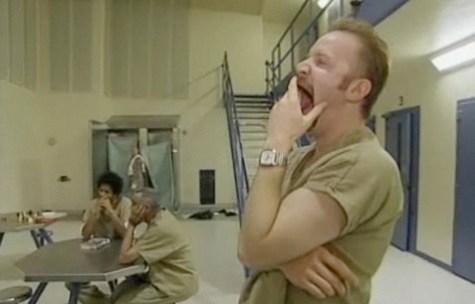
Spurlock nails it. “One of the most surprising things about prison is that you are pretty much left on your own. all you can do is kinda suck it up and fall into a pattern. I’m gonna get up, gonna eat, gonna play cards, gonna watch TV, gonna do some push ups, do some sits ups, write a letter, read a book….”
He continues, “People will be in their rooms or down here – just hanging out, you know, on the phones. The punishment is the monotony. This is it. You don’t have to think. You’re in jail. There is no thinking involved. And you’re feeding the machine. And you feel like that … you don’t feel like a person in a lot of ways.”
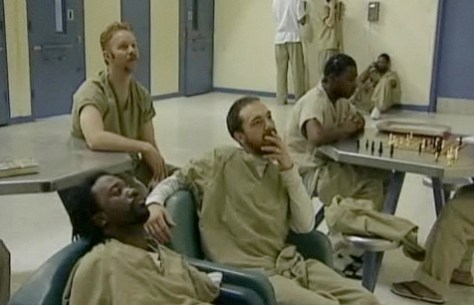

Spurlock elaborates “I haven’t seen a tree in over two week;, I haven’t seen one blade of grass; I haven’t breathed fresh air. It gets to you being in here … it really does. I see people like George and Randy who keep making the same mistakes over and over and over again. What is the system doing for these guys? They’re stuck! I see this cycle that were putting people in and punishing people for problems we could be helping them with. And the prisons and jails are just becoming a dumping ground. It really is a place that feels hopeless.”

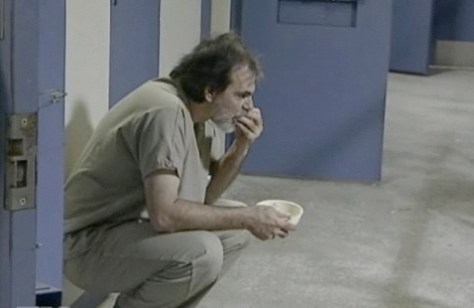
Spurlock even challenged his sanity by agreeing to a 72 hours stretch in solitary confinement. Spurlock couldn’t comprehend how Randy (mentioned earlier) spent a year in solitary.
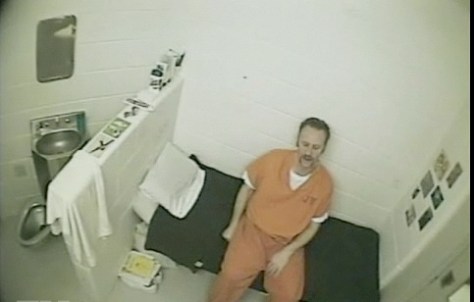
Great series. Great episode. Sobering reality. Spend 45 minutes of your life and witness the monotonous and expensive warehousing of society’s misfits.

Discombobulated
I was delighted to find this collection of “Jail Finds” recently. It is a quiet statement amidst the cacophony of dross we are subject to daily.
The person who documents these notes, scribbles and profundities works for a volunteer library service serving the local Dane County Jail and operated by the University of Wisconsin in Madison.
These are things I find abandoned in books or stuffed on the book cart at the jail where I volunteer. A little context: these come from a county jail, not a state prison – a very important distinction. Most inmates (approx. 75%) are short-term “holds.” They’re there awaiting trial (meaning they couldn’t afford bail); on probation violations; or are federal prisoners being shuffled around the system. About 1/4 are women and 1/3 are minorities. The vast majority stay less than 30 days.

"Subject Mukasey, President Bush and Vice President Dick Cheney to Guantanamo style Waterboarding. Then ask them if it is Torture."

Events and Consequences

Health Testing Request
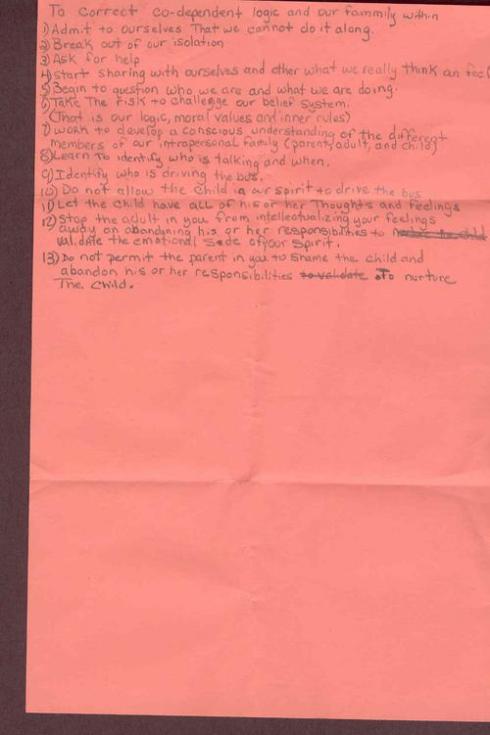
Childhood and Adulthood
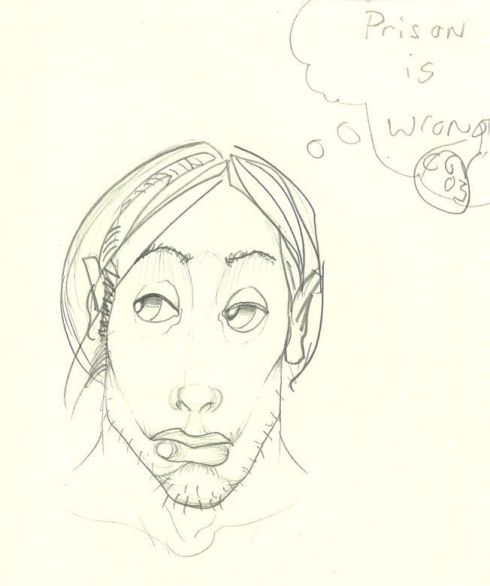
Prison is Wrong
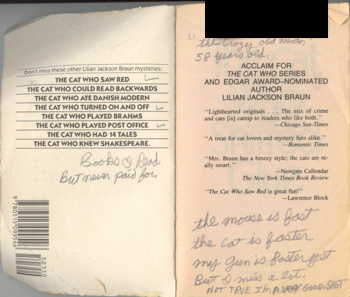
The Mouse is Fast, The Cat is Faster, My Gun is Faster Yet, But I Miss a lot. NOT TRUE, I'M A VERY GOOD SHOT

Vocabulary

Letter of pledges, hopes and favours.
What ties these examples and the other 100 or so in the collection is humanity and surprise. Humanity we should hope of all and surprise we should absolutely insist on from all. Some of these scribbles are penitent in the old fashioned ideal, some are reflections of harsh reality.
I wouldn’t argue, that in my mini-curation, I may be biased. I have picked the most appealing and the most redemptive of scripts, but I feel this only goes some small way to redress the imbalance of mainstream media that a) simultaneously condemns and sensationalises criminals and b) cares little for the transgressor once locked away.

"God give me serenity to accept the things I cannot change and give me valour to change those I can. And wisdom to recognize the difference. May your will be done and not mine."

Prisoners of the Cebu Provincial Detention and Rehabilitation Centre dance the Rico Mambo. Photo Credit: Bernie Ledesma, 2008
UPDATE 10.05.12: They just did Gangham Sytle
– – – – – – – – – – – – – – – – – – – – – – – –
My general endeavour with Prison Photography is to ask readers to assess the visual culture surrounding prisons and prison populations more critically. The videos and photos in which prisoners present themselves beyond all stereotypes are important. The back story is revelatory too.
The routines are the result of a new approach to rehabilitation in Philippine prisons (8 facilities at last count) beginning at Cebu Provincial Detention and Rehabilitation Center (CPDRC). The program was initiated by Byron Garcia the brother of Cebu Governor (Warden) Gwendolyn Garcia. Ms. Garcia was the first female warden at Cebu, which leaves me wondering if the novel dance program is the result of progressive governorship or just an accident of uncomplicated nepotism.
Byron Garcia introduced an exercise program where the prisoners marched in unison, starting out with marching to the beat of a drum, but moved on to dancing to pop music; he began with one of his favourite songs, Another Brick in the Wall (Part 2) by Pink Floyd. Early on, Garcia selected camp hits In The Navy and Y.M.C.A. by The Village People for the program.
All of this is well known to webnerds who follow the biggest viral videos. Thriller has had over 50 million views.
The list continues – MC Hammer’s Can’t Touch This, Laura Brannigan’s Gloria, Bonnie Tyler’s I Need a Hero, Van Halen’s Jump, and Queen’s Radio Ga Ga. The dancing inmates of CPDRC are self-proclaimed “World Entertainers” now and have been featured on pretty much every major global news source. Here’s the BBC’s article.
The routines are endearing to the point that one’s will to know the perhaps-less-than-shiny-happy-reality behind the dancing program is shoved to the back of the mind.
Predictably, as with all things related to penology it is not quite as simple as clapping inmates dancing together, forgetting their rivalries and jigging toward reform.
The dance program is compulsory. “The British Channel 4 Documentary Murderers on the Dancefloor broadcast in January 2008 portrayed life in the prison. The program showed various inmates praising Byron Garcia, the founder of the initiative – many of whom had tattoos praising Mr Garcia. However, it also featured an anonymous ex-inmate who claimed Mr Garcia employs certain prisoners to beat prisoners who refuse to dance. Garcia was filmed in the documentary holding an American M4 Carbine, saying, “This is an M16 M4 rifle, and it can make people dance”, before aiming the gun at the cameraman. This statement was acknowledged as a joke by the narrator. His Youtube account states any accusation that any form of abuse goes on as part of the program is false, and the program serves the purpose of reforming the inmates.” (Source: Wikipedia)

Prisoners at Cebu Provincial Detention and Rehabilitation Centre form a cross shape. Photo Credit Bernie Ledesma, 2008
Garcia maintains that prisoners dance in honour of Peace Advocates, their Catholic Archbishop and against dissenters of the church. I find it hard to believe that all 1,500+ prisoners dance to voice the exact same political or religious opinion. There is certainly coercion at work here, but I think it is that of forced empty comment than of physical torture for those who abstain.
The show is put on monthly and the gantry around the yard is full of fans; likely family and friends but also genuine admirers. I heard of one spectator’s description of goose-bumps each time she watches a new routine. I can’t go that far but I must admit that the exercise, diversion, surface camaraderie and sincere adulation the prisoners enjoy must be extremely positive. It is worth noting that male and female inmates dance together. Could you really expect to see co-ed dance therapy in any US prison?
UPDATE
Read Marco Bohr’s The Story Behind the Dancing Inmates for a 2011 critique of CEBU and some images of the collapse of the shocking regime prior to Garcia’s arrival.
For the best still photography of CPDRC inmates in action go to Bernie Ledesma’s Flickr Set or his JPG Magazine “Jailhouse Rock” Feature.
POSTSCRIPT
All of this, while focusing on the policies of progressive prison authorities distracts us from the ongoing heinous conditions in Philippine prisons, the detention of children alongside dangerous adults and the ongoing abuse of those minors.
Special Emergency Response Teams (SERTs) are commonplace. Less so perhaps are the “sports team” group shots seen here at the end of a good days work out.

Training Exercise, Team Portrait. Photo Credit: I.M.T.T. 2004
Personal politics dictates how one feels about these constructed scenarios. To me they just seem unfortunate sad – not because of what they are, but because of what they represent. However, we must accept that tactical training within prisons is conducted with the same professional intent as that of any police authority or force of shock and awe. With caution, I’d say these trainings are a reality of prison management, but insist that they should not be considered an inevitability.
Once you get past the unnerving brevity of the group portrait, it is the second unposed image (below) that arrests the attention. It differs from other official images from within prison walls because of its ambiguity. As an isolated image, it is not clear whether the confrontation shown is genuine or not. Without the referenced source, could this be read as an actual suppression of inmate violence? How many eyes would be keen or informed enough to tell if the prisoner and guard uniforms were those of controlled dress rehearsal?
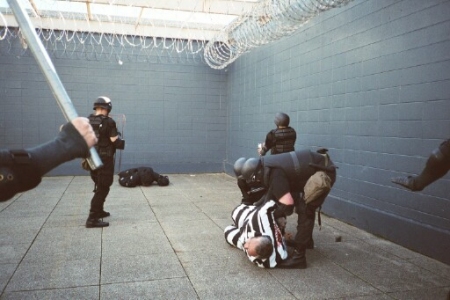
Training Exercise. Photo Credit: I.M.T.T. 2004
From building arguments of fact concerning the Abu Ghraib photographs, Errol Morris talks about the inherent traps for viewers of images, “You look at a photograph and you think you know all you need to know. That here you have a veridical piece of reality to look at. And, you need look no further. It, of in itself, is enough. You look as these infamous photographs that came out of Abu Ghraib. You look at the photographs of Gilligan, the prisoner on the box with leads, and of Gus, the prisoner on the leash, and you think you know what these are images of. ‘This is despicable, blah, blah, blah’ … You need look no further … and I believe noone looked any further, [they] presumed to know what the images were about and wrote articles accordingly.”
Morris adds to his general point, “We try to figure out the world by looking at things, and nothing we ever create is complete but you try to figure out what our relationship is to reality – to the real world.”
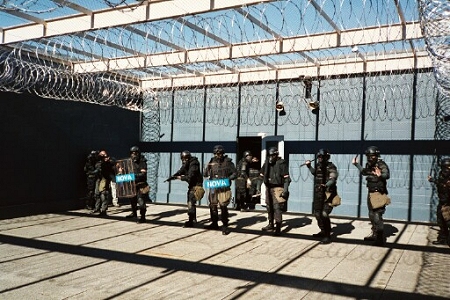
Training Exercise. Photo Credit: I.M.T.T. 2004
In a world of visual bombardment where deliberate disturbances between reality and fantasy are now commonplace have we lost interest in the strength of imagery and its testimonies? Images are mistakenly and willfully misrepresented and misinterpreted. In many ways, this is a fine game – a novel game. But does the game keep people on their toes or does it lead to apathy and disinterest? As Morris asks “What is true and what is false?” Without the proud group portrait to provide context would viewers have cared to question the seeming brutality of the second photograph?
Or am I missing the mark here? Is a lack of visual curiosity and/or sophistication really the problem here? Or, is the real problem the viewers normalisation to images of violence? Do the two issues compound one another? I would argue that many folk are too familiar with images (often involving wire, concrete walls and the ephemera of incarceration) to presume that the attacks meted out are a) unjustified or b) outside of the legal allowances of a prison authority. The issue of ‘Reality’ almost becomes redundant.
Perhaps, even, this worrisome trend of anesthetised reaction to human suffering can even be stretched through the interwoven spectacle of modern society and placed at the door of second rate video games. Prison Tycoon 4: Supermax, as featured recently on BLDGBLOG challenges the gamer to draw the most profit from prison administration; “Grow your facility to SuperMax capabilities, housing the most dangerous and diabolical criminals on earth – all for the bottom line.”

Prison Tycoon 4: Supermax. Screenshot. Source: IGN.com
I have never liked role playing video games that incorporate violence. But I am not an opponent pointing to them as the cause of delinquency among societies youth. I just don’t like them. Prison Tycoon is less gratuitous than Grand Theft Auto and the like. But I don’t know if this is any comfort. To manipulate a virtual prison population with “friendly interaction and fighting between inmates dependent upon mood and gang affiliation” and to rely on “guards [who] will subdue aggressive prisoners, medical staff to treat injuries, chaplains administer to prisoner’s spiritual needs and therapists talk to prisoners to lift their spirits” seems a bit too sinister and calculated for an evening of gaming.
And the ability to use “96 detailed prisoner model variations created to allow for a wide and varied prison population” and use a “unique ‘builder within a builder’ system to open your buildings and place their interior content wherever you like” in addition to the “over 100 different rooms and objects to place within the prison buildings, each one allowing prisoners to interact with them on various levels and each one having different effects on the prisoner’s mood.” seems like a gamer’s invitation to unleash virtual gang violence akin to those most unfortunate of prisoner abuses in real life.
LAN Party. Source: http://www.davesdaily.com/pictures/391-lanparty.htm
Really, why does this game exist? I suppose it is just completing the loop – the gamer, as a God of Pixels, can create criminals in his other games and then manipulate them in this one.
For more information about High Risk Prisoner Transportation, Corrections Crisis Response, Cell Extraction, Escape Apprehension Training, Suicide Bomber Mitigation Tactics, Tactical Weapon and Explosive Training, Athermal Weapon Sight Usage and Finnish Sniper Training please visit the International Mobile Training Team Website. If all that seems like too much reading then just go to the IMTT promotional video and watch grown men in costume run around with guns to a butt-rock soundtrack.
This has absolutely nothing to do with photography. The matter-of-fact second answer is outshone by the hasty confusion of the first.
Question: How much is a card from prison worth?
Answer: Like, if you sold a letter from someone in prison?! Nothing. Why would people want to buy a letter from a criminal?!
Answer: In a game of monopoly, depending on the house rules, around $50.

Get Out Of Jail Free Card
Source: Original Wiki Page
Update: Prison Photography collated a Directory of Photographic & Visual Resources for Guantanamo in May 2009.
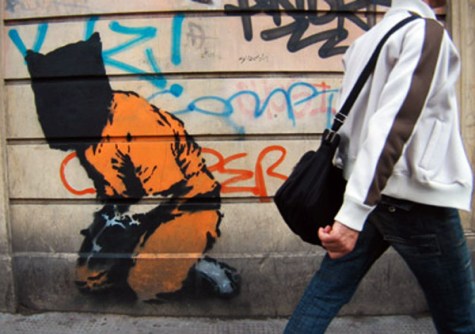
Guantanamo Prisoner, Political Graffiti. Banksy
Anyone who says the recent media tour of Guantanamo isn’t a public relations exercise by the lame duck has not had their eyes open. Global media were given a tour of camps 4, 5 and 6 at Gitmo and all the footage was screened and vetted before release.
Video: Here is the Guardian’s three minute offering. With any hope Obama will put this illegal operation out of action in 2009.
Artistic legacy of Guantanamo

Guantanamo Protesters outside the US Embassy, London
Meanwhile, we can think of the potency that the orange jump-suit has gained. It’s another icon of the Bush presidency. With regard it’s establishment and its bare-faced operations, Guantanamo was far outside of the public’s imagination. Our culture stomached the guilt and under the Bush administration it was never likely Guantanamo prison would be brought back into line with international law. Activist and non-activist art protested Guantanamo by subverting the camp’s own visual vocabulary.

UHC Collective. "This is Camp X-Ray". Art Installation, Manchester, 2003. Guards with replica guns were on duty 24 hrs and followed a regime copied from media reports.
Back on my home turf in Manchester, UHC, a notoriously bold and inventive art collective, scaled up a version of Camp X-Ray on an unused lot in Withington. It was complete with guard towers, fake guns and orders and activity that replicated the media’s reports of Guantanamo, Cuba. See other UHC Projects here, and read the BBC report here.

Road to Guantanamo (2006). A Michael Winterbottom Film, Spanish Release
And while we are not focusing entirely on photography, slightly off topic with video, I cannot recommend Road to Guantanamo highly enough. The film tells the ridiculous story of three young British-Pakistanis who were in the wrong place at the wrong time (southern Afghanistan, November 2003), and ended up in Guantanamo for 2 years. Your jaw will not leave the floor.

 Prison Photography