
You are currently browsing the category archive for the ‘Rehabilitative’ category.
Sometimes the simplest ideas are the best. With the aid of inmate Renata Abramson (pictured in sceengrab below), Detective Kim Bogucki and Photographer/Film Director Kathlyn Horan co-founded The IF Project and asked ladies at the Washington Corrections Center for Women a single simple question:
“If there was something someone could have said or done that would have changed the path that led you here, what would it have been?”
Simply, the filmed testimonies (also here) and over 300 essays give the public an open line on the difficult lives these ladies have lived.
The lazy definition of ‘choice’ that everybody falls back on to justify punishments meted out upon the disadvantaged in our society – “they chose to do their crime, they do the time” – is exposed by these ladies’ stories. Many of them had no choice, at least not choice that would be obvious to an unloved teenager without any support, example or love.
I also know that The IF Project has expanded into men’s prisons in Washington State. Wonderful news.
IF you wouldn’t have noticed, the lady in the top image is cutting out the Washington Department of Corrections uniform badge.
IF you do anything today, spare 13 minutes for The IF Project trailer.
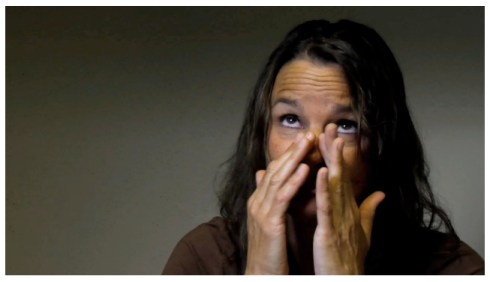
The IF Project Trailer, Screengrab
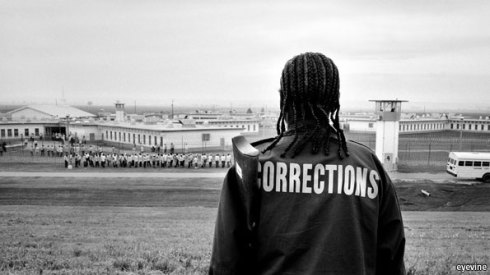
© Eyevine / Lori Waselchuk
Last weeks article, Rough Justice in America, by The Economist repeats many truths of America’s broken prison system we know already, here summarised:
“The system has three big flaws, say criminologists. First, it puts too many people away for too long. Second, it criminalises acts that need not be criminalised. Third, it is unpredictable. Many laws, especially federal ones, are so vaguely written that people cannot easily tell whether they have broken them.”
As expected the arguments made against mass incarceration here are on based on financial sustainability and fortunately such thinking is melding with the notion of social sustainability. The stories of George Norris and Michelle Collette form the anchor to the piece which posits that “Never in the civilised world have so many been locked up for so little.”
LORI WASELCHUK
I recognise the photographs as those of Lori Waselchuk whose work Grace Before Dying from the Angola Prison Hospice should not be missed. For it, Waselchuk won a Soros Documentary Photography Grant (2007), a Photolucida Critical Mass Top50 (2008). Here’s a great interview with her by Nicole Pasulka of the Morning News.
– – – –
Thanks to Joerg for the link
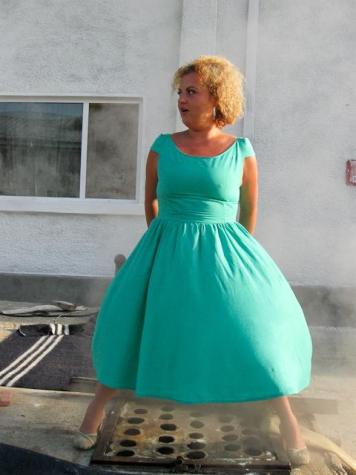
Fourteen female prisoners at Tirgsor Prison in Romania participated in a six-camera workshop led by Cosmin Bumbuţ.
The workshop was suggested by a Miss Raducanu (presumably the warden), and Cosmin Bumbuţ took up the initiative. Bumbuţ gained sponsorship from f64 and insisted that – after basic training – the women be left unsupervised with the cameras for the duration of the project.
Bumbut: “I received six Canon PowerShot cameras that I took with me to Tirgsor in July. The cameras worried me, they had so many buttons and the manual was so complex that I was skeptical that anyone could use them; I, for one, wasn’t able to. I felt very nervous.”


Over a two month period the group captured 14,000 images. 395 were chosen for the final exhibition and 95 can be seen in an online gallery at Punctum (Romanian language). Here is a Google translation.
I’ve picked out 12 images.
This is a marvelous project. I would like to see more photography used as rehabilitation in prisons. I have a colleague who uses video in an ethnological framework and the men really benefit from the novel educational approach.
This Romanian project is similar to the pinhole photography of the girls of Remann Hall here in Washington State.
Finally, it is worth saying that Bumbut was inspired by Klavdij Sluban‘s prison workshops which he has conducted across the globe.





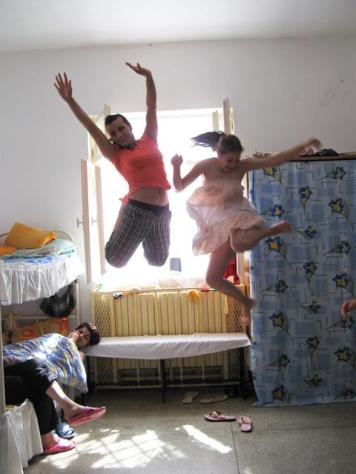

I’ve talked about biologist Nalini Nadkarni and the Sustainable Prisons Project in Washington State before here and here.
Well, Nadkarni is back at TED again, this time delivering a quick 6 minute piece on how the things we consider static – trees, perceptions, prejudices and the lives of prisoners – are all open to change … if we see the possibilities, if we allow the possibilities.
At times, Nadkarni’s implored arguments (about tree art) are a bit of a stretch, but ultimately I am focused only on the practical & repeatable efforts her team is making to engage the prison population – a population of whom most others have given up.
Alfie Brooks (not his real name) is the focus of Amelia Gentleman‘s recent Guardian article. Photographer Tom Wichelow spent 12 months with Alfie documenting his life:
During those 12 months, Alfie was sentenced to eleven days in prison (for stealing 400 balloons). It was his first stay in prison. Alfie intends it to be his only stay in prison. He was bored.

A coffee table at his flat, on which are instructions on how to use the curfew tag he has to wear. © Tom Wichelow
To the journalist, Alfie is simultaneously endearing and frustrating; he delivers pearls of wisdom and then childish logic. More startlingly, sometimes the two are the same – and we, the reader, need to rethink our perceptions and expectations of a younger generation without the same future-oriented behaviours we value and reward.
Alfie is affable and greeted warmly by folk about his hometown. He isn’t violent and has never stolen from an individual, only shops. It is a code he justifies. He has also smoked marijuana for as long as he can’t remember:
AMELIA GENTLEMAN
For me, Gentleman’s piece is not a ground-breaking piece of journalism, but it is unique. It takes the time to look at a young life that could be the norm for more young lives than we’d like to admit. It really spells out for us the drifting uncertainties of life for youth who’ve opted out of formal education, but are still bright, articulate, playful and “clear with ambition”. Gentleman has a fondness and hope for Alfie which is appropriate and understandable.
TOM WICHELOW
Gentleman’s piece is well supplemented by Tom Wichelow’s photo essay, A Year in the Life of Alfie Brooks. His year long study of Alfie is a nice counterpoint to other work in his portfolio, notably his work on CCTV in the Whitehawk housing estate, Brighton, You’ll Never be 16 Again and 2000 portraits.
From CONTACT blog:
James Mackay‘s project ‘Even Though I’m Free I am Not’ is a confrontational investigation into Burma’s political prisoners. Travelling across the globe, Mackay documents Burma’s former political prisoners.
Visit CONTACT for an interview with James about the project.
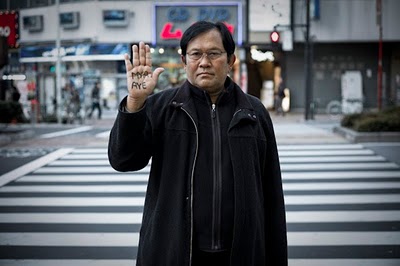
Dr Aye Chan, Insein Prison, Tharawaddy Prison, 7 years © James Mackay
This excerpt (0.01 – 3.17 minutes) from Darkness and Light is particularly interesting in light of the recent unanimous celebration of Phil Toledano’s Days with my Father.
Avedon admits that his work was invasive and disturbing and that those tenets always exist within the arena for art. Avedon also faced accusations of exploitation for his later work In The American West.
Avedon’s work is good comparison to Toledano’s because reactions to Toledano’s work has been beyond positive. We have seen it as loving and we have seen it as our privilege; this is probably the case, but it doesn’t explain the absence of any discussion on ethics (however brief). Just a thought.
Personally, I am a fan of Toledano’s Days with my Father, and I wonder … do we respond to death differently today, do we respond to the approach of death in photography differently? Here’s a CNN clip of Toledano “blubbing” about his project.
Happy Fathers Day.

EL LAMENTO DE LOS MUROS
On March 31st 1977, Paula Luttringer, a 21 year-old pregnant botany student was kidnapped by police of the Argentine military junta and detained in an extrajudicial prison. During her five month detention, she gave birth to her eldest daughter.
Released abruptly during what she thought was transfer to a regular prison, she was forced to leave the country immediately to avoid another “disappearance.” She went first to Uruguay, finally settling in France. (Source)
During the Dirty War (1976-1983) hundreds of secret detention centres were established across Argentina for the purposes of interrogation and torture.
In 1995, Paula returned to Argentina and took up photography as a means to explore the memories, mental scars and the crimes against her and other women. El Lamento de los Muros (The Wailing of the Walls) is the result.
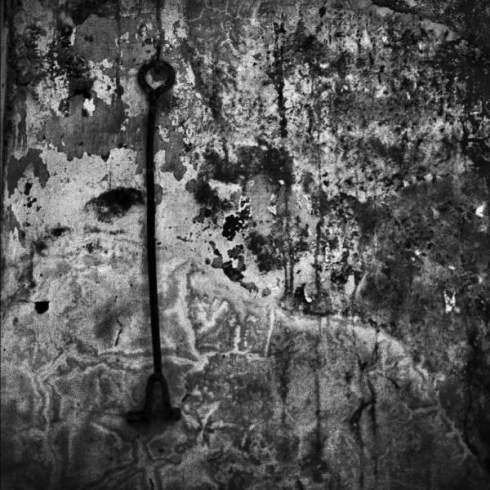
Three years ago, I met Paula. She had just enjoyed acclaim at the 2006 Houston Fotofest, and was searching for further funding to travel the exhibition and expand on the educational lessons attached to the project.
The Wailing of the Walls is about the violence brought against women and the continuing means by which those women cope and live in the aftermath. Paula was adamant; she only wanted funding from women. 100 donors to fund the gathered testimony of 100 survivors. This was a project by a woman, for women supported by women. The funding initiative was named 100×100.
PAULA’S WORDS
I have twice heard people urge Paula happiness in that she survived. Paula is unequivocal; having survived does not make her happy, living in a world in which people didn’t have to be survivors would make her happy. The violence once it is done, cannot be undone.
For more on Paula’s motivations for the project read this interview, this articleand listen to this audio interview.
RECOGNITION
Wendy Watriss and Fred Baldwin, of Houston Fotofest must be singled for special praise in bringing Paula’s work to a larger audience and consciousness.
The statements that accompany each of these images have been co-opted from Fotofest’s feature and from the George Eastman House page on Paula’s work.
‘THE WAILING OF THE WALLS’ IMAGES AND TEXT
“Walls that served to stifle the desperate screams, the cries of those tortured and raped, and the indescribable, agonized moans of those who, although they were freed, remain aware of their open wounds—who feel that they will never get out of that hole.”
Juan Travnik, Buenos Aires in the FOTOFEST2006 catalogue.
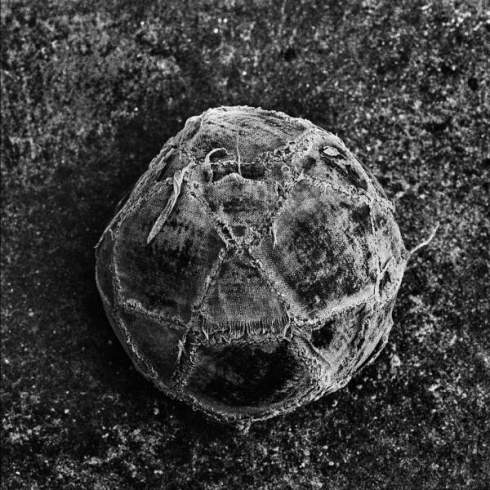
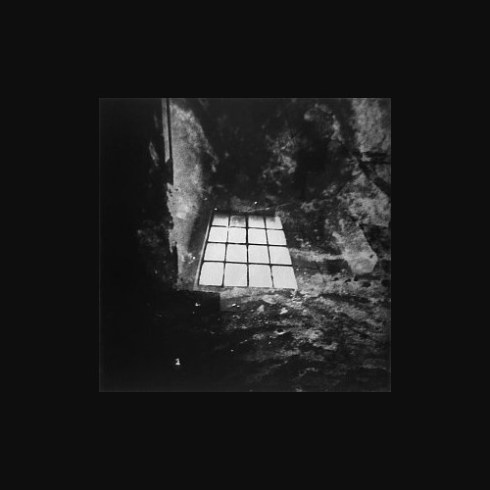
“It is very hard to describe the terror of the minutes, hours, days, months, spent there. At first when you’ve been kidnapped you have no idea about the place around you. Some of us imagined it to be round, others like a football stadium with the guards walking above us. We didn’t know which direction our bodies were facing, where our head was, where our feet were pointing. I remember clinging to the mat with all my strength so as not to fall even though I knew I was on the floor.”
Liliana Calizo was abducted on September 1st, 1976 in Cordoba. She was then taken to the Secret Detention Center “La Perla”
– – – –

“I went down about twenty or thirty steps and I heard big iron doors being shut. I imagined that the place was underground, that it was big, because you could hear people’s voices echoing and the airplanes taxiing overhead or nearby. The noise drove you mad. One of the men said to me: so you’re a psychologist? Well bitch, like all the psychologists, here you’re really going to find out what’s good. And he began to punch me in the stomach.”
Marta Candeloro was abducted on June 7, 1977 in Neuquen. She was then taken to the Secret Detention Centre “La Cueva.”
– – – –
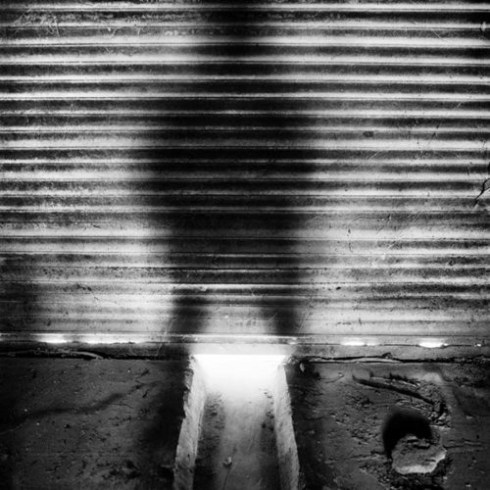
“And this marks you, it’s a wonderful feeling that stays with you the rest of your life. You’re left with this dual task: you have to be constantly working out what comes from the trauma and what from normal life. I have this dual task in life. I have to decide which feelings are the result of the trauma and what there is beneath of less intensity, more diluted, which is that what comes from normal life. So I talk to someone who has never been in a clandestine prison and then I play the role of a normal person and I realise what that involves, I step into normality. These things that happen to all of us who were victims of repression …”
Liliana Gardella was abducted on November 25, 1977 in Mar del Plata. She was then taken to the Secret Detention Center “ESMA”
– – – –
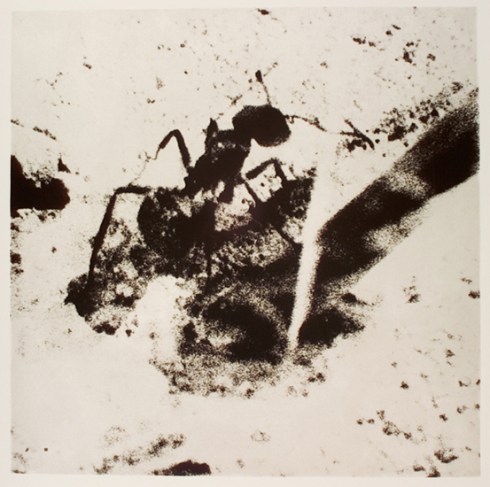
Ants used to come in and out, and I would watch these ants because they were coming in and then going out into the world. They were walking across the earth, the outside world, and then coming back in again, and watching them I didn’t feel so alone.
Ledda Barreiro,” La Cueva” Illegal Detention Centre
– – – –
Source

Source
“Something strange used to happen at night, the screams of torture were different than those during the day. Even if the screams of torture are always the same they sound different at night. And it’s also different when they come to get you at night. The noises and the screams are not with me always, but when I do remember them, it makes me very sad. I am paralyzed by those screams, I’m back in that time and place. As somebody once said — and I’ve given this some thought and I think it’s right — although life goes on, although some of us were freed, you never get out of the pit.”
Isabel Cerruti was abducted on July 12, 1978 in Buenos Aires. She was then taken to the Secret Detention Center “El Olimpo.”
– – – –

Source
‘EL MATADERO’
It is worth noting an earlier project too.
The images below are from Luttringer’s earlier series El Matadero (The Slaughterhouse) for which she won the best Portfolio Prize at PhotoEspana (1999). The manhandling of carcasses through rooms designed for dismemberment is a shocking precursor to The Wailing of the Walls. Luttringer’s work echoes themes of mortality and the manipulation (herding, processing) of flesh.
Many people are gripped by the psychological charge of Roger Ballen‘s work, but the photography of Outland, Shadow Chamber and Boarding House obscures reality and fuses it with imagination. Luttringer’s work, on the other hand, is an attempt to mobilise our understanding of the historical moment. Photography is a tool for Paula, but the real import of this exercise is the oral testimonies recorded and written and the associated benefits that may have arisen for the women having shared their memories.
For me at least, the visceral images of El Matadero, are a solemn counterpoint to Luttringer’s work on kidnap and detention from Argentina’s Dirty War.

Source

Source
BIO
In 1999, Luttringer was chosen by the National Museum of Fine Arts in Buenos Aires as one of the twenty photographers of the ‘New Generation’. In 1999, she won the best Portfolio Prize at PhotoEspana, for her project “El Matadero”. In 2000, she was awarded an artist`s grant by the National Arts Fund of Argentina for her project “El Lamento de los Muros”. In 2001, she was made a Guggenheim Fellow for her project “El Lamento de los Muros”. Luttringer’s photography is part of the permanent collections of both The National Museum of Fine Arts (MNBA) and the Museum of Modern Art (MAMBA) in Buenos Aires; the Museum of Fine Arts in Houston (MFAH); the George Eastman House in Rochester, NY; Portland Art Museum in Oregon; La Bibliothèque nationale de France in Paris; and the Portuguese Photography Centre in Portugal. She currently lives and works in Buenos Aires and Paris.

 Prison Photography