
You are currently browsing the category archive for the ‘Visual Feeds’ category.
– – –
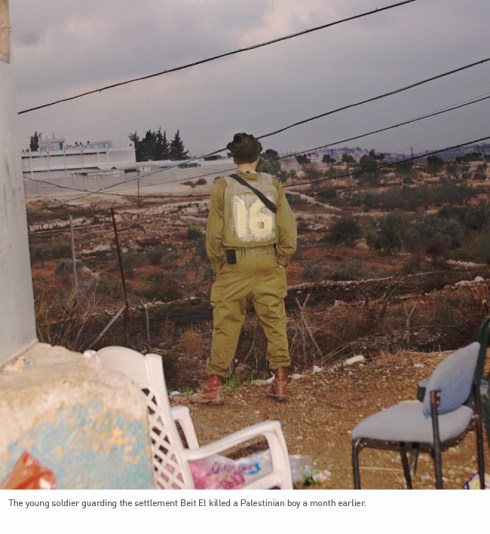
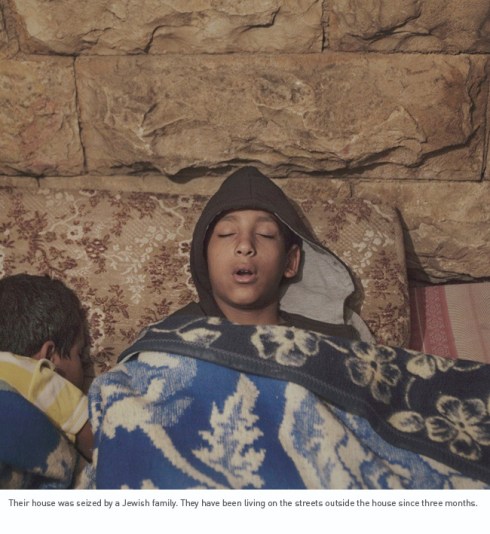
Life’s A Blast is a personal meditation on Israel and Palestine as seen through the lens of a young Swedish visitor. Linda Forsell visited Israel, Gaza and the West Bank several times between 2008 and 2010. She returned with a selection of images that read like a journal.
I first became aware of Forsell’s work when Life’s A Blast was shortlisted for the 2010 Magnum Expressions Award. I’m a big fan. I, therefore, did not hesitate to write a foreword when invited to do so by Linda. Below, punctuated by Linda’s images, is the I essay I wrote the new-release book Life’s A Blast.
– – –

– – –
“He lowered the glasses and pulled down the cotton mask from his face and wiped his nose on the back of his wrist and then glassed the country again. Then he just sat there holding the binoculars and watching the ashen daylight congeal over the land. He knew only that the child was his warrant. He said: If he is not the word of God, God never spoke.”
— Cormac McCarthy, The Road
It’s fair to speculate that all photography surfacing from Israel and Palestine is about land. Knowing what we do about land disputes, settlements and segregation in the region, it’s difficult not to ascribe images a political position favoring the land claims of either the Israelis or Palestinians. This is understandable in a climate of contemporary opinion that has roundly rejected the idea of photography and photographer as objective agents.
Linda Forsell’s photographs are not landscape photographs in the traditional sense. However, the beguiling vignettes within the pages of this book do return us to issues of land, and to the discomfiting realisation that no one in Israel or Palestine has a grounded or reliable relationship to the land.
In considering the surety of land-claims – claims backed with violence – in Israel and the Palestinian Territories, it may seem absurd to describe peoples’ connections to land as without root. Perhaps, the word ‘ambiguous’ more faithfully describes the disconnect. Between the certainty of established political positions and the uncertainty of physical existence in the region there exists a vast gulf of ambiguity.
Life’s A Blast is a challenge to convention and photographic authority, a sustained and deliberate visual wobble.
Within a photograph of an older man teetering atop a wall, the wobble is literal. In the photographs of children wielding weapons and playing among destroyed buildings, the imbalance is allegorical. Men, women and children in Forsell’s work maintain relationships among themselves, but struggle to find their feet.
The tropes of photography – particularly photojournalism – in Israel and Palestine are well known; the checkpoint; the rock-slinging youth; the huddled mother; the wall; the distant settlements on a desert hillside; the coffin raised high at a funeral; and – perhaps with most appearances on international newspaper front pages – the flag. The flag is often accompanied by some billowing smoke.
These tropes persist because, within the boundaries of a news story, these scenes are the illustrative of the quote/unquote action. As consumers of images, we must keep at the forefront of our minds that living in Israel and Palestine goes on outside the boundaries of news column inches.
– – –


– – –
We have begun to see a small but noticeable response by contemporary photographers who have consciously moved away from “crisis photography” – I’m thinking here of recent work and publications by Irina Rozovsky and Yael Ben Zion – toward subtler observations of subtler gestures.
Forsell’s concern for the individual is noticeably different to the drawn back and almost cartographical response by celebrated photographers such as Sophie Ristelbuehler, Willie Doherty, Paul Seawright, Simon Norfolk and Richard Mosse. Of this group, curator and critic Charlotte Cotton says:
“Rather than being caught up in the chaotic midst of an event, or at close quarters to individual pain and suffering, photographers choose instead to represent what is left behind in the wake of such tragedies, often doing so with styles that purpose a qualifying perspective.” [1]
Equally committed to ideas of scarification and dislocation, Forsell, by contrast, takes us closer to people, not further away. In so doing, we encounter the personal and psychological; a soldier who doesn’t want to be there, an old man perplexed by border-point paperwork, the laughter of military-men, a side-street pat down and the confused glances of children. There’s vanity amid the daze and haze, too, in the form of rock-throwing demonstrators that look like they’re dressed for a violent-chic photoshoot. It’s only disconcerting if you accept there are no easy answers for the people of Israel and Palestine.
Too often, repeated news images provide us the excuse to think that events don’t change and can’t change. Worse still, is the trap to think that Israelis and Palestinians are different from us. Such thinking allows us to rationalise ongoing abuses. In discussing atrocities generally, lawyer and feminist scholar Catherine McKinnon characterises attitudes:
“If the events are socially considered unusual, the fact that they happened is denied in specific instances; if they are regarded as usual the fact that they are violating is denied; if it is happening, it’s not so bad, and if it’s really bad, it isn’t happening,” [2]
McKinnon describes the trap and illogic of apathy. The exit door from denial is to first see the victims of abuse as humans. To identify common emotions and thus ourselves in Forsell’s subjects is our responsibility to them … and her gift to us. Turning these pages is to shake the foundations of our excusatory logic.
Life’s A Blast is a significant contribution to the visual discourse of Israel and Palestine. It abandons literal depiction of the region and, instead, looks toward emotional territories.
It is the prior exploration of these emotional lands that will provide the most reliable base on which to stand for those who desire to debate the geopolitics of the region’s contested borders, laws and land.
– – –
1. Charlotte Cotton, ‘The Photograph as Contemporary Art’, p.167. Thames & Hudson, October, 2004.
2. Catharine McKinnon, ‘Are Women Human?: And Other International Dialogues’, p.3, Belknap Press, 2007.
– – –


– – –
Life’s a Blast (106 pages) 10 x 13 inches.
Published by Premiss Förlag.
Printed by Elanders Fälth & Hässler.
ISBN: 9789186743055
Available at the Premiss Förlag website.
Life’s a Blast does not yet have U.S. distribution, so if you want to buy a copy in cold-hard-cash-dollars you’ll have to email Linda and ask nicely: linda@lindaforsell.com
– – –
Click for a larger version
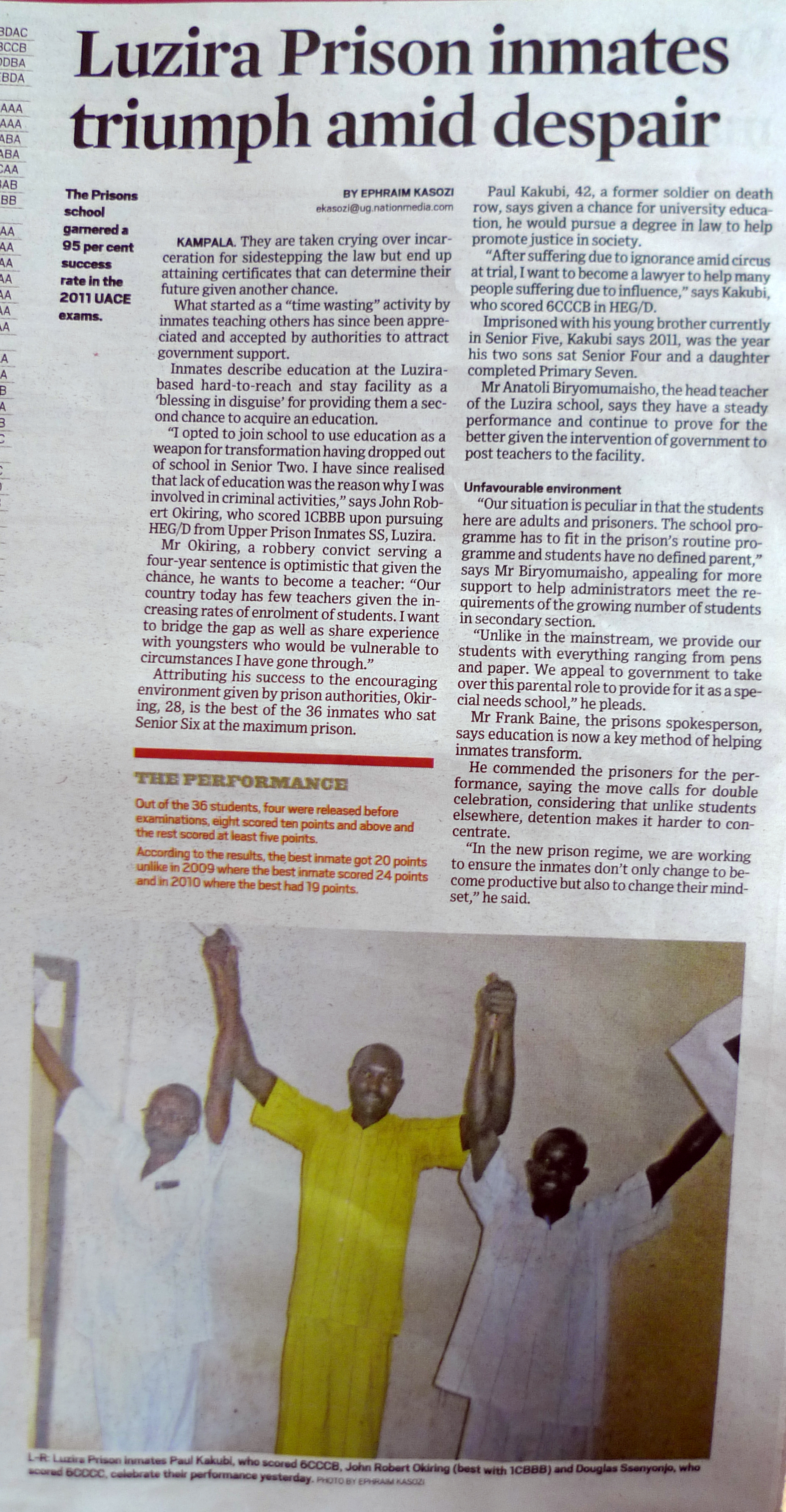
PRISON EDUCATION AND REFORM
“Our situation is peculiar in that the students here are adults and prisoners […] Students have no defined parent. […] Unlike in the mainstream, we provide our students with everything [as a parent would]. We appeal to the government to take over this parental role.”
– – Mr Anatoli Biryomumaisho, head teacher of the Luzira Prison School, quoted in the Daily Monitor, Uganda, March 1st 2012.
From the tone of this article and the situation described by Biryomumaisho it seems Ugandan prison reformers have similar difficulties as their American counterparts in convincing wider society to invest in education for prisoners.
The activity described at the Luzira School is small, unhyped and vital; just one small victory among billions that play out every hour of every day. Quite different in scale to the crusade of Invisible Children.
Andrea Stultiens
Dutch photographer and critic, Andrea Stultiens sent the above article to me yesterday.
Stultiens has spent a lot of time in Uganda. If you want to be exposed to truly novel (and vernacular) photography from Uganda, you should explore her archival project History In Progress Uganda (Facebook group) and pick up a copy of her book The Kaddu Wasswa Archive.
KONY 2012 CONTROVERSY
Elsewhere, Uganda – or a version of Uganda – has been all over the internet. I’ve not much to add to the debate about the viral and controversial KONY2012/Invisible Children campaign, except to advise you to read these five pieces:
Invisible Children founders posing with guns: an interview with the photographer (Washington Post)
In Uganda, Few Can See Kony Video (NYT)
More Perspective on KONY2012 (Rosebell Kagumire’s blog)
Guest post: Joseph Kony is not in Uganda (and other complicated things) (Foreign Policy)
Why Invisible Children Can’t Explain Away This Photo (Scarlett Lion/Glenna Gordon)
And also, follow Glenna Gordon, John Edwin Mason and Rosebell Kagumire on Twitter. They’ve got reasonable things to say often.
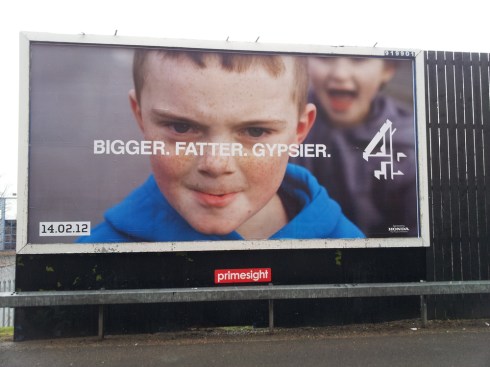
Channel Four in the UK has launched this controversial ad campaign for a new series of ‘My Big Fat Gypsy Wedding.’ Image by Ross McCullough.
This post has nothing to do with prisons, but as you know I’m appalled when imagery is not used responsibly.
In the past 24 hours I’ve come across two advertisement campaigns that are beyond indecent. I am incensed.
The situation is more galling given the fact that both advertisers are groups that I’d expect to have an enlightened approach to the politics of representation.
CHANNEL FOUR
In the UK, the usually responsible Channel Four has launched a controversial ad campaign for a new series of ‘My Big Fat Gypsy Wedding.’ Emblazoned across image of gypsy youth are the words: BIGGER. FATTER. GYPSIER.
Matt Daw, Projects Manager at PhotoVoice today said:
The first two words just seem inappropriate. The last is inconceivable in today’s world. In short, the advert presents a boy’s recognisable face and asks us to make a huge number of assumptions about him based on his being a member of an ethnic minority. No other context is offered.
Members of the Hackney Traveller community have said:
These adverts are stigmatising us by the words and pictures they use. This programme is turning us into something that we are not’.
Manchester-based journalist and photographer, Ciara Leeming who has worked extensively with Roma (European travellers in the UK) groups tweeted that the campaign was “downright racist.”
Photovoice will be picketing Channel 4 today.
PETA
Meanwhile, the animal rights group PETA wants to fight cruelty against animals by making light of violence against women.
The premise of their latest TV campaign is ludicrous: If your boyfriend becomes vegan, he’ll immediate be such a “stud” that you should be ready for sex marathons so violent, he’ll put your head through the wall … resulting in a neck brace. After that he’ll send you down the road – in your underwear – to buy post-coitus vegetables.
Unbelievable.
This is the latest of PETA’s “ads” produced for web distribution with the intention to shock and no hope of making it on to TV. But still.
What is wrong with you people? Oh yeah, you’re single minded advertisers with dollar signs obscuring your view of the sensible and right.
Matt Bors, my favourite Portland-based cartoonist batters PETA with his post, PETA Targets No One Ever With Its Latest Campaign: “I’m big into not injuring the women I have sex with or bashing their heads into walls.”

PRINTED MATTERS
For the upcoming Cruel and Unusual exhibition, Hester Keijser and I opted for a newsprint catalogue. We did this for several reasons.
Firstly, the message behind the exhibition is one that calls for political thought and hopefully political change. Shifts in attitudes come about through public education; it made sense to distribute information as far and wide as was possible. Not everyone can afford a photobook/catalogue, but 4,000 free copies of a newspaper nullifies the issue. Some might call the newspaper medium democratic, but I just call the solution common sense. 
Secondly, we had a lot of photographers to feature. 32 pages of a tabloid-sized newspaper is a sizable amount of column inches with which to fairly deal with the many issues in the photographers’ works.
And third, Hester and I wanted to bring attention to the fact that [photo]bloggers continue to shape, react to, and distort new media economies. As we say in our curatorial statement:
“Cruel and Unusual looks at the utility of freelance online publishing. As bloggers with academic backgrounds, we happily invest time and intellectual capital in our research and writing. Our blogs and those of colleagues have become resources – almost contemporary libraries – that others utilize and perhaps even capitalise upon. For a host of reasons, printed journalism is in decline. Simultaneously, bloggers refine their messages unhindered. Related, but not necessarily causal, we want to acknowledge these two trends and the disruption at hand.”
We aren’t particularly worried about not knowing what the future holds, because for now we are propelled by opportunities to create things in the present.
SOME OTHER NEWSPRINT PHOTO PUBLICATIONS
Most people are probably aware of Alec Soth’s Last Days of W. President Bush was a constant source of partisan news stories, and Op-Ed’s on Bush were divided and divisive. Given that Bush was a leader who orbited world events without necessarily controlling them and given that he was a Commander-in-Chief whose war cabinet tried to warp media to its own message, Soth’s use of a newspaper is ironic and appropriate. Jeff Ladd noted that Soth’s subjects look worn out and exhausted as if reflecting the American psyche after eight years of Bush. A newspaper will soon yellow and show aging – perhaps Soth hoped his newspaper would be short lived like the memory of Bush and the reparations required following his presidency?
Recently, Harry Hardie at HERE has collaborated on two newsprint photo publications.
CAIRO DIVIDED (32 pages) sequences the photos of Jason Larkin with an authoritative essay (in both English and Arabic) by Jack Shenker about suburbanization around Egypt’s capital. Since January 25th of 2011, Egypt has not been out the news, and yet this project is not about revolution. It is however about poverty, wealth and class stratification and as such provides a good context for the revolution in Egypt. Excellent design with eye-opening photographs. Highly recommended. More info here.
Guy Martin’s The Missing is borne of a collaboration between Panos Pictures, HERE and Martin’s alma mater The University of Falmouth. Each of its 48 pages has a large image of a missing poster photographed by Guy Martin. The posters “adorned the walls of the courthouse and justice rooms on Benghazi’s seafront.” Martin estimates that in Libya, 30,000 men are missing after the 8 month conflict. As such, the quasi-legal vernacular documents he re-photographed in-situ were the making of “communal place of memory and mourning.” The newspaper acts as a bulletin existing somewhere between the makeshift and the permanent; between memory and knowing; and – as with those pictured – in ambiguous flux with time. More info here.
Shifting gears, Portrait Salon 11 is not about political events. It is, however, a political stand against institutional exclusion. In the tradition of the 1863 French Salon des Refuses, the London-based Portrait Salon is a curated showcase of photographs that were submitted but not selected for the prestigious Taylor Wessing Photographic Portrait Prize. The use of a newspaper is a mischievous challenge to the immobility of a gallery exhibition that chose 60 works from 6,000 submissions; the newspaper can move cheaply and in large quantities beyond gallery walls. Furthermore, the accompanying Portrait Salon exhibition projected portraits in order to include more photography and not be limited by physical space. The exhibition and newspaper were organised by Miranda Gavin, Wayne Ford and others. For purchase.
I’ve highlighted these projects and in each case tried to justify why the choice of newsprint was appropriate and theoretically consistent. I believe that the Cruel and Unusual newspaper is those things too.
CRUEL AND UNUSUAL: AVAILABLE ONLINE
A non-printable, non-downloadable, non-alterable screen-preview version is available online.
Starting February 18, the newspaper is also available for free in the Noorderlicht Photogallery and for sale in the webshop.
The exhibition is split into two sections: 1, a traditional presentation of 11 photographers, and 2, a heady mayhemic wall of work-prints, background material contact sheets from Prison Photography on the Road (PPOTR).
Similarly, the newspaper is divided into two sections. A 20 page PPOTR pullout is enveloped in 12 pages of descriptions of the photographers in the main part of the exhibition.
Below are the opening page and the back page of the PPOTR pullout. The portrait on the opening page was made by Tim Matsui who documented my workshop at Sing Sing Prison.

The back page is a list of 32 of our favourite international photography blogs with QR codes linking to their websites. This was our cheeky riff on the classifieds section of newspapers!

And below are two pairings of PDF pages and Hester’s photographs of the actual printed object. The paper is really beautiful … so Hester tells me; I’ve not held one yet! I would like to thank the designer Pierre Derks who worked with Hester and I. He has expertise, patience and put in some hard graft.


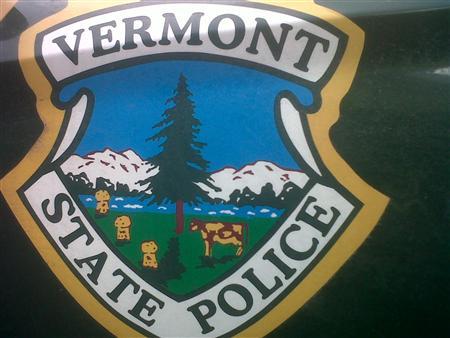
The Vermont State Police emblem is pictured in this undated handout photo received by Reuters on February 2, 2012 from the Vermont State Police.

Call it petulance, call it resistance, call it subversion, call it opportunism, call it what you want. I’ll call it damn funny.
Vermont prisoners modified the State’s official police insignia, sneaked an image of a pig into the design and saw it printed up on 30 police cruisers that patrolled the roads for a year.
That the amended design went unnoticed for so long is really the story for me. It was finally picked up by a trooper who was inspecting his car while out on the job.
PRISON LABOUR HAPPENS
I suppose the other startling aspect to this story is that it will alert many Americans to the fact that prisoners carry out jobs that we might not expect of an incarcerated class. Most might think it’s foolish to give prisoners even the opportunity to interfere with the emblems of law enforcement, but when it comes to the economics of prison labour, there’s a whole unique logic to be discovered.
I don’t think there’s a license plate in the country that isn’t pressed inside a prison. Each state usually has one prison workshop to punch those out. Prisoners make text books, boots, flags, mattresses, office chairs, floor stripper. They harvest collards and tomatoes, pick almonds and box eggs. In California, the huge Prison Industry Authority (PIA) distributes milk and even produces meat.
Low cost production of goods is practiced in the private as well as public prisons. Depressingly, the ever conniving business lobby-group ALEC have led the loosening of laws to secure cheap prison labor for private business.
May I recommend the article, The Hidden History of ALEC and Prison Labor as a good introduction to the problematic trend and philosophical shift away from rehabilitation and toward profit:
Although a wide variety of goods have long been produced by state and federal prisoners for the US government—license plates are the classic example, with more recent contracts including everything from guided missile parts to the solar panels powering government buildings—prison labor for the private sector was legally barred for years, to avoid unfair competition with private companies. But this has changed thanks to the American Legislative Exchange Council (ALEC), its Prison Industries Act, and a little-known federal program known as PIE (the Prison Industries Enhancement Certification Program). While much has been written about prison labor in the past several years, these forces, which have driven its expansion, remain largely unknown.
If you want to know more about the intersects of business and incarceration, I recommend the book Prison Profiteers, edited by Paul Wright and Tara Herivel.
More on the VT police emblems here. Thanks to Matthew Spencer for the tip.

Ava DuVernay took home the U.S. Directing Award gong in the Dramatic category at last nights Sundance Festival Awards.
DuVernay’s film Middle of Nowhere is about a happily married woman who then finds herself with an incarcerated husband. “[In film] we are used to seeing these visits, and the women leaving out the prison gate. The story returns to the men inside, but what happens to these women?” asks DuVernay.
 “The epidemic of incarceration really effects black and brown communities.” explains DuVernay, who’d seen the struggles in her own community.
From the Sundance website:
‘What happens when love takes you places you never thought you would go? When her husband, Derek, is sentenced to eight years in a California prison, Ruby drops out of medical school to maintain her marriage and focus on ensuring Derek’s survival in his violent new environment’
This is of course great news for Ava, but also great news for the public to whom Ava has given the chance to get inside the stories of millions. When a loved one is locked up, wives, girlfriends, children, husbands, partners and family members are constantly working their own paths through concurrent but very different types of “sentence.”
For me the most joyous thing about this win is that this is a prison movie that doesn’t centre on an action packed break-out, or an unlikely lifelong flicker of hope, or the violence of prison gangs as “the other”. It’s non-sensational and human. Bravo Ava!
INTERVIEW AND TRAILER
BIOGRAPHY
In addition to her latest feature film, Middle of Nowhere, Ava DuVernay’s directorial work includes the critically acclaimed dramatic feature I Will Follow, as well as the musical documentaries This Is the Life and My Mic Sounds Nice. The UCLA graduate is the founder of the African American Film Festival Releasing Movement, better known as AFFRM.
(Found via: AFRICA IS A COUNTRY)
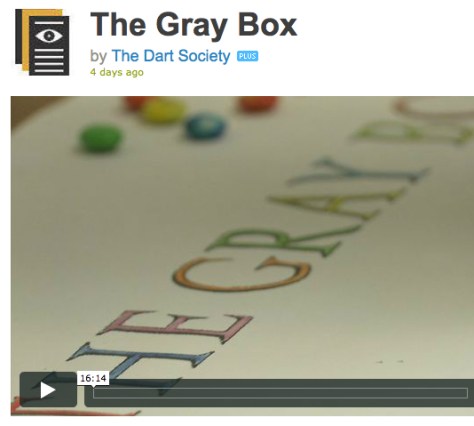
I feel I’ve tried and fallen short in elucidating the core of the matter as regards solitary confinement. When I watched The Gray Box, by freelance journalist Susan Greene and DAX Films, I knew it was something I had to share.
The Gray Box speaks as I never could; it has voices of experience. You’ll be awed by the psychological terror they describe and by the activities isolated prisoners employ to remain sane.
Of all the many battles at hand for prison reformers, it is felt that the campaign against the over-use of solitary confinement in American prisons is an issue that currently resonates enough with the public to effect some policy change.
The anti-Solitary bloc has simplified its message saying that solitary confinement does permanent damage to the mind of he or she imprisoned; a view backed up by medical science.
Publics are also more educated about isolation – and the manipulation/interrogation techniques associated with it – because Guantanamo prison has been regularly discussed in the media for over a decade.
Essentially, the knowledge that solitary destroys people is knowledge that anyone on the political spectrum can understand and oppose. From the hardcore secular ACLU to coalitions of churches, the voices in opposition to solitary confinement are wide and varied. Even so, we do still see some prisons such as Rikers Island which are bucking the trend and pushing for the to use of more solitary confinement.
Furthermore, the few actions of what we might refer to as prisoner resistance include calls to curtail the use of solitary confinement. (This is something Isaac Ontiveros covered when we discussed the California hunger strike).
Solitary confinement is not an issue I feel I’ve adequately discussed here on the blog. I’ve brought up it’s historical genesis; I’ve discussed isolation in and out of prisons; and I’ve referred you to stories about infamous U.S. prisoners such as Robert King and Leonard Peltier who served and are serving time in isolation.
Truly, if you want to know about the abusive use of solitary confinement in US prison’s follow James Ridgeway’s vital journalism at Solitary Watch.
Ridgeway, a voice you can rely on, says about the film and of Greene’s article The Gray Box: An Investigative Look at Solitary Confinement:
This is one of the most comprehensive articles ever written about solitary confinement in the United States, and is particularly noteworthy for including the voices of prisoners, obtained through correspondence with those buried in isolation. It is also passionate and personal.
JOURNALISTS
Susan Greene is a former-columnist at the Denver Post who often wrote about the widespread use of solitary in Colorado’s prisons and at the federal supermax, ADX Florence.
James Ridgeway was interviewed by the Dart Center and talked about the murky statistics and exchange of (mis)information about American prisoners in solitary.
Joseph Rodriguez alerted me to this film. Joseph’s own work Re-Entry in Los Angeles appears among the Spring 2012 Dart Society Reports.
The Dart Society Reports distributes journalism about trauma, violence and human rights.

DOC#: 312197
DOB: 11.25.1964
POB: North Kingston, RI
Sentence: 5 years
Work: Floor Worker
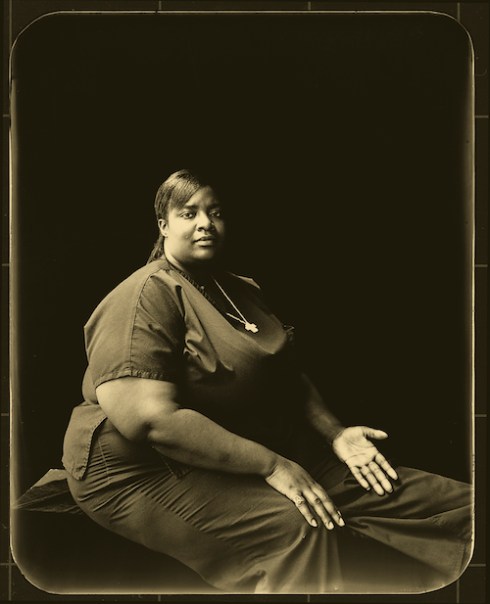
Pamela Winfield, Easter Bunny, Children’s Visiting Day, Louisiana Correctional Institute for Women, St. Gabriel, Louisiana. © Deborah Luster. Courtesy Jack Shainman Gallery.
ANNOUNCEMENT: CRUEL AND UNUSUAL
With a big lump of pride in my belly and knowledge of known unknowns, I am pleased to announce Cruel and Unusual, an exhibition of prison photography Hester Keijser and I are curating at Noorderlicht Gallery, Groningen, Holland.
Hester contacted me just before I set out on Prison Photography on the Road (PPOTR) and asked if I’d co-curate a show; she wanted to tap the prison photo landscape and tell Europeans about the mass-incarceration looming on the horizon should their governments repeat the bottom-line economics and unforgiving approach of American policy-makers.
Hester writes why she invited a curatorial novice like me to collaborate, here.
CURATORIAL DECISION MAKING
Just as I got out from behind the desk for PPOTR, to make in-person connections and audio recordings, so an exhibition is another new way for me to present photography of our hidden carceral spaces, and, in so doing, stoke the fires of the reform debates.
As you can imagine, we had scores of photographers from which to choose. Hester distilled some thoughts, guided me by the hand when necessary, and we plumped for eleven stellar photographers: Araminta de Clermont, Amy Elkins, Alyse Emdur, Christiane Feser, Jane Lindsay, Deborah Luster, Nathalie Mohadjer, Yana Payusova, Lizzie Sadin and Lori Waselchuk.

Anwar, from the series ‘Life After’ © Araminta de Clermont

Inmate volunteers at the Angola Prison Hospice massage a dying patients limbs. © Lori Waselchuk

From the series ‘Dungeon’. © Nathalie Mohadjer
The eleven photographers employ a variety of strategies in order to challenge prevailing stereotypes about crime and incarceration. Vernacular photography, found materials, alternative processes, painted photos, digital manipulations and straight black and white documentary will all be in evidence.
A TOUCH OF PPOTR
Alongside an orthodox(ish) presentation of the eleven main photographers, I wanted also to capture the chaos, interactions and visual excitement I saw in photographers’ studios, contact-sheets and home-towns while on the road.
Along one wall of the exhibition, we’re mounting a hectic presentation of work-prints, behind-the-scenes images and rough text culled from photographers archives. Photographers included are Scott Houston, Adam Shemper, Sye Williams, Jon Lowenstein, Joseph Rodriguez, Ara Oshagan, Jeff Barnet-Winsby, Lloyd Degrane, Harvey Finkle, Sean Kernan, Tim Gruber, Jenn Ackerman, and Steve Davis. Tim Matsui, Jack Jeffries and Frank McMains provide the b-roll.
This parlays nicely into the fact we’re producing a newspaper format catalogue … in a run of 3,000 copies!
The digital age has simultaneously brought about the decline of printed journalism and the rise of freelancers (bloggers) who publish their own content and worldview at will. Related, but not necessarily causal, we wanted to acknowledge these two trends and the disruption at hand.
Every which way I look at it, Cruel and Unusual is an experiment. It feels good to be trying something new and risking mistakes. Hopefully, our presentation does the subject matter justice.
DETAILS
‘Cruel and Unusual’
18 February – 1 April, 2012
Stichting Fotografie Noorderlicht
Akerkhof 12
9711 JB Groningen
Netherlands
Opening hours: Wed–Sun: 12–6pm
Admission: FREE
Telephone: +31 (0) 50 3182227
Email: info@noorderlicht.com
Opening reception: 17th February
Curators talk: 18th February

Installation shot, Gems, by Jane Lindsay. Bottle cap, resin.

 Prison Photography