
You are currently browsing the category archive for the ‘Visual Feeds’ category.
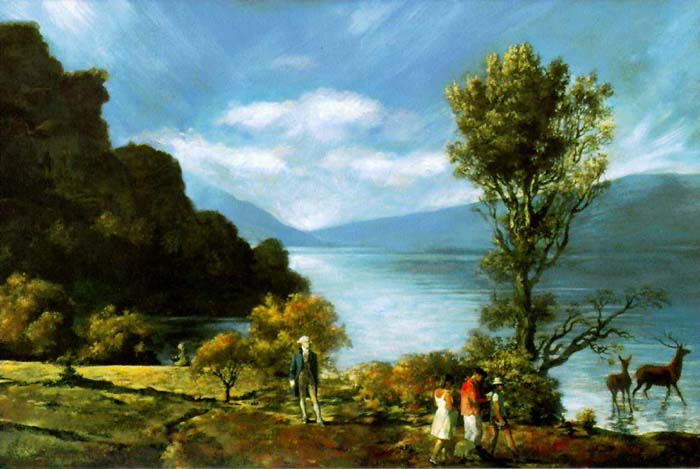
Komar & Melamid UNITED STATES: MOST WANTED PAINTING.
I am not asking here about photographs of America’s Most Wanted, I am asking quite literally about what photograph America most wants.
This question has virtually nothing to do with the most expensive photographs, as that list only tells us the dollars put behind one person or groups’ well-heeled want.
The question is not so ridiculous, nor should it be totally subjective. In 1994, Russian artists Komar and Melamid embarked via online survey to discover the appearance of the most and least wanted/desired paintings for people across different countries. George Washington chilling with three kids and a couple of wading deers (above) is – according to the science – America’s most wanted painting.
Komar and Melamid asked preferences toward colours, modern or traditional styles, old or new subjects, wild or domestic animals, natural or portrait, outdoor or indoor, realistic or different looking (if different whether exaggerations of real objects or imaginary objects were better).
They asked whether paintings should teach a lesson, relate to religion, be relaxing. They asked if paintings should be textured or flat, colors blended or separate, brush strokes or smooth paint, serious or festive, busy or simple, large or small. They asked if the painting should include geometric or random patterns. If the painting was of people should they be famous or ordinary, nude or clothed, working or at leisure, historic or recent figures, single people or groups.
Komar and Melamid asked for opinions on Picasso, Pollock, Dali, Monet, Rembrandt and Warhol. They also asked if they preferred black and white or colour.
[By the by, the letters about the survey are hilarious!]
If we were to do the same with photography on what criteria would we canvas response? As you think on that you may want to listen to America’s Most Wanted Song, as determined by a similar Komar and Melamid survey. If that doesn’t convince you about the wisdom of crowds then America’s Least Wanted Song will. We can, it seem, all agree on what is terrible!

I really would like to develop a list of criteria for defining what we want from a photograph:
B&W or colour; celebrity or ordinary people; pets or wild animals; square or rectangle shaped; people that look like you or people that look different to you; street or interior; with caption or no caption; candid or posed; family and friends or strangers; part of a story or single image; realism or abstract; In focus or blurry; historical or recent scenes; with or without border/sprocket holes; large objects or fine detail, obvious or hidden objects; visual pun or dry as a bone, film or digital, pixels or no pixels, starving or healthy environments?
Should a photograph be amusing, moralistic, quick to understand or engaging over time; deliver a message, educate, allow the viewer to escape, assist with dreams, show you things you know or things you don’t.
As for the touchstone photographs to gauge taste by? Opinions on the works of Steichen, Leibowitz, Apollo mission photographers, photobooths, Matthew Brady, school portraits, war photographers’ works, Joel Sternfeld, newspaper or magazine photographers, Gerhard Richter, Miroslav Tichy, porn videographers’ stills?
What would be – what is – America’s Most Wanted Photograph?
Below, for your viewing pleasure are the most wanted paintings of various other countries.
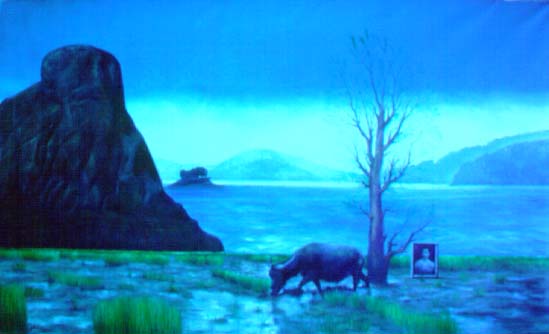
Komar & Melamid CHINA: MOST WANTED PAINTING
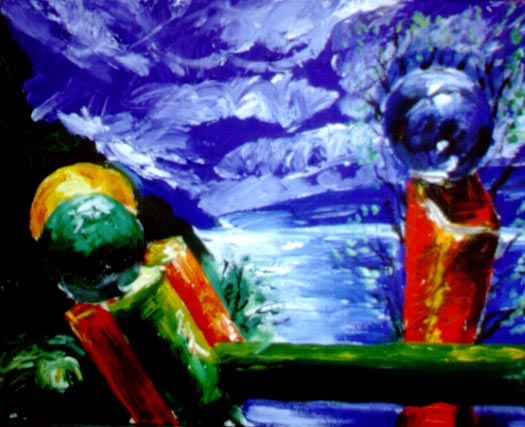
Komar & Melamid ITALY: MOST WANTED PAINTING
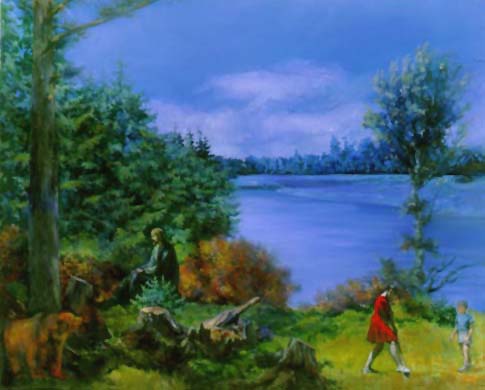
Komar & Melamid RUSSIA: MOST WANTED PAINTING
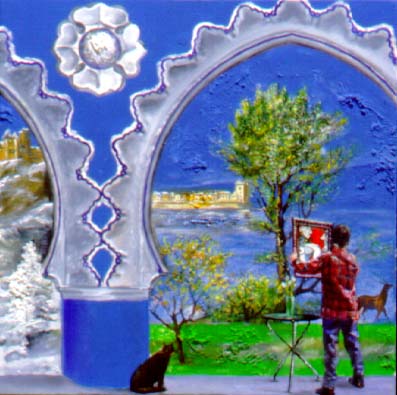
Komar & Melamid GERMANY: MOST WANTED PAINTING

Komar & Melamid FRANCE: MOST WANTED PAINTING
Painting by Numbers: Komar and Melamid’s Scientific Guide to Art, JoAnn Wypijewski (Editor) is available at all good thrift stores (and Amazon)
This time last year, I talked about the torture of Iraqis by the UK Army. The issue at hand then was specifically the death of Baha Mousa.
As part of court proceedings against the British Army into Mousa’s death, hundreds of films from the British interrogation centre in Basra have been released.
The Guardian has this report. [Warning: Content may be disturbing to some viewers.]
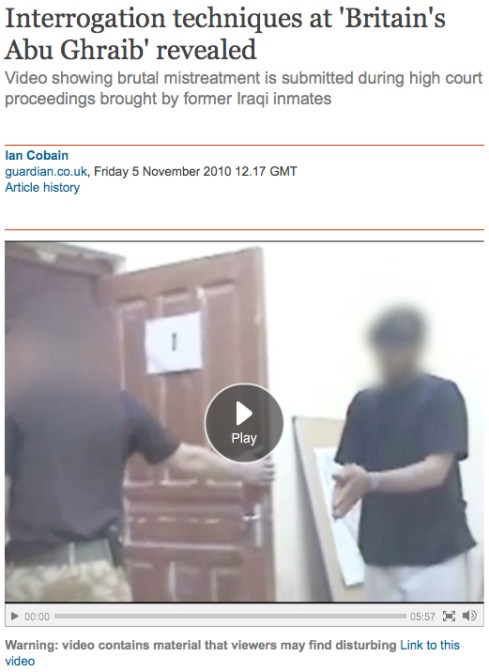
Only last week, I also noted the late to surface reports of US complicity in Iraqi upon Iraqi torture in Samarra.
It seems now we are starting to “see” a more varied picture of violence in Iraq. This is not the images of violence through the lenses of embedded journalists or through the sights of military aircraft, but images/footage of bullying; personalised verbal and physical abuse of men behind closed doors.
Without doubt, the most indelible images of the Iraq war are those from Abu Ghraib; they are the images the world remembers, will always remember.
Likewise, these videos of interrogation and of the uninhibited darker side of standard operations are key to understanding the facts of the Iraq War.
Also read: British troops use torture – even if it is by another name
The pile is my system. Sort and pile. Sort and pile. Until the piles have disappeared.
– Kristan Horton
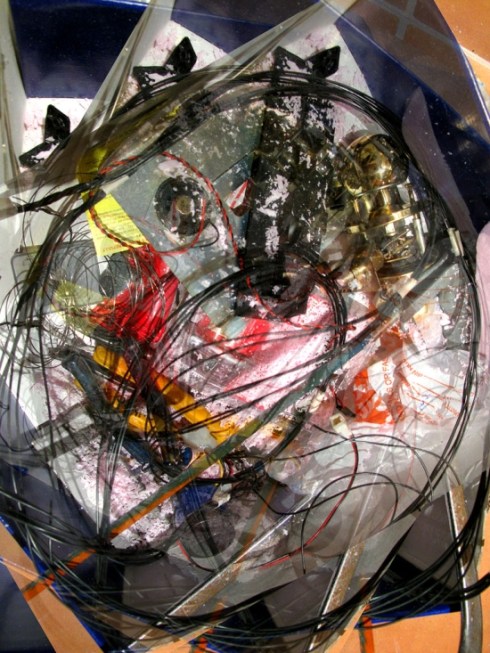
Orbit (doorknob), 2009. Digital colour photograph, Ed. 5. 134.5 x 101.5cm/ 53 x 40in. © Kristan Horton
Well, I guess this announcement saves me the review I was going to post … er, in a way. Kristan Horton has won the Grange Prize.
Earlier this week, I spent a couple of hours looking over the four shortlisted artists and watching the Grange Prize directed videos on youtube. I also had a listen to this slightly unsatisfying panel discussion among the artists.
Alongside Moyra Davey, Horton was my joint favourite. Josh Brand will make some important work with his photogram experiments but his time is yet to come. Leslie Hewitt‘s photography was not personal enough for me – her statements on history were far more expansive than Horton’s more personal musings about time. I think that subtle difference may endeared Horton to the voting public.
Oh, by the way, what should we think of a $50,000 prize for photography voted for entirely by the public?
Back to Horton. I dig his nervous energy, I dig the fact he’s not a “trained” photographer, and quite simply I like the composite-prints he has made of piles of stuff in his studio. I think they are nice objects.
What intrigued me about this prize was that the shortlisted artists were all gentle thinkers and their work was quite solitary. Maybe the humour in Horton’s sugar lump and popcorn models for Dr. Strangelove, Dr. Strangelove also swayed my preference?
All in all, the shortlisted works by the four artists were quite inaccessible required a lot of digestion (which, isn’t really a criticism). The videos and the audio also proved to me that sometimes artists are not the best people to speak about their work. They are so close they see and speak every nuance which can get in the way of immediate appreciation.
Sometimes objects can speak for themselves, which I think Horton’s do.

Tumbling competition, San Quentin Little Olympics Field Meet, 1930. Courtesy Anne T. Kent California Room Collection, Marin County Free Library
Earlier this morning I pointed out the riches of the Anne T. Kent California Room Collection, in the Marin County Free Library Archives. The San Quentin Little Olympics Field Meet 1930 Album deserves it own post.
Any sack race that has contestants cocooned up to their necks is a serious affair (image 2). Any tumble would hurt.
The tug-of-war (image 3) is fought on a remarkably complex purpose-built platform. It unfortunately looks like a rack.
I have no idea what narrative the parade (image 4) carries, but African American inmates donning hessian sacks painted to mimic “primitive” costume and carrying a whiter-than-whiter mustachioed swan-king is particularly discomforting.
Pole vault without a 60 inch crash-mat beneath the bar?
Lots to be said about cross-dressing and gender-bending in prisons, but not to be superimposed upon these 80 year old photographs. Two fascinating images.
And we just had Halloween. Who knew pie-eating contests (last image) produced zombies?
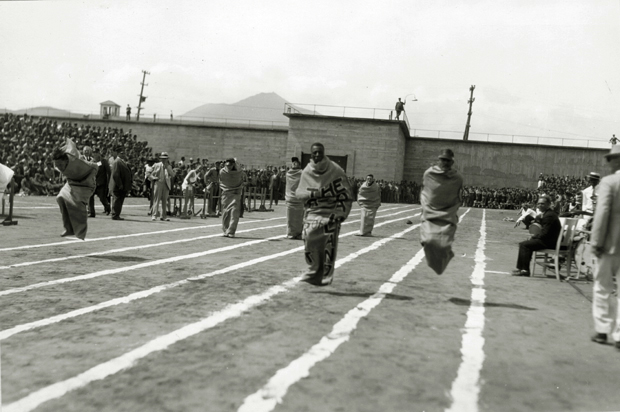
Sack race, San Quentin Little Olympics Field Meet, 1930. Anne T. Kent California Room Collection, Marin County Free Library.

Tug-of-war competition with officials looking on, San Quentin Little Olympics Field Meet, 1930. Courtesy Anne T. Kent California Room Collection, Marin County Free Library

Prisoners in costume parading at the San Quentin Little Olympics Field Meet, 1930. Courtesy Anne T. Kent California Room Collection, Marin County Free Library.
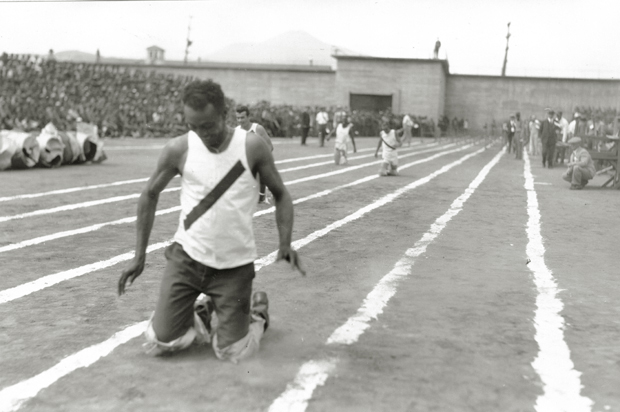
"Fifty-yard crawl" race, San Quentin Little Olympics Field Meet, 1930. Courtesy Anne T. Kent California Room Collection, Marin County Free Library.

High-jump competition, San Quentin Little Olympics Field Meet, 1930. Courtesy Anne T. Kent California Room Collection, Marin County Free Library.

Pole vault competition, San Quentin Little Olympics Field Meet, 1930. Courtesy Anne T. Kent California Room Collection, Marin County Free Library.

Long-jump competition, San Quentin Little Olympics Field Meet, 1930. Courtesy Anne T. Kent California Room Collection, Marin County Free Library.

Clown performance featuring a duck, San Quentin Little Olympics Field Meet, 1930. Courtesy Anne T. Kent California Room Collection, Marin County Free Library.
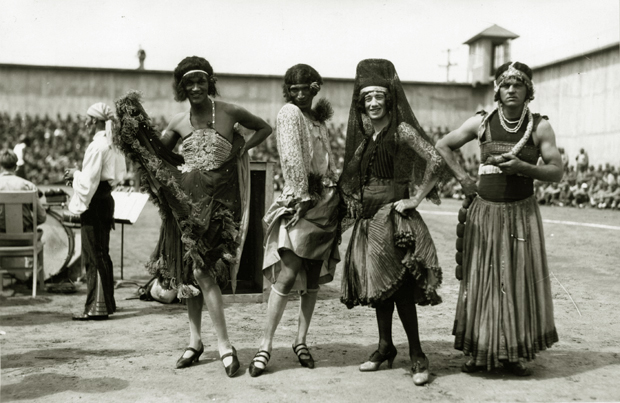
Stage entertainment with four male dancers in female dress, San Quentin Little Olympics Field Meet, 1930. Courtesy Anne T. Kent California Room Collection, Marin County Free Library.

Courtesy Anne T. Kent California Room Collection, Marin County Free Library.

Pie-eating contest showing three participants, San Quentin Little Olympics Field Meet, 1930. Courtesy Anne T. Kent California Room Collection, Marin County Free Library.
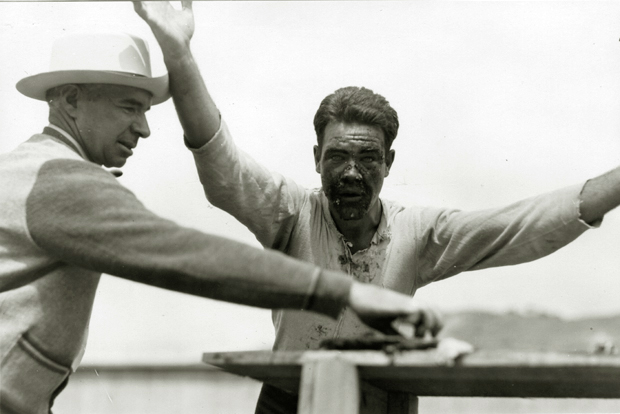
Pie-eating contest (close-up of one participant), San Quentin Little Olympics Field Meet, 1930. Courtesy Anne T. Kent California Room Collection, Marin County Free Library
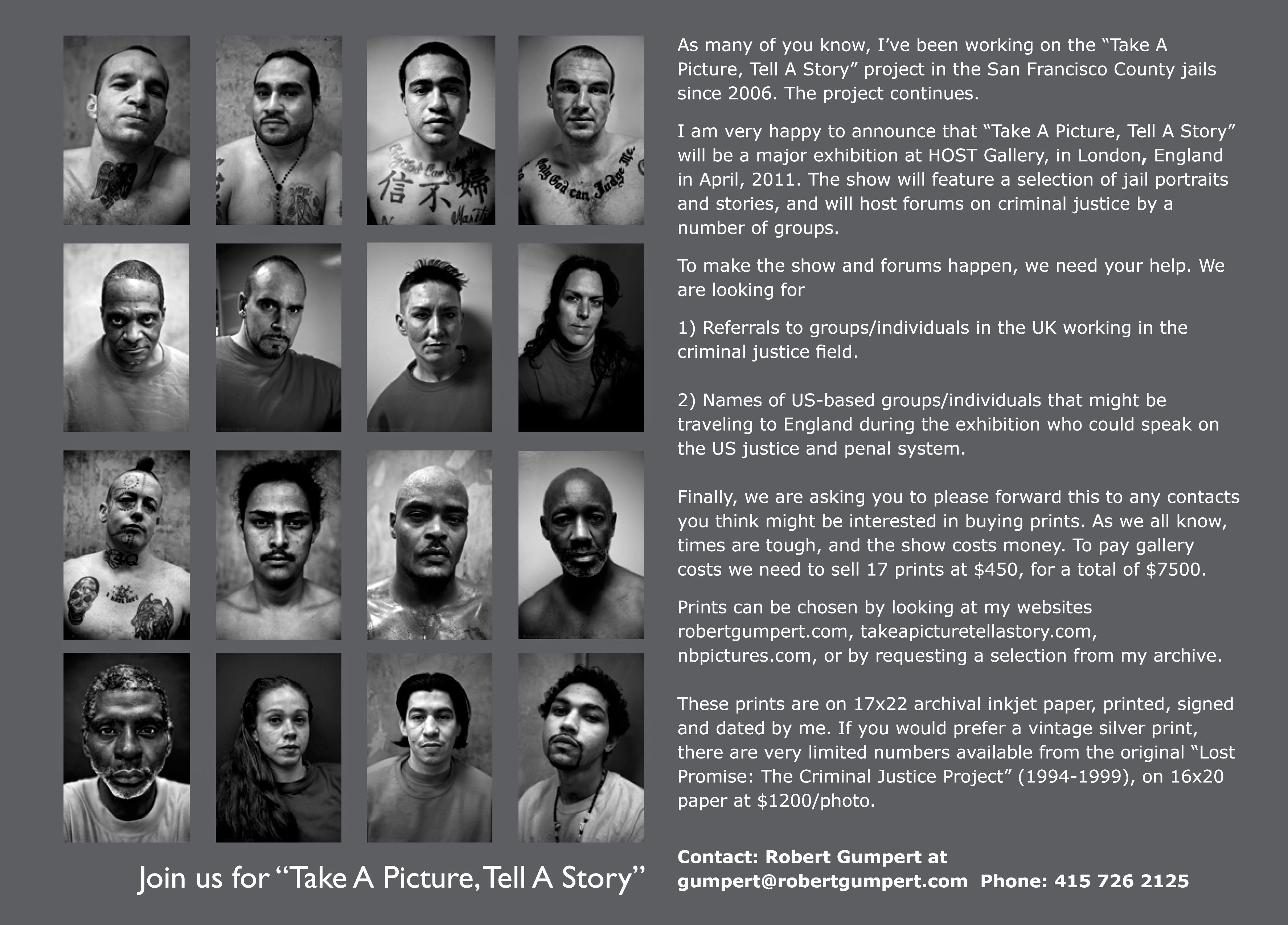
Good friend Bob Gumpert will be showing his portraiture from the San Francisco and San Bruno county jails at HOST gallery in London in April of next year.
From Bob’s email this week:
As many of you know I’ve been working since 2006 on the “Take A Picture, Tell A Story” project in the San Francisco County jails. The project continues. I go into the jails about three times a month and post to takeapicturetellastory.com as time and stories allow.
The show will host forums on criminal justice by a number of groups. To make the show and outreach happen we need your help with the following:
1) Referrals with groups/individuals in the UK working in the criminal justice field.
2) Names at US based groups/individuals that might be traveling to England during the exhibit who could speak on the US system.
3) Forwarding this note and flyer to your any of your contacts that might be able to help with contacts or might be able to help with funding by purchasing a print.
Obviously, I have a wild bias in seeing work such as Bob’s getting a wide audience.
Yet, photography from prisons/jails tests the theory that photography shows and delivers stories we otherwise would not see. Bob’s portraits and audio gives voice to the marginalised. Whatever the reasons for their incarceration, no one deserves to be made invisible. Bob’s work empowers his subjects and reveals the limitations of our criminal justice systems.
So, friends stateside and over there in Blighty, get your thinking caps on and see if you can help spread the word and find him some allies (and cash?)


Golf Five Zero watchtower. Crossmaglen, South Armagh, Northern Ireland, UK. © Jonathan Olley.
Last month, I had a jolly nice chat with a jolly nice chap about what all this means at Prison Photography. Where’s this open journal taking me?
I said if I took this whole thing to the academy, it could be as simple as a historic survey: The Uses of Photography to Represent, Control and Surveil Prison, Prisoners and Publics in the United States (1945 – 2010).
I was encouraged to ditch the historical view and engage the modern. Ask myself, why should anyone care about prisons? Only a small minority care now and that status quo has remained for many reasons tied up in the antagonisms of capitalism. Would a historical survey change minds and attitudes or just lay out on paper the distinctions most people have already made between themselves and those in prison?
Perhaps people would care more if the abuse of human rights that exists within the criminal justice system of America were shown to impinge on everyone, not only on those caught in its cogs?*
What if we consider the methods and philosophies of management used by prisons and identify where they overlap with management of citizens in the “free” society. Think corporate parks, protest policing, anti-photography laws, stop and search, street surveillance, wire taps, CCTV.
My contention has always been that there was no moral division or severance of social contract over and through prison walls. For me it’s never been us & them; it is us & others among us put in a particular institution we call prison.
But, now I am seeing also, there is an ever decreasing division of tactics either side of prison walls. Strategies of management and technologies of discipline perfected in prisons have crept into daily routine.
What has this emphasis on containment and of monitoring – at the expense of education and social justice – done to our society and to our expectations of society?
SURVEILLANCE/CCTV IN PHOTOGRAPHY
And now for the tie in with photography…
Thinking about surveillance, obviously we have the big show at Tate from this Summer, Exposed: Voyeurism, Surveillance & the Camera with its devoted section to CCTV. (Jonathan Olley‘s work from Northern Ireland is the standout.)
But I always think back to Tom Wichelow‘s series Whitehawk CCTV (1999), possibly because he insists it is not a criticism of CCTV just a look at the politicisation of the human subject viewed through its lens.
Most remarkable in the series is the trio of images of the tragic site of a murder. They reveal to us that looking and bearing witness can be an act of respect as much as that of curiosity as much as an act of control. We are all compelled to look, but some observers are recording the feed and have a disciplinary apparatus to back it up.

Untitled (CCTV footage). Young family visits murder site. Brighton 1999. © Tom Wichelow

Untitled. Friends of murdered boy visit the site. Brighton 1999. © Tom Wichelow

Untitled. Resident reveals murder site outside her bungalow window. Brighton 1999. © Tom Wichelow
– – –
*There’s a simple argument that we all suffer because our tax dollars support a broken system that makes us no safer.
I know the drill, Got cells to burn,
I’m dressed to kill, A mortal coil,
And time is still, On secret soil.
Yeah pay the bills, Cells to burn, Mouths to fill
On Boeing jets, In the sunset make glowing threats.
Yes shall we take a spin again in business,
This time is fixed lets sweeten our facilities,
It took all the man in me.
Lyrics from Massive Attack’s Atlas Air
The animated video for Massive Attack’s Atlas Air, directed by Edouard Salier is a tour de force.
Rampaging and amorphous, what can only be described as a Donnie Darkoesque were-bunny, rips it way through and across blackened territories of prismatic violence. Against and allied, it runs with commercial jets into explosions. Apparently, this is a second appearance for the satanic leporid; it previously romped around Massive Attack’s last video Splitting the Atom.
The randomness of it all, sometimes seen through a gun-sight, recalls the Wikileaks Apache Attack video. But other things are going on too – burning oil fields (the first Gulf War); shattering buildings (9/11); Prestwick airport gets a mention (not the most well known airport but it was the site of a botched car-bomb attack in 2007).
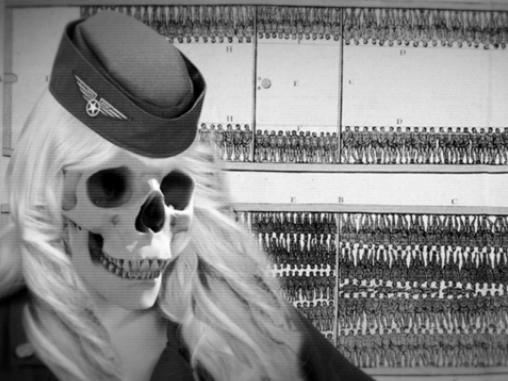
Ultimately, this is a video about extrajudicial rendition flights, the absence of law and the suspension of human rights. The screen grab above – which flashes by so quickly you’ll be forgiven for missing it – deals quite clearly with the involuntary movement of humans, only in this case that of slavery.
Just as the 9/11 plotters usurped commercial airliners for their ideology, the US military adopted commercial jets for its murky logistics. Salier doesn’t miss the opportunity to point out the hypocrisy in the visuals. 737’s get a mention in Atlas Air‘s lyrics.
Salier shows us the negation of order and, perversely, the power-distorted dominance and slick allure of disorder.
By strangling any reason out the compressed annihilation, the Atlas Air video is, for me, one of the finest visualisations of REAL terror. Massive Attack and Salier are not describing anything that relates to the rhetorical usage of the word ‘terror’ pushed on us by war-mongering politicians; they are dealing with pure destructive force as and when it is sent out against an equal force.
This is not a narrative of us against them or of us against them and their allies, or even us and our allies against them and their allies, it is about how fucked it all is … and about the terrifying, beyond-human-scale to which violence escalates. By relying on images of man made cities and theatres of war, Salier reminds us that these crushing vortexes are of our own creation and our own instigation.
I’ve admired Massive Attack’s intelligent use of video before.
*GWOT = Global War on Terror
Photographer Mohamed Bourouissa asked a friend – known only as JC – detained in a French prison to share the banality of his confinement via cell phones pictures and over 300 SMS messages.
Bourouissa’s exhibition ‘Temps Mort’ (‘Time Out’ or ‘Dead Time’) which closed at the Galerie Kamel Mennour today featured nine images and an 18 minute film montage of the correspondence.
Earlier this year, Algerian-born Bourouissa gained significant attention in the US with his show Périphéries at Yossi Milo Gallery which depicted the lives of youth in the depressed banlieue neighbourhoods on the outskirts of Paris. (Reviews here and here.) ‘Temps Mort’ confirms Bourouissa’s commitment to the underprivileged in French society.

JC and Bourouissa worked together over a period of 6 months. Initially Bourouissa had to instruct JC closely describing the shots he was looking for. Bourouissa broke down the boundary between the imprisoned JC and himself as a free man by filming repeated actions outside the walls on his own camera phone – at one point in the film the JC’s steps on a jail corridor blur into Bourouissa’s steps through snow in the free world. (I concede this blog post cannot come close to describing the mood of the finished video.)
For exhibition, nine pixelated images were blown-up; the degraded resolution mocking the Parisian preoccupations with Impressionism and Pointilism. As Bourouissa’s press release explains, images were hung adjacent to prison newspapers “reconstructing a comprehensive representation of the prison world, and mentally filling in the blanks of the images, the spaces between the bed pan, radio, barred window, lamp, etc.” The viewer sees the abnormality of confined life.
We should bear in mind that in 2008, Bourouissa and JC were working against a national debate in France about the appalling state of their prison system. Again from the Temps Mort press release, “How not to express our outrage at the French prisons? Their infamous exercise cages, their areas of lawlessness, their unhealthy showers and four rolls of toilet paper monthly.”

Gleaning available information from poorly translated sources (1A, 1B, 2A, 2B, 3A, 3B, 4A, 4B), I am still not sure how the images were secured. Reviews suggest that cell phones are banned within French prisons – which I would expect to be the case – so the feat seems even more remarkable. (I have detailed a short-lived case of cell phone photography behind UK bars.)
Whatever, first impressions may offer, Temps Mort is not a lazy presentation of “vernacudigi” photos. In many of his projects Bourouissa wants to “make the illegal legal”. Just as with Peripheries he gives over much of the creative process to his subjects. Many images for Peripheries were staged simulations of actual events experienced previously by the photographer and subjects. After a period, Bourouissa gave JC very little direction and their output synchronised. Alone the photographs would fall short, but Bourouissa always intended to pair them with the film.
Of course we should not miss the obvious here. Low-res imagery is associated with the spontaneous capture of event, with protest, with skirmish, with citizen documentation and more often than not with the testimony of the individual against the (violent) uncertainties of the State in which they exist.
Low-res is about the privilege of witness beyond any inherent privilege of existence. Romantically, low-res photography is thought of as a tool for use against dominate conglomerate forces; practically low-res photography is the evidence of the effects of those forces.
Bourouissa presents the incarcerated masses as the disenfranchised and the dispossessed.
MOHAMED BOUROUISSA
A student at le Fresnoy, Mohamed Bourouissa graduated from the National School of Decorative Arts and also holds a DEA (M.A.) in Plastic Arts from the Sorbonne (2004). He recently benefited from a solo exhibition at the Finnish Museum of Photography in Helsinki and has participated in numerous group exhibitions, most notably at the New Museum in New York. In 2010, the artist will show his work at the Berlin Biennial and at Manifesta. Born in Blida, Algeria, in 1978. Lives and works in Paris. Represented by gallery Les Filles du Calvaire, Paris / Brussels. (Source)

via Vingt

 Prison Photography