
You are currently browsing the category archive for the ‘Visual Feeds’ category.
PART ONE OF A SERIES OF POSTS DISCUSSING PHOTOGRAPHERS’ ACTIONS AND RESPONSES TO THE KILLING OF FABIENNE CHERISMA IN PORT-AU-PRINCE, HAITI ON THE 19TH JANUARY 2010.
“The question is not whether Fabienne will be remembered as a victim of the earthquake but whether, outside her family, she will be remembered at all.”
Rory Carroll, The Guardian, January 26th, 2010
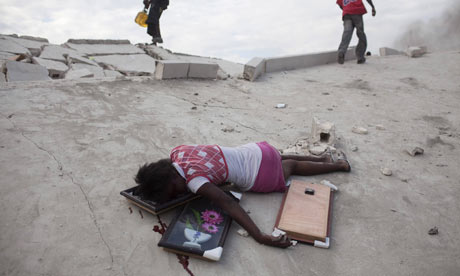
15-year-old Fabienne Cherisma lies dead after being shot in the head in Port-au-Prince. Photograph: Carlos Garcia Rawlins/Reuters.
Fifteen year-old Fabienne Cherisma was shot dead by police at approximately 4pm, January 19th, 2010.
On the 26th of January, the Guardian published an account of Fabienne’s life – her schooling, her sales acumen and her aspirations to be a nurse. The piece is not long, but it needn’t be. It is a modest effort – hopefully the first of a few – to remind us that Fabienne was a daughter, a sister, a source of love and pride for her family and, in the end, an innocent victim.
THE IMAGE THAT REMAINS, THE SYMBOL THAT EMERGES
There is a chance that Fabienne Cherisma could become a symbol of the Haitian earthquake and the problematic aftermath; that she become a tragic silhouette extending meaning far beyond the facts of her abrupt and unjust death.
This notion can be at once offensive and inevitable. If the visual rhetoric is going to play out as such, then if it is not Fabienne, it will be another victim.
What purpose could the emergence of a such a symbol serve?
Thus far Fabienne’s death is a story that has caught wide attention. It came without warning, it was unexpected. Her death – resulting not from nature’s violence but from human action – stands out from other deaths as a particular injustice; Fabienne’s killing is salt in the wounds. While tens of thousands lay obscured beneath rubble, she lay limp and exposed on a bare roof-top. The image itself is an affront.
If one believes that images fuel public awareness, thus securing donations and aid, and thus helping Haiti’s immediate future, then certain images and stories will carry that awareness and emotion.
All the accusations of media exploitation in Haiti do not discredit the positive effects a single image can – without any manipulation – have in the minds of millions. I wouldn’t call this the magic or the power of photography, I’d call it the mysterious perversion of photography. I don’t, and can’t, explain it. I merely observe it.
THE RESPONSIBLE USES OF PHOTOGRAPHY
Fears amongst those who care about media and its conduct hope that the focus can remain on Haiti and its long-term recovery. If the media deserts Haiti after a few short weeks then all accusations of disaster pornography will be upheld.
Photo-editors are now searching for the images that will maintain the humanitarian momentum on Hispanola. These images will be from committed photojournalists who stick around once press photographers have left.
It would be worthwhile to see and hear journalists’ reporting that follows up on the experiences of victims who may or may not have already appeared in coverage. I actually expect journos will follow up on the stories of the child born amid the rubble, the elderly woman rescued after 10 days and the man rescued after search and rescue was called off.
The Haitian recovery must be reported more than the initial chaos.
In the scenario of mass reproduction and circulation, the image of Fabienne’s dead body needn’t be one of mere exploitation. Nothing is so one-dimensional. Of course, this is very sensitive territory and above all the wishes of her family should prevail … in an ideal world.
That said, the history of photojournalism is replete with globally-recognised subjects whose visage was appropriated without their knowledge and/or consent. There’s no model release form in war and disaster.
Fabienne may become a symbol for the innocent victims of this disaster as Kim Phúc did for those in Vietnam. The politics of the two crises are a planet apart, but our modes of consumption are not.


Images are highly manipulable; Errol Morris asserts a caption will turn can turn the reading of a photograph 180 degrees.
The inconvenience of captions often results in the creation of symbol.
I don’t think it will be long before a symbol, a brand for Haitian plight, will rest upon a single image. Western thought demands a visual book-end to the visual dialogue.
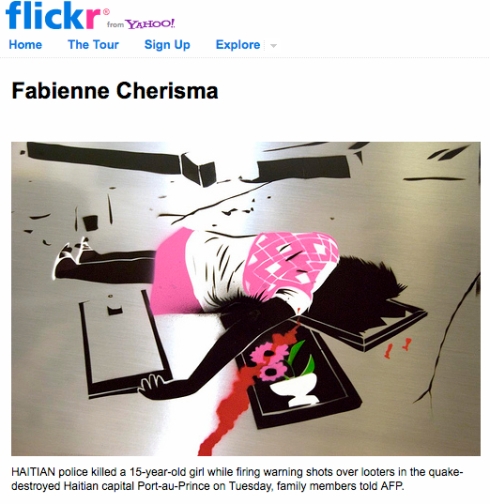
Pureevilbunny has already documented a graphic (in both senses of the word) stencil rendering of of Fabiennie’s corpse (artist not stated). The incongruous pink clothing, argyle sweater, flowers and blood are elements that shock.
THE PHOTOGRAPHIC EVIDENCES AVAILABLE
I do not want to prescribe a means of viewing images of Fabienne’s death. I am interested in informing the public about the photographers who witnessed and recorded the event.
The most widely circulated image is that atop this article by Carlos Garcia Rawlins and distributed by Reuters. It was used in the Daily Mail among others and in the Guardian’s original reporting of the killing:
Jan Grarup of Noor images was also present. Grarup’s dispatch for the 19th and 20th January contains 136 images, nine of which include Fabienne.
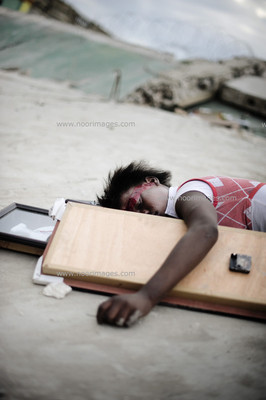
© Jan Grarup / Noor Images
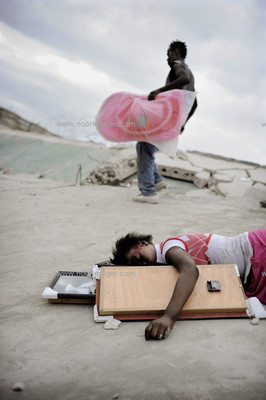
© Jan Grarup / Noor Images
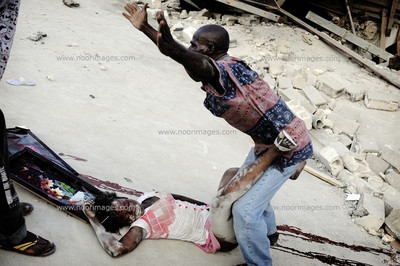
© Jan Grarup / Noor Images
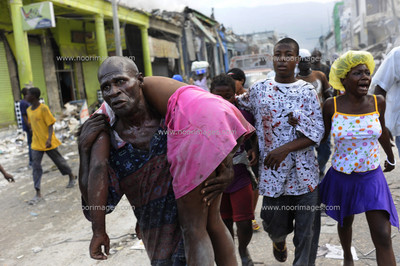
© Jan Grarup / Noor Images
Fabienne’s body is in a distinctly different position between the photographs of Garcia-Rawlins and Grarup:
© Carlos Garcia Rawlins/Reuters.
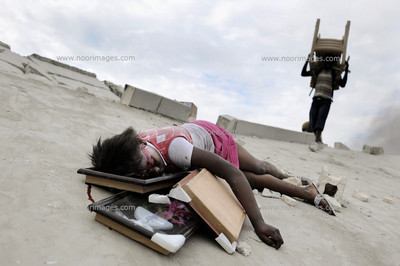
© Jan Grarup / Noor Images
Grarup was present at the scene before Garcia-Rawlins. Between their photographings, the framed pictures slid, Fabienne’s hips turned and her body rolled.
How much time was there between Fabienne’s slaying and the two photographers at the side of her body? How much time was there between the two of them photographing Fabienne? Were Grarup and Garcia-Rawlins on the roof at the same time? Did they see each other work?
Both photographers were obviously present before Osam, Fabienne’s father, carried her body away.
In the immediate aftermath, Grarup documented with a few frames a distraught Osam and family.
Olivier Laban Mattei continued documenting events. Laban Mattei’s dispatch of 28 images, is in fact only five images repeated.
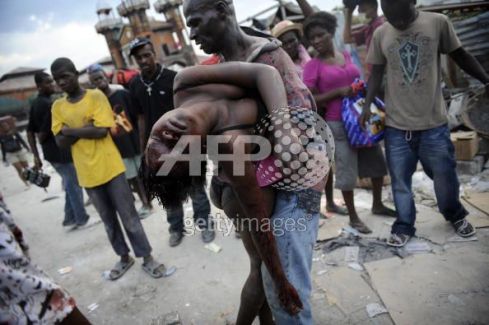
Osam Cherisma carries the body of his daughter Fabienne killed by a policeman during lootings in the Marthely Seiee street January 19, 2010 in Port-au-Prince. © Olivier Laban Mattei/AFP/Getty Images.
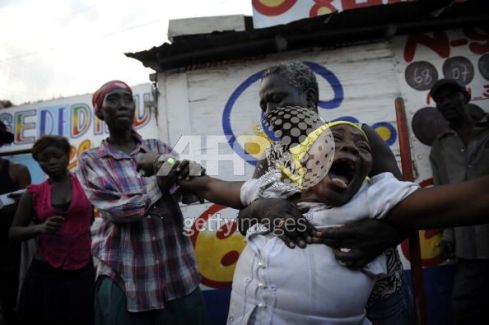
Armante Cherisma cries in front of the body of her daughter, Fabienne, 15 years old, killed by a policeman during lootings in the Marthely Seiee street January 19, 2010 in Port-au-Prince. © Olivier Laban Mattei/AFP/Getty Images.
Despite the amateurish piecing together of evidences, presented here is a basic timeline to Fabienne’s death. These images placed in sequence describe more fully her tragic death and take Fabienne’s memory beyond that (Garcia-Rawlins’) single image.
Fabienne was an innocent. Whether misdirected warning shots or deliberate targeting, her shooting was needless.
If Fabienne’s death does come to symbolise something larger, I hope it does so to benefit the survivors in Haiti; that the injustice brought upon her will only distill our resolve to avoid injustices to others.
If the shocking form of her body, face down in the broken frame, becomes symbolic it cannot be for reductive consumption, disaster cliche or political gain.
AFTER THE PHOTOGRAPHS
‘With morgues overflowing, and earthquake fatalities being bulldozed into mass graves, the Cherismas took their daughter’s body out of the city. With a borrowed $70 they rented a private bus, and drove for four hours to relatives in Zorange. They buried her in a Catholic ceremony and placed a white cross over the grave.’ (Source)
– – –
ALSO IN THE ‘PHOTOGRAPHING FABIENNE’ SERIES
Part Two: More on Fabienne Cherisma (Carlos Garcia Rawlins)
Part Three: Furthermore on Fabienne Cherisma (Michael Mullady)
Part Four: Yet more on Fabienne Cherisma (Linsmier, Nathan Weber)
Part Five: Interview with Edward Linsmier
Part Six: Interview with Jan Grarup
Part Seven: Interview with Paul Hansen
Part Eight: Interview with Michael Winiarski
Part Nine: Interview with Nathan Weber
Part Ten: Interview with James Oatway
Part Eleven: Interview with Nick Kozak
Part Twelve: Two Months On (Winiarski/Hansen)
Reporter Rory Carroll Clarifies Some Details
Part Fourteen: Interview with Alon Skuy
Part Fifteen: Conclusions

Magnum has produced a three minute In Motion piece on Haiti:
The multimedia piece as a whole is disappointing. It features the photographs of Abbas, Christopher Anderson, Eve Arnold, Jonas Bendiksen, Bruce Gilden, Cristina Garcia Rodero and Alex Webb – all incredible photographers, but bundled together they compete against (and detract from) one another.
Abbas’ silvery images of Hounsis, ladies dressed in white (2000) … mix with his images of Saut D’eau (2000) … mix with his images of the Pentecostal Protestants of Jacmel … mix with Gilden’s hard-flash from Plaine du Nord (1985) … mix with Gilden’s street photography in Port-au-Prince (1990 & 1994) … mix with Eve Arnold’s quiet compositions (1956) … mix with Christopher Anderson’s menace … mix with Jonas Bendiksen’s beautiful retreated studies of Haitians in agrarian landscapes and activities … mix with Rodero‘s image of the rituals of Soukri, photos of the Carnival at Jacmel and Souvenance …
The slideshow concludes with a vertiginous volley of portraits of Restavek child servants/slaves by Paolo Pellegrin (who strangely has no credit line).
It’s all too busy and without context and frankly does nothing to describe the country of Haiti. It is in some ways just a limp, late addition to the flurry of visuals we’ve been served these past eleven days.
Magnum would have been much better promoting the recent traveling exhibition Disposable People – Contemporary Global Slavery, and making ‘In Motion’ pieces for contributors Webb and Pellegrin.
ALEX WEBB INTERVIEW
Fototapeta‘s interview with Webb is well worth reading. He talks about the cultural differences between the US and countries of Central and Southern America (with repeated references to to Haiti); about open energy and discrete action; about shooting in colour and in B&W; and about reconciling photojournalism with an inevitable personal reaction.
Webb notes his ongoing balancing act,
“I always felt to some extent that I am out one fringe of Magnum, but I was brought into Magnum particularly by Charles Harbutt, and Charles was really oriented not towards traditional photojournalism at that point. I mean at that point Marc Riboud was doing a lot of rather traditional photojournalism. Charles was encouraging a much more personal kind of vision of the world, and that influenced me much more. I have taken elements of that, which is a very personal approach, but taken them into situations that people do not associate with a totally personal approach like going somewhere else, like Haiti, where political violence takes place, therefore it is photojournalism, but I am actually taking a very personal approach inside places like Haiti.”
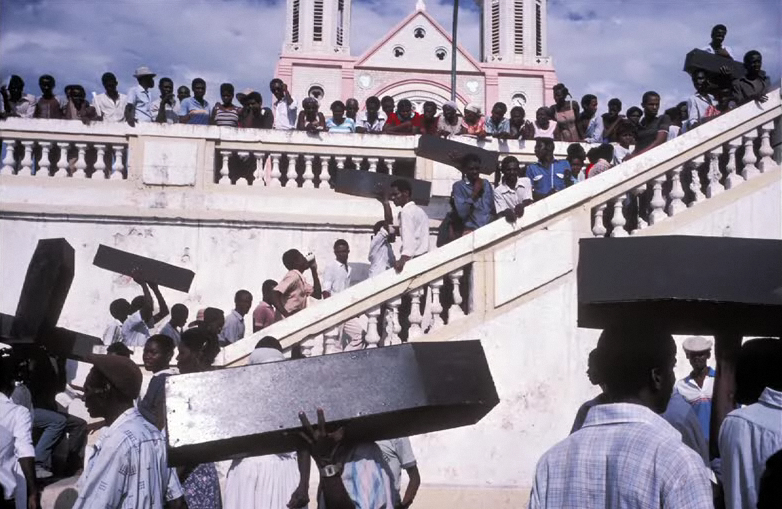
HAITI. Port-au-Prince. 1987. A memorial for victims of army violence. © Alex Webb
I picked out the image by Alex Webb (above) as my preferred image because, while it’s subject is death, it is – as a single image – actually about the bonds of a Haitian community and the composition of Webb’s craft. And they equalise one another perfectly.
I don’t wish to be misunderstood, Magnum: In Motion is a phenomenal service to the global photographic community. I can’t imagine a world nor web without it. The archive is a treasure. I guess when I believe a slideshow has fallen short I want to state it as such. I only criticise because I care.
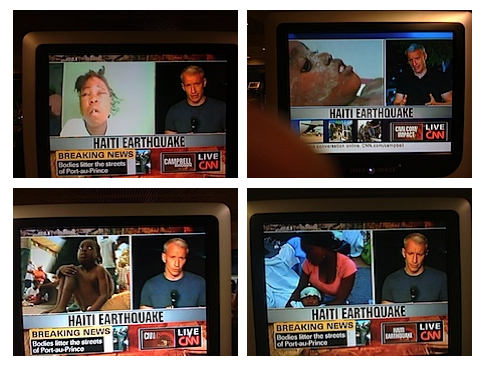
It one thing having foolish and clumsy media commentary of flash-in-the-pan (US) regional stories. It is another when CNN and Anderson Cooper use that same approach covering a humanitarian disaster.
As folk interested in media we should speak out when we see offensive framing and “reporting”.
Anderson Cooper’s bravado is only slightly more insulting than other major networks, but if we picket Cooper and his CNN editors maybe we’ll make a dent large enough that other major networks will also take note.
Michael Shaw just emailed this to concerned social media types. I am behind his sentiment:
I’m writing because I’ve just done a post at BAGnewsNotes that I think is extremely important.
It’s an appeal to readers to contact CNN, or tweet them (@andersoncooper @CNN – PLEASE STOP visually exploiting the Haitians! http://bit.ly/8R1DGc) about the way Anderson Cooper/CNN is visually exploiting the Haitians.
What Cooper has been doing is a complete affront, and it’s time we pushed back in a more systematic way. Haiti is going through a completely sub-human experience as it is, and the humanitarian effort, and dignity for its people, should absolutely extend to the media sphere.
Thanks so much for putting your eyes on this, and being part of the response.
Here’s hoping.

Matt and Scott at Dvafoto have made some important observations on the behaviour of the press in Haiti.
Dvafoto just got a redesign too, bringing all their commentaries of the past up to the surface again. Well worth swimming about in the visual archive for a while.

2Double (day dooblay), a 21 year old rap kreyol artist, records a track in the Koze Kreyol studio in Port au Prince, Haiti, on July 18th, 2008. The rapper has had some recent success and local recognition but continues to live in the notorious Cite Soliel slum with his mother and 3 year old son. He says he hopes to use his music to get his family to a better environment. © David Zentz/Aurora Photos
Just two weeks ago 100Eyes launched a new issue Gade, Haiti. Who at that time would have knwon that the world’s attention would sear down upon that previously abused, cliched far away nation?
Today Andy Levin put out the following call:
“Shoot for 100Eyes: Gade, Haiti!
The situation in Haiti has brought a tremendous many talented photographers to Haiti, with many more on the way. We would like to find a way to broaden the picture of Haiti that is currently in the news, by combining work with the disaster area with work from the rest of the nation.
If you are going to Haiti and will be there in February, I am asking photographers to spread out around the country and to spend day or two photographing something other than the earthquake ravaged area, to be included in a special issue of 100Eyes on Haiti.
I am hopeful that photographers can use the same resourcefulness in getting around Haiti as they have in getting to the disaster area … and I know that there are many stories to be told beyond what we are currently seeing, many struggles that happen on a daily basis. There is beauty, there is laughter as well.
We believe that the effort made by photographers in doing this would more than make up for the relative small resources going into the project, by helping to create a broader picture of Haitian life, and to put the horrific, and important, images that are currently being taken in Port au Prince in context.
As part of the project we will be having Haitian children and students take pictures to show the events through their own eyes, an effort that was planned before the tragedy. In addition we ask that each photographer try and bring a compact digital camera and find a Haitian child to work with in whatever area of the country that you are working in.
Depending on the amount of work received we may have needs for volunteer editors and coordinators as well. For those more interested in a structured environment I am going be extending the 100Eyes Workshop in Haiti through the end of the month and possibly beyond.
For details on this please contact me through our workshop page for Haiti, here.”
If I was a photographer I’d be anxiously looking for an avenue to broaden the media coverage away from only disaster consumption. This seems like the best opportunity; Structured, purposeful and community based.
We have seen the terrifying images, now let’s get past them to action. If you’ve got money give it, if you’ve got a camera get involved.
DAVID ZENTZ
I picked the image above out from the selection at 100 Eyes. David Zentz has done two series on Haiti, Saut D’eau and 2Double.
David’s work at Verve, 100Eyes and Aurora Photos. David also has a blog, Your Moment of Zentz.

Related to crime and tangentially to prisons, Colin Pantall has been examining the cult, mythologies and obfuscations at the point where visual media and female criminals cross. He does so over four posts.
Pantall summarises: In Media and Crime, Yvonne Jewkes identifies seven standard narratives to describe women who commit serious crimes:
• Sexuality and sexual deviance
• (Absence of) physical attractiveness
• Bad wives
• Bad mothers
• Mythical monsters
• Mad cows
• Evil manipulators
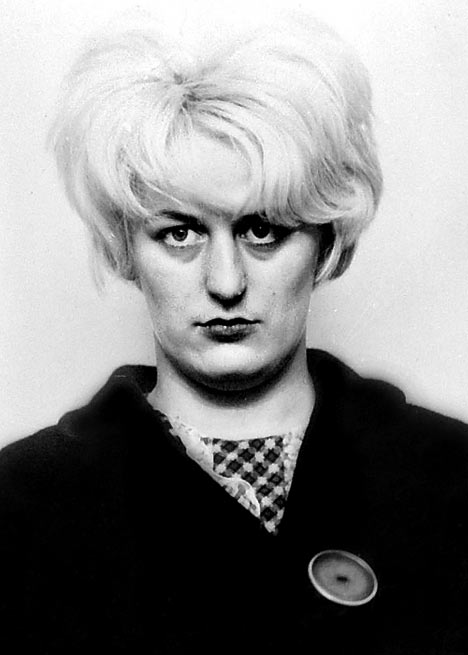
He takes on the common consumption of Myra Hindley’s mugshot:
“The world brought bored indifference to her mentor, the sadistic, fascistic Ian Brady. He was just another bad bloke.”
“It is a police photograph taken in maximum light in a dungeon. That stark, sinister expression could also be one of fright, the antithesis of the transgressive transcendence conceived by Brady.”
Pantall compares: the national disgust at a smirking bully with the forgiveness of the victims parents.
Finally, Pantall confesses he has no idea if Amanda Knox is guilty or not.

In his ‘Trial by Photography’ post he points out that she’s already been judged for not behaving – or looking – innocent in front of the cameras.
He closes, astutely noting, “A virtual reconstruction of the murder of Meredith Kercher was shown in court, with the screen fading to red at the end. Which puts everything about the trial into question.”
Now we know what the six jurors and two judges think. Did the visual aides used by the prosecution disproportionally affect Knox’s guilty verdict?

This post is a while overdue. As I am sure you know, Medecins Sans Frontier launched Condition: Critical this year. It is a website to bring together the many stories of victims of the war, assemble video and photo tools for activism and to leave messages of support. That’s right … no money, just a letter and awareness.
As part of the effort, my mate Ben has had his hand in the first four videos pushed out to the world. Ben’s summary of this conflict and humanitarian situation;
“Its the world’s deadliest conflict since the second world war and yet the majority of people have never heard of it. According to the IRC at least at least 5 million Congolese have died in more than a decade of conflict sparked off by the 1994 genocide in neighboring Rwanda. Most of the deaths are linked to a lack of medical facilities as the ability to access medical care in Eastern Congo has crumbled with the war.”
Ben’s team trained the comms people out in the field to gather stories and then they edited it to relay the stories in a powerful, respectful way. First hand tales and simple honest images. No gore, only testimony.
Drawing the War is the troubling tale of a boy carried away by opposition forces and set to work.

There are four videos from the MSF Condition Critical campaign on duckrabbit vimeo profile. The other three are Mishoka’s Story, Bahati’s Story, and Francoise’s Story.
So it seems that Ben has had some success in challenging and changing the public relations that non-profits and charities have to their global audience. Now all he, us and the people of Congo require it awareness, effort and mindshare.
Ben has asked us to do one or four of four things: 1. Leave a message of solidarity on the map; 2. Twitter about it and link to it on Facebook (for Twitter use #conditioncritical); 3. Embed one of the video’s on their blogs; 4. Write something about the project. Tewfic, Mark, Charlie, Mediastorm, Daniel and Boing have done their bit. Pass it along.
WHILE WE ARE ON MSF
I also recommend following the MSF Photoblog, managed by Bruno Decock (I think) as it endeavours (commendably) in public to deliver relevant balanced, effective, non-sensational and representative photographs of Africa. Not easy!
Photographers Dominic Nahr, Julie Remy, Martin Beaulieu, Robin Meldrum, Yasuyoshi Chiba and Cedric Gerbehaye have been involved in the collaborations with MSF for Condition Critical.
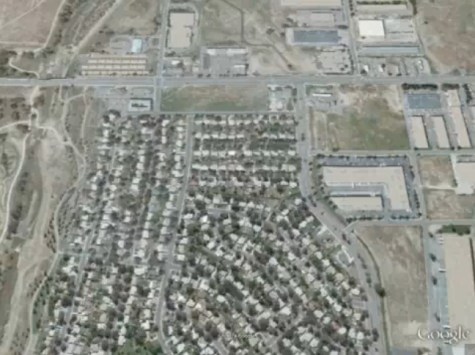
Aurora Detention Facility, Aurora, Colorado, Google Earth Screenshot
POSITIONING PRISONS IN SPACE AND IN OUR MINDS
One of the main stated goals of Prison Photography is to bring visual documents of prisons in America and abroad to a wider audience, so I was very excited to hear about Thousand Kites‘ newest initiative.
Incarceration Nation is a prison mapping and image bank that (un)earths the presence of prisons in our communities using Google Earth videos and user generated content. Our goal is to provide bloggers, researchers, activists, and interested citizens access to often suppressed images of the U.S. prison industrial complex.
Thousand Kites artist Nick Szuberla tells it as it is:
PRISONS AND ABANDONED INFRASTRUCTURES
Minutes after viewing the nations’ subdivided carceral systems lounging up against the nations’ desert mountains, rural towns and even sub-divided suburbs, I came across the BLDGBLOG analysis of California City:
In the desert 100 miles northeast of Los Angeles is a suburb abandoned in advance of itself—the unfinished extension of a place called California City. Visible from above now are a series of badly paved streets carved into the dust and gravel, like some peculiarly American response to the Nazca Lines.
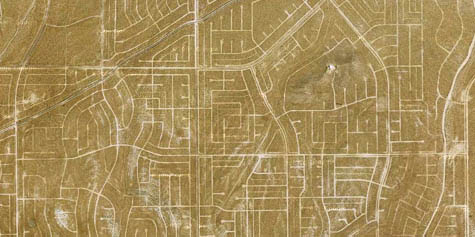
Geoglyphs of Nowhere
BLDGBLOG continues:
And it’s a weird geography: two of the most prominent nearby landmarks include a prison and an automobile test-driving facility run by Honda. There is also a visually spectacular boron mine to the southeast – it’s the largest open-pit mine in California, according to the Center for Land Use Interpretation – and an Air Force base.
The prison is the California City Correctional Center, a private prison run by Corrections Corporation of America (CCA) for federal authorities. If you want to buy shares in CCA and profit from the misery of and warehousing of human beings CCA operates on the stock market under CXW. But, please note: By investing in CCA you automatically qualify as the sperm of the devil and invite a dump-truck of shat-karma to your door and into your life.

The Geometry of Incarceration
Szuberla’s opinion that prisons are hidden is indisputable; prisons are willfully sited in remote locations. Policy provides prisons with predictable, constant, distant operating funds – even when local monies may dwindle.
PRISONS, ECONOMIES, FILM
Prisons, while occasionally a boon to local economic health, are always moral and morale parasites to their host towns.
Prison Town is a great film that follows the workers and residents of Susanville, CA. Initial apprehension, curiosity and hope for what prisons could bring to a suffering economy soon turn to realizations that the prison spurred mainly minimum wage jobs outside the institution and destroyed the will of those working inside.
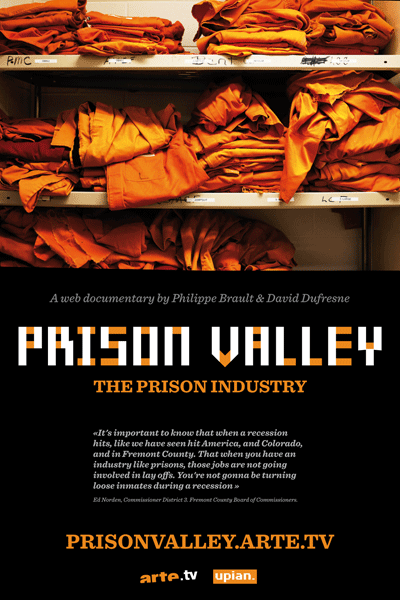
Prison Valley is a web-documentary in production right now by Frenchmen David Dufresne and Philippe Brault. It looks at Colorado’s prison towns during the recent recession.

 Prison Photography