
You are currently browsing the category archive for the ‘Words’ category.
Nicely said:
It was disheartening to read Justice Scalia, in his dissent, describe the case as one “whose proper outcome is so clearly indicated by tradition and common sense, that the decision ought to be shaped by the law, rather than vice versa.”
Justice Scalia’s respect for the requirements of the law apparently stops when convicted felons are the litigants. While he calls for common sense, he ignores the expert testimony, which led to the finding that prisoner release was necessary. He implies that 46,000 prisoners will be released en masse, and indiscriminately. At the time the opinion was issued, the prison population had already undergone a reduction of 9,000 inmates.
The reality is that the releases will not be en masse and the figure will be much lower. Relatively few prisoners serve their entire sentences due to the availability of good-time credits, which provide for reduction in the time served. The state has great discretion to select those inmates whose early release presents a minimal risk to public safety. Many of those prisoners who are serving time for technical parole violations will be diverted to community-based programs.
Justice Scalia also claims, without proof, that “Most of them will not be prisoners with medical conditions or severe mental illness; and many will undoubtedly be fine physical specimens who have developed intimidating muscles pumping iron in the prison gym.”
Justice Scalia ignores the reality that gyms have been used to house prisoners for many years, which is part of the problem brought on by overcrowding. Overcrowding and lockdowns compromise the immune systems of prisoners due to a lack of fresh air and exercise. The lack of sanitary conditions in these gyms exacerbates the spread of disease. Weights have not been available in California prisons for more than a decade.
While Justice Scalia’s criticism of the majority decision is trenchant and beautifully written, it is based on a false notion of the conditions in prison and blindness to the consequences of subjecting men to inhumane treatment for more than a decade. Justice Scalia ignores the sad reality that many of those who suffer from mental or physical disabilities lack the ability or means to bring complaints to federal court, especially given the difficult obstacles placed by Congress and the Court to prisoner lawsuits in recent years.
via zunguzungu

Photo Credit: Nina Berman
Recently, Bryan Formhals pleaded for photographers to write more; Joerg repeated the call.
Nina Berman, a very intelligent photographer, is also a fierce writer with undeviating message. On the 6th May, Berman wrote this:
“The Taliban stone women, we act outraged, spend billions trying to destroy them. And here in the land of the free? We dress girls up, shove shit in their mouths, make them plead for more, smile while they’re being tortured, gang bang them with multiple partners in multiple entry points, infect them, drug them, then dress them up with fake tits and travel them on the convention (prostitution) circuit. Annual US sales $10 billion. Worldwide porn industry sales are more than Apple, Google, Amazon and Microsoft combined.”
Paraphrasing the introduction to Domestic Slavery: The cold and stark photographs of ordinary-looking buildings in and around Paris by Raphael Dallaporta are combined with Ondine Millot’s texts to become chilling portraits of hidden agony. The texts describe what went on in these photographed buildings, confronting the viewer with stories of abuse and cruelty, forcing us to consider the idea that behind the façade of the ordinary can lie a discomforting reality. […] Domestic Slavery bears witness to the banality of everyday inhumanity.

Some of the stories in Domestic Slavery are harrowing, and in some cases not least because the abusers are women, or a collection of individuals from the same extended family. These are tales of evil made normal.
From Domestic Slavery:
“For four years Violette slept without a mattress on the tiled kitchen floor of an apartment in the 13th arrondissement in Paris. Her work timetable was carefully planned. In the morning, she got up at 4am to prepare breakfast for Sahondra, her employer, and her son; afterwards, she travelled into central Paris where, at 6am, she began work for a cleaning company run by Sahondra’s brother-in- law; at 10am she returned to Sahondra’s apartment where she did the housework and prepared lunch and dinner; at 4pm, she travelled to Massy-Palaiseau – about 20kms from Paris – where she cleaned the apartment of Mamy, Sahondra’s brother. When she returned to the 13th arrondissement around 10pm each day, there was more work: a pile of washing-up or ironing kept her busy until midnight, either at Sahondra’s or in her sister’s next-door apartment. For four years, during which time she was hardly fed, Violette worked 18 to 20 hours a day. She had left Madagascar aged 22 in the hope of earning enough money to feed her child, who she left behind. During the whole ordeal her four employers paid her nothing.”
“With the aid of the CCEM, the Committee Against Modern Slavery, she took her employers to court. Her case was heard in 1999 in Paris and it became the first-ever case of modern slavery dealt with in France under penal law. Her employers were ordered to pay Violette €22,900 in damages and interest; they were also fined and given suspended prison sentences.”
PHOTOGRAPHING SCENES OF UNLAWFUL ACTS
The type of sorrowful external view (long after the matter) employed by Dallaporta brought to mind Angela Strassheim‘s stake-out street shots of former crime-scenes for her series Evidence, of which I have written about previously. The two leave me feeling so differently however, I’d like to explore the reasons.
Both Dallaporta and Strassheim found their building-subjects due to information on public record following judicial process/trial. Neither photographer makes effort to show the architectures as extraordinary – because they are not. Yet, Dallaporta’s photography leaves me morose and confused about the human condition. I think it has something to do with closure – or lack of – in each of the projects.
Strassheim’s work leads the viewer through the crime. In the titles, she lists the weapons used. Strassheim shows us the traces of metals, that are traces of DNA, that are traces of blood, not only by being their but by using specialist forensic techniques. She literally reveals the marks of homicides.
Strassheim’s effort is two-fold in showing us the evidence but more crucially the conclusion of violence. It was bloody murder, but it was brief and it is over. Dallaporta’s works on the other hand don’t offer me an out. I am not mollified by the idea that this was a collection of one-off final acts. Often the buildings are only one of multiple sites of abuse.
I have no idea about the prevalence of domestic slavery in France, but I presume it is no different to other Western nations. If I need homicide figures I can find them, but if I want figures on illegal imprisonment and servitude I’m at a dead-end. Dallaporta’s work is an attack on our complacency.
In describing the bare details of each abuse, Dallaporta and Millot succeed in positioning domestic slavery as anywhere and everywhere; they present it as a national issue and as everyone’s problem. Domestic Slavery might just be the harshest indictment of absent community in our societies. Dallaporta’s work certainly plays on the unknown.
Inside of me, Domestic Slavery induces fear of the unknown. I can understand murder – it has been explained to me since I was a young child – but I do not understand modern slavery. Dallaporta’s work brings that to bear and, for me, that it is what makes Domestic Slavery so successful.
I received a perplexing email this week. It read:
Hi. I am xxxxx-xxxxxx from WebSponsors. My company represents a leader in online criminal justice degrees.
They would like to buy a simple text ad on the bottom of your page (https://prisonphotography.wordpress.com/2009/02/28/the-feedback-of-exile-interview-with-stephen-tourlentes/). It would look like…
“criminal justice” or “justice degrees” — with a link to our client’s site.
We can pay $84 via PayPal ASAP for this ad.
Please let me know if you are interested. Thanks for your time & consideration.
I politely declined.
I am alarmed by the rise of for-profit education in the US, and I am particularly offended by online education. Not being in a classroom with a teacher and peers denies the personal exchange of ideas which is, in my opinion, the most valuable aspect of education.
I’m doubly offended by the rise of (what some refer to as) “cop schools.” They feed the bloated prison industrial complex and do nothing to question the broken policies that created the obese, expensive and overly punitive systems.
Read this article from the New York Times:
The report,“Subprime Opportunity” (PDF) by the Education Trust, found that in 2008, only 22 percent of the first-time, full-time bachelor’s degree students at for-profit colleges over all graduate within six years, compared with 55 percent at public institutions and 65 percent at private nonprofit colleges.
Among Phoenix’s online students, only 5 percent graduated within six years, and at the campuses in Cleveland and Wichita, Kan., only 4 percent graduated within six years.
“For-profits proudly claim to be models of access in higher education because they willingly open their doors to disadvantaged, underprepared students.” said José L. Cruz, a vice president for the trust. “But we must ask the question, ‘Access to what?’ ”
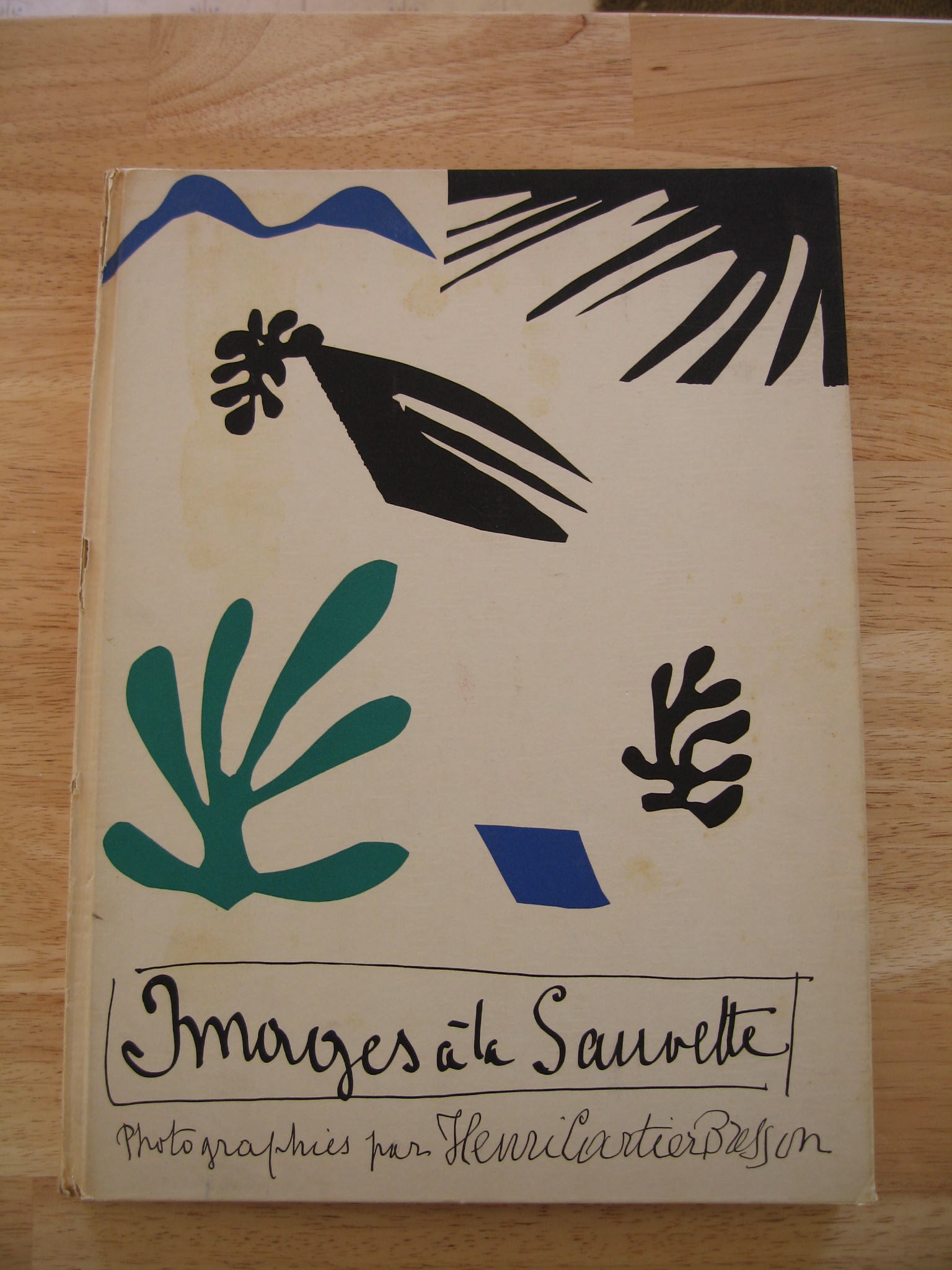
“Images à la Sauvette (The Decisive Moment) is a monograph of Cartier-Bresson’s best work, but it has overriding unifying factors that elevate it into a great photobook. The first is the concept of the ‘decisive moment’ itself, which defines the elegance of Cartier-Bresson’s imagery… No one achieved it more often or better, but allied with it was Cartier-Bresson’s thoroughly clear-eyed view of the world-astute, non-sentimental, beautiful, profound… Images à la Sauvette is one of the greatest of all photobooks”
Parr & Badger, The Photobook: A History, Vol. I, p.208

Last year, I mentioned the time I found one of the greatest photography monographs of all time in a bin full of donated books at Seattle’s Books to Prisoners program.
Well, now it’s up for sale on eBay. At $850 (or buy it now $1,300) it’s an absolute steal.
So, if you’ve got some spare change and fancy covering the postage on 400 packages of books to US prisoners, then pop on over and buy it.
Bryan Formhals has delivered some festive cheer for Raw File and I. Picked as one of his Top 15 Photography Websites of 2010.
We’ve still a long way to go in terms of consistent output, but Formhals is on the money about working with quality editors. Keith Axline has been a rock.
Formhals:
“Raw File exploded onto my radar when they brought in Pete Brook as a writer. It’s a perfect example of how a mainstream magazine can tap into the talent of someone who knows their way around the blogosphere. The posts aren’t as frequent as I would prefer, but they’re always carefully selected and well written. You can tell Pete is working with good editors who are helping him refine his message. As much as I believe in independent blogs, there’s no getting around the fact that great editing elevates content. I’ll address this in a future post, but I think you’ll see more mainstream publications tapping into the blogosphere to find talented bloggers to run their photography blogs.”
Bryan confesses the “link-bait” title to his piece, but his selection is in fact very thoughtful and though out. Each pick is a departure point for discussion on a specific emerging, dying or morphing aspect of photo talk, sharing and criticism on the web. A melange of choices. Check it out.

In the interests of disclosure, I listed Formhals in Raw File’s Favourite Photobloggers article.
Lots of lists of photobooks cropping up for different reasons.
PHONAR
To close out the remarkable efforts of Jonathan Worth’s experimental open-sourced, web-based, free Photography and Narrative (#PHONAR) course offered through Coventry University, the #PHONAR course closed with a bevvy of recommended readings.
The following photographers, writers, teachers and journalists made picks:
Alec Soth; Andy Adams; Cory Doctorow; Daniel Meadows; David Campbell; Edmund Clark; Fred Ritchin; Geoff Dyer; Gilles Peress; Grant Scott; Harry Hardie; Jeff Brouws; Joel Meyerowitz; John Edwin Mason; Jonathan Shaw; Jonathan Worth; Ken Schles; Larissa Leclair; Ludwig Haskins; Matt Johnston; Michael Hallett; Miki Johnson; Mikko Takkunen; Nathalie Belayche; Peter Dench; Pete Brook; Sean O’Hagan; Simon Roberts; Stephen Mayes; Steve Pyke; Todd Hido
As a contributor, I picked out three titles. Predictably, each dealt with photography in sites of incarceration:

Too Much Time – Jane Evelyn Atwood


Chris Verene‘s Family was a later addition.

It was a privilege to be asked to guest lecture on this pioneering educational model. Thanks to Jonathan, Matt Johnston @mjohnstonmedia (Chief Engineer) and students for their encouragement and engagement.
WAYNE FORD
The #PHONAR list was spurred by Wayne Ford’s Photobooks and Narrative list.
JOHN EDWIN MASON
Following the #PHONAR list, contributor John Edwin Mason extended his selections. Mason’s Photobooks and Narrative: My (Slightly Flawed) Phonar List has an African and African American emphasis.
ALEC SOTH
Tonight, Soth put forward his Top 10+ Photobooks of 2010. As ever, Soth is thorough, thoughtful and generous in response.
JEFF LADD
Jeff at 5B4 has picked out his 15 choices for Best Books of 2010. The comments section is lively and I don’t think being to conceptual (as Jeff is accused of) is a problem, even if it were a fair allegation.
SEAN O’HAGAN
Sean at the Guardian has selected 2010’s best photography books that you should put in someones stocking.
NIALL MCDIARMID
Niall has put together his Photobooks and Magazines of the Year.
Verily, never will Allah change the condition of a people until they change it themselves with their own soul.
– Qur’an 13:11 or 8:53

Abdel Ameen, Halfway House. Richmond, Virginia. © Bryan Shih
Bryan Shih has produced an essay on prison reentry services for Muslims.
Shih says:
“Transitioning out of prison back into society is difficult for anyone, but the scarcity of Islamic centered re-entry resources often adds to the obstacles confronting prison converts to Islam. […] A lot of the people I photograph are from groups and communities that are on the margins, and that does something to their psychology.”
From a quick squint at Shih’s portfolio, Prison Converts to Islam, it is obvious he has traveled widely and photographed in San Quentin Prison, California as well as in Richmond, Virginia (above). Possibly in other states too.
I have very rarely spoken about Islam in US prisons, mainly because it is not a subject I know a lot about. But that is changing.
Recently, in discussion with New York based documentary photographer Jolie Stahl (about an altogether different project of hers from the mid-80s), Stahl took the opportunity to tell me about her photographs for the book Black Pilgrimage to Islam.
Stahl is married to the author, Robert Dannin, former editorial director of Magnum Photos, and professor of history at Suffolk University, Boston Massachusetts.
The book deals with all aspects of the Islamic experience in America and necessarily covers the increase in Islamic worship within US prisons among predominantly African American populations. Figures used for Dannin’s book indicate an increase in the numbers of self-identified Muslims in New York prison facilities between 1989 and 1992 (1989 in parentheses): Sullivan Prison, 84 (112); Green Haven Prison, 348 (286); Auburn Prison, 310 (234); Attica Prison, 388 (327); Wende Prison, 125 (74); and Eastern Prison, 175 (135).
Fortunately for us, chapter seven of Dannin’s book which is devoted to prison Islam is available online, as part of the digitised version of Making Muslim Space (Barbara Daly Metcalf (ed.), 1996, UC Press).
Dannin suggests that the body-focused discipline of Islam provides fortitude despite the stark, oppressive prison environment:
“If one tries to extend the Foucauldian idea of the prison as a simulacrum of the medieval monastery, there is a realization that something has changed, because this architecture conducive to introspection and Christian rebirth has increasingly become a place of mosques and communal prayers. The predictable monastic effect has been achieved, but somewhere its content has been subverted. […] Islam’s popularity in the prison system rests in part on the way in which qur’anically prescribed activities structure an alternative social space that enables the prisoner to reside, as it were, in another place within the same confining walls.
This same logic explains the rampant success of prison yoga initiatives. [1], [2], [3]

Door to Masjid Sankore at Green Haven Correctional Facility, N.Y. © Jolie Stahl.
New York State was the progenitor for much of today’s prison-based Islamic worship. Dannin writes:
“Following the Attica riot, DOCS designated Green Haven, the scene of similarly explosive tensions, a “program facility,” where emphasis was placed on learning and rehabilitation as opposed to punishment. College courses, vocational training, substance-abuse programs, work release, and family-reunion visits resulted directly from a negotiation of inmate demands and the actions of newly appointed liberal administrators. Muslims were situated at the center of these activities …”
The community and equanimity fostered by Islam echoed the social justice priorities of the Black Panther movement. Swiftly, the Masjid Sankore at Green Haven “achieved its reputation as the most important center for Islamic da‘wa in America”. Dannin traces the understandable transition of locked down minorities from political revolutionaries to religious observers.
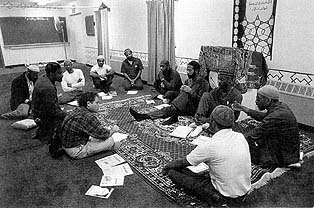
The Majlis ash-Shura, or high council, of Masjid Sankore at Green Haven Correctional Facility, N.Y., with author Bob Dannin (center left), 1988. © Jolie Stahl

Friday prayers at Masjid Sankore, Green Haven Correctional Facility, N.Y. © Jolie Stahl.


 Prison Photography