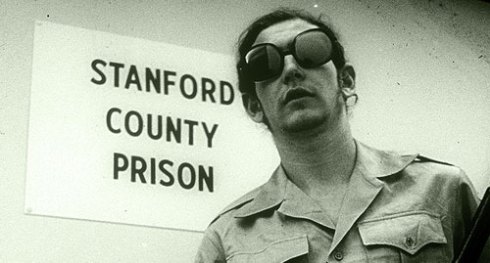
39 years ago today, Philip Zimbardo and his psychology students embarked on The Stanford Prison Experiment and demonstrated that we are all capable of psychological and physical violence upon other humans in conducive institutional environments.

The fabricated prison in the basement of the Stanford University Psychology Department became grim reality when the volunteers – randomly selected as either ‘prisoners’ or ‘guards’ – played out their parts with authoritarian abuse and complete submission, respectively.

The experiment was abandoned after six days. It was intended to last two weeks.

Everything you could ever want to know about the original experiment and its legacy can be found here.

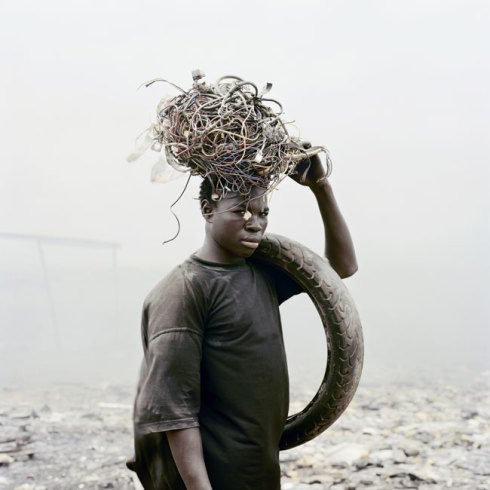
Yakubu Al Hasan, Agbogbloshie Market, Accra, Ghana 2009

Yakubu Al Hasan, Agbogbloshie Market, Accra, Ghana 2009

Pieter Hugo’s series Permanent Error appeared in last weeks New York Magazine under the title A Global Graveyard for Dead Computers in Ghana.

The style is not too distant from Nollywood or The Hyena & Other Men, the former of which dusted up a small (and in my opinion, unnecessary) brouhaha last year about neo-colonialism/exploitation in photography.

Hugo’s case, in this instance, is not helped by the fact that the NY Times magazine piece is purely a gallery with no journalist  elaborations, save the captions.

The merits and shortcomings of Hugo’s photographic approach is only half the issue; our denial of the extent of racial and economic inequality colours our response.

Hugo graduated in 1994. In this interview (which I think I came across amongst James’ youtube feast) Hugo gives an interesting perspective on how his work fits historically in the South African tradition.

“The photography in South Africa comes from a very political background. Pre-1994, it was an extreme situation here. And if one had the skill you had a certain responsibility to inform the world what was happening here. It was very much all black and white. This is wrong and this is right. There are good guys and there are bad guys.

That’s all changed now. Guys that were good are now bad and the lines aren’t as distinct as they were. […] Things are more complex […] One of the things I hope people get when they look at my pictures is that things are complex.”

This still might not excuse an aesthetic that aggressively depicts African subjects as “the other”, but then, what split second act of opening the shutter is not a machine-mediated differentiation between user and subject?

AFTER THOUGHT

The overtly-political nature of South African (photojournalism) photography is something David Goldblatt, as an art-documentarian, had to negotiate himself away from. And yet, as Fred Ritchin remarks, “during Goldblatt’s career, which began in the early 1960s, nearly everything that he saw was contextualized by the distorting prism of apartheid.”

This makes me wonder if there’s been an adequate survey of ‘South African photography from the second half of the 20th century’ toured on an international stage. If there has been, please let me know.

Between April and now, right under everybody’s noses, Visura Magazine only went and interviewed about over a dozen of the really important folk in photography. Here’s a few:

Interview: Jessica Ingram
Interview: Michael Itkoff
Interview: Mark Murrmann (Mother Jones)
Interview: Claire O’Neill (NPR Picture Show)
Interview: Nathalie Herschdorfer (Curator, Musée de l’Elysée): reGeneration project
Interview: Brian Storm (MediaStorm)
Interview: James Estrin & Josh Haner (NY Times Lens Blog)
Interview: David Alan Harvey (Burn Magazine)
Interview: Nelson Ramírez de Arellano (Curator, Fototeca de Cuba)
Interview: Jon Levy (FOTO8)
Interview: Ricardo Viera (Curator, LUAG)
Interview: Idurre Alonso (Curator, MoLAA)

And in plain sight of everyone, Gerald Holubowicz went long-from and interviewed on film some of the sharpest minds and forward thinkers in the industry (Sharpness is a must to mastermind the diversification and survival of leading collectives such as VII and Magnum.)

Gerald’s interview series “Sortir du Cadre” (Think outside the box) has so far quizzed

Interview: Stephen Mayes (Director of VII)
Interview: Mark Lubell (Managing Director of Magnum)
Interview: Paul Melcher (Cofounder and Senior Vice President of PictureGroup)
Interview: Jean Pierre Pappis (Founder of Polaris Images)

– – –

First class efforts from Gerald and from Adriana Teresa and Lauren Schneidermann at Visura

Over the next few weeks, posts at Prison Photography may thin out a little as I devote a chunk of energies to a new gig at Wired’s photography blog, Raw File. For the following reasons, this is an exciting new departure for me:

– I can call on the expertise of a knowledgeable and calm editor (when I pitch ideas, he says “home run” or “leave it alone”)
– I can piggyback on the back of some ridiculous stats (I guess that’s just Wired for you?!)
– Readers of Raw File have a many more reasons to stop there than they do here (ie, they’re not only tangentially interested in prison reform or in the past somehow stumbled upon my photography commentaries) … and they are harsh critics.

So far I’ve looked at:

– Laura Pannack’s recent work and success – Striking Teenage Portraits Boost Young Photog’s Career
– The alternatives to the Norsigian/Ansel Adams saga – Troves, Caches and Suitcases: Famous Lost Photographs Discovered
– and a Southern California Rapid Transit Employee of the Month Portrait Archive – Fabulous Bus Driver Photos Show Off Mustaches, Sunglasses

TWEETS

My tweeting activity shall also migrate from @brookpete to @rawfileblog. Please follow and spread the word on this newly-active-stretches-every-morning twitter account.

La Fenice, Venice, Italy, 2008.

La Fenice, Venice, Italy, 2008. © David Leventi

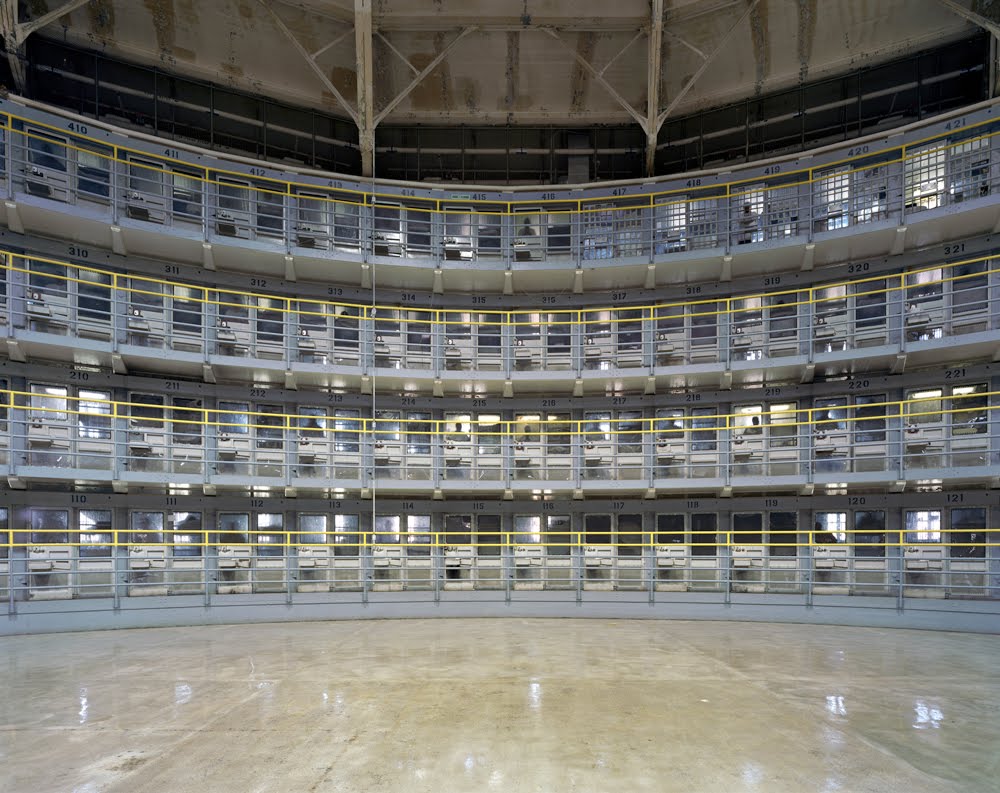
I first saw one of David Leventi‘s Opera House prints at Exposed, the 2009 Critical Mass Top 50 exhibition at the PCNW, Seattle in March this year. To be honest, I struggled to access it. I am grateful therefore, for his interview with Sarina Finkelstein in which Leventi outlines his motivations and emotional response to these architectures. Toward the end, Leventi discusses his recent interest and move toward roundhouse prisons as subjects – and how they compare to opera houses:

“[Stateville Correctional Center, Joliet, IL] happens to be a reverse opera house. It has basically the same architectural structure as an opera house, but the difference is in who is observing who. In an opera house, the audience of many is observing a few. In a jail, it’s the reverse, giving me the opportunity as a photographer to better understand what it must feel like to be a tenor performing for a full house, albeit with a captive audience.”

Prisoners in their cells, Stateville Correctional Center, Joliet, IL, 2010. © David Leventi

Leventi adds, “I have always had stage fright. Photographing from the center of a round prison is pure anxiety. The in-mates are all yelling, jeering, talking, in cacophony. You become the center of attention and taking the photograph becomes a performance in itself.  At first, I was really intimidated, but then I blanked everything out and focused on photographing. It must be the same for the performer.”

Leventi adds that in the case of both opera houses and prisons, access is the most difficult aspect of his work. No surprise there!

All interesting stuff. I’ll be eager to see his continued progress on this subject matter. Roundhouse prisons are a rarity these days; Bentham’s Panopticon is more likely to crop up in discourses on philosophy than it is in those of criminology or correctional management.

Leventi’s images of opera houses and Stateville prison are reminiscent of some of Richard Ross’ photographs from Architecture of Authority. And, likewise, Leventi plans to look at churches and religious buildings, presumably drawing more parallels between these complete spaces.

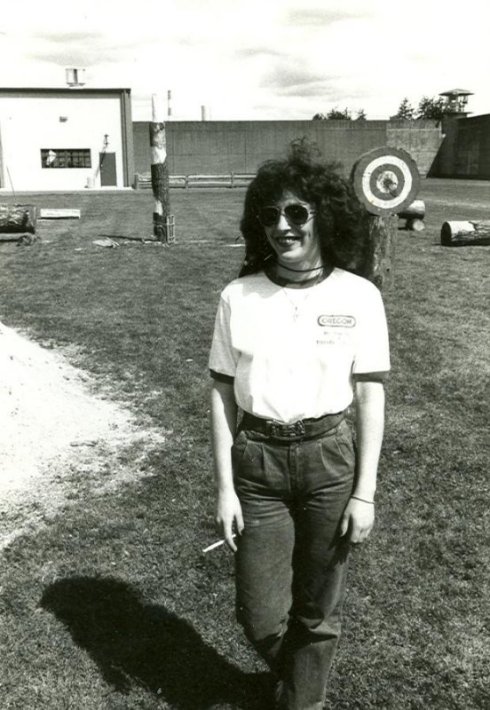
Cutting a chair and stool. © Gary Walrath. Taken with Pentax ME super.

Cutting a chair and stool. © Gary Walrath. Taken with Pentax ME super.

Two years ago, I found Gary Walrath‘s set of photos from a 1970s Logging Show at Oregon State Prison. They are so unique they don’t really fit into any recognisable discussion … still.

I have also repeatedly tried to contact Gary about the background to the series. No luck. So, I simply provide a couple of images, a link and some bemusement at the spectacle of axes and chainsaws within prison walls.

Gary is a busy amateur photographer and a seven times chainsaw World Champion, in the Un-limited Hotsaw Class. His weapon? The Iron Horse.

‘The Iron Horse – 90 hp 500cc Husqvarna Motorcycle Engine. Running Oregon 1/2 pitch chain on a 36″ custom made guide bar. The drive sprocket is 16 tooth. Over 8,000 RPM in the cut.’ (Source)

Ronda (she drove the prisoners nuts). © Gary Walrath. Taken with Pentax ME super.

Ronda (she drove the prisoners nuts). © Gary Walrath. Taken with Pentax ME super.

California State Prison, Corcoran. 2006, ink and pencil on paper, 52 x 156 inches.

California State Prison, Corcoran. 2006, ink and pencil on paper, 52 x 156 inches.

Not a photographer, but an illustrator.

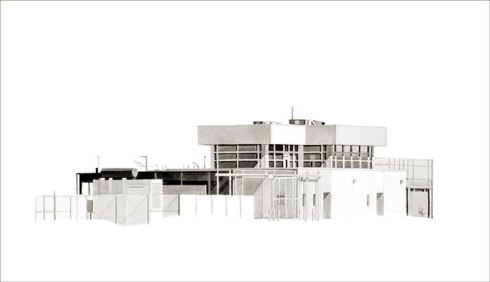
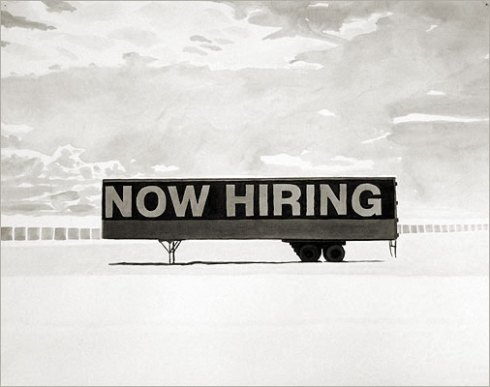
Within Buddy Bunting‘s Panorama series are five West Coast prison facilities. Prisons pop up in other series such as High Living too.

Bunting, like Sandow Birk and Alex Donis before him uses canny illustration to rifle home the banality of (secure) structures and signs in the mundane US hinterlands. Bunting’s grayscale world is one of malls, excavated hillsides, prisons and abandonment.

These subjects are old and familiar to American artists; artists who have attempted to reconcile their art with the psychology of deserts, gas stations and limitless geographies.

Bunting’s work is brooding, but most disturbingly it stakes out an invisible truth – that being, that post-industrial activities in dislocated rural areas are of sinister and charged ideological purpose.

The celebrated colour photography of Shore, Sternfeld and Eggleston is laconic, seductive and – admittedly – sometimes jarring, but never is it so critical or detached as Bunting’s work. Regarding detachment and the artist’s distance, the claim here that sketching has pushed out the great photographers may seem ludicrous and yet that is how I read Bunting’s very intelligent work.

READ & LISTEN

Jen Graves, the art critic for Seattle’s The Stranger (the best free newspaper in America) wrote this article and conducted this audio interview. Well worth your time!

Oregon Gatehouse (its yellow mimicked the shade of rock looming behind as a train went through)  2008, ink and pencil on paper, 30 x 52 in

Oregon Gatehouse (its yellow mimicked the shade of rock looming behind as a train went through). 2008, ink and pencil on paper, 30 x 52 inches.

Walmart Distribution Center. 2008, ink and pencil on paper, 20 x 26 inches.

I came across Julie Adnan‘s Born in Jail series at Bite Magazine. I wanted to know more about the women and of the social backdrop of criminal justice within Northern Iraq. I was happy that Adnan could answer a few questions.

This woman was imprisoned on 8 Feb. 2009. The child was born in prison; he is 6 months old. She, an Arab from Mosul, was arrested for prostitution. At the time of the photograph, she had been imprisoned for 18 months. © Julie Adnan

This woman was imprisoned on 8 Feb. 2009. The child was born in prison; he is 6 months old. She, an Arab from Mosul, was arrested for prostitution. At the time of the photograph, she had been imprisoned for 18 months. © Julie Adnan

CONVERSATION

Why did you choose this subject?
I choose this subject because there are many children in the prison without having committed any criminal offence; there only because they’re children of those who may (or may not) have done something wrong. Nobody thinks about what the children will remember when they grow up.

What prison is this?
This is the Arbil prison for women, in the city of Arbil (also written Erbil or Irbil or Arbela) in Kurdistan of Iraq.

How long were you on assignment?
It took a long time to gain permission from the government, but after [getting permission] I took the photographs in two different visits over two weeks.

This child was born in prison. He is 8 months old. His mother was imprisoned on 29 Jan. 2009, sentenced to a year in prison for illegal sex with another person. She is from Arbil. © Julie Adnan

This child was born in prison. He is 8 months old. His mother was imprisoned on 29 Jan. 2009, sentenced to a year in prison for illegal sex with another person. She is from Erbil. © Julie Adnan

What were the reactions of staff, women and children to your photography?
The children thought it was game and they loved it, but the women was so afraid of the camera and of the photographs. As you can see, they do not want their faces to appear.

Did the families ever see or receive prints?
Unfortunately, I did not send any photos to them and I do not know if they’ve seen the photographs anywhere.

Do you plan to return to this subject or any other stories within prisons?
Yes, but not with photography. I want to document their letters to their families in a booklet.

Five of the eight women are in prison for prostitution. What sort of sentence does that carry?
It depends on their crime. It could range from a few months to five years.

Is there ever a notion that a prostitute might be a victim?
Because Islamic law rules prostitution as a crime, the government and other people can not say anything about them. Prostitution is something in the culture they cannot accept, however we have some people now who allow [make accommodations] for them but they cannot really change or do anything.

One lady was imprisoned for sex outside of marriage. Is a prison sentence common for such a transgression?
Within traditions here, a woman’s family may kill her for that [sex outside of management]. Sometimes, a woman’s stay in the prison is necessary as a secure place or a shelter.

This female gypsy was sentenced to 15 months in prison for robbery. She would like her daughter be with her in prison. Her daughter was 1 year, 8 months old at the time of the portrait. © Julie Adnan

This female gypsy was sentenced to 15 months in prison for robbery. She prefers her daughter to be with her in prison. Her daughter was 1 year, 8 months old at the time of the portrait. © Julie Adnan

MORE READING

Julie Adnan maintains a Lightstalker profile and a Flickr photostream. Her work has been featured at Greater Middle East Photo (a blog I highly recommend).

This article, Life in a Womens’ Shelter, Erbil perhaps more than any other relates the dangers for women should they compromise their families “honour”. It talks about shelters and prisons as being alternative institutions to family homes which – in extreme cases – can harbour the real threat of murder.

BIOGRAPHY

Adnan, from Kirkuk in Iraq, is a 25 year old freelance photographer, and currently a student at the art academy of Sulemanyah University in Iraq. Adnan has worked for a number of agencies newspapers and websites including The New York Times, Reuters, National Geographic, Al-Sharql Awsat, The Washington Post, Jordan Times, Taw photography magazine, Kakh magazine, Kurdistani New, Aso newspaper, Institute for War and Peace Reporting (IWPR), Driknews agency, World News Network, BBC World Website, IO Donna magazine of Italy and L’Express of France.

EMAIL

prisonphotography [at] gmail [dot] com

Prison Photography Archives

Post Categories