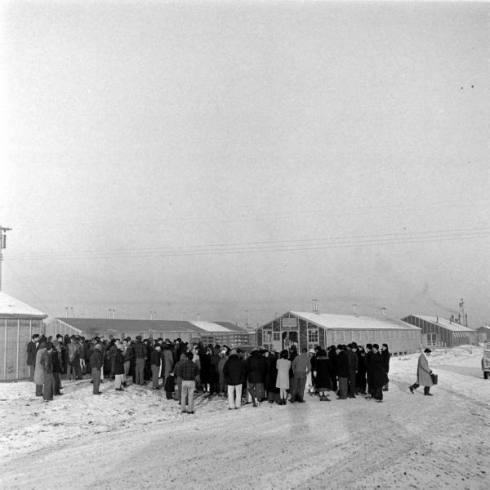
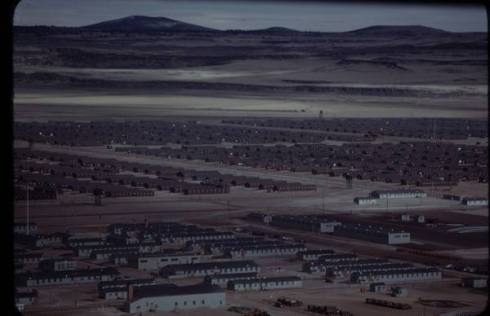
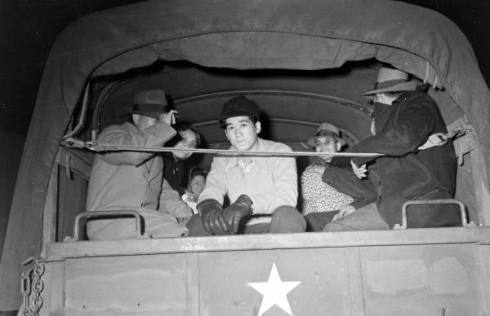
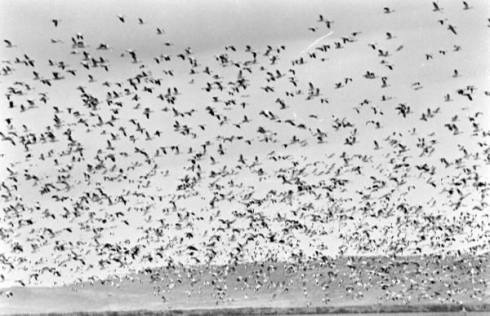
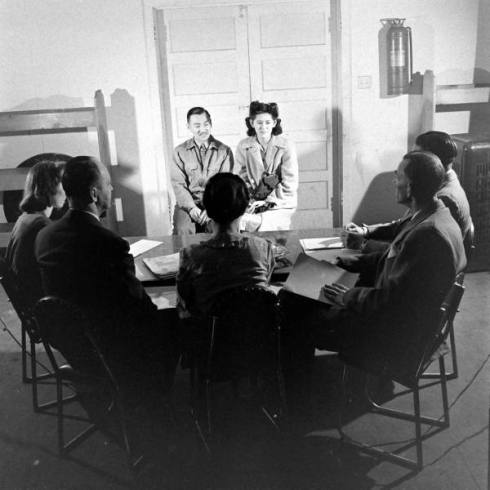
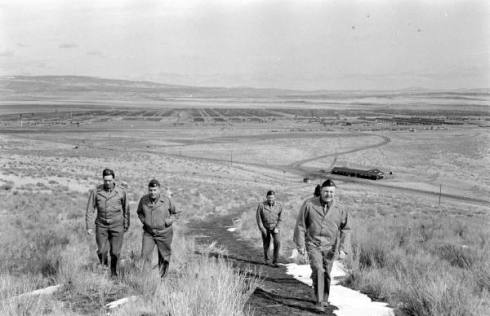
A couple of weeks ago I posted four Library of Congress photographs (attributed to Russell Lee) of Tule Lake internment camp .

In follow up, I encourage you to check out the 200+ images of Tule Lake by Carl Mydans on the Google/LIFE archive. Mydans took these for a LIFE Magazine feature in 1944. [More down the page]

I am especially drawn to the photographs in which Mydans’ presence cannot be ignored – a blinding flash,or fixed stare. Are some of Mydans prints are attempts to be poetic? The scenarios for other prints seem invasive. [More, scroll down]

Mydans’ success was his portraits; his reportage of the interactions between internees and authorities appear to be staged. Maybe pictures were staged, or maybe authorities just fidgeted in front of the camera?


– – – – –

For more about Japanese-American Internment during WWII, refer to the Densho archive of video-recorded oral testimony paired with images and documents of the time. It is the most thorough archive I know of.

– – – – –

Found via International Center for Photography, FANS IN A FLASHBULB blog:

http://fansinaflashbulb.wordpress.com/2010/05/29/tule-lake-internment-camp/

Photographer Unknown

Billy Baque‘s Cuban Polaroid describes a camera’s self-contained process:

“A wooden box with the bellows and lens from a folding camera mounted at one end with a complete darkroom inside. Using photographic printing paper the photographer would expose a sheet of paper for the negative, develop, stop, and fix it inside the camera, then put a copy stand on the camera and photograph the negative (to obtain a positive), develop, stop, and fix, then wash the final print in a coffee can of water attached to his homemade tripod.”

Baque, then provides a global visual tour of street photographers using (often for official purposes) DIY cameras.

UPDATE

Joe Van Cleave commented at Baque’s site with a volley of links about photographers work in India and Bangladesh.

Mark Dummett (photographs and words) reported on Bangladeshi photographer Safder Ali. Ali’s been running his passport-sized photography business with an antique box camera by the side of a busy street in Dhaka since 1952.

View Dummett’s BBC slideshow

© Mark Dummett

– – – –

Found via Make Magzaine

Joerg has predicted this’ll be all over the photobioblogosphere, so I’ll oblige.

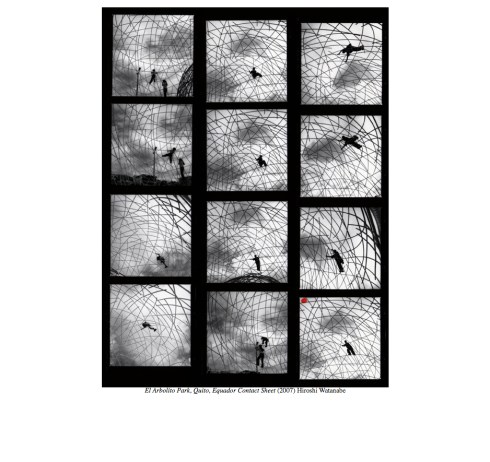
PROOF at the Edelman Gallery exhibits well known photographs with their original contact sheets.

Do I actually like the show or have I been instantly suckered by a seductive concept? I actually like the show; PROOF demystifies some of the lore about famous photography. We need to talk more about photography within the context of its manufacture.

My favourite? Hirshi Watanabe.

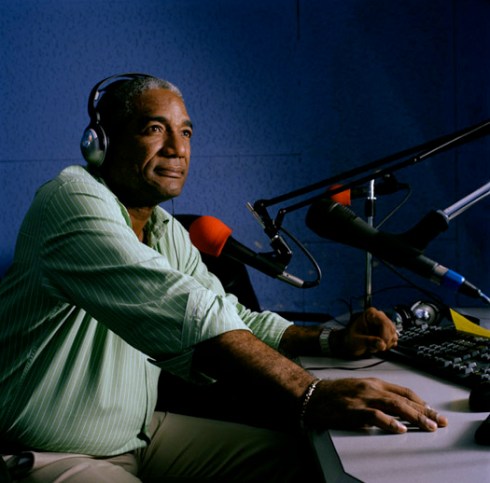
Two weeks ago, I participated in an OPEN-i webinar about Haiti imagery. Louis Quail, another of the panelists, committed eight days to photographing Haitians during the month of May.

I wanted to present Quail’s work here as his photographs are products of a quieter, more engaged process than a lot of the photojournalism created in the earthquake’s immediate aftermath.

The Haiti webinar is not posted yet, but a growing archive of OPEN-i webinars is available at its Vimeo channel.

From Boing Boing:

Physicians for Human Rights (PHR) today released evidence it says indicates that the Bush administration conducted “illegal and unethical human experimentation and research” on detainees’ response to torture while in CIA custody after 9/11. The group says such illegal activity would violate the Nuremburg Code, and could open the door to prosecutions. Their report is based on publicly available documents, and explores the participation of medical professionals in the CIA’s “enhanced interrogation program.” Download the full report at phrtorturepapers.org.”

Boing Boing goes on to interview the Dr. Scott Allen, co-director of the Center For Prisoner Health and Human Rights at Brown University, and Medical Advisor to PHR.

Allen contends that the ongoing monitoring of torture techniques (waterboarding, stress positions) crossed over into note taking and experimentation on human subjects. Protocols would then demand the involvement of ethics board, consent forms, etc – the safeguards of legitimate research – but obviously, the US military and CIA never saw torture as “experimentation” in its most formal definition.

Allen: “I think it’s certainly possible that while they weren’t eagerly looking forward to setting up research they might have been backed into this by saying, let’s take notes. That citation we note of Appendix F in the CIA 2004 Inspector General’s report, the one that describes the directives to doctors, says, ‘Take these notes in a very meticulous way about how detainees respond to waterboarding so we can better inform our procedures in future.’ That’s describing the framework of a research protocol.”

The note-taking on interrogation techniques probably doesn’t surprise many, but the results of new legal avenues opened up by defining torture tactics as “experiment” and “research” may?

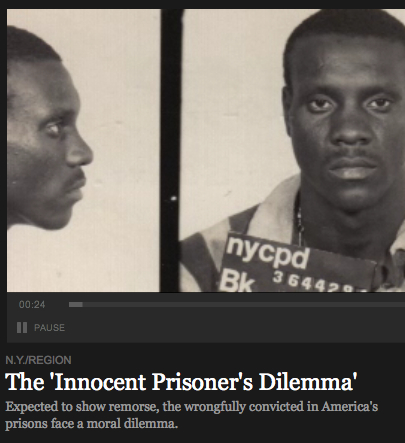
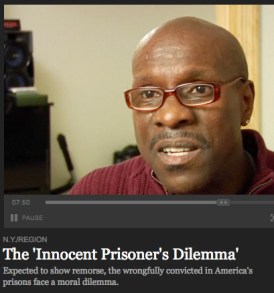
New York Times video The ‘Innocent Prisoner’s Dilemma pores over the profound moral dilemma innocent prisoners face when they present themselves to a parole board. The piece focuses on the case of Herbert Murray (above).

REMORSE IS A PREREQUISITE

Showing remorse for the crime for which they he/she was sentenced increases a prisoner’s chances of parole; the parole board wants to see contrition, wants to see the individual accept the charges, faults and responsibility the court defined many years previous.

One problem. What if the offender was wrongfully convicted? What if he or she IS innocent? The situation becomes Kafkaesque; he or she must agree to a terrible and false scenario (their agency in a crime) in order to escape a much worse scenario (further imprisonment). If an innocent man or woman acknowledges responsibility in order to curry favour, they then become the writers not only of their own history but of their own future. The individual will be forever tied to his or her parole record and the “admission” of guilt.

Herbert Murray’s story is shocking. He spent more than 29 years in prison (he was eligible for parole after 15). Murray only got out due to advanced interventions from his original lawyer and the Second Look Clinic at Brooklyn Law School.

DECISION MAKERS, KEY HOLDERS

Have you ever wondered who sits on a parole board and makes the decisions that affect tens of thousands of prisoners lives each year?

This article Convicted of Murder as Teenager and Paroled at 41 by Trymaine Lee details the job-track:

“Parole Board members, who must have a college degree and five years of experience in criminal justice, sociology, law, social work or medicine, can serve an unlimited number of six-year terms, earning $101,600 a year. By law, they must interview inmates in person and are required to consider their criminal histories, prison achievements and sense of remorse. Ultimately, though, parole decisions are subjective.”

It is great to read reporting that brings a focus to the rudimentary details of staffing and regulation, in this case that of the parole systems. There are many different arms to the criminal justice system and often they don’t compliment one another. In Murray’s case, the parole system reinforced the mistake of the judicial system.

This expository journalism reminds me of NPR’s investigative series on the bail system in January, 2010.

– – –

Thanks to Stan for the tip.

New Orleans. In the collection of the Peter Sekear Estate.

Actually, Jacob Holdt was the new Peter Sekaer … we just never knew about Sekaer. Until now.

Sekaer

The New York Times reported today on Signs of Life at the High Museum of Art in Atlanta, a major survey of Peter Sekaer’s life and of his works. Sekaer died prematurely in 1950 at the age of 49, leaving stacks of unsorted photographs.

Curator, Julian Cox said of his work, “We wanted to uncover this hidden gem. Sekaer was like the passage of a meteor, very bright but fairly brief.”

Sekaer often took photographic trips with friend Walker Evans. Sekaer photographed high streets, impoverished neighbourhoods, markets and games. He photographed signs and billboards. From 1936-43 he worked on assignment for various government agencies including the FSA, the USHA and the REA. His task was to document the depressed country and thus Seaker photographed a lot of poor Americans.

Excepting the New Deal agencies, this focus and unexpected coverage was repeated 40 years later by another Dane.

Jacob Holdt‘s ongoing life’s work American Pictures* is equally committed to describing the hardships of the American South. Holdt met many people suffering in a discriminatory culture with discriminatory laws. (I wrote about Holdt following his autobiographical presentation at the 2009 New York Photography Festival.

Holdt (b.1947) is the geist of Sekaer.

It should be noted Holdt doesn’t call himself a photographer, rather a man who uses the camera as a tool in his activism. Sekaer was professional from 1936 onward.

DANISH INQUISITION

It would be foolish to attribute their curiosity and achievements to their Danish heritage, or to suggest that foreign eyes can see with more clarity the shortcomings of their host nation. Sekaer and Holdt likely were/are simply good people with a belief in stories to be told.

Sekaer was an anomaly for his time; an outspoken, moody Dane, with a German camera, asking folk about their lives. Sekaer’s daughter, Christina explains that it wasn’t just his eyes that made his photographs, Sekaer’s voice did too, “His accent helped people want to talk to him.”

Sixty years on, it’s nice to meet you Mr. Sekaer.

More images here.

Peter Sekaer (American, born Denmark, 1901–1950)

Born in Copenhagen, Denmark, in 1901, Peter Sekaer immigrated to the United States in 1918 at the age of seventeen. After successfully operating a printing business in New York City producing posters, advertisements and window displays, he enrolled in the Art Students League in 1929 to study painting. He soon became involved in the New York art scene, befriending, among others, the artist Ben Shahn and the photographer Walker Evans.

By 1934 Sekaer had left painting behind to study photography with Berenice Abbott at the New School for Social Research. Through his friendship with Walker Evans he secured contracts from 1936 to 1943 to work on assignment as a photographer for various government agencies that were created as part of President Roosevelt’s New Deal program. In 1945 Sekaer started his own commercial photography business, shooting advertisements and human interest stories for magazines.

In 1950, at age forty-nine, Sekaer suffered a fatal heart attack. His life’s work has been preserved by his wife, Elisabeth Sekaer Rothschild, and their younger daughter, Christina Sekaer.

'Family Shelling Pecans, Austin, Texas', 1939. G Peter Sekaer. Collection of the High Art Museum, Atlanta. Purchased with funds from Robert Yellowlees.

Signs of Life: Photographs by Peter Sekaer is the first major exhibition dedicated to the work of the Danish-born American photographer Peter Sekaer. Organized by the High, the exhibition runs June 5, 2010 through January 11, 2011. High Museum of Art, 1280 Peachtree Street, N.E. Atlanta, Georgia 30309.

– – –

*Conflating Holdt and Sekaer further, a 1999 exhibition at the Addison Gallery of American Art was titled ‘Peter Sekaer: American Pictures’. I don’t know if the curators knew of Holdt’s body of work.

Photographing an American Marine with a malnourished boy during Operation Restore Hope, Mogadishu, Somalia (1991). © Paul Lowe/Panos

Victor Acquah has established AfricanLens to present African nations as “you” and “photojournalists who travel across the continent see it.” Hopefully, AfricanLens as a collaborative space for photographers contributing outside of their employers’ (agencies’) influence or editors’ decisions may dish up some novel, calmer stories.

AfricanLens also provides a platform for analysis. Early indications – and early contributors – are good. David Campbell, professor of cultural and political geography at Durham University, over the past couple of years has published (to academia AND blogs) excellent research and positions on media and photography; Campbell’s editorial for AfricanLens takes on the potential pitfalls of the debate about defining Africa:

“What is the visual story that needs to be told about Africa? … Would we even ask that question of the Americas, Asia or Europe? It is unlikely. Others are represented in ways designed to shore up the self and  ‘Africa’ is central to the formation of European and North American identity.”

This is a familiar argument, and inasmuch as it still exists, I reckon it is as valid as ever; visual consumption is almost always simplifying and reductive. Would we be better with dozens of  [Insert individual African nation names here]Lens instead of AfricanLens? Possibly, but let us not expect to run before we can walk. That Campbell’s position questions some tenets of AfricanLens itself would suggest this is to be an intellectually honest and open forum.

Campbell presented the above image from Somalia by Paul Lowe in 1991. Lowe’s image is an echo of Nathan Weber’s from Haiti (talked about here) and reminds me that discourse on the use and usefulness of photography outside our borders is as vital as ever.

Good luck to Victor and AfricanLens.

Photographers and Fabienne Cherisma, Port-au-Prince, Haiti, January 19th 2010. © Nathan Weber

EMAIL

prisonphotography [at] gmail [dot] com

Prison Photography Archives

Post Categories